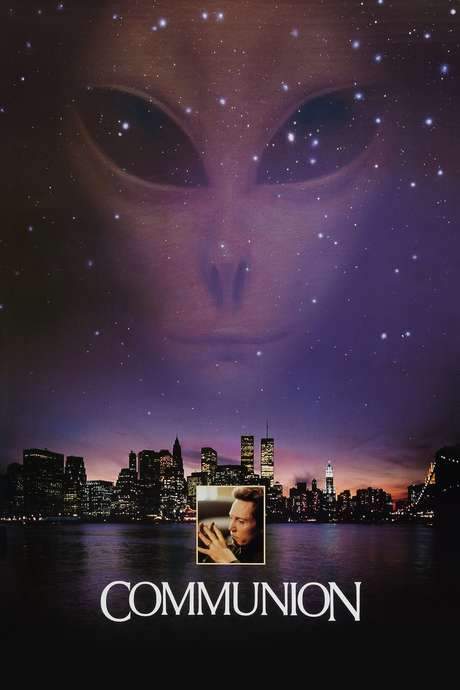
What Is Communion About?
The premise of Communion in 309 words, with nothing given away. The full story follows below.
In 1985, Whitley Strieber is a successful New York author whose nights are haunted by uneasy dreams of an unseen presence. By day he moves through Manhattan’s literary circles with a confident ease, yet the shadows that linger after he closes his manuscript hint at something beyond ordinary imagination. The film paints his world in the muted tones of a city that never sleeps, while a persistent, disquieting undercurrent suggests that the ordinary may be a thin veneer.
When Strieber and his family retreat to a secluded cabin in the mountains, the tranquil wilderness becomes a stark contrast to his urban life. A sudden flash of bright light and a fleeting glimpse of a watchful face at the doorway awaken both wonder and terror, casting a strange glow over the familiar comforts of his wife Anne and son Andrew. Their weekend getaway, meant to be a quiet escape, transforms into an unsettling tableau where the boundaries between reality and the inexplicable begin to blur.
Back in the city, Strieber’s creative routine is increasingly cracked by vivid visions of otherworldly beings—grey silhouettes, blue‑clad figures, and insect‑like shapes that intrude on his waking hours. The once‑steady marriage feels the strain as Anne watches her husband grapple with doubts that threaten to unravel their domestic stability. Concerned for his son, Strieber seeks the counsel of Dr. Janet Duffy, a therapist attuned to the mysteries of memory and trauma, whose sessions probe the depth of his experiences without offering easy answers.
The tone of the story is a careful balance of psychological tension and subtle horror, inviting viewers to dwell in the liminal space where everyday life meets the unknown. Through Strieber’s reluctant quest for meaning, the film explores how a single, inexplicable encounter can ripple through a family’s ordinary world, leaving them to wonder what lies just beyond the edge of perception.
What Happens in Communion?
The complete story of Communion, from the first scene to the last, in 356 words (about 2 minutes). Spoilers throughout. Names in the text link to 6 cast member pages.
Spoilers ahead
In 1985, New York–based author Whitley Strieber, Christopher Walken, leads a seemingly stable life with his wife Anne, Lindsay Crouse, and their son Andrew Joel Carlson in Manhattan. He enjoys professional success, yet his nights are invaded by paranoid dreams of an unseen presence.
During a weekend at the family cabin in the woods, the intruder alarm sounds and Strieber glimpses a face watching him from the doorway as bright light floods the cabin windows, waking Andrew and their friends Alex Andreas Katsulas and Sarah Terri Hanauer, while Anne remains asleep.
Back in New York, life seems to return to normal, but Strieber finds that his work and personal life are increasingly unsettled by recurring nightmares and visions of strange alien beings—greys, blue doctors, and bugs—that invade his waking hours and strain his marriage, and begin to worry Andrew.
After an incident at the cabin in which Strieber becomes convinced there are alien beings inside the home and even pulls his gun on Anne, he worries about his son’s exposure and agrees to see psychiatrist Dr. Janet Duffy, who specializes in hypnotic regression therapy. Frances Sternhagen plays the doctor, and her sessions hint that Strieber may have been abducted and experimented on, even as he remains skeptical about confirming anything.
He reluctantly attends a group therapy session with others who report similar experiences, trying to separate belief from memory while feeling pulled to confront the truth. Eventually he realizes he must face the visions, not deny them, and returns to the cabin where most of the incidents occur. There, he interacts with the alien beings and comes to understand that this contact has been a lifelong thread—one that was passed down from his father Karl and is now likely to be passed on to Andrew.
Making peace with the extraordinary presence, Strieber chooses to integrate it into his life and from that point on, the boundary between the normal and the otherworldly remains porous. In the final scene, he sits in his office and appears to welcome the face of a ‘grey’ alien, signaling a choice to live with the unknown rather than retreat from it.
Communion Timeline: Every Key Event in Order
12 key events in the order they happen, from “Whitley Strieber's life in Manhattan” to “Final acceptance and office scene”. 11 events name a place, across 5 locations.
- 1
Whitley Strieber's life in Manhattan
Whitley Strieber, a New York–based author, lives with his wife Anne and their son Andrew in Manhattan. He seems successful on the outside, but is repeatedly woken by paranoid dreams that someone else is in the room.
When:1985 Where:Manhattan, NY
- 2
Paranoid dreams begin
The nightmares begin to intrude on his waking life, with Strieber convinced there is an unseen intruder in his home. The dreams grow more vivid and persistent, unsettling both his work and family.
When:1985 Where:Manhattan, NY
- 3
Cabin night intrusion
On a trip to the family cabin in the woods, the intruder alarm is triggered and Strieber sees a face watching him from the doorway. Bright light fills the cabin windows and wakes Andrew and two friends, Alex and Sarah, while Anne remains asleep. The unsettling event marks the first time the group encounters something otherworldly.
When:1985 Where:Cabin, woods
- 4
Return to New York; uneasy normalcy
Disturbed by the incident, the group returns to New York and tries to resume normal life, but Strieber finds that his work and personal life are affected by recurring nightmares and visions.
When:1985 Where:New York, NY
- 5
Alien visions intensify
The visions broaden from nightmares to encounters with alien beings, including greys, blue doctors, and bugs, driving a wedge between Strieber and his wife as well as Andrew.
When:1985-1986 Where:New York, NY
- 6
Gun incident at the cabin
During another visit to the cabin he becomes convinced aliens are inside the home, and he pulls his gun in a tense moment that nearly harms Anne. The fear also pushes him to worry that Andrew is beginning to have the same visions. The event marks a turning point toward seeking help.
When:1985 Where:Cabin, woods
- 7
Therapist encounter
He is convinced to see psychiatrist Dr. Janet Duffy, who specializes in hypnotic regression therapy. The therapy aims to uncover repressed experiences and possible abduction memories.
When:1985-1986 Where:New York, NY
- 8
Hypnotic regression and group therapy
The therapy suggests that Strieber has possibly been abducted and experimented on, though he remains skeptical. He reluctantly attends a group therapy session with other abductees.
When:1985-1986 Where:New York, NY
- 9
Confronting the visions at the cabin
Realizing he must face his visions, Strieber returns to the cabin, where he interacts with the alien beings and begins to accept that they may have been part of his life all along.
When:1985-1986 Where:Cabin, woods
- 10
Revelation of lineage
He learns that contact with the alien visitors has been a lifelong thread passed down from his father Karl, and that he will eventually pass it on to Andrew.
- 11
Reconciliation with family
Making up with his family, Strieber comes to terms with the alien presence as part of his life, rather than a threat. He begins to integrate the visitors into his daily existence.
Where:Family home
- 12
Final acceptance and office scene
In the final moment, he sits in his office and embraces the face of a grey alien, signaling acceptance and integration of the visitation into his life. The scene closes with a note of uneasy peace between human and alien.
When:End Where:Strieber's office
Who Are the Main Characters in Communion?
6 characters, among them Whitley Strieber (Christopher Walken), Anne Strieber (Lindsay Crouse) and Andrew Strieber (Jonathan Fromdahl): who each one is and the part they play in the story. Every profile links to the actor’s page.
-

Whitley Strieber (Christopher Walken)
Played by Christopher Walken
A successful author whose nights are haunted by paranoid dreams and sightings of alien beings. His skepticism clashes with mounting evidence, driving him to seek answers through therapy and direct confrontations with the unknown.
- ❄️ Sci-Fi
- 🎭 Drama
- 🧠 Psychological
-

Anne Strieber (Lindsay Crouse)
Played by Lindsay Crouse
Whitley's wife who tries to maintain normal family life amidst unsettling visions. She serves as a stabilizing presence for their son and the surrounding family while the couple grapples with doubt and fear.
- ❄️ Drama
- 🧠 Family
- 💑 Relationship
- AS
Andrew Strieber (Jonathan Fromdahl)
Played by Jonathan Fromdahl
Whitley and Anne's son who becomes entangled in the experiences and visions of contact. His emergence into the mystery tests the family dynamics and his sense of safety.
- 👶 Family
- 🧠 Psychology
- 🛡️ Protection
-

Dr. Janet Duffy (Frances Sternhagen)
Played by Frances Sternhagen
A psychiatrist specializing in hypnotic regression who guides Strieber toward confronting his experiences. She represents medical skepticism while also validating the potential reality of his memories.
- 🧠 Psychology
- 🩺 Medical
- 🧩 Mystery
- A(
Alex (Andreas Katsulas)
Played by Andreas Katsulas
Family friend at the cabin who witnesses the unsettling events, highlighting the communal impact of the encounters and the ambiguity surrounding what is happening.
- 👥 Friend
- 🧭 Mystery
- 🧩 Community
- S(
Sarah (Terri Hanauer)
Played by Terri Hanauer
Another family friend who bears witness to the strange happenings, contributing to the group dynamics and the sense that the events extend beyond the nuclear family.
- 👥 Friend
- 🧭 Mystery
- 👁️ Perception
Where and When Is Communion Set?
Communion is set in Manhattan, New York and Cabin in the woods (1985). Here is why the time and place matter to the story.
When
1985
Set in 1985, the narrative unfolds in a mid-1980s urban environment that bleeds into a secluded countryside cabin. The era’s technological and cultural backdrop informs the characters’ skepticism and eagerness to understand extraordinary experiences. Memory, therapy, and distant scientific curiosity shape how the events are interpreted during this period.
Where
Manhattan, New York, Cabin in the woods
The story shifts between Whitley Strieber's Manhattan apartment and a remote family cabin in the woods, highlighting the contrast between the bustling city life and isolated retreat where strange encounters occur. Manhattan represents the author’s professional success and normal domesticity, while the cabin becomes the claustrophobic setting for otherworldly intrusions. These two places frame the tension between everyday life and the unknown.
- 🏙️ Urban
- 🌲 Rural
- 👨👩👧 Family
What Are the Themes of Communion?
3 ideas the story keeps returning to, among them Alien Contact, Reality vs Perception and Family & Legacy.
-
01
Alien Contact
The core of the film centers on Whitley Strieber's repeated encounters with extraterrestrial beings and the sense that contact has shaped his life beyond a single moment. Encounters blur the line between dream and reality, driving a quest for truth. The theme also raises the idea that such contact may be hereditary, passing from parent to child.
-
02
Reality vs Perception
Hypnosis and regression therapy probe the boundary between truth and illusion. Strieber vacillates between validation and doubt as doctors confirm possible experiments, while he maintains personal skepticism. The story questions whether subjective experiences can be as compelling as objective evidence and how memory shapes belief.
-
03
Family & Legacy
Marital strain and paternal concerns anchor the narrative as visions intrude on daily life. The alien contact is framed as a family matter, suggesting a lineage of encounters that could be passed to Whitley’s son Andrew. Acceptance of the visitation eventually reinforces family bonds and shared purpose.
What Kind of Film Is Communion?
Tense in tone, with variable pacing and a moderate story, going by the plot summary.
- Tone
- Tense
- Pacing
- Variable
- Story
- Moderate
- Intensity
- High
- Ending
- Ambiguous
A tense and psychologically unsettling journey into one man's paranoia and fragmented memories of alien contact, creating a deeply anxious and uncanny atmosphere that blurs the line between nightmare and reality.
- paranoid
- anxious
- uncanny
- psychological
- unsettling
- nightmarish
- alien abduction
- memory and trauma
- father son relationship
- psychological horror
Content notes: alien abduction, psychological trauma, child endangerment, gun threat.
Quiz
How well do you remember Communion? Test yourself on the story.