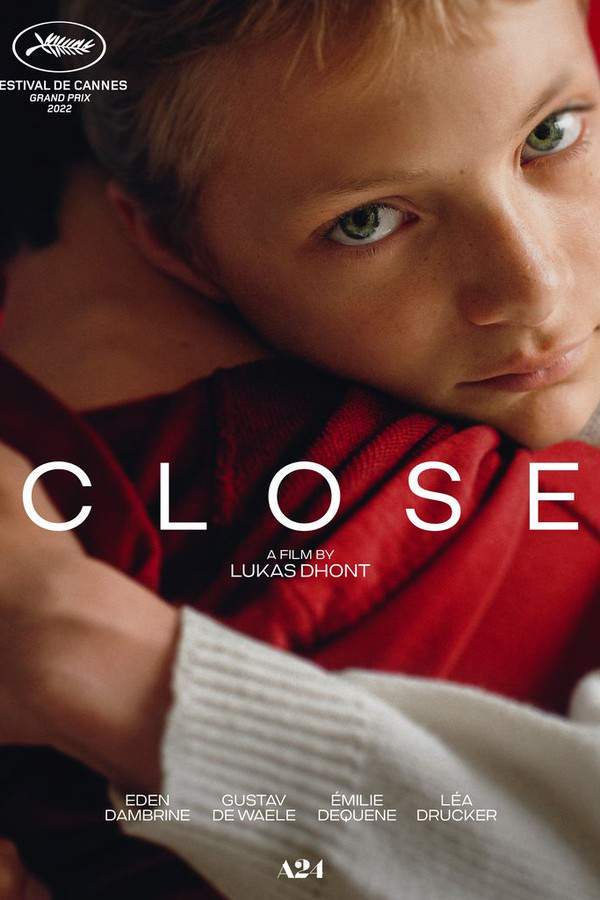
Close 2023

Directed by

Lukas Dhont
Made by

A24
Close Plot Summary
Read the complete plot summary and ending explained for Close (2023). From turning points to emotional moments, uncover what really happened and why it matters.
In rural Belgium, two 13-year-old boys, Léo Eden Dambrine and Rémi Gustav De Waele, share a bond that feels deeply intimate for their age, a closeness that colors every day they spend together. They have a quiet routine of sleeping in the same bed in Rémi’s bedroom, a detail their families receive with warmth and without judgment; Sophie Émilie Dequenne and Peter Kevin Janssens love Léo like a second child, while Léo’s family helps run a flower farm where the boys freely roam, play, and drift between work and imagination among the blooms. The setting—sunlit fields, the hum of bees, the steady cadence of farm life—shapes the ordinary space where their friendship grows.
At school, a trio of female classmates openly asks if the two are a couple, and Léo answers with a firm denial while Rémi stays quiet, leaving the question hovering in the air. The moment makes Léo uneasy, a sign of how external perceptions press in and threaten the safety of their bond. Soon he faces harsh, homophobic slurs from other boys, a reminder that their closeness may not be accepted beyond the privacy of home. Fearing ostracism more than the truth of his feelings, Léo begins to seek new friendships and even takes up ice hockey, an activity that keeps him busy and away from Rémi, a deliberate distancing that unsettles both of them. The once-easy companionship thins as Léo’s world widens in ways that do not include Rémi.
One night, during a sleepover at Rémi’s, Léo decides to sleep on a separate mattress. When he wakes, he finds Rémi sharing the same bed still, and a rush of confusion and anger erupts into aggression that leaves Rémi hurt and bewildered. From that moment, Léo grows more distant, resuming solitary routines, riding his bicycle with classmates other than Rémi, continuing ice hockey, and spending more time helping his family on the farm. Rémi confronts him in vain, and the tension flares into a brief, painful fight between the two friends. The depth of their connection now sits at risk, hidden behind a wall of misunderstanding and fear.
The school trip that Rémi misses becomes a turning point: the class returns with news that Rémi has killed himself. Léo confronts the catastrophe with a gravity that he cannot fully show; he believes his withdrawal and his inability to respond to Rémi’s needs contributed to the tragedy, and the weight of that belief tugs at him in every moment. Yet he closes himself off, unable to grieve openly during the class therapy sessions offered by the school. The obituaries paint Rémi as a happy, friendly boy, a portrayal that one by one sparks a defiant response in Léo—an insistence on grappling with the truth of his pain rather than accepting the glossy version the world offers.
In the months that follow, Léo tries to mask his sorrow through routine: ice hockey, tending the garden, and the endless repetition of farm chores. Still, none of his new friendships offers the same shelter or clarity he once found with Rémi. He does find solace in confiding, gradually, in his older brother Charlie Igor van Dessel, whose presence offers a quieter form of comfort and a mirror for Léo’s fear and longing. Charlie’s support becomes a crucial anchor as the family navigates grief from a distance, while Sophie Émilie Dequenne and Peter Kevin Janssens grapple with their own sorrow and the sense of a future that Rémi’s absence has forever altered.
After Rémi’s funeral, Léo feels a pressing need to speak with Sophie, hoping to maintain a thread of connection with the family even as the world shifts around them. During a dinner that brings Sophie and Peter to Léo’s home, the moment deepens as Charlie speaks about his own future plans, and Sophie and Peter confront the stark reality of a boy who will never grow up into those possibilities. The conversation carries an ache that lingers, a reminder of the fragility of youth and the heavy burden of unspoken grief.
When summer arrives and Léo visits Sophie at her workplace, a slow, uneasy drive home becomes the catalyst for confession: he tells Sophie that he believes Rémi’s suicide was his fault for pushing him away. The revelation comes with a tremor of fear, but it is met with a gentle, healing moment as Sophie holds him and they cry together, allowing the shared pain to begin to loosen its grip. In the months that follow, Sophie and Peter move away, leaving the house empty and the fields silent in a way they were not before. In the final quiet of the field where Léo and Rémi once ran together, Léo walks through the memory of their friendship and allows himself to grieve at last, acknowledging the depth of what they shared and the accident of time that kept them apart.
This is a story of a fragile, formative bond under pressure, of the brutal ache of loss, and of the slow, painstaking process of learning to bear the weight of guilt while honoring the lasting memory of a friend who helped define who Léo becomes.
Close Timeline
Follow the complete movie timeline of Close (2023) with every major event in chronological order. Great for understanding complex plots and story progression.
Léo and Rémi's close bond
Léo and Rémi are two 13-year-old boys who share a deeply intimate friendship in rural Belgium. They sleep in the same bed at Rémi's bedroom, finding daily comfort in their closeness. Their families accept them without judgment and treat Léo as a second child, helping on the flower farm.
School gossip and fear of ostracism
At school, classmates openly wonder if they are a couple. Léo denies it while Rémi stays quiet, and external perceptions begin to weigh on him. To avoid being ostracized, Léo seeks new friendships and even takes up ice hockey, deliberately excluding Rémi.
Bed incident and fallout
One night, Léo sleeps on a separate mattress at Rémi's, but when he wakes up he finds Rémi sleeping on the same mattress. Léo responds with aggression, leaving Rémi hurt and confused. The rift between them starts to widen.
Drifting apart
Léo becomes distant, stops overnight visits, and rides his bike with other students. He keeps playing ice hockey and helps with the family farm, while Rémi tries to reach out but is ignored. Their once seamless bond frays under social pressure.
Confrontation and fight
Rémi confronts Léo about the distance and hurt, but Léo reacts defensively. Rémi attacks in the confrontation and they end up fighting.
Rémi's suicide revealed
After a school trip, Rémi is absent and the class learns he has killed himself. Léo believes his withdrawal from Rémi caused the tragedy and begins to shut down emotionally. He cannot speak during the therapy sessions offered by the school.
Defiance and pain
The obituaries and classmates describe Rémi as a happy and friendly boy, which triggers a defiant opposition in Léo. He tries to push down his pain and return to routines, though nothing feels the same. He also finds it hard to connect with new friends, clinging instead to the memory of Rémi.
Support from family
Léo continues with ice hockey and farm work, but the deep bond with Rémi lingers. He finds some comfort by confiding in his older brother Charlie, who offers a listening ear and steadier support.
Funeral reflections
Following Rémi's funeral, Léo wants to talk to Sophie about his guilt. During a family dinner with Sophie and Peter, Charlie describes his own future plans, and Peter breaks down while listening. Sophie mourns the loss as she and Peter realize Rémi's future is now gone.
Confession to Sophie
Summer vacation begins and Léo visits Sophie at her workplace. When she drives him home, he confesses that he believes Rémi's suicide is his fault for pushing him away. Sophie comforts him with tenderness as they cry together.
Grieving and moving on
Sophie and Peter have moved away, leaving the house empty. Léo walks across the field they used to run through, remembering their connection and allowing himself to grieve. He begins to accept the loss and imagines a future where Rémi's memory remains part of his life.
Close Characters
Explore all characters from Close (2023). Get detailed profiles with their roles, arcs, and key relationships explained.
Léo (Eden Dambrine)
A sensitive, conflicted 13-year-old who struggles with social pressure and fear of ostracism. He withdraws from Rémi after an emotional incident, hides his inner pain, and grapples with guilt over Rémi's suicide. His growth arc centers on confronting grief and accepting vulnerability.
Rémi (Gustav De Waele)
Léo's best friend, affectionate and outgoing, whose sudden death triggers a painful unraveling of Léo's world. He is depicted as warm and playful, a contrast to Léo's reluctance to share feelings. His death becomes the catalyst for the film's exploration of grief and memory.
Sophie (Émilie Dequenne)
Rémi's mother who provides a steady, supportive presence for Léo and Rémi's family. She embodies warmth and resilience, offering comfort and a beacon of care as the family processes tragedy. Her relationship with Léo deepens as he seeks solace.
Peter (Kevin Janssens)
Rémi's father, a practical, steady figure who participates in the family’s emotional journey. He shares a responsibility for keeping the family together and supporting Léo as he grieves. His role anchors the film's everyday realism.
Charlie (Igor van Dessel)
Léo's older brother, a source of comfort and guidance who offers a window into healing and future possibilities. He helps Léo articulate his grief and navigate his evolving relationship with Rémi.
Close Settings
Learn where and when Close (2023) takes place. Explore the film’s settings, era, and how they shape the narrative.
Location
Rural Belgium
Set in a quiet rural area of Belgium, the film centers on a flower farm and the small community around it. The landscape features fields and farm work that frame the close-knit atmosphere in which Léo and Rémi's friendship unfolds. The setting emphasizes social pressures and the intensity of teenage bonds within a tight community.
Close Themes
Discover the main themes in Close (2023). Analyze the deeper meanings, emotional layers, and social commentary behind the film.
💔
Grief
The narrative follows Léo as he grapples with guilt and sorrow after Rémi's suicide, and the inability to express his pain to those around him. Grief is shown as an isolating process that compounds misunderstandings and emotional distance. The film portrays a tender, painful path to acknowledging loss.
🤝
Friendship
Two boys share a deep, intimate connection that outsiders misinterpret or threaten. The film tracks how outside judgments and fear of ostracism strain their bond. It examines loyalty, tenderness, and the fragility of childhood friendship under social pressure.
🌈
Identity & Acceptance
The boys' relationship unfolds in a context of homophobia and stigma. The story explores how characters navigate their own identities and the fear of rejection by family and community. It ultimately centers on seeking understanding and compassionate acceptance.

Coming soon on iOS and Android
The Plot Explained Mobile App
From blockbusters to hidden gems — dive into movie stories anytime, anywhere. Save your favorites, discover plots faster, and never miss a twist again.
Sign up to be the first to know when we launch. Your email stays private — always.
Explore the mobile appClose Ending Explained
Unravel the ending of Close (2023) with our detailed explanation. Understand the final scenes, character fates, and unresolved questions.
At the climax of Close, Sam and Zoe find themselves trapped in the house’s control room while chaos erupts outside. To their shock, the police arriving aren’t there to help but are actually hired killers. Rima arrives unexpectedly by helicopter and is attacked by the formidable assassin known as The Suit. Zoe and Sam expect Rima to be behind the conspiracy, but instead, she is injured trying to defend herself. In a desperate move, Zoe fights off The Suit and manages to shoot him using his own gun, just as a second assailant enters the room and tries to attack her. Struggling to remember the access code to escape, Sam finally recalls that it’s Zoe’s birthday, helps her unlock the door, and they get out just in time. In the aftermath, Rima receives medical attention, and Zoe chooses to part ways with Sam, urging her to reconnect with her estranged daughter. Sam leaves the scene and returns home to Los Angeles, symbolizing her own journey toward healing.
As for who was really trying to kill Zoe—initially, viewers suspect Rima because of her hostility and apparent motives, but it turns out she was innocent. The true orchestrators were agents working for Sikong, the rival company competing for the same business deal. Their goal wasn’t just sabotage but to destabilize Hassine Mining by killing Zoe, thereby ruining her chances at a crucial corporate merger. Rima’s attempts to protect Zoe were genuine, though she claimed to be being blackmailed—a detail left ambiguous, possibly suggesting a betrayal or a hidden pawn in the larger scheme. The first attack that compromised the house’s security may have involved betrayal by someone close to Zoe, possibly her previous bodyguard, but this remains unexplained.
Ongoing through the film is a deeper emotional story about Sam. She is a highly capable bodyguard, but her dedication to Zoe masks unresolved pain from her past. As a teenager, Sam became pregnant and gave her daughter up for adoption, feeling unready for motherhood. Over the course of the story, she is driven by a desire not just to protect Zoe but to make amends for her own lost relationship. Her emotional breakthrough occurs when she promises Zoe she will try to reconnect with her daughter, revealing an underlying hope for genuine connection. Ultimately, Close isn’t just a thriller about danger; it’s a story about women—mothers and daughters—finding their strength by fighting back, bridging emotional gaps, and growing closer through shared adversity. The film emphasizes that resilience and compassion can help in healing both personal and external wounds, leaving the characters with a sense of hope amid chaos.
Close Spoiler-Free Summary
Discover the spoiler-free summary of Close (2023). Get a concise overview without any spoilers.
In the gentle expanse of rural Belgium, the rhythm of farm life and the hush of sun‑lit fields shape a world where days glide between chores, imagination, and the quiet intimacy of shared spaces. Within this bucolic backdrop, two thirteen‑year‑old boys form a bond that feels both ordinary and profound, navigating the threshold between childhood and the uncertain terrain of adolescence.
Leo lives with a family that tends a flower farm, his days punctuated by the scent of blossoms and the steady hum of bees. Remi shares a home where the warmth of his parents, Sophie and Peter, welcomes Leo as a second child. Their friendship is lived out in simple rituals—sleeping in the same room, wandering the fields together, and slipping between work and play with an ease that speaks to a deep, unspoken understanding.
As school corridors echo with the chatter of peers, the boys encounter the subtle pressures of external perception. Questions about their closeness surface, and the occasional sting of judgment hints at the societal expectations that begin to push against their private world. Leo starts to explore new activities and friendships, seeking a broader sense of self while the bond with Remi hovers, fragile yet resilient. The tension between staying true to their shared history and stepping into individual identities creates a quiet, emotional undercurrent that guides their interactions.
Through the watchful presence of Charlie, Leo’s older brother, and the supportive yet grieving parents, the story paints a portrait of growing up under the weight of love, fear, and the search for belonging. The film’s tone is intimate and contemplative, inviting viewers to feel the tender ache of a friendship on the cusp of change, set against a landscape that is both nurturing and inexorably moving forward.
Movies with Similar Twists and Themes
Uncover films that echo the narrative beats, emotional arcs, or dramatic twists of the one you're exploring. These recommendations are handpicked based on story depth, thematic resonance, and spoiler-worthy moments — perfect for fans who crave more of the same intrigue.


Featured on this page

What's After the Movie?
Not sure whether to stay after the credits? Find out!
Check out our other apps:

SAT Sphere
Build confidence for the Digital SAT.

Mori Atlas
Discover wild places worth protecting.

Luntero
Search smarter for a home in Amsterdam.

Plot Explained
Unravel movie endings and hidden clues.

Pokechamp
Dive into Pokémon data and battle logic.

Driving Theory
Get ready for your European theory test.

Movie Dust
Plan your next cinema trip with ease.

Musemap
Find art and culture as you travel.

Selkobase
Compare credentials before committing.

Local Manual
Turn an unfamiliar country into practical next steps.

Lernavi
Compare school systems before your next move.

GymRoam
Find a workout stop wherever your plans take you.
Explore Our Movie Platform
New Movie Releases (2026)
Famous Movie Actors
Top Film Production Studios
Movie Plot Summaries & Endings
Major Movie Awards & Winners
Best Concert Films & Music Documentaries
Movie Collections and Curated Lists
© 2026 What's After the Movie. All rights reserved.
Privacy Policy