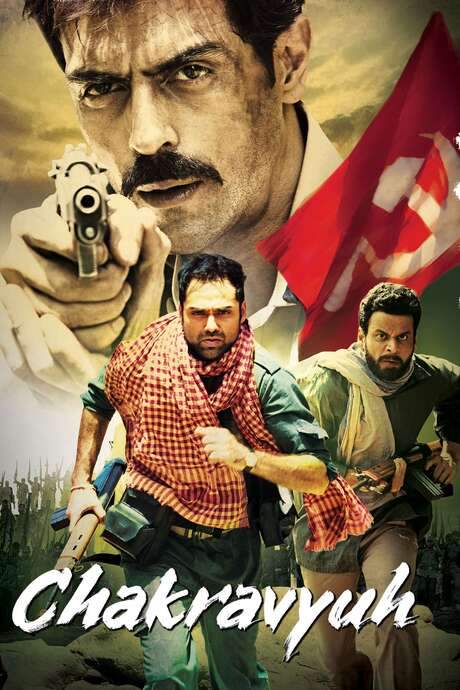
Chakravyuh 2012

Directed by

Prakash Jha
Made by

Where to Watch Chakravyuh
See current US streaming, rental, and purchase options for Chakravyuh (2012) via JustWatch.






Chakravyuh Plot Summary
Read the complete plot summary and ending explained for Chakravyuh (2012). From turning points to emotional moments, uncover what really happened and why it matters.
Chakravyuh traces the entwined lives of two best friends, Adil Khan, Arjun Rampal, and Kabir, Abhay Deol, as they tread the fine line between duty and conscience in a region where conflict has become a way of life. Adil, a highly decorated police officer, is dispatched to the troubled town of Nandighat after a brutal massacre leaves 84 officers dead. The operation is spearheaded by a seasoned colleague, KK, whose fate turns on a single, devastating realization: the trap was set, and the Maoists were ready for the police at every turn. The weight of this collapse lands squarely on Adil’s shoulders, testing his resolve as he begins to see the depth of the challenge before him.
The shadowy world of the insurgents centers on the enigmatic Rajan, the ruthless leader who commands a growing chorus of disaffected locals. Rajan’s network has learned to outpace the efforts of the state, enforcing a parallel system of courts, protection money, and local discipline that keeps the people dependent on the Naxal movement. In this volatile landscape, the Rajan group gains a powerful ally in Mahanta, a corporate magnate intent on carving out a massive steel enterprise in the region. The industrialist, Prashanth Mahanta—the Chairman of the Mahanta Group Industries—represents the push-and-pull between development and displacement, a pressure point at the heart of the conflict that pits big business against the needs of those who dwell on the land.
Adil’s personal life gives the story its warmer, more intimate center. His wife, Rhea Menon, an IPS officer in her own right, deepens the moral tension as she watches Adil wrestle with impossible choices. The couple stands at the crossroads where love and profession collide, offering a quieter lens on the violence that surrounds them. As the crackdown on Naxal activity intensifies, Adil finds himself inching closer to the truth that the forces he fights against are not simply faceless enemies; they are a reflection of a deeper struggle within Indian society—one where land, resources, and power are constantly contested.
Into this charged atmosphere enters Kabir, a restless, loyal friend whose own past has kept him on the margins of the police world. Kabir’s plan is audacious: infiltrate Rajan’s inner circle and become Adil’s informer, using the inside information to dismantle the Maoist network from within. The partnership works, and Adil’s raids grow more successful—an enormous arms cache is seized, two top national leaders are killed, and Rajan is captured. It seems the alliance between Adil and Kabir is delivering the victory the state seeks. Yet Kabir’s undercover ascent also reveals a human truth that the battlefield rarely makes visible: the rural poor, unprotected and neglected, bear the brunt of development’s neglect. The land is taken, forests are cleared, and water is diverted to serve larger commercial ambitions, all while the promised benefits never reach those who suffer the consequences.
As Kabir moves deeper into the Naxal ranks, his interactions with activists—such as Juhi and others who share their pain and their hope—become more intense. Juhi, a devoted revolutionary with a soft heart, forms a complicated bond with Kabir, while the broader movement’s grip tightens. The ground trembles further when the mining dream revives, and the Mahanta group escalates its efforts to relocate villages for a colossal Rs 15,000 crore steel plant. Adil, unwilling to play along with the exploitation tied to the project, clashed with the corporate interests and finds himself sidelined by higher-ups who want the operation to move forward.
In Rajan’s absence, leadership within the Naxals becomes a contest, and Kabir is chosen to helm the resistance. Juhi sacrifices herself during a police raid in a bid to shield Kabir, a moment that intensifies the rift between Kabir’s new loyalties and Adil’s adherence to the law. Kabir’s growing alignment with the activists deepens the moral ambiguity: he sees the consequences of the government’s hardness and begins to question whether the system he once served can ever truly protect the vulnerable people of Nandighat. Juhi’s ordeal—an act of brutality that highlights the violence endemic to the cycle—serves as a turning point that cements Kabir’s new path and complicates Adil’s judgment.
The conflict crescendos as the Mahanta plant project gains momentum and the state’s machinery tightens its grip on the region. Kabir orchestrates a daring strike against Mahanta’s headquarters, capturing the group head and demanding Rajan’s release in exchange. Adil counters by embedding a tracker in Rajan before proceeding with the exchange, a move intended to undermine Kabir’s fragile coalition. Kabir, aware of the tracker’s presence, uses it to lure Adil away from the insurgents, and the pursuit continues with tragic consequences. Juhi reappears in the narrative at a critical moment, but she is fatally shot as the pursuit unfolds, underscoring the human cost of the escalating violence.
The final confrontation unfolds with a grim inevitability. Adil corners Kabir, and when Kabir reaches for his gun, Adil fires. The act seals a brutal truth that neither man can escape: in a landscape defined by competing claims over land, power, and protection, the line between ally and adversary can blur beyond recognition. Chakravyuh is a cinematic meditation on loyalty, ideology, and the price of pursuing justice in a world where the stakes are measured not just in lives saved or lost, but in the survival of communities scrutinized by a system that too often prioritizes speed, profit, and order over the needs of the people at its margins.
Chakravyuh Timeline
Follow the complete movie timeline of Chakravyuh (2012) with every major event in chronological order. Great for understanding complex plots and story progression.
Adil arrives in Nandighat after the 84-police massacre
Adil Khan is posted to Nandighat following a horrific massacre that leaves 84 policemen dead. The region already shows the power of a well-organized Maoist movement led by Rajan, with a parallel governance system in place. He confronts a security situation where conventional policing is outmatched.
Kabir proposes infiltration of Rajan's group
Kabir, Adil's old friend, re-enters his life with a bold plan. He proposes infiltrating Rajan's Maoist group as an informer to help topple them from within. Adil agrees, hoping insider intelligence will turn the tide in Nandighat.
Kabir infiltrates and earns Maoist trust
Kabir infiltrates Rajan's circle and quickly earns their trust. He secretly feeds information to Adil, enabling the police to strike more effectively against the Maoists. The operation begins to tilt in favor of the security forces.
Massive crackdown; arms cache raid and Rajan's capture
A massive crackdown follows as an enormous arms cache is raided and two top leaders, along with 63 activists, are killed at an arms-training camp. Rajan is captured, and the Maoists begin to retreat under pressure. The early success boosts Adil and Kabir's inside operation.
Kabir sees rural oppression; bonds with Juhi and others
Kabir begins glimpsing the rural poor's plight and grows sympathetic toward the activists. He forms ties with key Naxal figures like Juhi, Naga, Babu, and Venu, and Juhi starts developing feelings for him. The line between informer and ally blurs as empathy grows.
Mahanta steel plant plan accelerates; Adil sidelined
The Mahanta Group pushes ahead with a plan to build a Rs 15,000 crore steel plant in the region, hiring private armies to evacuate villages. Adil refuses to cooperate with the project, but his superiors sideline him, diminishing his influence. The corporate motive intensifies the conflict between state, industry, and locals.
Juhi's sacrifice and brutal detention
Juhi sacrifices herself during a police raid to protect Kabir and the Naxal cause. She is later subjected to police brutality and sexually assaulted in lock-up, exposing the brutality faced by activists. Kabir learns of her death and the cost of resistance.
Kabir publicly commits to the Naxals
Kabir declares his allegiance to the Naxals and their leadership, severing his ties with the police. He commits fully to the movement and takes on a leadership role within the group. Adil watches as the line between confidant and adversary dissolves.
Attack on Mahanta HQ; Rajan's exchange plan
Kabir leads an assault on Mahanta's HQ and abducts the group head, using the operation to demand Rajan's release in exchange. Adil counters by secretly planting an electronic tracker inside Rajan before the handover. The stage is set for a deadly confrontation over power and allegiance.
Adil turns Kabir into a public symbol; the trial begins
To discredit Kabir, Adil releases a story portraying him as Adil's informant and friend. The Naxals hold a trial for Kabir, testing his loyalty and the cost of his double life. The polarized response hardens the rift between police and insurgents.
Tracker reveal; Juhi's death; pursuit
Adil's forces strike using the Rajan tracker, forcing Kabir to confront the dangerous game he helped play. Kabir discovers Rajan also carries a tracker and uses the device to lure Adil away. In a fateful moment, Juhi returns to aid Kabir and is shot dead by Adil.
Final confrontation: Kabir dies at Adil's hand
In the climactic confrontation, Adil corners Kabir as he reaches for his gun and shoots him. The friendship that powered the initial infiltration ends in tragedy, underscoring the cost of violent conflict. The state and insurgents alike have paid a heavy price.
Origins of the Naxal movement
The film traces the Naxal movement back to Naxalbari in West Bengal 45 years ago, describing how land rights and poverty sparked a long-running insurgency. It shows how the movement spread to hundreds of districts and became a major internal security challenge. The background also explains the ideological roots fueling the conflict.
Motive behind the conflict: land, resources, and development
The summary highlights how private companies seek tribal lands and resources under the banner of national development, while local communities are displaced. The Mahanta steel plant plan embodies this clash between profit and people. The insurgency is driven by dispossession as much as ideology.
Chakravyuh Characters
Explore all characters from Chakravyuh (2012). Get detailed profiles with their roles, arcs, and key relationships explained.
Adil Khan (Arjun Rampal)
A highly decorated police officer assigned to Nandighat to quell the Maoist uprising. He navigates a complex web of insider information, corrupt politics, and on-the-ground danger. He becomes increasingly conflicted as the state's heavy-handed tactics harm civilians and as development moves forward. His partnership with Kabir drives the story forward, even as he steels himself to ruthless measures.
Kabir (Abhay Deol)
A roguish but loyal friend who infiltrates Rajan's group as an informer. He balances loyalty to Adil with empathy for the oppressed and undergoes a moral awakening as events unfold. His choices propel the conflict and reveal how personal ties collide with political aims. Ultimately, Kabir's path forces difficult sacrifices.
Govind Suryavanshi (Om Puri)
A Marxist ideologue who heads the Maoist movement in the region. Oxford-educated but disillusioned by oppression, he leads a parallel system that challenges state authority. Govind embodies the theater of insurgency and the strategic thinking behind the movement.
Rajan (Manoj Bajpayee)
Charismatic leader of the Naxal group, Rajan commands fierce loyalty and a ruthless willingness to defend his people. He uses a nationalist rhetoric to justify violent action and maintain control over the movement. His presence sharpens the moral ambiguities at the heart of the conflict.
Rhea Menon (Esha Gupta)
Adil's wife and an IPS officer who brings a personal stake to the conflict. She embodies professional duty while navigating the emotional costs of living through internal security battles. Her perspective highlights the human side of the security-state tension.
Prashanth Mahanta (Kabir Bedi)
Chairman of the Mahanta Group Industries, a corporate power broker pursuing land rights for a steel plant. His influence extends into politics and security arrangements, illustrating the collaboration between business interests and state power. He stands as a major obstacle to the village communities.
Juhi (Anjali Patil)
A dedicated revolutionary who becomes romantically involved with Kabir and witnesses the costs of resistance, including violence and police brutality. Her sacrifice marks a turning point in the struggle and intensifies the personal stakes for the protagonists.
Home Minister (Kiran Karmarkar)
A political figure who steers security policy and development agendas, balancing public order with industrial ambitions. His decisions shape the government's response to the uprising and affect both sides of the conflict.
Chakravyuh Settings
Learn where and when Chakravyuh (2012) takes place. Explore the film’s settings, era, and how they shape the narrative.
Time period
Contemporary
Set in present-day India, the story unfolds in a resource-rich belt where police operations, political maneuvering, and industrial ambitions collide. The conflict mirrors ongoing internal security challenges and land-right disputes in the 21st century. The atmosphere blends governance, development, and insurgent resistance.
Location
Nandighat
Nandighat is a mineral-rich district where security forces clash with Maoist insurgents. The region becomes a flashpoint for a mega steel plant that threatens tribal lands and local livelihoods. Local communities navigate a landscape where informal justice, police pressure, and corporate interests intersect.
Chakravyuh Themes
Discover the main themes in Chakravyuh (2012). Analyze the deeper meanings, emotional layers, and social commentary behind the film.
🪖
Loyalty
Kabir infiltrates Rajan's group to aid Adil, risking his safety and credibility. The duo's bond is tested as deception, duty, and risk pull them in opposite directions. The narrative examines how loyalty can be manipulated by higher powers, and whether friendship can survive under such strain. The cost of loyalty is paid in trust and lives.
🚜
Exploitation
Industrial interests push for land to build a mega steel plant in Nandighat, threatening livelihoods. Villagers are displaced as private armies and corrupt officials sideline their rights. The film exposes how development can become a tool of coercion when legal protections fail. It highlights the clash between corporate ambitions and the dignity of the displaced.
💥
Conflict
Two parallel forces—state security and insurgent groups—engage in a deadly game of cat and mouse. The violence includes police crackdowns, armed raids, and retaliatory attacks that blur lines between oppressor and oppressed. Civilians suffer as both sides pursue strategic advantage. The escalating confrontations drive characters to radical choices.
⚖️
Morality
Adil and Kabir justify their actions through different moral frameworks, raising questions about justice and legitimacy. The showdown between state power and insurgent ideals challenges viewers to redefine who is the hero or villain. The film presents a morally gray landscape where right and wrong are not clear-cut. The ending underscores the human cost of pursuing justice through violence.

Coming soon on iOS and Android
The Plot Explained Mobile App
From blockbusters to hidden gems — dive into movie stories anytime, anywhere. Save your favorites, discover plots faster, and never miss a twist again.
Sign up to be the first to know when we launch. Your email stays private — always.
Explore the mobile appChakravyuh Spoiler-Free Summary
Discover the spoiler-free summary of Chakravyuh (2012). Get a concise overview without any spoilers.
In the mineral‑rich hinterland of Nandighat, a remote district where tribal villages cling to ancient forests and the promise of development hangs like a mirage, a tense standoff simmers between the state, powerful corporate interests, and a restless movement that claims to defend the dispossessed. The landscape is rugged and shadowed, the air thick with the unspoken grievances of people whose lives are caught in a tug‑of‑war between law, livelihood, and a yearning for dignity. The film breathes a gritty, atmospheric tone, blending political urgency with the personal costs of an unseen conflict.
Adil is a highly decorated senior police officer, tasked with restoring order in this fraught region. He carries the weight of a recent tragedy and the expectations of a government eager to move a massive steel‑plant project forward. Yet his resolve is tested not only by the challenging terrain but also by the bond he shares with his longtime friend, Kabir, a restless, impulsive soul who once walked the same police academy corridors before striking out on his own. Their friendship is the emotional core that anchors the story, contrasting duty with loyalty.
When Kabir volunteers to go undercover within the insurgent group, his natural charm and street‑wise instincts grant him entry to a world that is both alien and hauntingly familiar. As he watches the lives of villagers and the motives of the movement unfold, the line between observer and participant blurs. The film hints at his growing inner conflict, a pull between the mission assigned by his friend and the empathy he feels for those he is meant to expose.
Beyond the personal drama, larger forces loom: a corporate magnate eyeing the land for a colossal steel plant, and a broader struggle over who gets to shape the future of Nandighat. The story invites the audience to ponder the price of progress, the gray zones of morality, and what happens when the two worlds a man walks between begin to overlap.
Featured on this page

What's After the Movie?
Not sure whether to stay after the credits? Find out!
Check out our other apps:

SAT Sphere
Build confidence for the Digital SAT.

Mori Atlas
Discover wild places worth protecting.

Luntero
Search smarter for a home in Amsterdam.

Plot Explained
Unravel movie endings and hidden clues.

Pokechamp
Dive into Pokémon data and battle logic.

Driving Theory
Get ready for your European theory test.

Movie Dust
Plan your next cinema trip with ease.

Musemap
Find art and culture as you travel.

Selkobase
Compare credentials before committing.

Local Manual
Turn an unfamiliar country into practical next steps.

Lernavi
Compare school systems before your next move.

GymRoam
Find a workout stop wherever your plans take you.
Explore Our Movie Platform
New Movie Releases (2026)
Famous Movie Actors
Top Film Production Studios
Movie Plot Summaries & Endings
Major Movie Awards & Winners
Best Concert Films & Music Documentaries
Movie Collections and Curated Lists
© 2026 What's After the Movie. All rights reserved.
Privacy Policy