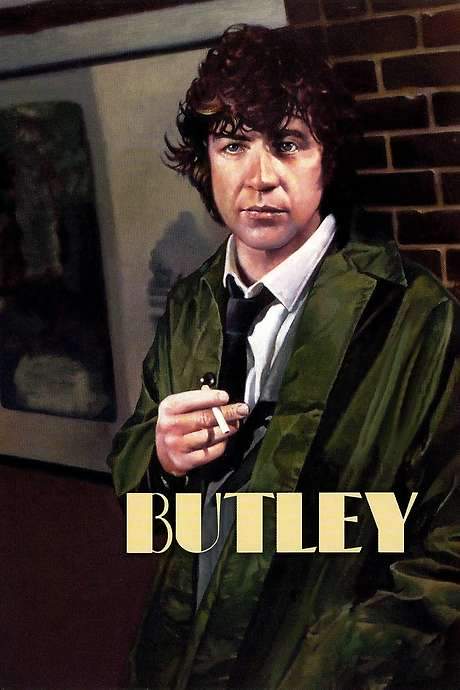



Where to Watch Butley
See current US streaming, rental, and purchase options for Butley (1974) via JustWatch.

Kino Film Collection
HD
Kanopy
SD
Plex
HD
Plex Channel
HD
Amazon Video
SD Streaming availability powered by 
Butley Plot Summary
Read the complete plot summary and ending explained for Butley (1974). From turning points to emotional moments, uncover what really happened and why it matters.
Butley, Alan Bates is a literature professor and longtime T. S. Eliot scholar who has recently shifted some of his focus to Beatrix Potter. He is, on the surface, a cultivated man, yet he exists on a tightrope of self-destruction as a suicidal alcoholic who loses both his wife and his male lover on the same day. The film follows a few hours in his day, a darkly comic cascade of confrontations and collapses, most of them taking place within the cluttered walls of his university office, with a brief opening that shows him waking in the flat he shares with Joey and moving through the city—an urban ritual punctuated by Underground rides and lunchtime escapes to the pub. The pattern that emerges is not just a single crisis but a portrait of a man whose authority over others is matched only by his inability to control himself.
Joey Keyston, Richard O’Callaghan, is a former student who has become Butley’s assistant, a position that has grown complicated and intimate as Butley admits to having “groomed” him in a way that crosses professional boundaries. Their relationship, spoken of in bleak, sometimes abusive terms, becomes a central thread in the day’s unraveling. Joey’s tenure at the university is precarious, tied to Butley’s will and mood, and as the day progresses, Joey’s own loyalties and feelings begin to shift in ways that threaten both of their fates. The film builds this dynamic in tight, intimate scenes where dialogue often slips into sarcasm, control, and moments of stark vulnerability.
Reg Nuttall, Michael Byrne, is a colleague who circles the chaos with a mix of skepticism and weary tolerance. He becomes an unwitting catalyst in the day’s cascade when he articulates the sense that Butley is living through multiple divorces at once. As Reg puts it, Butley seems to be dividing his life into separations: from a wife who is no longer present, from Joey who has discovered he’s fallen for someone else (a fact Butley pretends not to hear), and from a new undergraduate that Butley has managed to lure away from her tutor, Edna. These revelations unfold through a string of encounters that reveal Butley’s talent for manipulation, his appetite for control, and his growing isolation. The tension between what Butley says and what his actions reveal grows with each scene, a deliberate pacing that lets the audience watch a mind fray in real time.
Edna Shaft, Jessica Tandy, appears as a younger undergraduate drawn into the orbit of Butley’s authority and charm. Her presence sharpens the sense that Butley’s influence is both seductive and corrosive, drawing people closer only to expose the fragility of their own choices. The office becomes a stage where the lines between teacher and mentor, predator and prey, blur in uneasy, unsettling ways. As the hours tick by, the atmosphere thickens with the weight of unspoken histories, unfulfilled promises, and the constant risk of an outburst that could shatter what little stability remains.
The day intensifies as Butley’s feigned normalcy collapses into a relentless barrage of insults and manipulation aimed at students and colleagues alike. The dialogue, sharp and merciless, traverses a spectrum of intellectual bravado, personal cruelty, and bitter self-satire. It culminates in a moment of violence when Reg, having previously turned away, finally interrupts the pattern with a punch that halts the escalating cruelty. Joey, who has shown a rare glimmer of compassion, gathers his belongings and moves to a new, smaller office that stands in the vacated space once occupied by Edna—an ending that signals a complete break from the man he has been serving.
The emotional weather of the film is brutal and unflinching, yet the comedy remains dark and sardonic, never fully releasing the tension that builds as each scene reveals another layer of Butley’s self-destruction. The relationship threads—between Butley and Joey, between Butley and Reg, and between Butley and Edna—are traced with a clinical eye for the way power, desire, and fear can coexist in a single temperament. The setting—the office that becomes both sanctuary and trap—acts as a microcosm of Butley’s psyche, a space where the scholar’s language and the bully’s voice collide.
In the end, the film returns to the idea that the surface of erudition and courtesy can mask a volatile, retaliatory core. The final tutorial—with a new, unnamed student—begins as a measured continuation of pedagogy, but quickly dissolves into a monologue of venom and control. Butley’s tirade reasserts itself, and the student exits with a look of clear disdain, a somber bookend to a day that started with loss and ended in further rupture. The film nods to the deeper tensions underlying the outwardly refined world, hinting at a sexuality that surfaces only in the most corrosive and cruel forms, a thread that is briefly touched upon when Butley refers to the chair as “a fairy queen.”
Harold Pinter’s direction frames this uneasy odyssey with a precision that makes every pause, every raised voice, and every insinuation feel loaded with consequence. The result is a darkly funny, devastatingly precise portrait of a man unraveling under the weight of his own ambitions and appetites, a study in how power can corrode intimacy, how grooming can masquerade as mentorship, and how the language of the educated mind can be weaponized to wound those closest to us. The film remains a stark, unflinching examination of a psyche in crisis, delivered with a cool, controlled wit that makes the moments of cruelty feel almost inevitable—until they cease to be mere performances and become the truth of a life come apart.
Butley Timeline
Follow the complete movie timeline of Butley (1974) with every major event in chronological order. Great for understanding complex plots and story progression.
Opening morning: hangover and commute
The film opens with Butley waking in his flat, nursing a hangover. He makes his way to the Underground and, at lunchtime, drinks shots in the corridor and at a pub. This opening sequence establishes his self-destructive mood and the day that will spiral out of control.
The office as a stage for abuse
Most of the action unfolds in Butley's office, where he bullies students, friends, and colleagues. He dominates the conversations, mocks others, and uses Joey as an unwilling confidant and assistant. The space becomes a claustrophobic theatre for power, control, and tension.
The living arrangement revealed
Through scene after scene, we learn Joey is more than a former student; he is Butley's assistant who remains for power and dependency. Butley hints at grooming him and keeping him close, treating loyalty as currency. The dynamic blurs lines between mentor, lover, and captor.
The fractures of Butley's personal life
On the same day, Butley faces fractures in his relationships as he mentions a string of divorces. Joey reveals he has met someone else (Reg), while Butley pretends not to hear Reg's name. The revelation deepens the day's volatility and sense of betrayal.
The eruption of verbal cruelty
The dialogue erupts into a long, unremitting torrent of insults, including hostile and homophobic remarks. Butley targets students, friends, and even objects like a chair, exposing his reckless contempt for those around him. The tirade marks a brutal rupture in his facade of authority.
Reg's confrontation and punch
Reg confronts Butley, and the tension erupts into a physical confrontation as Reg punches him. The fight shatters the illusion of Butley's control and accelerates the unraveling of the day. The moment crystallizes the consequences of his cruelty.
Joey's decision to leave
Joey, though briefly moved by compassion, begins planning his escape. He gathers his belongings and moves to a new, tiny office that has just been vacated by Edna, signaling a severing of their professional and personal ties. The change marks a concrete step toward ending their arrangement.
Breakup ripples through home and work
The breakup pattern plays out in both home and work settings, with Butley unable to maintain his grip on anyone around him. He fights to salvage status, but the space grows more claustrophobic and hostile. The day culminates in a collapse of his influence and self-image.
A new tutorial student arrives
A new student arrives for a tutorial, and Butley immediately resumes his combative, belittling approach. He asserts authority through insults and manipulative lectures, showing no restraint. The student's reaction foreshadows the day’s ultimate rejection.
The new tutorial ends in contempt
Butley continues verbally attacking the new student, illustrating the depth of his cruelty. The student leaves with a look of disgust, marking the beginning of the end for any possibility of reform. The scene reinforces the cycle of abuse that defines his day.
The closing mood: isolation and rage
The day closes with Butley alone, still ranting and unable to connect meaningfully with others. His rage remains unchecked as the world around him shrinks away. The final mood is one of unresolved despair rather than redemption.
Abusive intellect: a critique of his persona
Throughout the film, Butley's persona as a T. S. Eliot scholar contrasts with his cruel behavior, revealing a troubling disconnect between intellect and morality. The day punctuates his decline and the costs of power without empathy. The ending underscores the tragedy of a man undone by his own patterns of abuse.
The final beat: restart of the cycle
In the last beat, Butley turns the session toward a new student, showing the cycle is ready to continue. An initial spark of fresh hope is crushed as he unloads more abuse, leaving the student to walk away in contempt. The film ends with no resolution, only the persistence of his corrosive behavior.
Butley Characters
Explore all characters from Butley (1974). Get detailed profiles with their roles, arcs, and key relationships explained.
Ben Butley (Alan Bates)
The title character, a literature professor and longtime T. S. Eliot scholar with a recently developed interest in Beatrix Potter, is a suicidal alcoholic who bullies students, friends, and colleagues, while rapidly unraveling after the loss of his wife and his male lover. He dominates conversations, uses others to shore up his ego, and reveals a brittle, self-destructive core as the day unfolds.
Anne Butley (Susan Engel)
Butley's wife, who becomes one of the many casualties of his crumbling world. She represents the personal costs of his self-absorption and the dissolution of his intimate life. Her presence signals the fragility of relationships under Butley's corrosive arrogance.
Joey Keyston (Richard O'Callaghan)
Butley's former student turned assistant, a long-suffering companion who is pulled deeper into Butley's toxic dynamic. He witnesses the abuse, maintains a fragile loyalty, and ultimately secures his own escape as he moves to a smaller office.
Reg Nuttall (Michael Byrne)
A figure connected to the day's conflicts, involved in the complicated web of relationships around Butley and Joey. He becomes a catalyst for confrontation and resolution within the story, symbolizing the consequences of Butley's manipulations.
Butley Settings
Learn where and when Butley (1974) takes place. Explore the film’s settings, era, and how they shape the narrative.
Time period
The events unfold over a single, tightly packed day, focusing on the rapid unraveling of Butley. It takes place within a contemporary urban academic milieu, highlighting the pressures and dynamics of university life. The pacing underscores the claustrophobic, almost theatrical intensity of one man’s breakdown.
Location
Butley's flat, Butley's office, London Underground, pub
The action is largely confined to the spaces of Butley's life: his cluttered flat and his cramped office, which together create a claustrophobic atmosphere. Interludes occur on the London Underground and in a pub, signaling brief escapes from the dominate presence of the office. These settings emphasize the social milieu of urban academic life and the erosion of personal boundaries throughout the day.
Butley Themes
Discover the main themes in Butley (1974). Analyze the deeper meanings, emotional layers, and social commentary behind the film.
🗣️
Abuse of Power
Butley wields his status as a professor to bully students, friends, and colleagues. The film examines how intellectual authority can mask coercive behavior and how verbal aggression corrodes trust. As the day progresses, the façade of control collapses, revealing a brittle, self-destructive core.
💔
Toxic Relationships
The narrative centers on damaged intimate and professional relationships, particularly how manipulation and need feed manipulation and betrayal. Butley’s encounters destabilize those around him, leading to heartbreak and detachment. The result is a web of fractured loyalties and failed connections.
🥃
Alcoholism and Decline
Butley is portrayed as a suicidal alcoholic whose drinking accompanies his moral and emotional collapse. The alcohol intensifies his outbursts and reduces his self-control, mirroring the broader collapse of his personal and professional life. The film uses intoxication as a lens to explore desperation and vulnerability.

Coming soon on iOS and Android
The Plot Explained Mobile App
From blockbusters to hidden gems — dive into movie stories anytime, anywhere. Save your favorites, discover plots faster, and never miss a twist again.
Sign up to be the first to know when we launch. Your email stays private — always.
Explore the mobile appButley Spoiler-Free Summary
Discover the spoiler-free summary of Butley (1974). Get a concise overview without any spoilers.
In the hallowed halls of Queen Mary’s College, London, academic rigor meets the restless pulse of a city that never quite sleeps. The film dwells largely in a cramped, paper‑strewn office that feels simultaneously a sanctuary and a pressure cooker, its walls echoing with the clatter of typewriters, the hiss of the Underground, and the occasional roar of a nearby pub. A darkly comic tone pervades, where erudite banter is laced with profanity, and every lecture is a thinly veiled arena for razor‑sharp wit.
Ben Butley is a middle‑aged English professor whose reputation as a T.S. Eliot authority masks a fragile personal life that has begun to unravel. He moves through his days with a blend of cultivated poise and self‑destructive tendencies, his keen intellect often turning on himself as much as on anyone else. The loss of his wife to another man and the sudden departure of his lover leave him navigating a solitary existence, his heavy drinking and caustic humor serving as both shield and self‑inflicted wound.
Around him swirl a handful of figures who populate his professional and emotional universe. Joey Keyston, a former student turned assistant, occupies a space that blurs the lines between mentorship and intimacy, while Reg Nuttall, a weary colleague, offers a skeptical counterpoint to Butley’s theatrical authority. Edna Shaft, a bright undergraduate, becomes another thread in the tangled tapestry of admiration, control, and vulnerability that defines the professor’s daily interactions. Their relationships are marked by power dynamics that seep into every conversation, hinting at deeper currents beneath the surface politeness.
Harold Pinter’s direction renders the film with a precision that makes every pause and raised voice feel loaded with consequence. The mood oscillates between bleak humor and stark melancholy, creating a portrait of a scholar whose polished exterior conceals a volatile inner world. The cinematography and dialogue work in concert to make the office feel both a microcosm of academia and a crucible for personal disintegration, inviting the audience to linger in the uneasy space between intellect and impulse.
Featured on this page

What's After the Movie?
Not sure whether to stay after the credits? Find out!
Check out our other apps:

SAT Sphere
Build confidence for the Digital SAT.

Mori Atlas
Discover wild places worth protecting.

Luntero
Search smarter for a home in Amsterdam.

Plot Explained
Unravel movie endings and hidden clues.

Pokechamp
Dive into Pokémon data and battle logic.

Driving Theory
Get ready for your European theory test.

Movie Dust
Plan your next cinema trip with ease.

Musemap
Find art and culture as you travel.

Selkobase
Compare credentials before committing.

Local Manual
Turn an unfamiliar country into practical next steps.

Lernavi
Compare school systems before your next move.

GymRoam
Find a workout stop wherever your plans take you.
Explore Our Movie Platform
New Movie Releases (2026)
Famous Movie Actors
Top Film Production Studios
Movie Plot Summaries & Endings
Major Movie Awards & Winners
Best Concert Films & Music Documentaries
Movie Collections and Curated Lists
© 2026 What's After the Movie. All rights reserved.
Privacy Policy