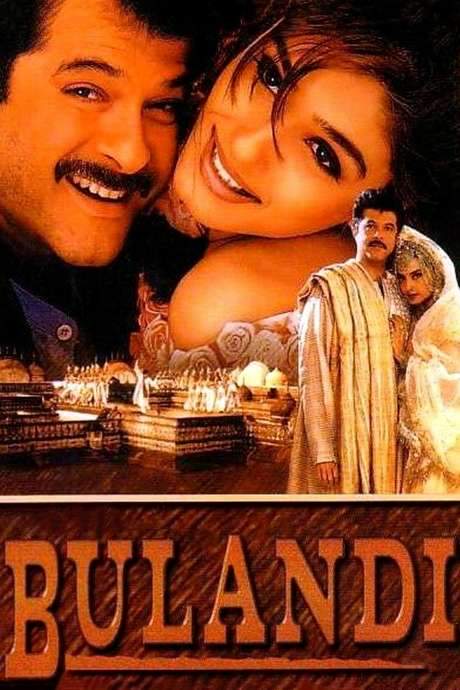
Bulandi 2000

Directed by

Rama Rao Tatineni
Made by

Where to Watch Bulandi
See current US streaming, rental, and purchase options for Bulandi (2000) via JustWatch.

Streaming availability powered by 
Bulandi Plot Summary
Read the complete plot summary and ending explained for Bulandi (2000). From turning points to emotional moments, uncover what really happened and why it matters.
Dharamraj “Dada” Thakur [Anil Kapoor] stands at the center of a village where his word is treated like law, a role he fills with a stern calm that blends discipline and care. Since the death of Ghajraj Thakur [Rajinikanth], the patriarch, Dada has been the unshakable pillar of the clan, and his household—comprising his wife Lakshmi [Rekha] and his two younger brothers, Arjun [Anil Kapoor] and Nakul [Harish Kumar]—mirrors a tight-knit, almost parental unit. The bond between Dada and Lakshmi is the backbone of the family, and they act as surrogate parents to Arjun and Nakul, guiding their choices and standing as a united front against outside pressures. When Arjun weds the city-born Meena [Raveena Tandon], a strain threads through the household. At first, Meena resents what she sees as Dada’s pervasive control over her husband, a control that seems to keep Arjun tethered to family duty rather than his own desires. Yet, as she discovers the depth of Dada’s influence extending beyond mere authority—learning that he once helped her father in business—Meena’s stance shifts. She begins to understand the loyalty and protection that undergird Dada’s leadership, and her initial resentment slowly gives way to a growing respect for her brother-in-law and the family they all share.
The peace of the village is upended when Arjun is accused of raping a schoolteacher, a charge that rattles the entire Thakur clan. The momentous question of guilt or innocence falls to Dada, whose decision will ripple through every corner of the household and beyond. The verdict will not only shape the fate of Arjun but also define the moral authority of the entire family, setting the stage for a clash between duty, justice, and tradition. As the community watches, Dada’s ruling carries the weight of generations of expectations, and the family braces for the consequences that will follow from his decision.
In a telltale flashback, Ghajraj Thakur lays down a brutal, uncompromising legacy. The elder Thakur orders his nephew Jagannath to marry the daughter of villagers he has wronged, a verdict that sparks outrage in the family and culminates in a wayward act of violence. Jagannath’s crime and the harsh punishment that follows set in motion a bitter feud. Ranjit Singh, Jagannath’s father, objects to the verdict and shoots Ghajraj in a world where blood ties and pride often trump mercy. As Ghajraj approaches death, he delivers a stark warning to Dharamraj: whenever a wrong verdict is given, the moment of error is the moment of his own death. With those final words, Ghajraj dies, and the family’s history fractures into predictable resentments and bitter rivalries. Jagannath seethes with envy toward his uncle’s kin and waits for an opportunity to strike, while the elder generation fades, leaving the younger ones to bear the burden of their choices.
From that point, Jagannath hatches a scheme to unleash trouble on Arjun’s life. He brings a teacher into the village school, instructing her to captivate Arjun and draw him away from his wife. The plan backfires when Arjun refuses to betray Meena, and Jagannath reacts with brutal violence, killing the woman and leaving the public to believe that Arjun’s actions drove her to suicide. Dharamraj, misled by events and appearances, punishes Arjun’s family with ten years of exile, a sentence that compounds the pain and fuels the fire of familial strife. Jagannath’s malice deepens as he learns of his niece’s affection for Nakul, and he sharpens his blade to eliminate the younger brother. The tension escalates until Arjun rushes to Nakul’s aid, while Meena, now heavily pregnant, attends the annual festival where her labor begins.
Amid the festival’s bustle, the old duel between duty and emotion comes to a head as Dharamraj confronts Jagannath in a fierce duel. In a decisive turn, Dharamraj’s Aunt Manorama [Aruna Irani] rushes to the scene, and in a climactic moment she strikes, killing Jagannath and ending his tyranny. She then reveals the truth that had been hidden under a veil of rumor: Arjun had been punished for crimes that Jagannath himself committed. The revelation forces Dharamraj to confront his father’s final admonition about the danger of ruling with a wrong verdict. The shock of that realization proves too heavy, and Dharamraj dies, realizing in that final instant that his judgment against his innocent brother’s family was a grave mistake. The story closes with Arjun ascending to the ancestral throne, stepping into the role of protector and custodian of the family’s venerable traditions, and continuing the lineage that had been disrupted by decades of deceit and violence.
The film unfolds as a sweeping, layered family epic that examines loyalty, power, and the cost of misjudgment. It traces how authority can both defend and destroy, how love can be tested by circumstance, and how truth, once exposed, reshapes a house built on long-standing alliances and old resentments. Through its interwoven timelines and generations, the story keeps its focus on the human consequences of every decision, and it does so with a measured, steady pace that underscores the emotional stakes without losing sight of the broader sense of community that anchors the Thakur clan. The characters—each drawn with clear motives and forthright flaws—move through a world where honor is both a shield and a burden, and where the ultimate act of justice comes not from vengeance but from the painful clarity that can only arrive when truth overturns a life’s most fateful verdict.
Bulandi Timeline
Follow the complete movie timeline of Bulandi (2000) with every major event in chronological order. Great for understanding complex plots and story progression.
Dada Thakur assumes village leadership
After the death of Gajraj Thakur, Dharamraj 'Dada' Thakur becomes the head of the village and his word is treated as law. He leads alongside his wife Lakshmi and his brothers Arjun and Nakul, weaving duty into daily life. The family relies on his authority to maintain order and tradition.
Arjun marries Meena
Arjun marries a city girl, Meena, which introduces tension as she adjusts to village customs. At first she resents Dharamraj's subservience to his elder brother, feeling it limits her husband's independence. The uneasy alliance foreshadows the conflict to come.
Meena's changed perception of Dada
Meena initially resents Dharamraj's control, but she learns that his actions protected her father’s interests. Her attitude shifts from resentment to cautious respect as she understands the reason behind his authority. This change deepens the household's tensions around duty and loyalty.
Arjun is wrongly accused of raping a schoolteacher
A serious accusation is laid against Arjun, and the village waits for Dada's verdict. The pending decision tests the limits of power, honor, and justice within the family. The outcome sets the stage for years of conflict and upheaval.
Gajraj Thakur's flashback and the fateful verdict
In a pivotal flashback, Gajraj Thakur orders Jagannath to marry the village woman he had raped. Ranjit Singh shoots him in disappointment, and Gajraj declares that the family will be abandoned for 18 years, forbidding water or aid to visiting relatives. He dies at the moment he utters that final verdict, foreshadowing a curse that will shape future events.
Jagannath's envy and plan to recruit a teacher
Jagannath becomes envious of his uncle's family and hatches a revenge plot. He engineers the arrival of a local schoolteacher, instructing her to win Arjun's heart, hoping to drive a wedge between him and Meena. This scheming plants seeds of tragedy as trust begins to fracture.
Arjun resists manipulation; the teacher is killed
Arjun resists the teacher's manipulations and refuses to betray Meena. In retaliation, Jagannath has the teacher killed and convinces the villagers she died by Arjun's actions. The false suicide narrative cements the rift and escalates the family crisis.
Dharamraj condemns exile for his brother's family
Following the tragedy, Dharamraj orders exile for his brother's family for 10 years, a decision that widens the rift within the Thakur clan. The exile deprives them of contact and intensifies Jagannath's scheming from afar. This punishment will later haunt Dharamraj when truth comes to light.
Jagannath targets Nakul; Arjun intervenes
Jagannath learns of Nakul's love for his sister-in-law and mobilizes goons to eliminate him. Arjun steps in to rescue Nakul, defending his brother and challenging Jagannath's grip on the village. The confrontation marks a turning point as danger closes in.
Meena gives birth at the festival
At the village's annual festival, Meena's water breaks and she gives birth to a child. Arjun fights to protect his family amid the chaos and competing loyalties. The birth lends a note of renewal amid a saga of treachery.
Dharamraj duels Jagannath
Dharamraj confronts Jagannath in a duel that embodies the clash between justice and revenge. The fight tests his resolve and forces him to confront the consequences of his earlier verdict. It culminates in a moment that redefines the family’s fate.
Aunt Manorama kills Jagannath and reveals truth
Aunt Manorama rushes to Dharamraj and kills Jagannath, ending the immediate threat. She then reveals that Jagannath alone committed the crimes wrongly laid on Arjun, and shares the truth about the past. The revelation shakes Dharamraj to his core and anchors the tragedy in truth.
Dharamraj realizes his wrong verdict; dies
Shocked by the truth, Dharamraj recalls his father's warning: whenever we give a wrong verdict, we die. He dies at that moment, paying for an earlier misjudgment. The patriarch's death signals the end of an era and the weight of guilt settles on Arjun.
Arjun takes the ancestral throne
With the patriarch gone and the truth uncovered, Arjun ascends the ancestral throne. He inherits the responsibility to govern justly and preserve the family’s traditions. The cycle of authority continues into the next generation.
Bulandi Characters
Explore all characters from Bulandi (2000). Get detailed profiles with their roles, arcs, and key relationships explained.
Dharamraj 'Dada' Thakur — Anil Kapoor
The patriarch of the Thakur clan; a stern, calm leader whose word functions as law in the village. He balances discipline with a protective, caring instinct for his family, serving as a pillar of the community. His insistence on tradition leads to costly misjudgments, including the exile of Arjun’s kin, and culminates in a tragic death when truth finally surfaces.
Arjun Thakur — Anil Kapoor
Dada's younger brother who marries Meena; loyal to his wife and family, he resists Jagannath’s schemes while trying to honor duty and affection. He is wrongfully punished for a crime he did not commit, leading to exile and deepening family rifts. In the end, the truth vindicates him and he rises to a position of ancestral responsibility.
Lakshmi — Rekha
Dada’s wife and moral anchor of the household; a quiet yet steadfast force who maintains unity and steady guidance for the family. She supports her husband while protecting her children and in-laws, embodying the emotional center that holds the clan together.
Meena — Raveena Tandon
City-born wife of Arjun who initially clashes with Dada’s controlling style. Over time she grows to understand the family’s loyalty and protection, especially as her own life and pregnancy become intertwined with the clan’s fate. She evolves from a skeptic to a valued family member.
Jagannath — Shakti Kapoor
The scheming antagonist whose jealousy and malice drive a plan to undermine Arjun and destabilize the family. He commits violence to crush rivals and manipulates events to seize power, fueling the feud that spears the narrative forward.
Ghajraj Thakur — Rajinikanth
The clan patriarch whose brutal legacy influences the present. His deathbed admonition about wrong verdicts casts a long shadow over later events, underscoring how past judgments shape the family’s fate.
Ranjit Singh — Ranjeet Bedi
Jagannath’s father who objects to punishment against his kin and ultimately shoots Ghajraj, intensifying the family feud. His actions illustrate how pride and vengeance propagate violence across generations.
Manorama — Aruna Irani
Dharamraj’s aunt who intervenes at a crucial moment and kills Jagannath to end his tyranny. She later reveals the truth about Arjun’s punishment, triggering a necessary confrontation with past misdeeds and reinforcing the moral clarity of the final acts.
Nakul — Harish Kumar
Arjun’s younger brother who becomes entangled in Jagannath’s plots. His presence heightens the protective instincts within the family and amplifies the stakes around Jagannath’s machinations.
Bulandi Settings
Learn where and when Bulandi (2000) takes place. Explore the film’s settings, era, and how they shape the narrative.
Location
Thakur Village
A close-knit rural Indian village where the Thakur clan wields social influence and honor dictates everyday life. Public verdicts, family meals, and ritual gatherings form the backdrop for power, duty, and loyalty. The setting concentrates tradition and hierarchy, amplifying the stakes of every decision within the family.
Bulandi Themes
Discover the main themes in Bulandi (2000). Analyze the deeper meanings, emotional layers, and social commentary behind the film.
⚖️
Duty & Justice
The story places duty to family against the pursuit of fair justice, showing how authority can blur moral lines. Dada’s rulings carry the weight of tradition, often at the expense of individual innocence. The narrative interrogates whether rightful power can coerce truth, with tragedy looming when verdicts go astray. Ultimately, the film asks whether justice can be truly served when love and tradition collide.
👪
Family & Power
Power concentrates within the Thakur household, shaping choices for brothers, wives, and the next generation. Loyalties are tested when Arjun weds Meena and Jagannath schemes to destabilize the clan. The drama explores how affection and duty sustain or fracture a family under a patriarch’s watchful eye. The clan’s cohesion hinges on balancing authority with compassion.
🔎
Truth & Revelation
A hidden past and misinterpreted events come to light through decisive action and revelation. The truth about Arjun’s innocence contradicts the earlier punitive verdict and forces a reevaluation of justice. The climactic disclosures reshape destinies and reveal how memories can mislead when power is on the line. The film treats truth as a catalyst for moral reckoning.
🔥
Cycle of Violence
Generations of feuds and punitive actions fuel a chain of retaliation that threatens to engulf the family. Jagannath’s schemes and Ghajraj’s brutal legacy drive the conflict, showing how violence circulates through kinship ties. The duel and ensuing tragedy demonstrate how vengeance corrodes trust and destabilizes leadership. The story suggests that breaking the cycle requires truth over vengeance.

Coming soon on iOS and Android
The Plot Explained Mobile App
From blockbusters to hidden gems — dive into movie stories anytime, anywhere. Save your favorites, discover plots faster, and never miss a twist again.
Sign up to be the first to know when we launch. Your email stays private — always.
Explore the mobile appBulandi Spoiler-Free Summary
Discover the spoiler-free summary of Bulandi (2000). Get a concise overview without any spoilers.
In a sun‑kissed rural town where tradition holds as much sway as the monsoon, a respected lineage governs the rhythm of daily life. The Thakur family, heads of the village, carry the weight of generations, their word shaping both the market stalls and the whispered hopes of the community. The atmosphere blends reverent ceremony with the quiet turbulence that inevitably stirs beneath any tightly knit society, inviting a sense of both stability and restrained anticipation.
At the heart of this world stands Dharamraj “Dada” Thakur, a stern yet caring patriarch whose calm authority is balanced by an underlying compassion. Beside him, Lakshmi supports the household with an unspoken strength, together forming the familial anchor for the two younger brothers—Arjun and Nakul. Their bond is more than blood; it is a shared guardianship that guides decisions and shields the clan from external pressures. When Arjun marries the city‑born Meena, the union introduces fresh perspectives that subtly challenge the established order, creating a gentle tension between duty to family and the desire for personal autonomy.
A sudden, serious allegation against Arjun threatens to unravel the delicate balance the Thakurs have long maintained. The resulting dilemma forces Dada to confront the clash between his deep‑rooted sense of honor and the evolving moral expectations of his people. The village watches, aware that the outcome will ripple through every corner of their tightly woven community, testing the limits of loyalty, justice, and tradition.
Against this backdrop of generational pride and quiet power, the film weaves an atmospheric portrait of a family standing at a crossroads. The tone remains measured and contemplative, inviting viewers to wonder how the weight of the past will shape the choices of those entrusted with its future, while the undercurrents of love, respect, and hidden unrest promise a story that lingers long after the final scene.
Featured on this page

What's After the Movie?
Not sure whether to stay after the credits? Find out!
Check out our other apps:

SAT Sphere
Build confidence for the Digital SAT.

Mori Atlas
Discover wild places worth protecting.

Luntero
Search smarter for a home in Amsterdam.

Plot Explained
Unravel movie endings and hidden clues.

Pokechamp
Dive into Pokémon data and battle logic.

Driving Theory
Get ready for your European theory test.

Movie Dust
Plan your next cinema trip with ease.

Musemap
Find art and culture as you travel.

Selkobase
Compare credentials before committing.

Local Manual
Turn an unfamiliar country into practical next steps.

Lernavi
Compare school systems before your next move.

GymRoam
Find a workout stop wherever your plans take you.
Explore Our Movie Platform
New Movie Releases (2026)
Famous Movie Actors
Top Film Production Studios
Movie Plot Summaries & Endings
Major Movie Awards & Winners
Best Concert Films & Music Documentaries
Movie Collections and Curated Lists
© 2026 What's After the Movie. All rights reserved.
Privacy Policy