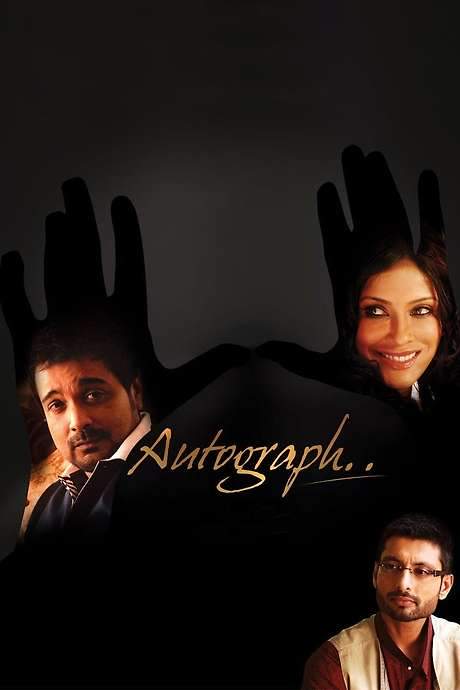

Where to Watch Autograph
See current US streaming, rental, and purchase options for Autograph (2010) via JustWatch.

Apple TV Store
HD
Google Play Movies
SD
YouTube
SD Streaming availability powered by 
Autograph Plot Summary
Read the complete plot summary and ending explained for Autograph (2010). From turning points to emotional moments, uncover what really happened and why it matters.
Shubhabrata, Indraneil Sengupta, is an ambitious but green filmmaker who aims for a breakthrough with his first foray into fiction: a modern remake of Satyajit Ray’s Nayak. He reimagines the story by swapping out classic settings for current ones—an airplane replaces the train, and the ending of Ray’s original is stretched out in his script. His dream project quickly collides with the practical reality of getting a big star on board. He repeatedly tries to recruit Prosenjit Chatterjee to play the hero, but is curtly dismissed by the actor’s team, led by Ashish (Pijush Ganguly) and Partha (Dwijen Banerjee).
The turning point arrives when Arun Chatterjee confronts a public, ego-shaking rebuke from Manoj Sarkar on a TV platform. Spurred by pride and a hunger to prove himself, Arun privately decides to bankroll and front the film, curbing the objections of Ashish and Partha and treating the project as a personal referendum on his own star power. The casting choice lands squarely on Srinandita, Shubhabrata’s live-in girlfriend, an actress rooted in translated European theatre. Srinandita—played by Nandana Sen—agrees to take the role after some initial hesitation, first aligning with Shubhabrata’s vision and later becoming a crucial emotional touchstone in the film’s unfolding drama.
As the production moves forward, Manoj Sarkar approaches Shubhabrata with a lifeline in case Arun falters, only to be rebuffed. Meanwhile, the two leads form a visible rapport in front of the camera, and Shubhabrata’s confidence grows along with a hint of arrogance. The lines between fiction and reality blur when the film’s narrative starts echoing in real life, and Arun and Srinandita’s closeness deepens into genuine companionship. Srinandita becomes not just a co-star but a confidante, and the film’s sense of ethical boundaries begins to fray.
The emotional core tightens when Arun, in a drunken moment, confesses to exploiting an aspiring actress during casting. Srinandita consoles him, framing his guilt as a sign of potential redemption. This confession is recorded on Srinandita’s handycam, a device she carries to rehearse for her next stage appearance as Antigone. Seizing a chance for publicity, Shubhabrata contends that the clip could turbocharge the film’s launch. Srinandita, sensing the danger of such a use, urges him to scrap the idea and insists on keeping the material private. Yet Shubhabrata proceeds, passing the clip to a TV news channel without Srinandita’s knowledge, sparking a cascade of consequences.
When the broadcast surfaces, Arun confronts both Shubhabrata and Srinandita, feeling betrayed and hurting from the manipulation. Srinandita reaches out to explain and apologize, but the moment hardens into distance. Arun’s response is fierce: he refuses to take legal action against the channel and, in a decisive blow, damages the relationship and pauses the film’s future. The revelation of Srinandita’s innocence helps him see the harm in the filmmaker’s opportunistic tactics, yet he ultimately decides to cancel the project and warns Shubhabrata about the consequences of inflating power with a camera and a story.
In the aftermath, Shubhabrata is seen missing Srinandita, but the final note of the film remains unresolved. A meeting with Manoj hints at a possible future, yet the outcome is deliberately left open, lingering like the ethical questions the film raises about ambition, art, and the price of success. The narrative artfully tracks the way a director’s drive to create a hit can pull the people around him into a web where friendship, responsibility, and fame collide, leaving viewers to ponder where art ends and personal integrity begins.
Autograph Timeline
Follow the complete movie timeline of Autograph (2010) with every major event in chronological order. Great for understanding complex plots and story progression.
Shubhabrata begins a modern Nayak remake
Shubhabrata, an ambitious but inexperienced filmmaker, sets out to remake Satyajit Ray's Nayak with contemporary twists. He relocates key moments, replacing the train journey with an airplane and extending the ending to suit his vision. The project is framed as his big break, driven by a desire for success more than flawless craft.
Arun spurns Shubhabrata's pitch
Shubhabrata's attempts to recruit Arun Chatterjee as the hero are repeatedly rejected. Arun's circle, including Ashish and Partha, dismiss the filmmaker's ideas as vanity. The early meetings set up the rivalry at the heart of the tale.
Arun challenged by a public jolt to ego
A televised public put-down from producer Manoj Sarkar stings Arun’s ego and convinces him to prove himself. He resolves to churn out a hit film single-handedly, after learning about Shubhabrata's script and inviting the young director to be involved. The moment shifts the power balance toward self-reliance over studio gatekeepers.
Manoj finances and star-cores the project
Impressed by Shubhabrata's passion, Manoj Sarkar agrees to finance the film, take the lead role himself, and oversee production. He overrides Ashish and Partha's objections, turning the project into a personal challenge to Arun's legitimacy. Shubhabrata begins to see his dream taking real shape.
Casting Srinandita as lead
Shubhabrata searches among actresses for the lead and selects Srinandita, his live-in girlfriend, an actress with a background in translated European theatre. After initial reservations, Srin responds to the role and agrees to participate. This personal casting deepens the bonds that will later complicate the project.
Manoj offers help if Arun falters
Manoj learns of the film's launch and approaches Shubhabrata with a conditional offer: if Arun later pulls out or the project stumbles, Manoj will lend a hand to salvage it. Shubhabrata dismisses the interference, confident in his own control of the project.
On-set bonding fuels authenticity
As shooting progresses, Shubhabrata encourages a growing bond between Arun and Srin to deepen authenticity for the film. Arun, buoyed by the attention, begins to gain confidence but also shows signs of arrogance. The line between onscreen relationships and real-life ties begins to blur.
Film-world mirrors reality
The film's own narrative unfolds in parallel as Arun's friendship with Srin deepens into confidante territory. Srin becomes more than an actress on set, and her involvement shapes the film's emotional core. Shubhabrata watches this real-life dynamic with mixed excitement and anxiety.
Climactic confession on the last shoot day
On the last day of shooting, Arun, drunk, invades Shubhabrata and Srin's apartment and confesses to having used an aspiring actress on the casting couch. Srin consoles him, recognizing his guilt as a sign of repentance. The confession is recorded inadvertently on Srin's handycam as she rehearses Antigone.
Srin refuses publicity and threatens to intervene
When Shubhabrata learns of the recording, he sees a publicity goldmine and plans to publish it. Srin is aghast and strongly dissuades him, extracting a promise that he will refrain from releasing the clip. The moral line between art and exploitation becomes a central tension.
Shubhabrata betrays Srin's trust
Despite Srin's pleas, Shubhabrata steals the clip and passes it to a TV news channel. Srin discovers the betrayal and leaves him, seeking a future as a drama teacher away from the city. The trust fracture marks the film's moral collapse.
TV broadcast escalates the conflict
The channel begins replaying the clip, and Arun, upon seeing it, feels betrayed by both Shubhabrata and Srin. Srin tries to explain by phone, but she disconnects when he refuses to believe her innocence. Ashish unsuccessfully urges legal action, leaving Arun to confront the deeper betrayals.
Confrontation and film cancellation
Arun confronts Shubhabrata, learns Srin's departure and her innocence, and decides to cancel the film. He warns Shubhabrata that he will use his influence to end his career if he tries anything again. The project collapses, leaving the future unresolved.
Open ending: a meeting with the producer
Even as Shubhabrata longs for Srin, he is seen arranging an appointment with Manoj. The outcome of their meeting is left unresolved, offering a partially open ending that suggests future consequences for his ambition. The final image centers on ambition, remorse, and the price of art.
Autograph Characters
Explore all characters from Autograph (2010). Get detailed profiles with their roles, arcs, and key relationships explained.
Shuvobrata Mitra (Indraneil Sengupta)
An ambitious but increasingly arrogant filmmaker who remakes Nayak with contemporary twists. He seeks success at any cost, collaborating with Arun but growing wary of rivals and his own ego as production advances.
Arun Chatterjee (Prosenjit Chatterjee)
A veteran star whose ego is jolted by a public putdown. He chooses to finance and star in Shubhabrata’s film to prove his own capability, driving a tense dynamic with the director while wrestling with temptation and pride.
Srinandita (Nandana Sen)
Shubhabrata’s live-in girlfriend and an actress in translated European theatre who agrees to play the lead. Her growing bond with Arun becomes central to the film’s moral entanglements, and her confession is exploited by Shubhabrata.
Ashish Chakravarty (Pijush Ganguly)
Arun’s associate who resists Shubhabrata’s control and later faces the consequences of working within the producer-driven system. He embodies the friction between artistic intent and commercial pressure.
Parthapratim Nag (Dwijen Banerjee)
Another industry figure who challenges the director’s approach, representing the competing viewpoints behind a film’s creation and the tensions that arise when ambition clashes with collaboration.
Manoj Sarkar (Biswajit Chakraborty)
The producer who publicly humbles Arun on a TV channel, then later contemplates backing the project himself. His involvement highlights how industry power can steer a filmmaker’s fate.
Autograph Settings
Learn where and when Autograph (2010) takes place. Explore the film’s settings, era, and how they shape the narrative.
Time period
Present day
The story unfolds in modern times, with contemporary filmmaking practices on display—handycam recordings, TV coverage, and publicity campaigns. The plot’s parallels with Nayak sit alongside current industry dynamics, including star casting, producer influence, and media-driven hype. The timeline follows real-time events around a film’s production and a publicized confession that blurs art and life.
Location
Kolkata, West Bengal, India
Kolkata serves as the backdrop for the Bengali film industry’s inner workings in Autograph. The city’s theatre tradition and cinema culture frame the characters’ ambitions and rivalries. Its busy streets, studios, and TV channels mirror the high-stakes atmosphere of making a film in contemporary India.
Autograph Themes
Discover the main themes in Autograph (2010). Analyze the deeper meanings, emotional layers, and social commentary behind the film.
🎬
Creative Ambition
A determined filmmaker relentlessly pursues a hit, remaking a classic with modern twists. Shubhabrata’s drive pushes him to take risks, overstep boundaries, and increasingly court fame. The line between art and manipulation grows thinner as the project progresses, revealing the cost of ambition.
💔
Betrayal Morality
Confidences get weaponized as Shubhabrata uses Srinandita’s recording to feed publicity, betraying trust for advantage. Arun’s ego is wounded by public scorn, yet he is drawn into a web where loyalty is uncertain. The characters’ choices raise questions about ethics in friendship, love, and cinema.
🗞️
Media Ethics
The TV channel and publicity machine become catalysts for outcomes that resemble the film’s plot, illustrating how media can distort truth. The clip’s circulation demonstrates the power—and danger—of backstage footage. The story probes responsibility in recording and broadcasting personal moments.

Coming soon on iOS and Android
The Plot Explained Mobile App
From blockbusters to hidden gems — dive into movie stories anytime, anywhere. Save your favorites, discover plots faster, and never miss a twist again.
Sign up to be the first to know when we launch. Your email stays private — always.
Explore the mobile appAutograph Spoiler-Free Summary
Discover the spoiler-free summary of Autograph (2010). Get a concise overview without any spoilers.
In the bustling world of Bengali cinema, a celebrated veteran of the silver screen is drawn into an ambitious venture that seeks to breathe new life into a beloved classic. Arun Chatterjee, a towering figure whose fame once seemed untouchable, is approached with a bold proposal to remake Satyajit Ray’s landmark film, promising a contemporary twist on a story that still haunts the cultural imagination. The project promises a collision of reverence and reinvention, setting the stage for a cinematic experiment that feels both inevitable and fraught.
Enter the restless dreamer, a fledgling director whose vision is as daring as it is untested. Shuvobrata arrives with a script that reimagines the original’s iconic moments—trading a timeless train journey for an airborne odyssey and extending the narrative beyond its famed conclusion. His enthusiasm is infectious, his determination palpable, and his willingness to challenge industry conventions hints at a fresh, if volatile, energy that could either revitalize or destabilize the familiar terrain of Bengali filmmaking.
Complicating the equation is the director’s personal muse, an avant‑garde actress whose presence on stage and screen blurs the lines between art and intimacy. Srinandita, a theater‑trained performer with a penchant for daring roles, becomes the focal point of the casting conversation, embodying the film’s ambition to merge performance with authentic emotion. Her involvement promises a dynamic chemistry that could deepen the narrative while also tightening the knot of professional and personal loyalties.
Against this backdrop of artistic reverence, modern aspiration, and tangled relationships, the story unfolds in a tone that balances homage with restless innovation. The atmosphere crackles with the anticipation of a project that could either cement legacies or expose fragile egos, inviting viewers to witness a dance between past glory and present ambition, all within the vibrant, ever‑evolving landscape of Kolkata’s film world.
Featured on this page

What's After the Movie?
Not sure whether to stay after the credits? Find out!
Check out our other apps:

SAT Sphere
Build confidence for the Digital SAT.

Mori Atlas
Discover wild places worth protecting.

Luntero
Search smarter for a home in Amsterdam.

Plot Explained
Unravel movie endings and hidden clues.

Pokechamp
Dive into Pokémon data and battle logic.

Driving Theory
Get ready for your European theory test.

Movie Dust
Plan your next cinema trip with ease.

Musemap
Find art and culture as you travel.

Selkobase
Compare credentials before committing.

Local Manual
Turn an unfamiliar country into practical next steps.

Lernavi
Compare school systems before your next move.

GymRoam
Find a workout stop wherever your plans take you.
Explore Our Movie Platform
New Movie Releases (2026)
Famous Movie Actors
Top Film Production Studios
Movie Plot Summaries & Endings
Major Movie Awards & Winners
Best Concert Films & Music Documentaries
Movie Collections and Curated Lists
© 2026 What's After the Movie. All rights reserved.
Privacy Policy