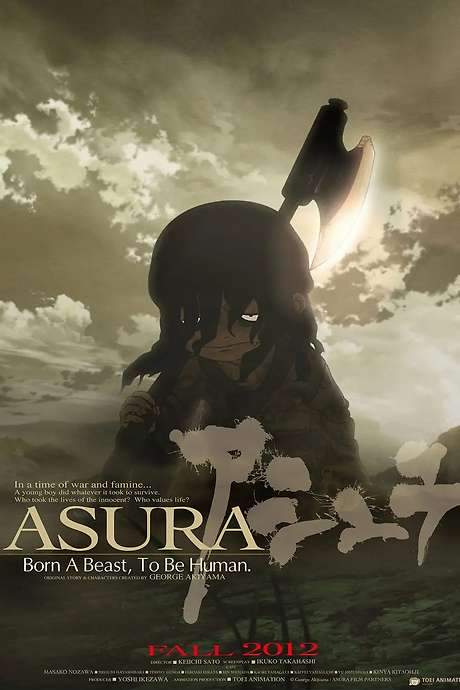
Asura 2012

Directed by

Keiichi Sato
Made by

Toei Animation
Asura Plot Summary
Read the complete plot summary and ending explained for Asura (2012). From turning points to emotional moments, uncover what really happened and why it matters.
In mid-15th-century Japan, floods, droughts, and famine have scoured Kyoto into a barren, unforgiving landscape, setting the stage for a conflict that would reshape the nation. Between 1459 and 1461, more than 80,000 people perish, and the air itself seems heavy with hardship and loss. From this brutal backdrop, a baby is born to a starving, impoverished mother who abandons him, a moment that marks the quiet beginning of a harsh, sprawling odyssey.
Eight years pass, and the boy grows into a feral figure, roaming the countryside with an axe and preying on those he encounters. He strikes first at a Buddhist monk, only to be checked by the monk’s calm defense. The monk offers mercy, providing temporary food and shelter, and names the child Asura Masako Nozawa; he also teaches a Buddhist chant, hoping that one day the boy might grasp its meaning. The monk’s kindness is a fragile beacon in a landscape where hunger often overrides humanity, and after a time, he departs, leaving the boy on the roadside with more questions than answers.
Eight years later, the trouble-wrought world widens as a man named Shichiro [Hiroaki Hirata] leads four boys who haul a massive log toward their village. Asura attacks the group, but is repelled by Shichiro’s strength and restraint. He follows them as they attempt to pass through a village, where a group of local boys blocks the way and demands payment. The village boys hurl rocks, and when Asura is struck, he erupts in anger and kills the leader, a brutal moment that signals how far the boy has fallen from any semblance of childhood.
The dead boy’s father, Jito, gives chase, driving Asura to tumble from a cliff onto a pile of corpses. In the aftermath, Asura is found and taken in by Wakasa, a girl from the village who offers shelter and food in an abandoned hut. She visits regularly, bringing nourishment and teaching him how to speak. A powerful bond forms; Asura becomes deeply attached to her, often slipping into the village to watch her from the shadows.
One rainy night, Asura waits outside as Wakasa meets Shichiro to discuss leaving the village. In a moment born of jealousy and fear, Asura attacks Shichiro with his axe. Wakasa is horrified by the violence and insists he depart, sending the feral boy back into the wilderness. Not long after, the village is struck by a colossal mudslide, a calamity that the monk witnesses with a heavy heart. The disaster creates a new chance for reckoning, as Asura again meets the monk, now speaking in the human tongue he learned from Wakasa and cursing himself for being born.
In a stark, mortifying gesture, the monk chops off his own arm, hoping to rouse Asura toward humanity. The act unsettles the boy, who does not understand the motive and runs away in confusion. The following months grow even darker as food becomes scarcer. Wakasa’s father is pressed to sell her, but he refuses; Shichiro shows what he can by sharing what he has, yet desperation pushes him to steal from others. Wakasa and her father lie dying in their home, and in a cruel turn, Asura kills Jito’s horse and presents the flesh to them as food—though they refuse to accept it, certain it’s human. Jito issues a bounty to capture the boy, and the villagers—torches aloft—give chase across the land.
The pursuit ends on a rope bridge, where Asura fights for his life and then tumbles into the river below as the bridge erupts in flames. Winter sweeps across the land, and the pursuit seems to fade into memory until winter’s chill reveals a harsher truth: Asura, miraculously alive, has endured the fall. A cart bears Wakasa’s body through the snow, its passengers unaware that Asura, scarred and transformed, has survived the ordeal just out of sight.
Time moves forward, and the monk’s words return with a quiet grace, praising the beauty of life as Asura—now grown into a redeemed figure—has become a Buddhist monk himself, carving a wooden statue of Buddha with patient hands. The film closes on a vision of renewal: the land restored to fertility, white doves circling above a city that once again seems to hold hope, a post-credit reminder that even in a world scarred by devastation, new life can emerge from the ashes.
Asura Timeline
Follow the complete movie timeline of Asura (2012) with every major event in chronological order. Great for understanding complex plots and story progression.
Birth amid famine
In a famine-ravaged Kyoto, a mother living in poverty gives birth to a child who is soon abandoned. The harsh conditions of mid-15th-century Japan set the scene for a brutal journey. The story follows a boy who is left to survive in a barren world.
Found by a Buddhist monk
Eight years after his birth, the boy roams the countryside armed with an axe. He is discovered by a Buddhist monk who defeats him and chooses to name him Asura. The monk provides shelter, teaches him a Buddhist chant, hoping he would understand it someday, and then leaves him at the roadside.
First violent encounter with Shichiro's group
Asura later encounters Shichiro and his four companions carrying a log toward a village. He is repelled by Shichiro when he attacks them, and later, in a village, confronts local boys who demand payment. After rocks are thrown and he is struck, Asura kills the leader in a fit of rage.
Pursued by Jito; fall from a cliff
Jito, the father of the boy who was killed, pursues Asura after the confrontation. Asura falls off a cliff onto a pile of corpses, narrowly escaping capture. The fall marks a turning point in his exile from society.
Taken in by Wakasa
Wakasa, a girl from the village, finds Asura and offers him shelter in an abandoned hut. She gives him food and teaches him how to speak, gradually forming a deep attachment. He becomes drawn to her, often following her into the village.
Jealousy and expulsion
One rainy night, Asura sees Wakasa with Shichiro discussing leaving the village. Consumed by jealousy, he attacks Shichiro with his axe. Wakasa, horrified by his actions, orders him to leave and he wanders back into solitude.
Mudslide destroys the village; monk tests him
Shortly after his departure, a massive mudslide devastates the village, killing many. The monk reappears and speaks to Asura in the human tongue learned from Wakasa. The monk cuts off his own arm to provoke Asura to eat it, but Asura misreads the gesture and runs away.
Scarcity and rescue attempt
Famine worsens and Wakasa's father is urged to sell her, but refuses. Shichiro brings what food he can, while Wakasa and her father lie dying at home. Asura kills one of Jito's horses to feed them, though Wakasa refuses, thinking it is human flesh.
Jito's chase and the bridge
Seeing Wakasa's worsening condition, Asura kills Jito's horse to provide meat, provoking a chase with villagers who brandish torches. He escapes their pursuit and is driven onto a rope bridge.
Bridge set ablaze; fall into river
Villagers burn the rope bridge to trap Asura, sending him plunging into the river far below. He survives the fall and disappears into the cold water. The community's fear of him hardens into a myth.
Winter and Wakasa's death carried away
Winter comes with snow and silence; Shichiro and village boys carry Wakasa's body on a cart, unknowingly passing Asura who has survived. The barren landscape gives way to a grim quiet as the season holds.
Redemption as monk; carving Buddha
Some time later, the monk's voice speaks about the beauty of life as Asura, now grown into an adult and a redeemed Buddhist monk. He carves a wooden Buddha statue, marking his transformation and spiritual path. The scene hints at a hopeful future beyond his tormented past.
Post-credits: fertile land and city
In a reflective post-credits scene, the land is shown rich and fertile again as white doves circle a city. The cycle of famine and war has given way to peace and renewal.
Asura Characters
Explore all characters from Asura (2012). Get detailed profiles with their roles, arcs, and key relationships explained.
Asura (Masako Nozawa)
A boy abandoned by poverty who devolves into a cannibalistic hunter, Asura’s early violence is driven by hunger and neglect. Guided by a monk’s teachings and his bond with Wakasa, he gradually learns language and compassion, though his past actions leave a lasting shadow. By the end he evolves into a mature, redeemed monk who carves a Buddha statue, signaling inner transformation.
Wakasa (Megumi Hayashibara)
A compassionate village girl who shelters Asura and teaches him to speak, giving him his first sense of belonging. Her pity and care anchor his remaining humanity amid the chaos. She ultimately becomes a casualty of the era’s brutality as the village collapses under hardship and violence.
Shichirou (Hiroaki Hirata)
A protective figure who leads a group and helps sustain Wakasa, he embodies a pragmatic survivor who tries to care for others in a harsh world. His interactions with Asura reveal the thin line between generosity and desperation in feudal society. His actions influence Asura’s path at key moments of crisis.
Monk (Kinya Kitaoji)
A Buddhist figure who rescues Asura and offers spiritual guidance, the monk introduces the boy to faith and ritual. He embodies a paradoxical mercy—sacrificing his own arm to teach Asura a crucial lesson about humanity—pushing the boy toward introspection and redemption.
Jito
The father of the boy killed by Asura who offers a bounty for his capture, representing the violent backlash against survival-driven violence. He embodies the ruthless aspect of the era’s feudal society and the villagers’ fear of danger.
Asura Settings
Learn where and when Asura (2012) takes place. Explore the film’s settings, era, and how they shape the narrative.
Time period
1459–1461
The events unfold during a famine-stricken mid-15th‑century Kyoto, a period of social collapse and looming civil strife. The era is marked by epidemics, the erosion of law, and widespread hunger that pushes people toward desperate acts. The narrative sits at the dawn of Japan’s greatest civil conflict, using this window to explore survival and transformation.
Location
Kyoto, Japan
In the mid-15th century, Kyoto is transformed into a barren wasteland by floods, drought and famine. The city’s once-thriving streets become deserted as disease and hunger cut through the population; more than 80,000 people perish between 1459 and 1461. This harsh backdrop shapes the film’s sense of danger and scarcity, framing the journeys of Asura and the other survivors. The setting emphasizes a civilization on the brink, where humanity struggles to endure.
Asura Themes
Discover the main themes in Asura (2012). Analyze the deeper meanings, emotional layers, and social commentary behind the film.
🕊️
Redemption
The story tracks Asura’s brutal beginnings and his gradual moral awakening. A Buddhist monk and the human connections he forms with Wakasa steer him toward language, compassion, and a sense of purpose. The final image of the redeemed Asura carving a Buddha statue signals the possibility of renewal after violence.
🌾
Survival
Famine, drought, and the collapse of society drive every decision. Characters must forage, barter, or steal just to stay alive, often blurring lines between mercy and desperation. The landscape itself mirrors this struggle, with scarcity shaping identity and choices.
⚔️
War & Chaos
The backdrop of a country on the edge of civil war saturates the narrative with danger and brutality. Violence becomes a currency of power, and even acts of mercy are tested by hunger and distrust. The cycle of attack and defense accelerates Asura’s drift toward barbarity and then back toward humanity.
🗣️
Language & Identity
Wakasa teaches Asura to speak, and the monk’s chants offer him a path to meaning beyond mere survival. Language becomes a bridge from feral instinct to social being, enabling him to articulate suffering, longing, and repentance. The transformation hinges on the power of words to rehumanize a boy shaped by a brutal landscape.

Coming soon on iOS and Android
The Plot Explained Mobile App
From blockbusters to hidden gems — dive into movie stories anytime, anywhere. Save your favorites, discover plots faster, and never miss a twist again.
Sign up to be the first to know when we launch. Your email stays private — always.
Explore the mobile appAsura Spoiler-Free Summary
Discover the spoiler-free summary of Asura (2012). Get a concise overview without any spoilers.
In a bleak, famine‑ravaged Japan where the fields around Kyoto have turned to dust and desperation hangs in the air, a feral child is left to the mercy of the wild. The landscape is unforgiving—sharp winds, cracked earth, and the constant threat of hunger shape a world that feels as ancient as it is brutal. Within this stark tableau, the story follows a nameless boy whose instincts have been honed by survival alone, moving through the wilderness like a shadow driven by rage and raw need.
When he finally crosses the thin line separating the untamed wild from the fragile settlements of humanity, he encounters the monk, a quiet figure who offers a fleeting taste of compassion and a whispered chant that hints at a different kind of power. Later, a village girl named Wakasa extends a tentative hand, teaching him language and the simple comforts of shelter. These contacts plant the seed of a conflicted identity, forcing the child—later called Asura—to grapple with the animal inside him and the faint call of something more humane.
The film weaves a tone of stark realism mixed with lyrical moments, its visuals echoing the harshness of the era while allowing brief, almost meditative glimpses of hope. The world feels both oppressively cold and strangely beautiful, a place where each breath is a negotiation between survival and the yearning for connection. As Asura stands at the crossroads of primal instinct and the possibility of redemption, the narrative invites viewers to wonder whether the beast within can ever truly be tamed, and what it means to find a place in a world that seems built for none.
Featured on this page

What's After the Movie?
Not sure whether to stay after the credits? Find out!
Check out our other apps:

SAT Sphere
Build confidence for the Digital SAT.

Mori Atlas
Discover wild places worth protecting.

Luntero
Search smarter for a home in Amsterdam.

Plot Explained
Unravel movie endings and hidden clues.

Pokechamp
Dive into Pokémon data and battle logic.

Driving Theory
Get ready for your European theory test.

Movie Dust
Plan your next cinema trip with ease.

Musemap
Find art and culture as you travel.

Selkobase
Compare credentials before committing.

Local Manual
Turn an unfamiliar country into practical next steps.

Lernavi
Compare school systems before your next move.

GymRoam
Find a workout stop wherever your plans take you.
Explore Our Movie Platform
New Movie Releases (2026)
Famous Movie Actors
Top Film Production Studios
Movie Plot Summaries & Endings
Major Movie Awards & Winners
Best Concert Films & Music Documentaries
Movie Collections and Curated Lists
© 2026 What's After the Movie. All rights reserved.
Privacy Policy