
What Is Anselm About?
The premise of Anselm in 235 words, with nothing given away. The full story follows below.
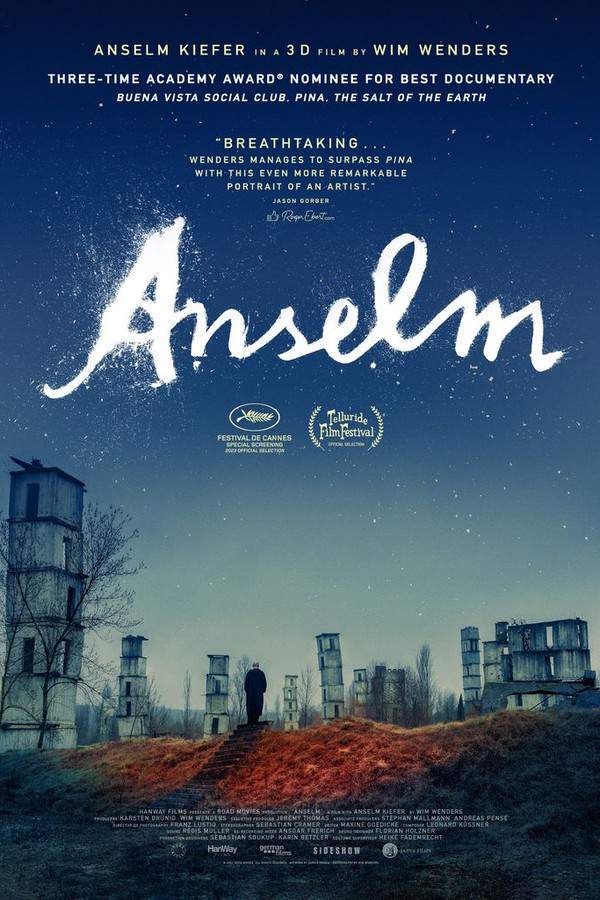
Rendered in striking 3D, Wim Wenders’ Anselm is an intimate, visually immersive portrait of Anselm Kiefer, the celebrated German painter and sculptor whose immense works turn landscape, architecture, and memory into meditations on history and human existence. The film moves through cavernous warehouses, expansive studios, fields, forests, and the artist’s rural property in southern France, revealing a world where monumental paintings and sculptural installations coexist with weathered branches, shattered glass, ruined walls, and traces of fire.
Kiefer’s creative process feels as important as the finished art. The camera observes him riding through his surroundings, taking photographs, studying books, painting, and working with large teams on ambitious installations. Archival images of his childhood and earlier career are interwoven with the present, giving the portrait a dreamlike sense of time folding into itself. His deep engagement with poetry, philosophy, mythology, and the weight of Germany’s past gives the work a restless intellectual and emotional depth.
The tone is contemplative, reverent, and occasionally uncanny. Quiet natural imagery and passages of reflective audio contrast with the scale and severity of Kiefer’s creations, while recurring motifs of childhood, ruins, travel, and artistic labor suggest a lifelong attempt to understand the forces that shape identity. Rather than presenting a conventional biography, the film constructs a sensory map of Kiefer’s inner world—a realm where creation and recollection are inseparable, and where beauty repeatedly emerges alongside decay, violence, and the passage of time.
What Happens in Anselm?
The complete story of Anselm, from the first scene to the last, in 364 words (about 2 minutes). Spoilers throughout. Names in the text link to 3 cast member pages.
Spoilers ahead
The film begins by showcasing various artworks created by Anselm Kiefer, ranging from dresses composed of glass shards and tree branches to towers constructed from the fragments of destroyed rooms. The narrative follows the artist as he navigates a massive warehouse near Paris on a bicycle, blending a musical montage with glimpses of his childhood spent drawing houses. Throughout the piece, the poetry of Paul Celan, a Ukrainian Jew persecuted during the Holocaust, is featured through historical recordings.
As the film progresses, Anselm Kiefer presents a book of paintings that darken progressively to symbolize the brain cancer of philosopher Martin Heidegger. The viewer witnesses the artist’s intense process, such as attaching dead crops and leaves to a massive canvas and torching the edges to create a burnt effect. During winter, he seeks inspiration in forests and fields using an analog camera, with the film juxtaposing his current methods against archival footage from the 1970s and 80s. During that era, his work faced criticism for invoking German legendary heroes who had been glorified by the Nazis.
The artist’s journey continues through the 1990s, where he utilized aerial photography to create oversized books and a massive library. Analysts suggest his work serves as a way to grapple with Germany’s past, which is described as an “open wound.” The film recalls his provocative 1960s travels across Europe, where he photographed himself performing the Nazi salute at monuments in occupied territories to educate the public. His interests are further revealed to include Greek Argonaut mythology and the construction of large-scale German warplane models during the onset of the Gulf War.
Eventually, he and his team relocated to a 200-acre estate in the south of France, where he developed enormous installations of ruined towers and vast warehouses. The film concludes with a surreal juxtaposition of the artist as a boy and as an adult. After the two versions of himself meet in a room to read poetry, the older man carries his younger self to a lake and remarks:
“Childhood is an empty room like the beginning of the world.”
The film ends with the image of an old man standing before an art piece before disappearing from existence.
Anselm Timeline: Every Key Event in Order
15 key events in the order they happen, from “Art Amidst Nature and the Paris Warehouse” to “Childhood Is an Empty Room”. 6 events name a place, across 6 locations.
- 1
Art Amidst Nature and the Paris Warehouse
The film opens with footage of Kiefer's creations placed inside natural environments, including dresses adorned with tree branches, sticks and glass shards. He has also built towers out of wall fragments from destroyed rooms. The artist is then seen riding a bicycle around a large warehouse outside Paris that contains many of his works.
Where:Warehouse outside Paris
- 2
A Childhood of Drawing and Myth
The film depicts the artist's childhood, showing the young Kiefer drawing houses. During these early years he also read stories about the Greek Argonaut mythology, imagery that would echo throughout his later artistic career.
- 3
The Poetry of Paul Celan
Poetry written by Paul Celan, a Ukrainian Jew who was persecuted during the Holocaust, is read out loud. The film also features historic recordings of Celan himself, lending a haunting voice to Kiefer's visual world.
- 4
Painting Heidegger's Decline
Kiefer shows a book containing progressively darker paintings that symbolize the progression of brain cancer in philosopher Martin Heidegger. Each page grows darker than the last, turning illness into a powerful visual metaphor.
- 5
Torching the Massive Canvas
Footage shows Kiefer making a huge painting to which he has attached dead leaves and crops. He torches these materials to create a burnt edge, and his crew extinguishes the flames immediately after. The finished half-burnt products become part of a collection of their own.
- 6
Winter Photography in Field and Forest
In the winter, Kiefer ventures out to a field and a forest carrying an analog camera. The photographs he takes of the stark landscapes serve as direct inspiration for his next paintings.
When:Winter Where:Field and forest
- 7
Painting in the Attic
Kiefer takes more pictures and paints more canvases inside an attic studio. The film juxtaposes his current work with archival footage of what he created in the 1970s and 1980s, drawing a line between past and present.
Where:Attic
- 8
Controversy Over German Heroes
In the 1980s, while representing Germany at international competitions, Kiefer's work drew sharp criticism. His paintings invoked German legendary heroes whom the Nazis had glorified, sparking debate over how history should be depicted in art.
When:1980s
- 9
The Winter Field Mural
After looking through some of his books, Kiefer paints an enormous mural of a winter field with creeks. The sweeping landscape translates the stark photographs from his winter excursions onto a truly monumental scale.
- 10
Aerial Views and the Giant Library
In the 1990s, Kiefer spends time doing aerial photography of various regions of the Earth. He makes enormous books with printouts of the images and builds an oversized library to house them. Analysts claim he wants his work to grapple with Germany's past, described as an 'open wound.'
When:1990s
Show the other 5 events of Anselm Hide the last 5 events
- 11
The Nazi Salute Photographs
In the 1960s, Kiefer traveled around Europe taking pictures of himself performing the Nazi salute in front of various monuments in Nazi-occupied territories. He explains that these provocative images were made in order to educate people about this dark history.
When:1960s Where:Europe
- 12
Warplanes at the Edge of War
In 1990, following exhibitions in America, Kiefer built huge models of historic German warplanes. The work coincided with the outbreak of the Gulf War, giving his historical references a new contemporary urgency.
When:1990
- 13
A New Studio in the South of France
Two years later, Kiefer and his team moved to a new studio on a 200-acre property in the south of France. There he created huge installations of ruined building towers, along with enormous warehouses that housed other installations and works in progress.
When:1992 Where:South of France
- 14
Young and Old Selves Converge
The film juxtaposes Kiefer's younger self playing in enormous mansions and discovering his older self's work with his older self traveling around aimlessly. Eventually both find themselves in the same room, where the younger self reads poetry from the same book that opened the film.
- 15
Childhood Is an Empty Room
The older Kiefer carries his younger self to the edge of a lake and remarks, 'Childhood is an empty room like the beginning of the world.' In the film's final moments, an old man standing in front of an art creation disappears from existence.
Where:Lake edge
Who Are the Main Characters in Anselm?
3 characters, among them Anselm Kiefer, Martin Heidegger and Paul Celan: who each one is and the part they play in the story. Every profile links to the actor’s page.
- AK
Anselm Kiefer
Played by Anselm Kiefer
Anselm Kiefer is a renowned artist known for his thought-provoking and often controversial works. His character embodies a deep connection to history, leveraging his art to confront Germany's past while exploring themes of memory and loss. Throughout the film, Kiefer's creativity and vulnerability are displayed as he navigates personal and collective trauma.
- 🎨 Artist
- 📖 Historian
- 🌍 Philosopher
- MH
Martin Heidegger
Played by Martin Heidegger
Martin Heidegger is portrayed as a philosopher suffering from brain cancer, serving as a symbolic representation of the burdens of history. His ideas and works influence Kiefer’s art, reflecting a complex interplay between philosophy and the artist's exploration of existence. Heidegger’s character illustrates the weight of intellect and the implications of his historical context on contemporary thought.
- 📚 Philosopher
- 🧠 Thinker
- 🏛️ Scholar
- PC
Paul Celan
Played by Paul Celan
Paul Celan, a poet and Holocaust survivor, is interwoven into the narrative through his impactful poetry. His experiences reflect the profound struggles faced by those persecuted during the Holocaust, connecting them to Kiefer's exploration of history and trauma. Celan's work resonates with themes of loss, memory, and the quest for meaning in the aftermath of devastation.
- ✍️ Poet
- 📜 Survivor
- 🌌 Memory
Where and When Is Anselm Set?
Anselm is set in Paris, France and South of France (1960s - 1990s). Here is why the time and place matter to the story.
When
1960s - 1990s
The narrative unfolds across several decades, from the provocative 1960s to the contemplative 1990s. This period was marked by Kiefer's experimentation with art and a grappling with Germany's historical wounds related to its Nazi past, as well as the cultural shifts and critiques present in the art world during those years.
Where
Paris, France, South of France
The film features various locations in France, primarily highlighting a massive warehouse near Paris and a 200-acre estate in the south of France. The Parisian setting serves as a backdrop for Anselm Kiefer's artistic expressions, while the southern estate becomes a place of large-scale installations and creative exploration in nature.
- 🗼 Paris
- 🇫🇷 France
- 🌳 Nature
What Are the Themes of Anselm?
2 ideas the story keeps returning to, among them Artistic Expression and Memory and Healing.
-
01
Artistic Expression
The theme of artistic expression is central to the film, showcasing Anselm Kiefer's unique methods and materials. His work reflects intense personal and collective trauma, exploring Germany’s complex history through various art forms. The film also highlights the importance of memory and legacy in shaping contemporary art.
-
02
Memory and Healing
Memory and healing emerge as crucial themes as the artist confronts the past through his artwork. Kiefer uses his art as a medium to process historical atrocities, aiming for societal reflection and understanding. The film prompts viewers to consider the scars of history and the potential for reconciliation through creative endeavors.
What Kind of Film Is Anselm?
Melancholic in tone, with slow pacing and a complex story, going by the plot summary.
- Tone
- Melancholic
- Pacing
- Slow
- Story
- Complex
- Intensity
- Medium
- Ending
- Ambiguous
A contemplative, visually sumptuous documentary that moves through Kiefer's stark landscapes and monumental works, linking childhood, poetry, and memory to a somber reflection on history and mortality.
- contemplative
- melancholic
- somber
- poetic
- surreal
- meditative
- artistic process
- holocaust memory
- german guilt
- childhood and memory
Content notes: holocaust and genocide, nazi imagery and persecution, war references, brain cancer and mortality, burning and destructive art processes.
Quiz
How well do you remember Anselm? Test yourself on the story.
