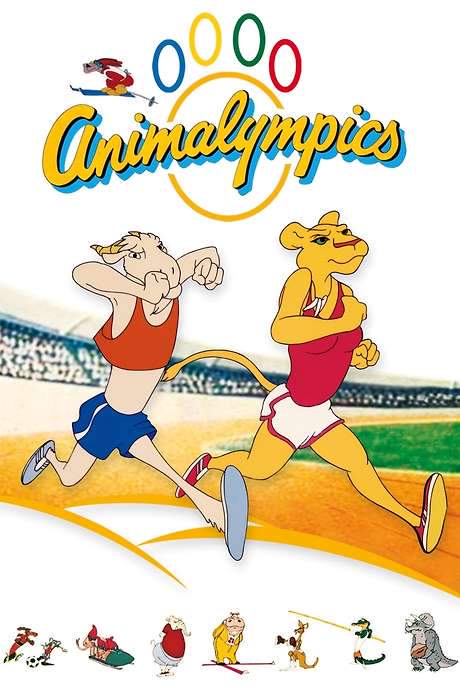
Animalympics 1980


Directed by
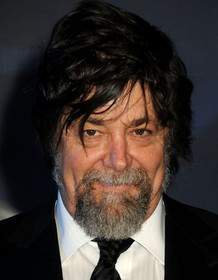
Steven Lisberger
Made by

Lisberger Studios
Where to Watch Animalympics
See current US streaming, rental, and purchase options for Animalympics (1980) via JustWatch.









Animalympics Plot Summary
Read the complete plot summary and ending explained for Animalympics (1980). From turning points to emotional moments, uncover what really happened and why it matters.
The film unfolds as a playful, satirical mosaic presented as the very first animal Olympic Games broadcast by the fictional ZOO television network. Contests blend summer and winter events under a globe-spanning lens where continents take the place of nations—North America, South America, Eurasia (representing the USSR), Europe (Western and Central Europe), Africa, Australia, and Asia. In this whimsical panorama, the occasional non-continent mentions pop up, from a New York City Rats soccer team to a California-born runner and a few standout international figures, all weaving a broader tapestry of competition, camaraderie, and comic mishaps.
The on-air heartbeat of the event is carried by Barbra Warblers, a songbird, voiced by [Gilda Radner], and anchoring alongside her the anchorturtle Henry Hummel, voiced by [Michael Fremer]. Their broadcasts frame the stories with a light, observational tone that glides between sports spectacle and the intimate moments that color each vignette. The 100-meter dash, for example, is presented in the flamboyant, stylized cadence of a drag race by Rugs Turkell, voiced by [Billy Crystal], giving a buoyant, behind-the-scenes flavor to a simple sprint and turning speed into performance.
Across the tapestry, several recurring narratives anchor the film’s emotional arc. The marathon sits at the center, featuring René Fromage and Kit Mambo as the favorites. Both runners are driven by different dreams—Fromage’s lifelong dedication to the race versus Mambo’s desire to carve out a name for herself—yet their paths converge in a moment of mutual admiration that blossoms into love. They hold hands as they cross the finish line together, a quiet testament to partnership over solitary victory. This thread threads through the broader competition, illustrating how perseverance, respect, and affection can transcend rivalry in a setting where victory is merely one of many possible outcomes.
Another pivotal storyline follows Kurt Wüffner, a West German dachshund who vanishes during a mountain-climbing expedition just after the slalom event, hinting at a mystery woven into the Games’ sensational atmosphere. The narrative explores how individual destinies can be touched by the vast, exuberant world of sports even as the scoreboard ticks away.
The film also revels in a series of dramatic clashes and near-misses marked by cunning, deceit, and the occasional spectacular reversal. In soccer, the New York Ratpack—led by Rizzo the “Whiz”—tempt fate with underhanded plays but are ultimately outmatched by the European All-Stars Hounds, guided by the crafty Rolf Shmecker. Ice hockey presents a tense showdown where the Eurasian Longhorns rig the rink with explosives to topple the North American Kodiaks, commanded by coach Bear McLane; yet the Kodiaks rally behind their star player Guy Lafluke to clinch victory. In the swimming arena, the 100-meter freestyle sees the giant Ono Nono attempting to flood the pool with a tidal wave to force a win, only to be outpaced by Dean Wilson, who commandeers his tail like a surfboard to glide to the finish line first. The boxing ring bears the bruising reputation of Janos Brushteckel, a fighter whose raw aggression is ultimately outmaneuvered by Joey Gongolong’s strategic, out-boxing approach that wears down the heavyweight’s intensity. In fencing, Count Maurice Boar-Deaux relies on underhanded tactics, yet is outsmarted by the elegant Contessa, whose grace and adaption turn the tables and restore a sense of rightful competition.
A smaller, touching thread follows Bolt Jenkins, an alligator whose origin story paints a picture of resilience and transformation. Born under unlikely circumstances and living in the sewers, Jenkins learns of a world-record high jump broken by Boris Amphibiensky and experiences a shift toward self-belief. He goes on to set records in the high jump, pole vault, and the 100-meter dash, ultimately sacrificing his hard-won gold medal in the 100-meter dash to an African competitor he regards as his superior—a moving moment that amplifies the Games’ underlying message: greatness often carries a generous spirit.
Throughout, the film offers a self-aware spoof of real-life sports luminaries and commentators, riffing on the larger-than-life personas of the era with affectionate satire. The result is a mosaic that emphasizes character, humor, and the joy of competition as much as it does the spectacle of the Games themselves.
In the end, the work stands as a collage of vignettes that feels both affectionate homage and playful parody. It invites viewers to savor the quirky personalities, the intertwined fates of athletes, and the stubborn, sometimes ridiculous, human (and animal) drive to compete—and to celebrate, above all, the moments when sports become a shared, humane experience.
Animalympics Timeline
Follow the complete movie timeline of Animalympics (1980) with every major event in chronological order. Great for understanding complex plots and story progression.
Broadcast launch of the first animal Olympic Games
The film opens with a broadcast-style introduction to the first animal Olympic Games. It explains the format as a series of standalone vignettes presented by the ZOO television network. The concept of continents competing rather than countries is established early on.
Drag-race style 100m dash
Jackie Fuelit covers the 100-meter dash in a tongue-in-cheek drag-race style. The segment features flashy commentary and exaggerated finishes that set the playful tone for the Games. Viewers are introduced to the satirical spirit of the broadcast.
Continental teams introduced
Continent-based teams are established, with North America, South America, Eurasia, Europe, Africa, Australia, and Asia competing. Eurasia represents the USSR, while Europe stands for Western and Central Europe. The setup frames the Games as a continental competition rather than national leagues.
Soccer chaos and comeback
In soccer, the New York Ratpack led by Rizzo the Whiz uses underhanded maneuvers to win, but the European All-Stars Hounds led by Rolf Shmecker overpower them. The match highlights a clash between cheating and fair play. Ultimately the European team takes the victory.
Ice hockey sabotage and triumph
During ice hockey, the Eurasian Longhorns rig the rink with explosives to take out their rivals, the North American Kodiaks. Bear McLane's coaching and the Kodiaks' resilience keep them in the game despite foul play. Guy Lafluke leads the Kodiaks to a hard-won victory.
Surfer vs. tidal wave in swimming
In the 100-meter freestyle, Ono Nono attempts to drown the field with a tidal wave, but Dean Wilson uses his tail as a makeshift surfboard to ride the wave to the finish. The crowd enjoys an absurd yet thrilling upset that blends fantasy with competition. Wilson's win showcases ingenuity over sheer size.
Boxing clash of brute force and strategy
In boxing, Janos Brushteckel's brutal power is countered by Joey Gongolong's clever out-boxing and patient defense. Gongolong wears down the opponent and lands the decisive blow. The bout emphasizes strategy and timing over raw aggression.
Fencing showdown and avenging Contessa
In fencing, Count Maurice Boar-Deaux uses underhanded tactics to remove rivals, but The Contessa's grace and quick thinking outsmart him. She avenges the wronged fencers and seizes the win with style and finesse.
Marathon romance and shared finish
The marathon storyline centers on René Fromage and Kit Mambo, both determined to win. As the race progresses, they find mutual admiration and decide to finish together. The pair cross the finish line hand in hand, offering a moment of collective triumph.
Disappearance after slalom
Kurt Wüffner, a West German dachshund skier, disappears during a mountain climbing expedition shortly after the slalom event. The mystery of his fate adds a somber thread to the otherwise playful Games. His disappearance hints at adventures beyond the competition.
Bolt Jenkins' sewer-born ascent
Bolt Jenkins, an alligator born as a handbag who lives in the sewers, is inspired by Boris Amphibiensky's high jump world record. He vows to break the record and quickly achieves world records in the high jump, pole vault, and later the 100-meter dash. In a gesture of respect, he sacrifices his gold medal to a superior African competitor.
Comic and cultural spoofing
Throughout the film, the broadcast nods and parodies real-life sports personalities like Howard Cosell and Muhammad Ali. The spoofing underlines the playful, surreal tone of the games and the commentary that accompanies each vignette. It adds a layer of humor to the athletic hijinks.
Animalympics Characters
Explore all characters from Animalympics (1980). Get detailed profiles with their roles, arcs, and key relationships explained.
Barbra Warblers (Gilda Radner)
A songbird who anchors most of the event coverage; she provides melodic, musical commentary that guides viewers through the Games. Her upbeat tone adds whimsy to the broadcast, balancing the zany feats with musical cues. She embodies the playful satire of sports journalism in Animalympics.
Henry Hummel (Michael Fremer)
An anchorturtle who serves as the steady voice of the broadcast. His calm, authoritative presence grounds the coverage amid the colorful antics and fierce rivalries. He delivers information with dry humor and a reliability viewers can trust.
René Fromage
A marathon favorite who has dedicated his life to the race; his focus and discipline symbolize endless training. He is driven to win but becomes moved by mutual admiration as he encounters Kit Mambo, changing the dynamic of the race. His and Kit's shared finish becomes a quiet testament to sportsmanship.
Kit Mambo
A marathon runner who seeks to make a name for herself; she is determined, strategic, and resilient under pressure. She challenges expectations with graceful pacing and clever maneuvering. Her partnership with René Fromage culminates in a finish that emphasizes unity over rivalry.
Bolt Jenkins
An alligator with a legend of overcoming adversity; born as a handbag, he lives in the sewers before learning to break world records. He rises to success in high jump, pole vault, and the 100-meter dash. In a show of sportsmanship, he sacrifices his gold medal to an African competitor.
Animalympics Settings
Learn where and when Animalympics (1980) takes place. Explore the film’s settings, era, and how they shape the narrative.
Location
Continental Arenas (North America, South America, Eurasia, Europe, Africa, Australia, Asia)
Animalympics unfolds across continental venues rather than national stadiums, broadcast by the ZOO network. The games mix summer and winter events, staged in multiple arenas that mirror Olympic competition on a global scale. Teams are organized by continents, creating a playful geopolitical twist rather than traditional country divisions.
Animalympics Themes
Discover the main themes in Animalympics (1980). Analyze the deeper meanings, emotional layers, and social commentary behind the film.
🏁
Sportsmanship
The film spoofs competitive sports to celebrate perseverance and fair play. It highlights both the glory of victory and the pitfalls of cheating, showing how honorable competition ultimately wins out. Through animal athletes, it mocks the politics of modern sports while extolling the virtues of determination and camaraderie. The marathon story of René Fromage and Kit Mambo emphasizes shared triumph over rivalry.
🌍
Global satire
Continents replace nations, creating a humorous lens on international competition. The broadcasts parody real-life sports personalities and the spectacle around them, using cartoons to critique media sensationalism. The races, dives, and skirmishes become a stage for cultural quirks across continents. It’s a playful commentary on how sports capture and caricature global identities.
💪
Perseverance
Bolt Jenkins’ journey from hardship to world-record attempts embodies resilience. He overcomes physical limitations and societal whispers to set new benchmarks in multiple events. The story shows how determination can reshape a fragile beginning into a record-breaking arc. Sacrificing a medal for a rival underscores sportsmanship over personal glory.
❤️
Love & Rivalry
Romantic subplots emerge within the high-stakes world of sport, notably the bond that forms between René Fromage and Kit Mambo. Love softens rivalry, guiding them toward a joint finish that transcends victory alone. The film uses these relationships to humanize competition and remind viewers that athletes are more than their records. Their shared finish illustrates how affection can coexist with ambition.

Coming soon on iOS and Android
The Plot Explained Mobile App
From blockbusters to hidden gems — dive into movie stories anytime, anywhere. Save your favorites, discover plots faster, and never miss a twist again.
Sign up to be the first to know when we launch. Your email stays private — always.
Explore the mobile appAnimalympics Spoiler-Free Summary
Discover the spoiler-free summary of Animalympics (1980). Get a concise overview without any spoilers.
The film opens as a flamboyant broadcast from the fictional ZOO television network, treating the world’s first Animal Olympics as a live‑sporting spectacle. Nations are replaced by continents—North America, South America, Eurasia, Europe, Africa, Australia and Asia—and each sends its most colorful fauna to compete in a dizzying mix of alpine, aquatic and track events. The premise is less about winning medals than about showcasing a global carnival of animal talent, all rendered in a glossy, parody‑infused style that mimics the high‑energy feel of 1970s sports coverage.
At the heart of the coverage are the charismatic commentators Barbra Warblers, a bright‑voiced songbird, and her steady partner Henry Hummel, a thoughtful turtle. Their banter flutters between witty observation and warm storytelling, turning each competition into a miniature documentary of personalities and quirks. Adding to the auditory tapestry is Rugs Turkell, whose rapid‑fire narration injects a drag‑race swagger into even the simplest sprint, ensuring the broadcast never loses its kinetic pulse.
Among the competitors, several figures anchor the film’s emotional texture. René Fromage arrives as a seasoned marathon runner whose devotion to the sport is matched only by his quiet determination, while Kit Mambo brings a fresh, ambitious spark, aiming to make a name for herself on the world stage. The narrative also follows Kurt Wüffner, a West German dachshund whose mountain‑climbing exploits hint at a deeper, slightly mysterious side to the Games, and Bolt Jenkins, an all‑igator who rose from unlikely beginnings to become a multi‑event wonder. Their distinct motivations and personalities weave together, suggesting that the true prize may be camaraderie and self‑discovery rather than a gold medal.
Overall, the movie feels like a lovingly crafted collage of vignettes—each a playful homage to real‑world sport icons, each brimming with satire, heart and the joyous absurdity of watching animals chase glory under the bright lights of a parody‑laden broadcast.
Movies with Similar Twists and Themes
Uncover films that echo the narrative beats, emotional arcs, or dramatic twists of the one you're exploring. These recommendations are handpicked based on story depth, thematic resonance, and spoiler-worthy moments — perfect for fans who crave more of the same intrigue.


Featured on this page

What's After the Movie?
Not sure whether to stay after the credits? Find out!
Check out our other apps:

SAT Sphere
Build confidence for the Digital SAT.

Mori Atlas
Discover wild places worth protecting.

Luntero
Search smarter for a home in Amsterdam.

Plot Explained
Unravel movie endings and hidden clues.

Pokechamp
Dive into Pokémon data and battle logic.

Driving Theory
Get ready for your European theory test.

Movie Dust
Plan your next cinema trip with ease.

Musemap
Find art and culture as you travel.

Selkobase
Compare credentials before committing.

Local Manual
Turn an unfamiliar country into practical next steps.

Lernavi
Compare school systems before your next move.

GymRoam
Find a workout stop wherever your plans take you.
Explore Our Movie Platform
New Movie Releases (2026)
Famous Movie Actors
Top Film Production Studios
Movie Plot Summaries & Endings
Major Movie Awards & Winners
Best Concert Films & Music Documentaries
Movie Collections and Curated Lists
© 2026 What's After the Movie. All rights reserved.
Privacy Policy