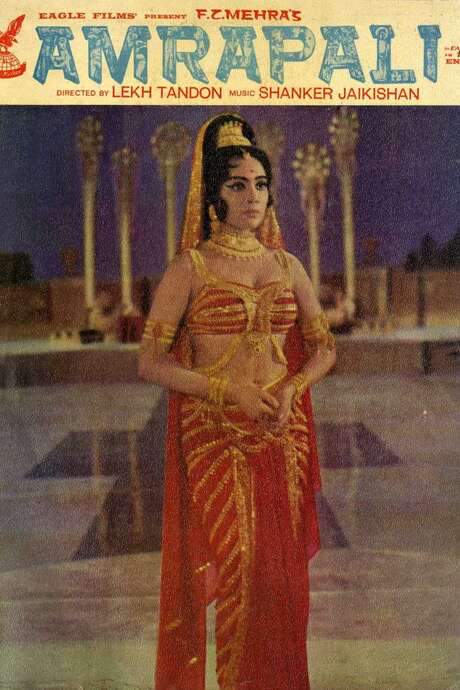
Amrapali 1966


Made by

Eagle Films
Where to Watch Amrapali
See current US streaming, rental, and purchase options for Amrapali (1966) via JustWatch.


Streaming availability powered by 
Amrapali Plot Summary
Read the complete plot summary and ending explained for Amrapali (1966). From turning points to emotional moments, uncover what really happened and why it matters.
Maharaja Ajatashatru, Sunil Dutt, of Magadha, is never satisfied by victory; Vaishali remains the last unconquered city, and his hunger for conquest grows despite forewarnings from astrologers and the cautions of his trusted Senapati, K. N. Singh. Even his mother pleads for mercy and restraint, but Ajatashatru presses on, chasing glory and power with a stubborn will that blinds him to the cost. The path to one more triumph leads him into a brutal confrontation with Vaishali’s defenses, and the result is a crushing defeat that leaves his army weary and his plans in disarray.
Wounded and fugitive, Ajatashatru sheds his disguise and hides among Vaishali’s people as a foot soldier. It is there, amid the ordinary rhythms of daily life, that he encounters Amrapali, Vyjayanthimala, a celebrated dancer who embodies Vaishali’s pride and resilience. She nurses the wounded stranger back to health, unaware that her benefactor is the rival monarch she will come to know only by heart. The two form an unlikely bond, drawn together by mutual respect and a growing, forbidden affection. As their relationship deepens, Ajatashatru’s longing for power clashes with Amrapali’s steadfast sense of duty to her city and its people.
Across the city, an uneasy alliance takes shape. Ajatashatru finds a willing ally in Senapati Badbadhra Singh, K. N. Singh, and together they begin to chip away at Vaishali from within. Their strategy is insidious: reduce the number of soldiers, weaken training, lower pay, and foster a creeping dependency on alcohol—an approach that saps morale and opens the city to Magadhan pressure. Amid the political maneuvering, Amrapali rises in Vaishali’s ranks, triumphing in a dance competition and earning the title of Rajnarthaki, the government dancer who is revered as a symbol of national pride and patriotism. Her coronation marks a high point for Vaishali’s cultural identity and a personal triumph for the young woman who embodies the city’s spirit, even as she guards a painful secret about the man she loves.
The truth about Ajatashatru is eventually revealed, and Amrapali is torn between love and loyalty. She confronts the harsh reality that her beloved is the man who would bring war and ruin upon Vaishali. The revelation shatters their bond and provokes a fierce backlash from the court. Accusations of treachery swirl, and Amrapali is condemned to a moonlit punishment: life in a dungeon and execution on a full moon night. The ruler of Vaishali, embodied by Bipin Gupta, imposes a sentence meant to erase a symbol of resistance; the city braces for a tragedy that would seal the fate of both lovers.
Ajatashatru’s rage and grief propel him to one final, desperate act. He marshals his army, launches a brutal assault on Vaishali, and razes portions of the city, driven by a desire to erase the betrayal and reclaim the honor he believes he has been denied. The siege is devastating, and countless lives are lost as the battle spills into symbol and memory. In a dramatic turn, Ajatashatru wins the right to free Amrapali from the dungeon, but the person who emerges is profoundly changed—no longer the same woman who had once danced with joy at the city’s performing arts, the new Amrapali is haunted by the sight of bloodshed and the weight of defeat.
In the wake of these revelations and bloodshed, Amrapali seeks a way out of the cycle of violence and vengeance. She seeks counsel with Gautama Buddha, Narendra Nath, whose presence represents a path toward peace and moral reckoning. Ajatashatru, moved by the consequences of his choices and the suffering he has caused, follows her lead and surrenders as well. The film closes on a note of introspection, as both former conqueror and former Rajnarthaki confront the future they must face together—one shaped by humility, penance, and the possibility of redemption, even after a career defined by war and love.
Amrapali Timeline
Follow the complete movie timeline of Amrapali (1966) with every major event in chronological order. Great for understanding complex plots and story progression.
Ajatashatru's unyielding conquest drive
Ajatashatru, the ambitious Maharaja of Magadha, is determined to conquer every rival city. His astrologers forewarn that further campaigns could overextend his exhausted army, while his Senapati cautions fatigue in the army. Despite his mother's protests, he ignores the counsel and marches toward war.
Defeat at Vaishali and retreat
Ajatashatru leads Magadhan forces against Vaishali but is decisively defeated by the Vaishali army. Wounded and in retreat, he escapes capture and his defeat marks the start of a brutal campaign. The loss shakes Magadha and fuels his resolve for a second, more cunning plan.
Hidden among Vaishali soldiers
While wounded, he disguises himself as a Vaishali soldier to hide among the ranks. Amrapali nurses him back to health, unaware that her guest is Magadha's rival king. A wary bond grows as she tends to his injuries and he hides his true identity.
Forbidden romance blossoms
Amrapali and Ajatashatru fall in love, their feelings blossoming in secret away from the court. She remains unaware that her lover is Magadha's monarch, and he hides his ambition behind a fragile romance. Their bond is a dangerous secret in a city torn by looming war.
Plot to weaken Vaishali from within
Ajatashatru teams up with Senapati Badbadhra Singh to undermine Vaishali from within. They plan to cut the number of soldiers, fuel alcohol use, and worsen training and pay to demoralize the defenders. The covert plot sets the stage for Magadha's return to conquer Vaishali on easier terms.
Amrapali crowned Rajnarthaki
Amrapali wins a dance competition and is crowned Rajnarthaki, the government dancer of Vaishali, revered as a patriot. Her public stature makes her love story with Ajatashatru even more explosive. The people see her as a symbol of Vaishali's identity.
Love discovery and heartbreak
At the height of her popularity, Amrapali discovers the true identity of her lover. She confronts him, breaks off their relationship, and tells him never to see her again. The revelation triggers a political storm, as the court brands her a traitor.
Execution decree for Amrapali
Vaishali's ruler orders Amrapali's life in prison and threatens execution on a full moon night if she persists. The decree marks her fall from grace and intensifies the rivalry between Magadha and Vaishali. The city braces for a drastic punishment tied to the moon's rise.
The siege and destruction of Vaishali
Enraged by Amrapali's perceived betrayal, Ajatashatru rallies his army and storms Vaishali, burning the city and killing many. The invasion destroys homes and temples, turning hope into ash. He relentlessly presses the assault until the defenders falter.
Liberation and transformation of Amrapali
Ajatashatru frees Amrapali from the dungeon, but the liberated woman is not the same; she is haunted by the bloodshed and is wary of her conqueror. She accompanies him back toward battle, yet the relationship has been irreparably damaged. The reunion is uneasy and strained.
Bloodshed overwhelms the lovers
On the battlefield, Amrapali witnesses the scale of carnage her love has unleashed. Horrified, she confesses she cannot live in this world of bloodshed and ruin. She seeks another path and ultimately surrenders to Gautama Buddha.
A new path: surrender to Buddha
Ajatashatru follows Amrapali's lead and surrenders to Gautama Buddha, choosing a path beyond conquest. The two acknowledge the futility of endless war and seek a different future. Their joint surrender closes the tale with a fragile hope amid a cycle of power.
Amrapali Characters
Explore all characters from Amrapali (1966). Get detailed profiles with their roles, arcs, and key relationships explained.
Ajatashatru (Sunil Dutt)
Magadha's ambitious king who cannot rest after victories, he pursues conquest despite warnings and the harm it causes. He disguises himself as a Vaishali soldier to seek refuge and becomes emotionally entangled with Amrapali, fueling the rivalries between the two cities. His ruthless pursuit of power leads to a brutal siege and ultimately a surrender to Gautama Buddha.
Amrapali (Vyjayanthimala)
Vaishali's celebrated Rajnarthaki and a symbol of patriotism, she rises through the ranks by winning a dance competition. She falls in love with Ajatashatru, but breaks off the relationship to protect Vaishali, facing political pressure and accusations of treachery. Witnessing the bloodshed, she ultimately seeks a moral resolution by surrendering to Buddha.
Gautama Buddha (Narendra Nath)
A moral anchor in the narrative, Buddha accepts the surrender of Ajatashatru and Amrapali, guiding them toward redemption rather than revenge. His presence provides a counterpoint to political violence and introduces themes of restraint and spiritual reckoning.
Senapati Veer of Magadh (Prem Nath Malhotra)
Magadha's general who counsels rest for the tired army and later aligns with Ajatashatru to execute a plan against Vaishali. His strategic mind and willingness to employ calculated ruses illustrate the ruthless pragmatism of war.
Kulpati Mahanam (Gajanan Jagirdar)
A senior Magadhan court official who coordinates military and administrative efforts, helping to implement the empire's broader strategy of conquest.
Balbadra Singh (K.N. Singh)
A trusted Magadhan noble and ally to Ajatashatru, instrumental in plotting the plan to demoralize Vaishali’s defenses and undermine its morale through subterfuge and intrigue.
Vaishali's Empress (Ruby Myers)
A regal figure within Vaishali's court who embodies the city's dignity and supports its leadership amid rising tensions with Magadha.
Vaishali's Samrat (Bipin Gupta)
The ruler of Vaishali who leads the city during crisis, ultimately passing judgment on Amrapali and guiding the state's response to Magadhan aggression.
In the song Neel Gagan Ki (Baburao Pendharkar)
An on-screen performer featured in the musical number 'Neel Gagan Ki', illustrating the cultural and festive aspects of Vaishali’s life amid political turmoil.
Raj Mata (Ajaat Shatru's Mother) (Mridula Rani)
Ajatashatru's mother, a matriarch who advocates caution and seeks to shield the realm from needless bloodshed. Her influence underscores the tension between dynastic ambition and maternal concern.
Amrapali Settings
Learn where and when Amrapali (1966) takes place. Explore the film’s settings, era, and how they shape the narrative.
Time period
Ancient India
Set in the era of the Mahajanapadas, the tale blends imperial ambition with emerging spiritual dynamics. The narrative moves from the Magadhan court to Vaishali’s streets, capturing a period of intense rivalry and fraught diplomacy. The presence of Gautama Buddha anchors a counterpoint to the violence of conquest, signaling a moral pivot within the historical conflict.
Location
Magadha, Vaishali
The story unfolds between the Magadhan capital of Magadha and the fortified city of Vaishali, highlighting two rival power centers. Vaishali is depicted as a proud republic with its own army and political structure, while Magadha pursues expansion through force. The film paints a world of royal courts, strategists, and looming sieges that set the stage for political and military intrigue.
Amrapali Themes
Discover the main themes in Amrapali (1966). Analyze the deeper meanings, emotional layers, and social commentary behind the film.
🗡️
Conquest
Ajatashatru's relentless hunger for victory drives the central conflict, pushing Magadha toward war with Vaishali. The film showcases how ambition, political scheming, and military might reshape destinies. It also explores the human cost of imperial expansion, including betrayal and bloodshed.
❤️
Love
Ajeetashatru and Amrapali's romance tests loyalties and political loyalties within their worlds. Amrapali, a celebrated patriot and dancer, must navigate her personal feelings against the fate of Vaishali. Their relationship becomes a catalyst for dramatic choices and moral reckoning as consequences unfold.
🙏
Redemption
Following the devastation, Ajatashatru and Amrapali surrender to Gautama Buddha, framing a path toward forgiveness rather than vengeance. The narrative uses this spiritual engagement to contrast power with restraint. Buddha’s presence offers a hopeful counterpoint to the violence of conquest and the lure of revenge.

Coming soon on iOS and Android
The Plot Explained Mobile App
From blockbusters to hidden gems — dive into movie stories anytime, anywhere. Save your favorites, discover plots faster, and never miss a twist again.
Sign up to be the first to know when we launch. Your email stays private — always.
Explore the mobile appAmrapali Spoiler-Free Summary
Discover the spoiler-free summary of Amrapali (1966). Get a concise overview without any spoilers.
In the ancient realms of Magadha and Vaishali, the clash of empires is felt in every market stall, temple courtyard, and riverbank. The film opens amid the aftermath of a failed campaign, painting a world where power is measured in the sweep of banners and the whispered counsel of astrologers. The visual palette blends grand palace architecture with the intimate bustle of the city’s streets, creating a tapestry that feels both epic and deeply personal. A steady hum of political tension underlies every scene, hinting at the fragile balance between conquest and the cultural pride of a proud republic.
Ajatashatru, the imperious ruler of Magadha, is driven by an unrelenting desire to expand his dominion. When his forces are humbled, he adopts a soldier’s garb and walks among the very people he once sought to subjugate. This covert immersion forces him to confront the ordinary lives that sustain a kingdom, and it is within this concealed existence that he encounters Amrapali, the celebrated courtesan whose artistry embodies the spirit of Vaishali. Her presence is a radiant counterpoint to his hardened ambition, and their tentative friendship blossoms into a subtle, forbidden affection that threatens to rewrite both their destinies.
The narrative’s tone is a delicate dance between sweeping historical drama and intimate character study. Lush choreography, resonant music, and richly textured costumes evoke the opulent world of ancient Indian courts while the story remains grounded in the emotional currents of love, duty, and the yearning for redemption. As Ajatashatru grapples with the pull of his imperial aspirations and the tenderness he feels for Amrapali, the audience is drawn into a realm where the lines between conqueror and lover blur, leaving a lingering question: can personal devotion ever triumph over the weight of empire?
Featured on this page

What's After the Movie?
Not sure whether to stay after the credits? Find out!
Check out our other apps:

SAT Sphere
Build confidence for the Digital SAT.

Mori Atlas
Discover wild places worth protecting.

Luntero
Search smarter for a home in Amsterdam.

Plot Explained
Unravel movie endings and hidden clues.

Pokechamp
Dive into Pokémon data and battle logic.

Driving Theory
Get ready for your European theory test.

Movie Dust
Plan your next cinema trip with ease.

Musemap
Find art and culture as you travel.

Selkobase
Compare credentials before committing.

Local Manual
Turn an unfamiliar country into practical next steps.

Lernavi
Compare school systems before your next move.

GymRoam
Find a workout stop wherever your plans take you.
Explore Our Movie Platform
New Movie Releases (2026)
Famous Movie Actors
Top Film Production Studios
Movie Plot Summaries & Endings
Major Movie Awards & Winners
Best Concert Films & Music Documentaries
Movie Collections and Curated Lists
© 2026 What's After the Movie. All rights reserved.
Privacy Policy