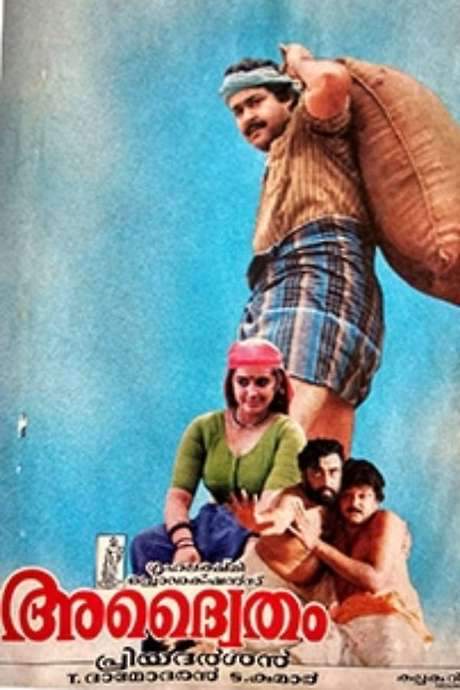



Adwaytham Plot Summary
Read the complete plot summary and ending explained for Adwaytham (1991). From turning points to emotional moments, uncover what really happened and why it matters.
Swami Amritananda Mohanlal arrives in Kerala on a mission to bring peace to a state torn by communal riots, a duty heavy with danger and suspicion. The district’s security is entrusted to Lakshmi IAS Revathi, the District Collector, who warns the revered Swamiji about the volatile outside world. Her presence also stirs old memories for the Swamiji, because she once shared a complicated past with him, a history that quiet whispers of unfinished feelings and unresolved choices.
In a sweeping flashback to the 1960s, Shivaprasad Mohanlal—the only son of Saraswathy Srividya—navigates a harsh home life bent by the meddling of his elder brother Sreedharan Jagannatha Varma and brother-in-law Krishnan Kutty Menon Janardhanan, a police officer loyal to the government. The Communist movement offers him a platform, but his path is tangled with love from Lakshmi, now a political ally she had once loved him back in their younger days, and with Karthy Chithra, a party worker with strong naxalite leanings who becomes involved with him. His closest childhood friend Vasu Jayaram remains a light-hearted beacon amid the turmoil.
Shivaprasad’s rise is shaped by the wily Shekharan M G Soman, the party leader who sees in him a tool to bend the system to his own ends. As Shivaprasad slips into petty crimes and the party’s darker uses of power, Karthy’s ploys to pull Lakshmi away from him lead to a betrayal that changes everything: Lakshmi, believing Shivaprasad’s double life, informs the police and he is arrested, spending years behind bars. The experience hardens him and deepens his hatred for Lakshmi, setting a course that will echo through the decades.
The late 1970s bring a political sea change. The Communist Party gains power and Shivaprasad is released, stepping into a corrupt, high-profile role as the chairman of the Temple Devaswom. Lakshmi, now an IAS officer, serves as the Devaswom Administrator under his shadow. Shivaprasad pushes to loot the temple, and when the temple staff—led by Sreekanta Poduval Narendra Prasad—protest, he unites forces with Pathrose Captain Raju to sow division. Vasu, reluctantly drawn into the temple’s machinations, becomes entangled with Parameshwaran Namboothiri’s daughter, the Thantri’s daughter, while she herself is promised to Chithran Namboothiri Maniyanpilla Raju.
Under Shekharan’s instructions, Shivaprasad orchestrates the theft of a sacred ornament, and the ensuing investigation leads to the Thantri’s arrest. The Thantri’s daughter confronts Vasu, who retracts his statement under pressure, and the resulting shame drives the Thantri to suicide. As Vasu advances within the Devaswom Board, he sides with the common people during board meetings, sparking a clash with Shivaprasad’s ambitions. Shekharan exposes Vasu’s supposed ulterior motives, threatening to ruin him; yet Vasu is allowed to remain after a period of repentance, and the old friendship between Shivaprasad and Vasu strains but survives.
Lakshmi learns that Karthy’s manipulation was a political ploy and, once the truth comes out, Vasu works to repair his bond with Shivaprasad. A tense confrontation with Shekharan follows; Vasu threatens to reveal everything to the police, and Pathrose’s goons—acting under Shekharan’s orders—move to finish him off. Shivaprasad rushes to save his friend, but Pathrose strikes first, killing Vasu before Shivaprasad can intervene. Grief and rage drive Shivaprasad toward vengeance; he confronts Shekharan, but the police arrest him, and Saraswathy [Srividya] dies, believing her son killed Vasu. After his mother’s death, Shivaprasad leaves home and wanders through temples across the country, ultimately becoming a renowned spiritual guide whose influence grows far beyond his former life.
Back in the present, the treacherous plot resurfaces: Shekharan and his allies plan a hit on Swami Amritananda during the Ratha-Yatra, using a bomb to silence him and erase their failures. Lakshmi, informed by Kaiyathan [Kuthiravattam Pappu], daringly races against time to protect the Swami, ultimately sacrificing her life to save him. With Lakshmi’s passing, Swami Amritananda reclaims the power of his past self, returning to Shivaprasad’s avatar to confront the forces that shattered so many lives. In a decisive sweep of justice, he eliminates Shekharan, Pathrose, Krishnan Kutty Menon, and their cohorts, restoring a fragile balance to a community torn by years of manipulation. In the end, Shivaprasad accepts responsibility for his actions, calling for unity and reminding the town that their strength lies in standing together rather than being driven apart.
Adwaytham Timeline
Follow the complete movie timeline of Adwaytham (1991) with every major event in chronological order. Great for understanding complex plots and story progression.
Swami Amritananda arrives in Kerala to restore peace
The present-day Swami Amritananda lands in Kerala amid widespread communal riots. He is revered worldwide, yet he faces persistent death threats from various quarters. Lakshmi IAS is assigned to oversee his security and warns him about the danger waiting outside, while the memories of their past romance linger.
Lakshmi assigned to Swami's security and memories resurface
Lakshmi is tasked with protecting Swami and managing the tense situation outside his vehicle. Her warning underscores the fragile security environment, and the interaction dredges up old memories of their former romance. The arrangement foreshadows the personal toll of duty on both their lives.
Shivan's rebellious youth and entry into the Communist movement (1960s)
In the 1960s, Shivan, Saraswathy's son, grows up amid a hostile family atmosphere and becomes a troublemaker. He drifts into the Communist movement and earns the nickname of a goonda by his adversaries. His early crimes set the stage for a collision between family loyalty, political ambition, and personal betrayal.
Lakshmi's love for Shivan challenges family opposition
Lakshmi, Sreedharan's daughter, falls in love with Shivan despite strong family objections. The romance ties him to a political path that complicates loyalties. Their bond foreshadows a volatile future shaped by love, power, and betrayal.
Karthy fabricates a story; Shivan is arrested
Karthy, a party worker with naxalite leanings, fabricates a story about Lakshmi's supposed relation with Shivan. Believing the tale, Lakshmi informs the police about Shivan's hideout, and he is arrested and sentenced for a couple of years. The arrest reshapes his character, fueling hatred toward Lakshmi.
Shivan's release and rise to power in the temple (late 1970s)
In the late 1970s, the political climate shifts and Shivan is released from prison. He is appointed as the chairman of the Temple Devaswom, while Lakshmi becomes an IAS officer and Devaswom Administrator under his watch. He begins a ruthless drive to loot the temple, facing resistance from staff.
Temple staff resist; Vasu's entry and romance angle
The temple staff protest Shivan's loot, and Vasu is brought in under his aegis to sow division. Vasu, a close friend, falls for the daughter of Thantri Parameshwaran Namboothiri, complicating temple politics with caste and love. Tension rises as loyalty and ambition collide.
The sacred ornament theft and the Thantri's arrest
Under Shekharan's instruction, Shivan orchestrates the theft of the sacred ornament; during the investigation the Thantri is arrested. Shivan's motive is to reclaim Krishnan Kutty's house, revealing how personal vendetta drives political games. The Thantri's daughter challenges the truth, and the Thantri kills himself in embarrassment.
Vasu rises on the Devaswom Board; internal betrayal unfolds
Vasu earns a position on the Devaswom Board and initially sides with the common people in meetings. Shekharan exposes Vasu's hidden motives to the others, leading to his ouster, though he is allowed to stay after repenting. The rift between Shivan and Vasu deepens as power struggles unfold.
Truth about Karthy and Lakshmi's revelation to Shivan
Lakshmi uncovers that Karthy manufactured the affair to damage her and Shivan for party ends. Vasu confronts Shekharan, threatening to reveal the truth to the cops. Pathrose, an associate of Shekharan, sends goons to finish Vasu, forcing Shivan to rush to his aid.
Vasu's death and Shivan's attempted vengeance
Pathrose kills Vasu before Shivan can reach him, a revelation that shatters Shivan and drives him toward vengeance. After Vasu's death, Shivan attempts to kill Shekharan, but the police intervene and Shivan is arrested. Saraswathy dies in the grief, believing her son killed Vasu.
Shivan retreats to a spiritual life
Grieved and disillusioned, Shivan leaves home to wander among temples across the country, adopting a spiritual path and eventually becoming a renowned spiritual cult leader. This transformation marks a rebirth of his influence beyond politics and crime.
Present-day climax: Lakshmi's sacrifice and Shivan's revenge
In the present, Shekharan and his accomplices plan to kill Swami Amritananda during the Ratha-Yatra with a bomb. Lakshmi sacrifices her life to save Swami, catalyzing his return to Shivan's avatar. Swami then exacts revenge by killing Shekharan, Pathrose, Krishnan Kutty Menon, and other conspirators, and urges the town to stay united.
Adwaytham Characters
Explore all characters from Adwaytham (1991). Get detailed profiles with their roles, arcs, and key relationships explained.
Shivaprasad / Shivan — Mohanlal
Shivan begins as a rebellious son who drifts into the Communist movement and rises to power through illicit acts. His arc traces a fall from crime to influence, and later a transformation into the spiritual Swami Amritananda. He remains driven by loyalty, conflict, and a complicated love life that pits personal history against public duty.
Lakshmi Menon — Revathi
A steadfast District Collector tasked with Swami Amritananda's security. Her past romance with Shivan complicates her professional judgment, and she navigates a web of political manipulation and personal sacrifice. Her ultimate act of sacrifice protects the Swami and reshapes the political landscape.
Shekharan — M. G. Soman
A political fixer who sees Shivan’s potential as a tool for personal gain. He orchestrates schemes to advance his own power, using religious and political factions to manipulate outcomes. His machinations contribute to both Shivan’s rise and his eventual downfall.
Vasu — Jayaram
Shivan’s loyal friend who is torn by caste constraints and loyalty. He often mediates conflicts and supports Shivan, yet he is pulled by his own relationships and the social order. His death marks a turning point in Shivan’s transformation.
Saraswathy — Srividya
Shivan’s mother who endures hardship and serves as the moral center of the family. Her sufferings and hopes influence Shivan’s spiritual turn, making her the emotional heart of the tragedy.
Pathrose — Captain Raju
An ally of Shekharan and a violent instrument of control who participates in the plot to kill Swami during the Ratha-Yatra. His presence embodies the brutality of political machination.
Karthy — Chithra
A party worker with strong naxalite leanings who manipulates Lakshmi and drives key revelations. Her actions show how political agendas can weaponize personal relationships.
Sreekanta Poduval — Narendra Prasad
The Devaswom administrator laboring in a tense battle over temple governance. His role reflects the friction between religious authority and the state’s ambitions.
Adwaytham Settings
Learn where and when Adwaytham (1991) takes place. Explore the film’s settings, era, and how they shape the narrative.
Time period
1960s–present
The narrative moves from the 1960s, when Shivaprasad turns to political activism, to the late 1970s, when a new communist government reshapes power structures. It then returns to the present, where Swami Amritananda's life is under security scrutiny and the plot culminates in a dramatic confrontation. The timeline blends personal journeys with shifting political landscapes across decades.
Location
Kerala, India
Set in Kerala, the film unfolds amid communal riots and political rivalries. It highlights the clash between religious leadership and state power, with temple precincts and Devaswom boards serving as battlegrounds for influence. The setting juxtaposes urban centers and temple spaces to mirror the tension between tradition and reform.
Adwaytham Themes
Discover the main themes in Adwaytham (1991). Analyze the deeper meanings, emotional layers, and social commentary behind the film.
🔥
Power and Corruption
The film traces how political power is leveraged for personal gain, from petty crime to control of temple affairs. Shivan's ascent is marked by manipulation and intimidation, while rivals try to bend him to their will. The convergence of religion and politics exposes how authority can corrupt communities and destinies.
💔
Love and Betrayal
Lakshmi's past romance with Shivan becomes a political weapon for party factions. Misleading narratives drive Lakshmi to denounce Shivan, triggering his fall and catalyzing a cascade of mistrust. Personal loyalties collide with public duties, widening the rift between characters.
🕊️
Redemption and Transformation
Shivan's transition from a rebellious youth to a spiritual figure anchors the film's moral arc. The story contrasts his earlier violence with later renown as Swami Amritananda, suggesting redemption through spiritual path rather than mere punishment. Yet, the path to peace remains marred by loss and violence.
⚖️
Justice and Duty
Lakshmi embodies duty as she navigates political scheming and the Devaswom governance. The temple's management and the staff's protests highlight the struggle for rightful authority. The resolution emphasizes courage, accountability, and the costs of seeking justice.

Coming soon on iOS and Android
The Plot Explained Mobile App
From blockbusters to hidden gems — dive into movie stories anytime, anywhere. Save your favorites, discover plots faster, and never miss a twist again.
Sign up to be the first to know when we launch. Your email stays private — always.
Explore the mobile appAdwaytham Spoiler-Free Summary
Discover the spoiler-free summary of Adwaytham (1991). Get a concise overview without any spoilers.
In a Kerala bruised by communal unrest, a revered spiritual leader arrives with a quiet determination to soothe the fractures that have split the land. The presence of a charismatic mystic, who bears the name Swami Amritananda, sets a contemplative tone against the backdrop of tense streets and whispered fears. Charged with maintaining order, the district’s administrator—Lakshmi, an IAS officer—acts as both guardian of the civil machinery and a reluctant guide to a world she has long kept at arm’s length, hinting at a shared history that lingers beneath their formal exchanges.
The narrative repeatedly dips into the 1960s, when a young idealist named Shivaprasad emerges from a modest household marked by familial pressure and the stirrings of a vibrant political movement. His journey intersects with youthful love, steadfast friendships, and the alluring promises of a cause that promises both purpose and turmoil. The film paints the era with a palette of idealism and uncertainty, where personal ambitions are entangled with the broader currents of social change, and where the bonds formed in those years echo across decades.
As the present-day quest for harmony unfolds, the story weaves the two timelines together, using memory and longing to explore how past choices shape present responsibilities. The interplay between Vasu, a constant friend, and the more calculating Shekharan, a political figure whose influence looms, adds layers of subtle tension. The atmosphere remains richly atmospheric—combining the lyrical cadence of temple rituals with the gritty reality of bureaucratic negotiation—creating a landscape where spiritual introspection and civic duty constantly intersect.
Through its measured pacing and evocative cinematography, the film invites viewers to contemplate the fragile balance between faith, power, and personal redemption. It offers a portrait of a community striving to heal, while its central characters navigate the weight of history, the pull of old emotions, and the ever‑present demand for unity amid discord.
Movies with Similar Twists and Themes
Uncover films that echo the narrative beats, emotional arcs, or dramatic twists of the one you're exploring. These recommendations are handpicked based on story depth, thematic resonance, and spoiler-worthy moments — perfect for fans who crave more of the same intrigue.





Featured on this page

What's After the Movie?
Not sure whether to stay after the credits? Find out!
Check out our other apps:

SAT Sphere
Build confidence for the Digital SAT.

Mori Atlas
Discover wild places worth protecting.

Luntero
Search smarter for a home in Amsterdam.

Plot Explained
Unravel movie endings and hidden clues.

Pokechamp
Dive into Pokémon data and battle logic.

Driving Theory
Get ready for your European theory test.

Movie Dust
Plan your next cinema trip with ease.

Musemap
Find art and culture as you travel.

Selkobase
Compare credentials before committing.

Local Manual
Turn an unfamiliar country into practical next steps.

Lernavi
Compare school systems before your next move.

GymRoam
Find a workout stop wherever your plans take you.
Explore Our Movie Platform
New Movie Releases (2026)
Famous Movie Actors
Top Film Production Studios
Movie Plot Summaries & Endings
Major Movie Awards & Winners
Best Concert Films & Music Documentaries
Movie Collections and Curated Lists
© 2026 What's After the Movie. All rights reserved.
Privacy Policy