
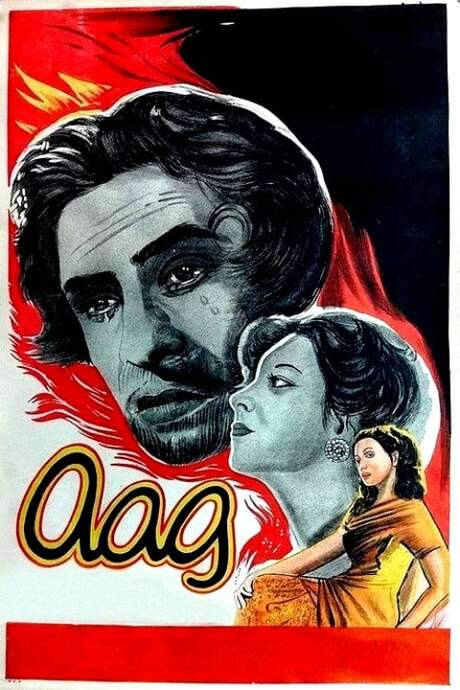
What Is Aag About?
The premise of Aag in 309 words, with nothing given away. The full story follows below.
In the hushed stillness of a wedding night, the groom’s visage—marked by ash and scar—startles his newly‑wed bride, Sudha. Rather than allowing the shock to silence the ceremony, he turns the moment into an invitation, beginning a reflective narration that will carry the audience back through the chapters of his life. The film opens on this intimate confession, promising a story that intertwines love, art, and the weight of expectation.
The world he describes is a bustling mid‑century Indian city where the clatter of courtrooms and the glow of footlights exist side by side. Born into a family of lawyers, Kewal feels a magnetic pull toward the theatre, a realm where imagination can outshine convention. He carries the quiet ache of a childhood dream rehearsed on makeshift stages, a yearning that persists even as familial duty nudges him toward a more respectable profession. The tone balances reverence for tradition with a restless, almost lyrical yearning for creative freedom.
Central to his recollection are the women who have shaped his artistic soul. As a boy, he shared a secret stage with Nimmi, a childhood companion whose presence lit his first performances. Years later, another Nimmi—a fellow student passionate about drama—reappears, challenging him to reconcile personal desire with the practicalities imposed by society. Alongside them, Rajan, a benefactor of the arts, provides the material support that gives Kewal’s visions a chance to breathe. Their intertwined relationships form a delicate choreography of affection, ambition, and loyalty.
The film’s atmosphere is one of wistful nostalgia, underscored by the subtle tension between duty and desire. It invites the viewer to linger on the texture of rehearsed dialogue, the scent of incense in an old theatre, and the quiet moments when a story teller looks into the eyes of his listener, offering a glimpse of a life lived at the edge of fire and applause.
What Happens in Aag?
The complete story of Aag, from the first scene to the last, in 1,000 words (about 4 minutes). Spoilers throughout. Names in the text link to 4 cast member pages.
Spoilers ahead
The film opens on a wedding night, when Sudha recoils in horror at the sight of the groom’s burnt, disfigured face. The moment is enough to pause a ceremony, but the groom shifts the moment into storytelling. He begins a long flashback, inviting Sudha (and the audience) to witness the life that shaped his scarred appearance. The tale centers on a boy named Kewal, whose heart beats for theatre even though he comes from a lineage of lawyers. In the very first pages of his story, the young Kewal Shashi Kapoor is deeply drawn to the stage; he dreams of creating a theatre company, writing plays, and starring in them, with his childhood muse Nirmala, nicknamed Nimmi Nargis as the female lead.
As a child, Kewal’s ambitions collide with the expectations of his family. He longs to stage a neighborhood play with Nimmi by his side, but fate intervenes: Nimmi’s family moves away on the day of their premiere, and the pair are separated just as their shared dream starts to take shape. The hurt from that early loss clings to him, but the next phase of his life solidifies the pull of the stage over the law books his family wants him to study. After finishing school, the now-grown Kewal Radically shifts gears under the pressure of tradition. He reluctantly accepts his father’s demand to pursue a legal career, joining the family trade and wearing the mantle of a lawyer, just as his forefathers did. The weight of expectation is heavy, and it pushes Kewal toward a crossroads where his creative fire refuses to be extinguished.
This tension pushes Kewal to return to his first love: theatre. In college, he encounters a new Nirmala, a girl who asks him to call her Nimmi, and she becomes a fresh entry point for his dreams. The second Nirmala Kamini Kaushal shares his passion for the stage, and she also embodies a practical challenge—the reality of life outside the theater’s glow. She, too, has her own path, and she questions whether Kewal can truly commit to a life carved out by art rather than money and status. The pair initially collide, with Kewal’s attention pulled between love, art, and the stubborn insistence of a society that prizes orderly careers.
Meanwhile, Kewal’s life outside the classroom begins to take shape in the form of a friendship with Rajan, a patron of the arts and the owner of a defunct theatre company. Rajan Premnath Malhotra becomes the partner Kewal needs: a man with the funding and belief to translate Kewal’s ideas into productions. The two men form a working, sometimes tense, partnership—Kewal writing and directing plays while Rajan finances them. It is during this turnaround that a new, stark possibility enters the frame: an unnamed woman displaced by Partition, whom Kewal discovers on the margins of life, become the lead in his new production. This woman is played by Nargis, a performer who brings a raw, lived-in depth to the role of the lead, and Kewal casts her in a pivotal position for his theatre’s rebirth.
As the production begins to take shape, Rajan becomes captivated by the lead in a way that goes beyond professional respect. He is drawn to the young woman’s presence, even as Kewal remains oblivious to her deeper feelings for him. The opening night of the production becomes a fulcrum moment: Rajan, overwhelmed by jealousy and artistic insecurity, rips down all the painted pictures of Nimmi that adorn the stage and the walls. In that same moment, Kewal discovers the emotional undercurrents between Rajan and Nimmi and tries to persuade the woman to accept Rajan as a partner, even if his heart belongs to someone else. But Nimmi—who loves Kewal—refuses to be defined by Rajan’s infatuation and insists she is in love with the man who created the dream she now inhabits.
The play itself erupts into crisis as Kewal lifts a lit torch—the so-called “Aag” that stands for fire and sacrifice—and sets his own face aflame in a symbolic act of self-sacrifice to salvage his friendship with Rajan. The theatre catches fire, the company is ruined, and Kewal is left disfigured. In the hospital, Nimmi visits the wounded man, a scene in which she offers flowers and, in a quiet moment, notices a ring on her own finger—an engagement ring from Rajan. Kewal, with his face bandaged, wishes her well and allows the moment to pass, while the audience is pulled back to the present moment of the wedding night. Sudha, the bride, has become predictive of the woman Kewal has always wanted: the girl who understands him not by the beauty of his features but by the essence of who he is.
As the flashback concludes, Sudha—who turns out to be the original Nimmi from Kewal’s childhood—reveals herself to be the person who could truly accept him as he is. In a quiet, decisive turn, Sudha/Nimmi accepts Kewal for the man he has become and agrees to join him in pursuing their shared dream: a theatre company that can tell stories with honesty, artistry, and no small amount of stubborn courage. The two vow to rebuild what the fire destroyed, to continue their collaboration, and to honor the life-long love that shaped them. The film ends on that vow, a testament to resilience and the transformative power of art.
In this sweeping, emotional journey, the film threads personal longing, family pressure, artistic ambition, and the blurred lines between love and friendship. It presents a world where ambition and affection collide, where a man’s deepest passion is both his greatest gift and his most severe test, and where the people who love him—Nimmis, Nirmalas, Rajans, and fathers—each shape the man he will become. The result is a richly textured drama that lingers on the edge of memory, asking what it means to be seen for who you truly are and to be brave enough to chase a dream even when it costs you everything you thought you wanted.
Aag Timeline: Every Key Event in Order
12 key events in the order they happen, from “Opening confession on wedding night” to “The new theatre venture begins”. 12 events name a place, across 11 locations.
- 1
Opening confession on wedding night
The film opens with a groom approaching his bride Sudha on their wedding night, and she screams upon seeing his burned, disfigured face. He explains that he will tell his life story, and the rest of the film unfolds as a flashback. He begins recounting his youth and his obsession with theatre.
When:Present Where:Wedding night
- 2
Childhood theatre dreams with the first Nimmi
As a young boy named Kewal, he is obsessed with theatre and dreams of opening a company. He falls for Nirmala, nicknamed Nimmi, a school classmate, and they plan to stage a neighbourhood play with her as the female lead. On the day of the premiere, Nimmi deserts him as her family moves away.
When:Childhood Where:School/Neighborhood
- 3
College life and a second Nimmi
After finishing school, Kewal reluctantly follows his father's demand to study law. In college, a different Nirmala asks him to call her Nimmi. They plan another play, but her parents arrange a marriage to a man in England, and she deserts him on the day of the premiere. Kewal also fails his law exam.
When:Youth/College Where:College
- 4
Leaving home to chase theatre
Frustrated with his father's insistence on law, Kewal argues and leaves the family home, despite his mother's protests. He resolves to pursue his childhood dream of theatre instead. He struggles at first but soon finds a patron who will back him.
When:Post-college Where:Home
- 5
Meeting Rajan and forming a theatre partnership
Kewal meets Rajan, a patron of the arts who owns a shuttered theatre company. They strike a creative partnership, with Kewal writing and producing plays while Rajan finances them. The collaboration marks the start of Kewal's new career away from the law.
When:Early career Where:Rajan's theatre
- 6
Discovery of a homeless lead for the play
During preparation for a new production, Kewal encounters a homeless woman displaced by Partition and casts her as the lead role. This unnamed actress becomes central to the project and eventually is associated with the name Nimmi later in the story. The production begins to take shape under their combined effort.
When:During preparation Where:Theatre, rehearsal
- 7
The love triangle forms
Rajan becomes besotted with the actress (Nimmi), while she is secretly in love with Kewal. Kewal remains unaware of her feelings as he focuses on the production. The triangle intensifies the tension behind the scenes.
When:Before opening night Where:Theatre/Backstage
- 8
Opening night and the fateful sacrifice
The opening night arrives with the production in full swing. On stage, Kewal uses a lit torch and burns his own face, apparently as a sacrifice to save his friendship with Rajan. The theatre catches fire and the company is burnt to the ground, leaving Kewal disfigured.
When:Opening night Where:Theatre stage
- 9
Aftermath and the revelation of love
Kewal confronts Nimmi and learns that she only loved him for his inner self, not his appearance. Nimmi visits him in hospital with a bandaged face and shows an engagement ring from Rajan, signaling her choice. She slips away, leaving Kewal to grapple with his new reality.
When:Post-fire Where:Hospital
- 10
Present day framing and the original Nimmi revealed
Back in the present, Sudha reveals that she is the original Nimmi from Kewal's childhood. She confesses her understanding and acceptance of him as he is, replacing the hurt with forgiveness. The storytelling ends with a hopeful sense that their theatre dream can still be realized.
When:Present Where:Wedding night / Present
- 11
Commitment to reopen the theatre company
Kewal and Sudha renew their vow to open a theatre company together, blending their shared past with the promise of a future on stage. Their bond solidifies as they commit to pursuing art despite the scars. The film closes on a note of resilience and creative ambition.
When:Present Where:Present
- 12
The new theatre venture begins
With the two finally united in purpose, they set plans in motion to reestablish the theatre company they've always wanted. The emphasis remains on art, memory, and the power of acceptance. This final arc echoes the themes of sacrifice and renewal that drive the film.
When:Present Where:Present
Who Are the Main Characters in Aag?
7 characters, among them Kewal Khanna (Raj Kapoor), Young Kewal Khanna (Shashi Kapoor) and Miss Nirmala: who each one is and the part they play in the story. Every profile links to the actor’s page.
- KK
Kewal Khanna (Raj Kapoor)
Played by Raj Kapoor
A gifted but stubborn dreamer from a family of lawyers who chooses theatre over law. He clashes with his father’s expectations yet remains devoted to his artistic vision. His arc centers on balancing personal passion with loyalty to friends, culminating in a transformative sacrifice for art and love.
- 🎭 Dreamer
- 🧭 Rebellious
- 🎬 Theatre advocate
- YK
Young Kewal Khanna (Shashi Kapoor)
Played by Shashi Kapoor
A tenacious child with a love for theatre and big dreams. His early heartbreaks with Nimmi foreshadow the conflicts of later adulthood. These memories propel his resolve to pursue a lifetime in the arts.
- 🎬 Young dreamer
- 🧭 Idealist
- 🎭 Theatre lover
- MN
Miss Nirmala
Played by Kamini Kaushal
A character encountered in Kewal’s early life, sharing the name with the later Nirmima and influencing his romantic perceptions. Her presence contributes to the thematic exploration of identity and affection.
- 🎭 Romantic foil
- 🧭 Identity
- N
Nimmi
Played by Nargis
A girl Kewal meets in school who becomes a recurring figure in his imagination, and later a lead in his theatre work. Her feelings for Kewal drive emotional tension and influence his decisions about love and art.
- ❤️ Love interest
- 🎭 Artistic muse
- R
Rajan
Played by Premnath Malhotra
A patron and founder of a theatre company who finances Kewal’s productions. He admires Nimmi and becomes a rival in both affection and artistic influence, pushing Kewal toward greater ambition and risk.
- 🎭 Patron
- 🧭 Ambitious
- 🧩 Rival
- KK
Kewal Khanna's Father
Played by Kamal Kapoor
A traditional lawyer who embodies family expectations and social pressure. His insistence on upholding the family business fuels Kewal’s rebellion and eventual pursuit of theatre.
- 👨👧 Classic patriarch
- 🧭 Duty-bound
- N(
Nirmala (Nigar Sultana)
Played by Nigar Sultana
A second character named Nirmala who appears within the theatre world and intersects with the central drama. Her role adds to the layered relationships surrounding Kewal’s dream.
- 🎭 Supporting ally
- 🧭 Intersecting fate
Where and When Is Aag Set?
Aag is set in India, urban theatre district, Kewal's home and college campus (1940s). Here is why the time and place matter to the story.
When
1940s
Set in the 1940s, the story spans a period of social change and colonial legacy leading up to and around Partition. It follows a young man who rejects a traditional legal path to chase the dream of running a theatre company. The era's shifting norms and upheavals shape relationships, opportunities, and the fate of artistic ambitions.
Where
India, urban theatre district, Kewal's home, college campus
The film unfolds across a pre-Partition Indian urban setting, anchored by a family home and a growing theatre scene. Much of the action moves between Kewal's neighbourhood, college venues, and backstage spaces where plays are crafted. Key sequences also occur in hospitals and improvised theatre spaces, reflecting the rise of art amid personal and social upheaval.
- 🎬 Indian cinema
- 🎭 Theatre district
- 🏡 Home
- 🎓 College town
What Are the Themes of Aag?
4 ideas the story keeps returning to, among them Dream vs Duty, Love and Sacrifice and Inner Beauty.
-
01
Dream vs Duty
Kewal abandons the family expectation of becoming a lawyer to pursue theatre, risking financial insecurity and familial discord. The clashes between obligation and personal passion drive the narrative forward. The fiery act of burning the stage also literalizes the cost of following one’s art.
-
02
Love and Sacrifice
Love complicates loyalties: Nimmi’s affection for Kewal contrasts with Rajan’s mentorship and ambitions. The characters navigate desire, duty, and the pain of unrequited or misdirected affection. Sacrifice becomes a recurring theme as relationships influence career and identity.
-
03
Inner Beauty
Nimmi rejects Kewal when she believes outer beauty initially drew her to him, highlighting the idea that true connection rests on inner qualities. The narrative emphasizes acceptance of one’s authentic self over appearances. This theme culminates in a renewed bond grounded in understanding rather than surface charm.
-
04
Theatre as Home
Theatre functions as both dream and refuge for Kewal, Rajan, and the cast, providing meaning beyond conventional careers. The stage becomes a space of collaboration, conflict, and identity formation. The characters’ fortunes rise and fall with productions, underscoring art’s power to define life.
What Kind of Film Is Aag?
Bittersweet in tone, with steady pacing and a moderate story, going by the plot summary.
- Tone
- Bittersweet
- Pacing
- Steady
- Story
- Moderate
- Intensity
- Medium
- Ending
- Bittersweet
A steady-paced, melancholic drama about an artist's lifelong struggle between passion and duty, marked by poignant loss, romantic yearning, and a bittersweet sense of resilience.
- melancholic
- nostalgic
- romantic
- tragic
- hopeful
- reflective
- artistic ambition
- unrequited love
- family pressure
- self-sacrifice
Content notes: self-immolation, disfigurement.
Quiz
How well do you remember Aag? Test yourself on the story.
