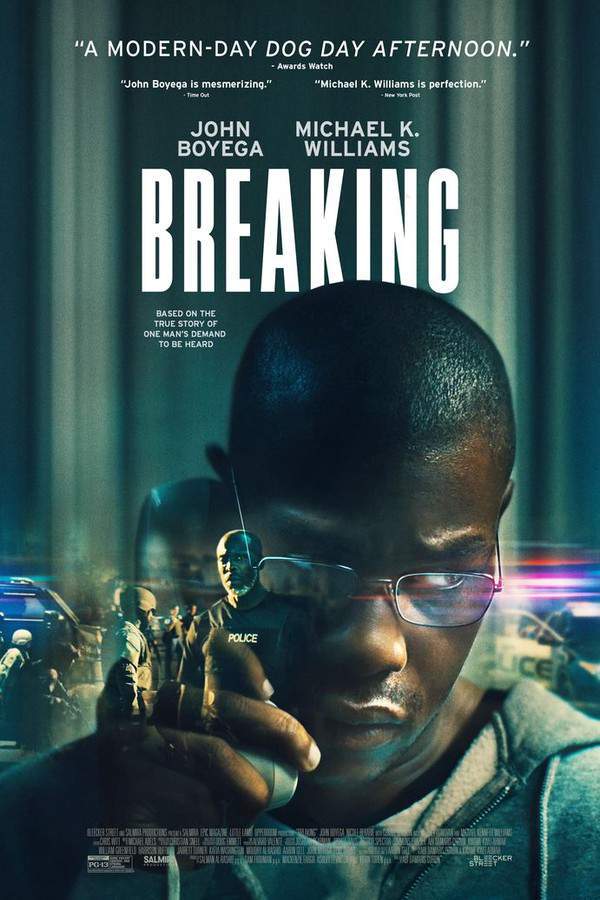
What Is Breaking About?
The premise of Breaking in 311 words, with nothing given away. The full story and the ending follow below.
In a quiet suburb of Marietta, Georgia, a former Marine finds himself caught in the grinding gears of a system that promised care but delivers uncertainty. Brian Brown‑Easley carries the invisible scars of combat and the very tangible weight of a missing VA disability check, a bureaucratic error that threatens his home and his health. The film opens on the fragile balance between personal survival and the sprawling, often impersonal institutions meant to protect veterans, setting a tone that is both starkly realistic and quietly urgent.
When Brian steps into a local Wells Fargo branch, the ordinary rhythm of banking is abruptly interrupted by a desperate demand for acknowledgment. He calmly informs the employees—branch manager Estel Valerie and teller Rosa Diaz—that he has taken a bold step to force the system’s attention, asking only that the doors be locked while his voice is heard. The tension builds not from violence but from the raw need to be seen, turning the bank into a pressure cooker where ordinary lives intersect with a singular, urgent plea for justice.
Outside, law enforcement and a media presence arrive, and the scene shifts into a gritty, dialogue‑driven negotiation led by crisis negotiator Eli Bernard, a fellow veteran whose empathy becomes the bridge between institutional authority and personal anguish. The film lingers on the careful, human-to-human exchanges, allowing the audience to feel the weight of each word and the fragile hope that understanding might prevail. The atmosphere is tense yet restrained, a study in how quiet desperation can ripple through a community.
Through this tightly focused lens, the narrative explores the broader questions of how society treats those who have served, the fragile trust placed in bureaucratic promises, and the quiet courage required to demand recognition. The mood is contemplative and haunting, inviting viewers to consider the unseen battles fought long after the front lines have faded.
What Happens in Breaking?
The complete story of Breaking, from the first scene to the last, in 710 words (about 3 minutes). Spoilers throughout.
Spoilers ahead
Brian Brown-Easley [John Boyega] is a former Lance Corporal in the U.S. Marine Corps who carries the quiet weight of war long after his service ends. Struggling with financial hardship and the persistent sting of psychological trauma, he can’t hold a steady job and relies on a monthly VA disability check of $892. When that check is unexpectedly withheld because of a disputed debt to a for-profit college, the situation snowballs into homelessness and mounting desperation. His life, already frayed by physical pain and invisible wounds, hangs in the balance as the system he trusted fails to deliver what he was promised.
In a bid to make his story heard and shine a light on a broken process, Easley walks into a Wells Fargo branch in Marietta, Georgia. Inside, Estel Valerie [Nicole Beharie] (the branch manager) and Rosa Diaz [Selenis Leyva] (a teller) become the first people he addresses, calmly stating that he has a bomb in his backpack and asking them to lock the doors. He does not demand money; instead, he insists that the VA correct the error and pay the funds he’s owed. He asks for a measured response, and he allows the other customers to leave unharmed, aiming to keep the situation contained while he seeks justice.
To ensure his message is heard, Easley calls 911 himself and reaches out to a local news outlet so the story cannot be buried. As the bank is surrounded by police, a media presence, and SWAT units, crisis negotiator Eli Bernard [Michael Kenneth Williams], who is described as a fellow veteran, attempts to bridge the gap and earn Easley’s trust. Bernard’s approach is rooted in empathy and patience, trying to acknowledge the veteran’s pain while steering him toward a peaceful resolution. The hostages, watching the scene unfold, begin to see Easley in a more sympathetic light as they witness his composed demeanor and earnest frustration.
The narrative follows the slow grind of negotiation, as Easley repeatedly asserts that his main goal is to be heard and acknowledged—“the VA must fix the error and pay what’s owed.” He grows increasingly agitated when he feels his story is being ignored or distorted, yet he maintains a calm exterior that keeps the tension from snapping into outright violence. The hostages’ sympathy deepens, and even a moment allows Rosa Diaz to call her child and reassure them she is safe, underscoring the humanity at stake in a standoff that could have exploded into tragedy.
As hours pass, the negotiation ebbs and flows. Bernard works to de-escalate, encourage surrender, and keep Easley focused on the essential demand: rightful payment and recognition from the VA. Easley’s resolve remains sharply focused on correcting a process that let him slip through the cracks, and the documentary-like realism of the exchanges paints a stark picture of veterans caught in bureaucratic inertia. Then, when it seems negotiations might bend toward a peaceful end, a fatal moment occurs: a police sniper shoots Easley as he moves near the front of the bank holding his backpack. The scene is chilling in its immediacy and abruptness, underscoring the fragility of the moment and the high stakes of a crisis that spiraled from a plea for justice into a fatal outcome.
The reveal that Easley’s backpack contained no explosives reframes what happened, casting a critical light on how the standoff was handled. News coverage follows, highlighting the public outrage and raising pressing questions about the treatment of veterans and the effectiveness of crisis response. A postscript notes that the VA never repaid the withheld funds, turning Easley’s case into a galvanizing symbol of how bureaucratic failures and neglect can drive vulnerable people to desperate acts—and how the aftermath of such tragedies can linger long after the cameras fade.
In this portrait of a life upended, the human cost of systemic failure is laid bare: a veteran’s plea for acknowledgment becomes a test of institutional accountability, and the people caught in the middle—the bank staff, the negotiator, and the surrounding community—are left to reflect on what justice should look like when the system itself falters. Easley’s story is not just about a single incident; it’s a meditation on memory, service, and the long arc of healing that society owes to those who have served.
Breaking Timeline: Every Key Event in Order
12 key events in the order they happen, from “Background: Military service and financial collapse” to “Legacy: unfolding symbol of neglect”.
- 1
Background: Military service and financial collapse
Easley is a former Marine who struggles with PTSD and financial hardship after his honorable discharge. He relies on a monthly VA disability check of $892, but the payment is withheld due to a disputed debt to a for-profit college. The resulting financial instability leaves him homeless and increasingly desperate as he tries to navigate a system that seems to fail him.
- 2
Bank entry and bomb threat declaration
He walks into a Wells Fargo bank branch in Marietta, Georgia and quietly informs two employees that there is a bomb in his backpack, asking them to lock the doors. He makes clear that he does not intend to hurt anyone, but insists that the VA fix the error and pay him the money he is owed. He allows other customers to leave the bank unharmed as he takes control of the situation.
Where:Wells Fargo bank branch, Marietta, GA
- 3
Non-monetary demand and restraint
Rather than demanding money, Easley emphasizes his demand for accountability from the VA. He instructs the bank staff to stay calm and keeps the hostages safe while the standoff unfolds. He then calls 911 to explain the situation and reaches out to a local news outlet to ensure the story is heard.
Where:Wells Fargo bank branch, Marietta, GA
- 4
Negotiator arrives and connects with the veteran
Crisis negotiator Eli Bernard tries to build rapport with Easley, treating him as a fellow veteran and seeking to connect over shared experiences. He pressures the situation toward a peaceful surrender while coordinating with police outside. The negotiation faces bureaucratic hurdles that limit timely decisions.
Where:Wells Fargo bank branch, Marietta, GA
- 5
Public attention and hostage empathy
Over hours, the hostages grow to sympathize with Easley, witnessing his calm demeanor and sincere frustration. Media and SWAT units circle the bank as reporters chase his story. Easley reiterates that his goal is the VA's acknowledgment, not bloodshed.
Where:Wells Fargo bank branch, Marietta, GA
- 6
Demand for VA acknowledgment intensifies
Easley becomes agitated as his narrative seems to be ignored or distorted by authorities. He repeats his demand that the VA acknowledge and correct the error and expresses frustration with the delay. The tension centers on whether his plight will be publicly recognized.
Where:Wells Fargo bank branch, Marietta, GA
- 7
Diaz allowed to contact her family
Diaz, a bank teller, is allowed to call her child to confirm she is safe, a moment that underscores Easley's concern for the safety of others. He continues to monitor the hostages' reactions and tries to maintain control through calm dialogue. The scene reinforces his insistence on a non-violent resolution.
Where:Wells Fargo bank branch, Marietta, GA
- 8
Easley releases a hostage in good faith
In a move meant to show cooperation, Easley releases one hostage to demonstrate willingness to cooperate with the authorities. The act is intended to propel the negotiations forward and to show he is not seeking to harm anyone. The remaining hostages observe the exchange with mixed emotions.
Where:Wells Fargo bank branch, Marietta, GA
- 9
Bureaucratic miscommunication hampers negotiations
Bernard and the police struggle with bureaucratic miscommunication from higher-ups, which complicates the decision-making process in the standoff. The delay fuels Easley's frustration and makes the negotiation more unstable. The situation becomes a test of communication as much as a standoff.
Where:Wells Fargo bank branch, Marietta, GA
- 10
Tragic conclusion: Easley is shot
A police sniper fatally shoots Easley as he steps toward the front of the bank while still holding his backpack. The shot ends the standoff and shocks the hostages and observers. The movie later reveals that the bomb threat was a bluff, since the backpack contained no explosives.
Where:Wells Fargo bank branch, Marietta, GA
- 11
Media aftermath and public reaction
News coverage highlights the fatal ending and sparks public outrage over how veterans are treated and how the crisis was handled. The incident prompts scrutiny of police tactics and communication with the VA and other social services. The community's response fuels a broader conversation about accountability.
- 12
Legacy: unfolding symbol of neglect
A postscript reveals that the VA never repaid the withheld funds, and Easley's case becomes a symbol of bureaucratic neglect and systems failing vulnerable veterans. The narrative serves as a critique of how administrative errors can have deadly consequences. The film closes by urging reflection on veterans' welfare and institutional responsibility.
Who Are the Main Characters in Breaking?
4 characters, among them Brian Brown-Easley (John Boyega), Estel Valerie (Nicole Beharie) and Rosa Diaz (Selenis Leyva): who each one is and the part they play in the story. Every profile links to the actor’s page.
-

Brian Brown-Easley (John Boyega)
Played by John Boyega
A former Marine with PTSD and a back injury, Easley faces financial ruin after his VA disability payment is withheld. He maintains a measured, principled stance, insisting on being heard and on correcting a bureaucratic error rather than seeking money. His humanity under pressure reveals the human cost of administrative neglect.
- 🎖️ Veteran
- 💼 Financially strapped
- 🧠 Traumatized
- 🗣️ Determined
-

Estel Valerie (Nicole Beharie)
Played by Nicole Beharie
The branch manager thrust into the crisis, she must balance protecting customers with complying with authorities. Her presence anchors the human drama of the bank under siege, showing leadership and composure under duress. Her role highlights the everyday impact of corporate and institutional responses to crises.
- 🏦 Bank staff
- 👔 Professional
- 🧭 Calming presence
- RD
Rosa Diaz (Selenis Leyva)
Played by Selenis Leyva
A bank teller who becomes a witness to Easley’s resolve, she experiences fear yet also a dawning empathy for his plight. Her perspective during the standoff underscores the moral complexity faced by ordinary employees in crisis scenarios. She embodies the tension between safety and solidarity.
- 💬 Empathy under pressure
- 🤝 Hostage
- 👩💼 Bank employee
-

Eli Bernard (Michael Kenneth Williams)
Played by Michael Kenneth Williams
A crisis negotiator who draws on his own veteran experience to connect with Easley, attempting to de-escalate the situation through dialogue. He encounters bureaucratic obstacles while trying to secure a peaceful outcome. His interactions illustrate the challenges of crisis management within a larger system.
- 🗣️ Negotiator
- 🧠 Veteran insight
- 🕊️ De-escalation
Where and When Is Breaking Set?
Breaking is set in Wells Fargo bank branch, Marietta and Georgia. Here is why the place matters to the story.
Where
Wells Fargo bank branch, Marietta, Georgia
The action unfolds inside a Wells Fargo bank branch in Marietta, a suburban city near Atlanta. The branch becomes the focal point of a tense hostage situation that draws in police, media, and crisis negotiators. The setting highlights how a routine financial moment can metastasize into a high-stakes confrontation driven by a veteran's desperate plea for recognition and payment.
- 🏦 Bank
- 🏙️ Suburban setting
- 💼 Financial stress
What Are the Themes of Breaking?
3 ideas the story keeps returning to, among them Veteran Trauma, Bureaucracy and Neglect and Communication and Empathy.
-
01
Veteran Trauma
Brian Easley’s military past and PTSD shape his perception of a broken system and his decision to take action. The calm, controlled manner in which he presents his demands contrasts with the explosive potential of the situation, underscoring how unseen injuries influence choices under pressure. The film uses his perspective to question whether society adequately supports veterans after service.
-
02
Bureaucracy and Neglect
A disputed debt and withheld VA funds reveal how bureaucratic red tape can destabilize a vulnerable individual. The negotiations are hampered by slow responses and miscommunication from higher-ups, illustrating systemic failures. The narrative critiques institutions that fail those who have sacrificed for the country.
-
03
Communication and Empathy
The crisis hinges on dialogue, trust, and empathy between Easley, the hostages, and the negotiator Eli Bernard. The film emphasizes listening and human connection as tools to de-escalate, rather than force, a volatile standoff. It argues that words and understanding can reframe a desperate moment.
How Does Breaking End?
The last act of Breaking and what it means, in 216 words. The ending lands as sad. Big spoilers: read the plot summary first if you have not seen it.
The final act, in full
In the final moments of “Breaking,” Brian Brown-Easley, having been bargaining for his dignity and justice, ultimately chooses to release the women hostage after convincing the police that he is willing to surrender. As he steps closer to the bank door, an FBI sniper, misjudging the situation and perhaps influenced by the police’s earlier dismissiveness, shoots him dead, ending his life tragically. This shooting underscores the film’s powerful commentary on the systemic neglect and racial bias faced by Black Americans like Brian. Throughout the hostage crisis, Brian’s respectful treatment of Rosa and Estel demonstrated his desire for dignity and justice, not violence. His demands were simple: he just wanted the VA to honor its promise of financial support for his service, which had been unjustly denied due to administrative corruption. Despite his calm and composed demeanor, he was met with brutality, as the authorities appeared more inclined to dismiss his message and devalue his life because of racial prejudice. The film concludes with a haunting image of Brian’s real-life photo alongside his daughter and a clip of his first 911 call — a poignant reminder of the real man behind the tragic end, emphasizing the ongoing struggles faced by many Black veterans and vulnerable Americans who are ignored and dehumanized by a system that failed them.”
What Kind of Film Is Breaking?
Tense in tone, with steady pacing and a straightforward story, going by the plot summary.
- Tone
- Tense
- Pacing
- Steady
- Story
- Straightforward
- Intensity
- High
- Ending
- Sad
A tense and somber real-time thriller that builds an oppressive atmosphere around a desperate man's final plea for justice, leaving the viewer with a profound sense of tragic frustration.
- tense
- anxious
- desperate
- somber
- claustrophobic
- frustrating
- systemic failure
- veteran trauma
- hostage crisis
- social justice
Content notes: police shooting, death, psychological trauma, financial desperation, hostage situation.
Quiz
How well do you remember Breaking? Test yourself on the story.