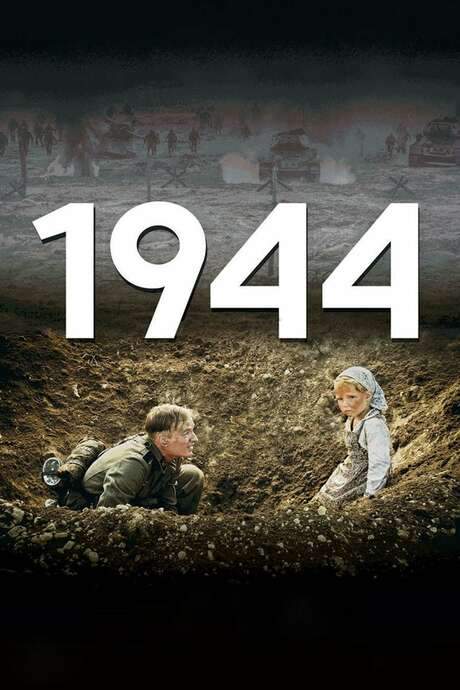
1944 2015


Made by

MRP Matila Röhr Productions
Where to Watch 1944
See current US streaming, rental, and purchase options for 1944 (2015) via JustWatch.

Cineverse Amazon Channel
HD
Midnight Pulp
HD
Midnight Pulp Amazon Channel
HD
Fawesome
HD
Hoopla
SD
Kanopy
HD
Fandango at Home Free
HD
Plex
HD
Plex Channel
HD
The Roku Channel
HD
Tubi TV
SD
YouTube Free
HD
Amazon Video
SD
Apple TV Store
HD Fandango At Home
SD
Google Play Movies
SD
YouTube
SD Streaming availability powered by 
1944 Plot Summary
Read the complete plot summary and ending explained for 1944 (2015). From turning points to emotional moments, uncover what really happened and why it matters.
The film opens in July 1944 on the Tannenberg Line in Estonia, where a unit of Estonian Waffen-SS soldiers led by Rudolf Kask Ivo Uukkivi find themselves pinned down by a relentless Red Army advance. A visiting Nazi official hands out signed photographs of Hitler, a gesture that draws smirks and scoffs from the exhausted troops and the civilians who gather to watch. The mood is a jagged mix of bravado and fear as propaganda collides with the hard reality of war. The Soviet onslaught grows overwhelming in numbers—tanks churn forward, infantry streams push through, and the German defenders are forced to retreat, sometimes through streams and crowds of frightened refugees. By the end of a ferocious clash, the victors are the Red Army, including an Estonian unit, and the German lines crumble in retreat.
As the fighting ebbs, the dead from both sides are buried in a mass grave, a stark symbol of the war’s indiscriminate reach. Among the living, a Red Army Estonian fighter named Jüri Jõgi Kristjan Üksküla strips the body of Karl Tammik Kaspar Velberg and uncovers an unposted letter written to Karl’s sister Aino Tammik Maiken Pius in Tallinn. When Tallinn falls to Soviet hands, Jüri travels there in person to deliver the letter, and a quiet, fragile friendship develops between Jüri and Aino, a connection that provokes the ire of his unit’s political officer and exposes the tension between personal loyalties and ideological control.
The story then shifts to the Sõrve Peninsula during the Moonsund operation in November, where Jüri’s unit captures a group of sixteen-year-old Estonian youths dressed in German uniforms. The political officer commands Jüri to execute them all, and when Jüri dares to question the order, the officer shoots him dead. Seconds later, one of Jüri’s comrades kills the officer in turn. On Jüri’s body, a comrade discovers the same unposted letter to Aino, and, during a spell of leave, he personally carries the letter to Tallinn to complete the long-delayed exchange.
Throughout its runtime, the film threads a meditation on loyalty, moral ambiguity, and the stubborn endurance of human connection in the face of brutal conflict. It treats letters as lifelines—small, intimate acts that outlast banners and battalions, binding strangers across time and tragedy. The narrative never shies away from the harsh consequences of war, yet it grounds its drama in the tender, almost ordinary stubbornness of people who choose to care for one another beyond the borders of the battlefield.
1944 Timeline
Follow the complete movie timeline of 1944 (2015) with every major event in chronological order. Great for understanding complex plots and story progression.
Battle on the Tannenberg Line
In July 1944, a unit of Estonian Waffen-SS soldiers holds the line against a numerically superior Red Army. The fighting is ferocious, and German troops have to retreat while streams of civilian refugees surge past the front. A visiting Nazi official arrives, handing out signed photographs of Hitler in an attempt to boost morale, but the gesture is met with ridicule.
Mass burial and a cryptic letter
After the ferocious battle, both sides bury their dead in a mass grave, underscoring the war's indiscriminate toll. Jüri, a Soviet Estonian in the Red Army, searches Karl's body and discovers an unposted letter addressed to Karl's sister Aino in Tallinn. The discovery hints at a personal link that transcends the battlefield.
Aino's letter reaches her world
As Soviet forces advance, Tallinn falls, and Jüri personally delivers Karl's unposted letter to Aino. The encounter forges an unlikely friendship between Jüri and Aino, unsettling the unit's political officer. The relationship adds a human dimension to the war's brutal machinery.
Growing tension in the unit
Jüri's budding friendship with Aino draws the ire of the unit's political officer, who sees a dangerous breach of loyalty. The officer's hostility foreshadows the moral conflicts that will erupt later on the battlefield. The war's personal connections become a source of friction at the front.
Moonsund operation begins on Sõrve Peninsula
In November, fighting shifts to the Sõrve Peninsula as part of the Moonsund operation. Jüri's unit engages in intense combat against German forces, continuing the brutal cycle of capture, defense, and retreat. Civilians and soldiers alike are pulled into the conflict's grind.
Capture of sixteen-year-old Estonian boys
During the operation, Jüri's unit takes prisoner a group of sixteen-year-old Estonian boys wearing German uniforms. The sight underscores the war's surreal mixing of enemy and homeland identities. The boys' presence intensifies the moral decision looming over Jüri and his comrades.
The order to kill and Jüri's doubt
The political officer orders Jüri to execute the captured boys, demanding unquestioning obedience. Jüri questions the order, exposing a personal struggle between duty and humanity amid war. The moment heightens the risk of mutiny within the unit.
Jüri is killed and the officer falls
Seconds after Jüri challenges the order, the political officer shoots Jüri dead, marking a grim moment when conscience is silenced by military discipline. In a swift reversal, one of Jüri's comrades executes the officer in retaliation. The cycle of violence deepens within the unit.
The letter on Jüri's body is found
After the deaths, a comrade combs Jüri's remains and finds the unposted letter to Aino. He keeps it safe for a spell of leave, planning to deliver it to Aino in Tallinn. The discovery preserves the thread of personal connection amid the carnage.
The letter reaches Aino
While on leave, the comrade travels to Tallinn and personally delivers the letter to Aino. The act reconstructs the wartime bridge between two families torn apart by the fighting. It offers a glimpse of a quieter, human response to war's horrors.
1944 Characters
Explore all characters from 1944 (2015). Get detailed profiles with their roles, arcs, and key relationships explained.
Jüri Jõgi (Kristjan Üksküla)
A Red Army Estonian fighter who grapples with loyalty to his unit and the humanity of civilians. He seeks connection beyond the front by delivering an unposted letter to Karl's sister, Aino. His principled stance is brutally tested when the political officer executes him.
Karl Tammik (Kaspar Velberg)
An Estonian soldier serving with German forces who becomes linked to the fate of his sister through the unposted letter. He embodies the war's divided loyalties, caught between brothers-in-arms and family ties as the front shifts.
Aino Tammik (Maiken Pius)
Karl's sister in Tallinn who comes to learn of her brother's fate through letters carried across the front. Her story highlights how ordinary lives intersect with war and how distance is bridged by small acts of communication.
1944 Settings
Learn where and when 1944 (2015) takes place. Explore the film’s settings, era, and how they shape the narrative.
Time period
1944
The narrative spans mid-1944 on the Eastern Front. It opens in July with a fierce contest along the Tannenberg Line as the Red Army pushes westward. By November, the Moonsund operation and Soviet capture of Tallinn alter the balance for Estonian soldiers on both sides. The period captures rapid shifts in fortunes and the human cost of war in the Baltic states.
Location
Tannenberg Line, Tallinn, Sõrve Peninsula, Moonsund operation
The action unfolds across key Estonian locations in 1944 during the Eastern Front. The Tannenberg Line becomes the main battlefield as German and Estonian troops hold off the Red Army's advance and civilians flee in droves. Civilians and soldiers alike are drawn into brutal combat, leaving behind mass graves of the fallen. The campaign spills from the front lines to Tallinn and the Sõrve Peninsula during the Moonsund operation, highlighting the war's reach into daily life.
1944 Themes
Discover the main themes in 1944 (2015). Analyze the deeper meanings, emotional layers, and social commentary behind the film.
💥
Frontlines
The film centers on brutal frontline combat at the Tannenberg Line and later on the Sõrve Peninsula, illustrating how war's violence dominates life and forces decisions that test loyalty and humanity.
✉️
Letters
Unposted letters found or delivered across enemy lines connect people across the front. They reveal personal stories and humanity that survive despite orders and hostilities.
🤝
Loyalties
Estonian soldiers fight on opposing sides, and a political officer's strict orders collide with individual conscience, leading to tragedy and moral ambiguity in the name of duty.

Coming soon on iOS and Android
The Plot Explained Mobile App
From blockbusters to hidden gems — dive into movie stories anytime, anywhere. Save your favorites, discover plots faster, and never miss a twist again.
Sign up to be the first to know when we launch. Your email stays private — always.
Explore the mobile app1944 Spoiler-Free Summary
Discover the spoiler-free summary of 1944 (2015). Get a concise overview without any spoilers.
In the summer of 1944, Estonia becomes a stark crossroads of a larger, grinding conflict that spreads from the rolling Blue Hills to the jagged shoreline of the Sõrve Peninsula. The country’s familiar landscapes are overrun with the relentless advance of armies, each side laying claim to the same soil and the same people. The film paints a haunting portrait of a nation caught between two unforgiving war machines, where the ordinary sounds of village life are eclipsed by the thunder of artillery and the ever‑present menace of uncertainty.
At the heart of this turmoil are two young Estonians whose lives have been pulled onto opposite sides of the front. Jüri serves in a Red Army unit, finding himself thrust into a role he never imagined, while Karl fights under a German banner, a reluctant participant in a cause that feels foreign to his own heritage. Between the front lines, a fragile connection forms through a simple, unposted letter addressed to Aino, Karl’s sister in Tallinn. This thread of correspondence hints at the lingering ties to home, the yearning for normalcy, and the quiet resistance of personal bonds in a world that demands absolute loyalty.
The tone is one of quiet intensity, blending the bleak realism of war’s devastation with moments of intimate humanity. Families are portrayed as silent witnesses to the sweeping changes around them, forced to navigate impossible choices and endure the weight of consequences that echo far beyond the battlefield. As the Eastern Front churns, the film invites the audience to contemplate how identity, duty, and affection collide when nations are torn asunder, leaving every character to wrestle with the question of who they are when the flags above them shift.
Featured on this page

What's After the Movie?
Not sure whether to stay after the credits? Find out!
Check out our other apps:

SAT Sphere
Build confidence for the Digital SAT.

Mori Atlas
Discover wild places worth protecting.

Luntero
Search smarter for a home in Amsterdam.

Plot Explained
Unravel movie endings and hidden clues.

Pokechamp
Dive into Pokémon data and battle logic.

Driving Theory
Get ready for your European theory test.

Movie Dust
Plan your next cinema trip with ease.

Musemap
Find art and culture as you travel.

Selkobase
Compare credentials before committing.

Local Manual
Turn an unfamiliar country into practical next steps.

Lernavi
Compare school systems before your next move.

GymRoam
Find a workout stop wherever your plans take you.
Explore Our Movie Platform
New Movie Releases (2026)
Famous Movie Actors
Top Film Production Studios
Movie Plot Summaries & Endings
Major Movie Awards & Winners
Best Concert Films & Music Documentaries
Movie Collections and Curated Lists
© 2026 What's After the Movie. All rights reserved.
Privacy Policy