Ziam 2025


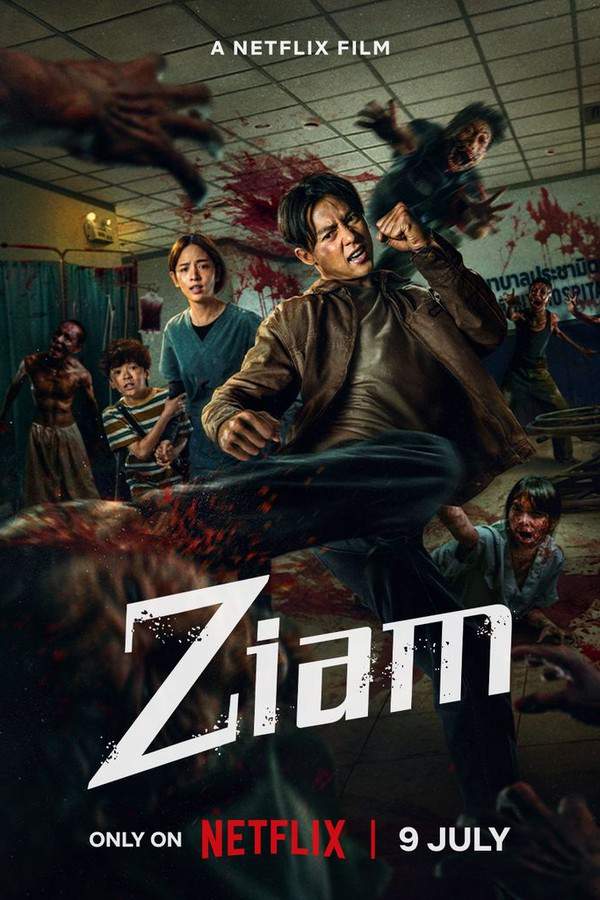
In a bleak and unforgiving world, former boxer Singh intends to leave his dangerous life behind and reunite with his girlfriend, Rin, a doctor, in their hometown. Hoping for a peaceful retirement, his dreams are disrupted when the hospital where Rin works is attacked and overrun by a relentless wave of zombies, forcing him to fight for their survival.


Does Ziam have end credit scenes?
No!
Ziam does not have end credit scenes. You can leave when the credits roll.
Where to Watch Ziam
See current US streaming, rental, and purchase options for Ziam (2025) via JustWatch.


Streaming availability powered by 
Meet the Full Cast and Actors of Ziam
Explore the complete cast of Ziam, including both lead and supporting actors. Learn who plays each character, discover their past roles and achievements, and find out what makes this ensemble cast stand out in the world of film and television.

External Links and Streaming Options
Discover where to watch Ziam online, including streaming platforms, rental options, and official sources. Compare reviews, ratings, and in-depth movie information across sites like IMDb, TMDb, Wikipedia or Rotten Tomatoes.







Ratings and Reviews for Ziam
See how Ziam is rated across major platforms like IMDb, Metacritic, and TMDb. Compare audience scores and critic reviews to understand where Ziam stands among top-rated movies in its genre.

The Movie Echo Score
Ziam presents a mixed experience that leans on its visceral action while struggling with narrative originality. In terms of craft, the film delivers practical gore and straightforward genre visuals but underutilizes its setting and pacing to create sustained tension. Character development and emotional depth are limited by uneven performances and predictable arcs. While sensory elements such as fight choreography and effects stand out, the derivative story and lack of cohesion diminish long-term engagement. Overall, Ziam offers sporadic thrills but falls short of a fully satisfying horror-action hybrid.
The Movie Echo Score Breakdown for Ziam

Art & Craft
Art and Craft in Ziam show competent gore effects and clear shot composition but suffer from uninspired design choices. The hospital environment appears flat and repetitive, and editing occasionally undermines suspense. In terms of cinematography, action sequences are captured with sufficient clarity yet lack creative framing. The production design feels functional rather than immersive. Overall, the film’s craft provides basic genre comfort without elevating the material into a distinctive visual experience.

Character & Emotion
When it comes to character and emotion, Ziam offers minimal depth and uneven performances. The central protagonist displays physical prowess but lacks nuanced motivations, while supporting roles emerge and vanish with little context. Dialogue often feels utilitarian, failing to foster strong emotional resonance or chemistry. At times, characters default to genre stereotypes, limiting audience investment in their outcomes. In summary, the film’s potential for meaningful connection is hindered by flat portrayals and predictable character arcs.

Story & Flow
Story and Flow in Ziam lean heavily on familiar tropes, resulting in predictable plot beats and limited originality. The narrative progression unfolds with a ticking-clock structure that many viewers find derivative, and pacing sometimes drags in exposition-heavy scenes. Attempts at thematic depth—such as environment-driven scarcity or familial bonds—are overshadowed by hasty scene transitions and a disjointed screenplay. Ultimately, the story feels stitched together from genre conventions, offering engagement through action rather than dramatic or narrative innovation.

Sensory Experience
Sensory Experience is the strongest aspect of Ziam, marked by satisfyingly brutal fight choreography and practical effects. Sound design emphasizes bone-crunching impacts and ambient tension, while the soundtrack supports the action without overwhelming it. The visceral gore and physical combat sequences provide a coherent visual style that genre enthusiasts will recognize and appreciate. Although some scenes lack stylistic flair, the film consistently delivers visceral thrills that keep audiences invested in its horror-action premise.

Rewatch Factor
The Rewatch Factor of Ziam is moderate, driven primarily by its action set pieces and gore effects. While viewers may revisit the film for its fight choreography and visceral moments, the lack of narrative depth and character resonance limits lasting appeal. Repeated viewings reveal the derivative structure and underdeveloped plot, reducing the incentive to reengage beyond initial thrills. In sum, the film offers occasional enjoyment on subsequent viewings but does not sustain strong replay value for broader audiences.


77%
TOMATOMETER

35%
User Score

4.9 /10
IMDb Rating

68
%
User Score
Take the Ultimate Ziam Movie Quiz
Challenge your knowledge of Ziam with this fun and interactive movie quiz. Test yourself on key plot points, iconic characters, hidden details, and memorable moments to see how well you really know the film.
Ziam (2025) Quiz: Test your knowledge of the post‑apocalyptic Thai thriller Ziam, released in 2025.
What is the name of the corporation that supplies food during the crisis?
Full Plot Summary and Ending Explained for Ziam
Read the complete plot summary of Ziam, including all major events, twists, and the full ending explained in detail. Explore key characters, themes, hidden meanings, and everything you need to understand the story from beginning to end.
In a world grappling with climate-driven upheaval, temperatures spike once more and a troubling chain reaction unfolds: a bacteria released by melting polar ice poisons a vast ocean harvest, making fish plucked from poisoned waters unsafe to eat. Food shortages ripple across nations, and the crisis threatens to endure for decades. Amid this turmoil, Thailand remains comparatively cushioned, thanks to its abundant food reserves and a powerful player at the center of the story, Mr. Vasu and his multi-billion-dollar venture, the VS Corporation, which is framed as a lifeline for a country in need.
At the heart of the operation is Singh, a former Muay Thai fighter who now works as a driver for VS, transporting crates filled with fish destined for distribution. Some workers offload these boxes from a shipwreck, and the narrative keeps you guessing about whether the vessel was carrying fish caught from poisoned waters or if there is a hidden lab aboard where artificial breeding is taking place. Purich is Vasu’s right-hand man, serving the freshly delivered fish to a table of men who assure themselves that this batch is safe. As Purich samples the catch himself, the men around the table begin a chilling transformation into zombies, revealing the danger lurking within the supply chain and the unsettling possibility that the crisis was engineered—or at least exploited—by those entrusted with food security.
Rin is a nurse at Prachamit Hospital, and her bond with Singh anchors the human side of the story. She worries about her boyfriend, who has drifted into a world of shady connections and shadowy dealings in the midst of civil unrest that has Bangkok under martial law. Once a celebrated Muay Thai fighter, Singh now fights for everyday survival as the city leans into scavenging and increasingly desperate theft to feed its people. Rin dreams of leaving the chaos behind and returning to their village in Chiang Dao, while Singh harbors a hopeful plan to propose to Rin, grounding the plot in a personal stakes that contrasts with the broader crisis unfolding around them.
The nightmare begins to spill from the shadows into the hospital when Purich arrives and begins to transform, turning other patients and staff into zombies. The crisis is not contained to the hospital walls: the same infected fish linked to the initial outbreak appears in the hospital kitchen and in the surrounding rooms, fueling a rapid spread. Vasu and his wife—who is facing a liver failure—arrive within the same building, and the plot thickens as a problematic liver transplant is arranged using a fish liver from the same batch Singh transported. The hospital’s corridors become a battlefield as the undead move with a relentless hunger, overwhelming the orderly routines of care and evacuation.
In response to the growing horror, the Royal Thai Army is mobilized and an effort to seal off the danger emerges. Singh enters the hospital to search for Rin as the dead begin to outnumber the living, fighting his way through zombies in a bid to reach the stairwells and the upper floors where Rin and a few others may still be safe. The army, unsure and overwhelmed, makes a drastic choice to evacuate Mr. Vasu and his wife, while Rin fights to stay close to the people she loves. The hospital’s siege escalates, and a child named Buddy forms a quiet, hopeful thread in the story, as he guides his mother and points the way for Rin and Singh to navigate the chaos.
A telling detail appears on a roadside billboard during the escape: “Insect Farming Project For Food Security,” a line that hints at the darker possibility that VS Corporation may have pursued ambitious, perhaps reckless, experiments to boost food production. The implication is clear—what began as a bid to solve a hunger crisis could have seeded a far deadlier threat, and the very architect of the crisis risks becoming its prey.
As the chaos crescendos, Rin and Buddy reach the hospital’s upper levels, where a tense dynamic unfolds as Singh and his employer’s safety becomes tangled with the mission to save Rin. The trio’s bond is tested when the army’s attempt to extract Vasu collides with the spread of infection, and a dramatic decision point arrives: Singh fights to give Rin and Buddy a chance to reach safety on the terrace, even as the building’s fate hangs in the balance. In a deeply emotional moment, Singh offers Rin a ring—the symbol of a life they hope to build together—before the fight carries him into the besieged parking area.
A pivotal discovery reframes the crisis: when Singh burns an inverted zombie—an officer turned by the infection—the hospital’s fire sprinklers are triggered, and water becomes a strange ally. The moment the water touches the transforming zombies, they reveal a grotesque new form—resembling fish turned into piranhas, their bodies armored with scales as they surge toward the living. They become waterborne “zombie fish,” a terrifying evolution that raises the stakes of every move within the hospital’s maze of corridors and stairwells.
With the building under a looming time limit, Singh presses toward the terrace as the bombs planted in the underground parking area threaten to collapse the entire complex. The helicopter, initially dispatched to extract Vasu and his wife, departs with Rin and Buddy when the situation worsens, leaving Singh behind. Rin pleads to wait, but the countdown to detonation forces a bitter separation. The explosion finally erupts and engulfs the hospital, bathing the scene in smoke and fire as the structure collapses.
In a narrow act of survival, Singh seeks a way to endure the blast, shedding light on a final, almost mythic escape. He dives into one of the rooftop water tanks, using the liquid shield to ride out the inferno as the building falls away. A zombie finds the open tank and claws toward him, but Singh reacts with a decisive attack, crushing the creature’s head and emerging from the water just as the wreckage settles. The blast confirms a brutal truth: the very system designed to feed the population may have bred its own monstrous consequence.
In the aftermath, [Singh] and Rin confront the fragile balance between love and survival. Rin, Buddy, and the remaining survivors make it to safety, while Mr. Vasu and his wife perish in the chaos that they may have helped unleash. The final image lingers on the moment of resilience—human connection and quiet courage enduring against a backdrop of a world reshaped by a crisis that began with food and ended with the fight for life.

Coming soon on iOS and Android
The Plot Explained Mobile App
From blockbusters to hidden gems — dive into movie stories anytime, anywhere. Save your favorites, discover plots faster, and never miss a twist again.
Sign up to be the first to know when we launch. Your email stays private — always.
Explore the mobile appWatch Trailers, Clips & Behind-the-Scenes for Ziam
Watch official trailers, exclusive clips, cast interviews, and behind-the-scenes footage from Ziam. Dive deeper into the making of the film, its standout moments, and key production insights.
Ziam Themes and Keywords
Discover the central themes, ideas, and keywords that define the movie’s story, tone, and message. Analyze the film’s deeper meanings, genre influences, and recurring concepts.
Ziam Other Names and Titles
Explore the various alternative titles, translations, and other names used for Ziam across different regions and languages. Understand how the film is marketed and recognized worldwide.
Similar Movies To Ziam You Should Know About
Browse a curated list of movies similar in genre, tone, characters, or story structure. Discover new titles like the one you're watching, perfect for fans of related plots, vibes, or cinematic styles.






Quick Links: Summary, Cast, Ratings, More

What's After the Movie?
Not sure whether to stay after the credits? Find out!
Check out our other apps:

SAT Sphere
Build confidence for the Digital SAT.

Mori Atlas
Discover wild places worth protecting.

Luntero
Search smarter for a home in Amsterdam.

Plot Explained
Unravel movie endings and hidden clues.

Pokechamp
Dive into Pokémon data and battle logic.

Driving Theory
Get ready for your European theory test.

Movie Dust
Plan your next cinema trip with ease.

Musemap
Find art and culture as you travel.

Selkobase
Compare credentials before committing.

Local Manual
Turn an unfamiliar country into practical next steps.

Lernavi
Compare school systems before your next move.

GymRoam
Find a workout stop wherever your plans take you.
Explore Our Movie Platform
New Movie Releases (2026)
Famous Movie Actors
Top Film Production Studios
Movie Plot Summaries & Endings
Major Movie Awards & Winners
Best Concert Films & Music Documentaries
Movie Collections and Curated Lists
© 2026 What's After the Movie. All rights reserved.
Privacy Policy