Tosca 2011

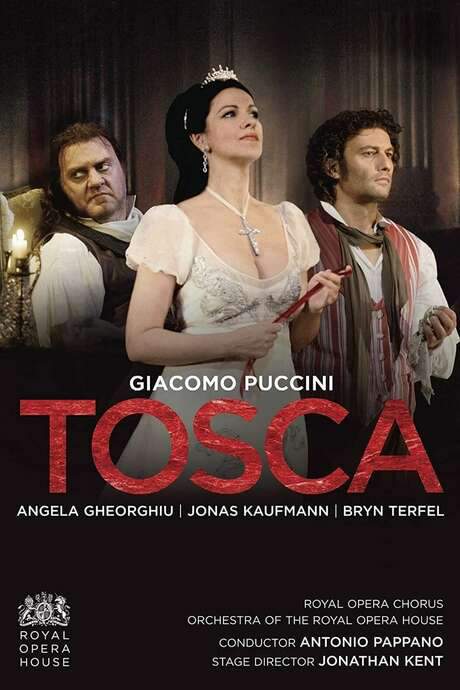
2011 Royal Opera House staging of Puccini’s Tosca, conducted by music director Antonio Pappano with the Royal Opera Chorus and Orchestra. The principal cast features Angela Gheorghiu as Tosca, Jonas Kaufmann as Cavaradossi, and Bryn Terfel as Scarpia. Visually, the production contrasts a grand church ceremony, a shadowy study with a hidden torture chamber and the hopeful light of a Roman dawn, heightening Tosca’s love, Cavaradossi’s idealism and Scarpia’s ruthless obsession. Drama, passion and exquisite music.


Does Tosca have end credit scenes?
No!
Tosca does not have end credit scenes. You can leave when the credits roll.
Meet the Full Cast and Actors of Tosca
Explore the complete cast of Tosca, including both lead and supporting actors. Learn who plays each character, discover their past roles and achievements, and find out what makes this ensemble cast stand out in the world of film and television.

Zhengzhong Zhou
Sciarrone - A police officer
Jonas Kaufmann
Mario Cavaradossi
Angela Gheorghiu
Floria Tosca
Orchestra of the Royal Opera House
Jeremy White
Sacristan
Lukas Jakobski
Cesare Angelotti
Bryn Terfel
Baron Scarpia
Hubert Francis
Spoletta - A police agent
William Payne
Shepherd Boy
John Morrissey
Gaoler
Antonio Pappano
Conductor
External Links and Streaming Options
Discover where to watch Tosca online, including streaming platforms, rental options, and official sources. Compare reviews, ratings, and in-depth movie information across sites like IMDb, TMDb or Letterboxd.



Take the Ultimate Tosca Movie Quiz
Challenge your knowledge of Tosca with this fun and interactive movie quiz. Test yourself on key plot points, iconic characters, hidden details, and memorable moments to see how well you really know the film.
Tosca (2011) Quiz: Test your knowledge of the 2011 film adaptation of "Tosca" with these ten questions ranging from easy to difficult.
Who is the lover of Mario Cavaradossi?
Full Plot Summary and Ending Explained for Tosca
Read the complete plot summary of Tosca, including all major events, twists, and the full ending explained in detail. Explore key characters, themes, hidden meanings, and everything you need to understand the story from beginning to end.
In What’s After the Movie, we explore the intricate and tragic story set in Rome during June 1800. The narrative begins with Cesare Angelotti, an escaped political prisoner, who finds refuge in the Church of Sant’Andrea della Valle. Secured by a hidden key his sister had concealed for him, Angelotti hides in his family’s private chapel, trying to evade the police. During this tense moment, the talented painter Mario Cavaradossi arrives to work on a portrait of Mary Magdalene, a piece inspired by Angelotti’s sister, the Marchesa Attavanti, whom Cavaradossi had seen praying in the church. As the story unfolds, Angelotti emerges from his hiding spot, and Cavaradossi recognizes him, promising to help him escape. He quickly guides Angelotti back into the chapel just as Floria Tosca, portrayed by Angela Gheorghiu, appears outside, calling to him.
Tosca, who is also Cavaradossi’s lover, immediately displays her possessiveness and suspicion. She questions him about his conversation and reminds him of their upcoming rendezvous that very evening. Tension erupts when Tosca notices a likeness of the Marchesa Attavanti in the painting and mistakenly believes Cavaradossi has been unfaithful. Despite her anger, Cavaradossi assures her of his loyalty and love. As Tosca departs, Angelotti re-emerges, and their secret meeting is momentarily disrupted by a signal indicating that the police have discovered Angelotti’s escape. The pair then flees to Cavaradossi’s home, but their hideout’s tranquility is soon shattered by the arrival of Baron Scarpia, the ruthless chief of secret police, portrayed by Bryn Terfel.
The police arrive searching for Angelotti, and Scarpia’s suspicion is confirmed when he finds a fan bearing the Attavanti crest, which Tosca had left behind. She is devastated, realizing her lover’s peril and suspecting her own involvement. Her emotional turmoil prompts her vow for revenge, and she leaves as the church begins its service, filled with worshippers. Scarpia, meanwhile, orders his men to follow Tosca, misled into believing she may be hiding Angelotti with Cavaradossi, and he openly declares his intention to manipulate Tosca for his own cruel pleasure.
In Act II, the story shifts to the opulent chambers of Scarpia at Palazzo Farnese. The villainous officer dreams of controlling Tosca as he anticipates how much he will enjoy having her at his mercy. His men report that Angelotti remains at large, but they have caught Cavaradossi instead. Scarpia interrogates the defiant painter, whose resilience only fuels the chief’s suspicions. As Tosca performs at a royal concert outside, Scarpia summons her, and she arrives just as Cavaradossi is being led away to be tortured. The anguished scene becomes more intense when Cavaradossi, battered and barely conscious, confronts Tosca about her betrayal, just as the news of Napoleon’s victory over Scarpia’s side arrives, transforming the political landscape and complicating the personal stakes.
Realizing the danger her lover is in, Tosca is forced to reveal Angelotti’s hideout under pressure from Scarpia, who is also increasingly captivated by her. Meanwhile, Cavaradossi, desperate and furious, defiantly proclaims his disdain for tyranny, drawing the wrath of Scarpia who immediately orders his execution. Scarpia, ever manipulative, offers Tosca a cruel choice: surrender herself and save Cavaradossi, or see her lover killed. She refuses to yield, calling on her faith and love, and a struggle ensues as Scarpia’s advances become more insistent. Just then, Spoletta, the police agent played by Hubert Francis, brings news that Angelotti has committed suicide to escape capture, leaving Tosca with no choice but to capitulate. She agrees to Scarpia’s terms, relents to his demands, and tricks him into writing her a safe-conduct pass for Cavaradossi to be released. As she prepares to escape, Tosca unexpectedly retaliates, stabbing Scarpia with a knife when he attempts to assault her physically. She seizes the safe-conduct, gathers her courage, and flees the scene.
In the final act, set at dawn, Cavaradossi is on the brink of execution on the ramparts of Castel Sant’Angelo. He secures a private farewell letter for Tosca and braces himself for death, overwhelmed by despair. Tosca, arriving just in time, recounts what has transpired. Together, they dream of future freedom, cherishing their love amidst the chaos of war and political upheaval. As the soldiers prepare to fire, Tosca urges Cavaradossi to fake his death convincingly, and she watches from a distance as the shot rings out. However, when Cavaradossi remains motionless, she realizes the terrible truth—he has truly been executed, and her fears are confirmed. In her heartbreak and rage, she vows to meet her fate before God and, with a desperate cry, leaps from the battlement, symbolizing her tragic end.
Throughout this story, themes of love, betrayal, political unrest, and vengeance intertwine, portraying the tragic depths of human resilience and despair amid turbulent times. The powerful music and performances, especially from the cast including Jonas Kaufmann, make this an unforgettable tale of passion and sacrifice.

Coming soon on iOS and Android
The Plot Explained Mobile App
From blockbusters to hidden gems — dive into movie stories anytime, anywhere. Save your favorites, discover plots faster, and never miss a twist again.
Sign up to be the first to know when we launch. Your email stays private — always.
Explore the mobile appDiscover Film Music Concerts Near You – Live Orchestras Performing Iconic Movie Soundtracks
Immerse yourself in the magic of cinema with live orchestral performances of your favorite film scores. From sweeping Hollywood blockbusters and animated classics to epic fantasy soundtracks, our curated listings connect you to upcoming film music events worldwide.
Explore concert film screenings paired with full orchestra concerts, read detailed event information, and secure your tickets for unforgettable evenings celebrating legendary composers like John Williams, Hans Zimmer, and more.


Tosca Other Names and Titles
Explore the various alternative titles, translations, and other names used for Tosca across different regions and languages. Understand how the film is marketed and recognized worldwide.
Quick Links: Summary, Cast, Ratings, More

What's After the Movie?
Not sure whether to stay after the credits? Find out!
Check out our other apps:

SAT Sphere
Build confidence for the Digital SAT.

Mori Atlas
Discover wild places worth protecting.

Luntero
Search smarter for a home in Amsterdam.

Plot Explained
Unravel movie endings and hidden clues.

Pokechamp
Dive into Pokémon data and battle logic.

Driving Theory
Get ready for your European theory test.

Movie Dust
Plan your next cinema trip with ease.

Musemap
Find art and culture as you travel.

Selkobase
Compare credentials before committing.

Local Manual
Turn an unfamiliar country into practical next steps.

Lernavi
Compare school systems before your next move.

GymRoam
Find a workout stop wherever your plans take you.
Explore Our Movie Platform
New Movie Releases (2026)
Famous Movie Actors
Top Film Production Studios
Movie Plot Summaries & Endings
Major Movie Awards & Winners
Best Concert Films & Music Documentaries
Movie Collections and Curated Lists
© 2026 What's After the Movie. All rights reserved.
Privacy Policy