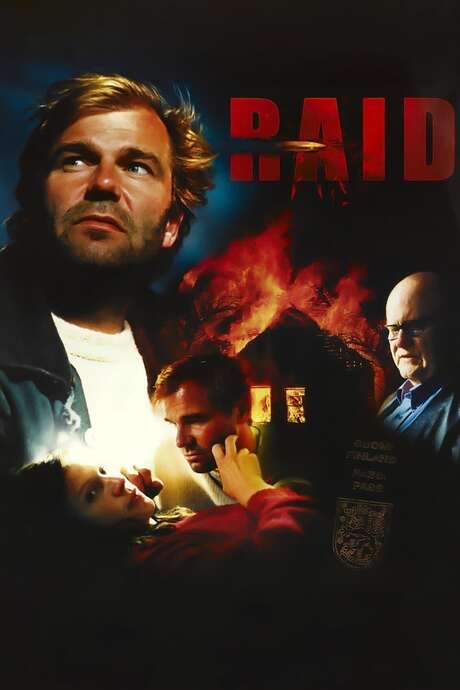
The Raid 1991

In the 1930s, China teeters on the brink of chaos after the deposed Emperor Pu‑Yi creates the puppet state of Manchukuo in Manchuria and collaborates with the Japanese to test poisonous gas. Lieutenant Mong leads a revolutionary unit tasked with stopping the scheme. While on the mission he encounters the clever, courageous veteran Uncle Choy and his comrades, who volunteer to assist. Though Mong doubts the aging Choy’s usefulness, the veteran seeks to prove his worth as they strive to thwart the plot.


Does The Raid have end credit scenes?
No!
The Raid does not have end credit scenes. You can leave when the credits roll.
Meet the Full Cast and Actors of The Raid
Explore the complete cast of The Raid, including both lead and supporting actors. Learn who plays each character, discover their past roles and achievements, and find out what makes this ensemble cast stand out in the world of film and television.

Tony Leung Ka Fai
Commander Masa

Jacky Cheung
Bobo Bear
Corey Yuen Kwai
Brother Big Nose
Lo Fan
Gambling woman
Lau Siu-Ming
Chinese Colonel
Kong Fu-Keung
Soldier
Dean Shek Tin
Dr. Choy
Ailen Sit Chun-Wai
Soldier
Sze Mei-Yee
Manchurian Emperor Puyi
Fennie Yuen Kit-Ying
Tina
Lau Tze-Ming
Soldier
Joyce Godenzi
Kim Pak Fai
Ho Wing-Cheung
Soldier
Paul Chu Kong
Lieutenant Mang Tai Hoi
Kei Kong-Hung
Smartie
Chiu Man-Yan
Nancy
Wong Choh-Wa
Soldier
Szeto Yue-Wa
Cook
External Links and Streaming Options
Discover where to watch The Raid online, including streaming platforms, rental options, and official sources. Compare reviews, ratings, and in-depth movie information across sites like IMDb, TMDb, Wikipedia or Letterboxd.




Full Plot Summary and Ending Explained for The Raid
Read the complete plot summary of The Raid, including all major events, twists, and the full ending explained in detail. Explore key characters, themes, hidden meanings, and everything you need to understand the story from beginning to end.
Set in the early years of the Republic of China, the Japanese-backed puppet regime in Manchuria places the Manchurian Emperor Puyi on the throne, with Sze Mei-Yee portraying the ruler and Tony Leung Ka Fai starring as Commander Masa, the stern enforcer of the regime. The balance of power in the north is a tense mix of political maneuvering and military pressure as the world around them edges toward broader conflict. Amid this chaos, several ordinary and not-so-ordinary figures converge on a dangerous mission that could alter the course of history.
Uncle Choi Dean Shek Tin is introduced as a former soldier who has studied medicine, carrying the weight of past disappointments. When indigenous jungle communities entrust him with a life-saving task, he steps into a perilous journey that begins on a road full of uncertainty and peril. Along the way, he encounters a group of soldiers who have survived a brutal exposure to poison gas, their lives hanging by a thread as the gas gnaws at their lungs and resolve. In a bid to honor his calling, Uncle Choi fights against the odds to save the Chinese Colonel Lau Siu-Ming, whose dying breath reframes the mission and places the burden of resistance into the hands of Lieutenant Mang Tai Hoi. The moment marks a pivot in Uncle Choi’s life; he had hoped to serve his country with wholehearted devotion, yet the doors of official duty have closed to him, leaving him to carve his own path through danger and duty.
Lieutenant Mang Tai Hoi comes into focus as a capable and determined leader who carries the weight of duty on his shoulders. Paul Chu Kong brings to life the man who inherits the responsibility thrust upon him at a pivotal moment. The dying wish of the colonel becomes a rallying cry for a counteroffensive that will test loyalties, skill, and courage as Mang Tai-hoi and his improvised band prepare to challenge a system designed to crush resistance.
As the plan unfolds, Uncle Choi dons a new disguise—the cook—to slip into the palace and reconnect with Mang Tai Hoi. The cook is brought to life by Szeto Yue-Wa, whose presence in the palace becomes a crucial pivot point for the mission. The team’s search centers on the enigmatic “Cheung-kong #1” Tina, the key to unlocking the poison gas base map and crippling the enemy’s deadly infrastructure. Tina is portrayed by Fennie Yuen Kit-Ying, whose role adds a personal stake to the political struggle and gives the mission a human center beyond strategy and bravado.
Throughout their dangerous trek, the group’s every move is hunted by the harsh realities of war and the political intrigues surrounding the puppet regime. The pursuit is led in part by the Empire’s own forces, including the calculating minds of Commander Masa’s faction and their uneasy adversaries, among them Kawashima, whose loyalties and motives add another layer of tension to the story. The tense cat-and-mouse game escalates as the group infiltrates a poison gas base, and their plan to rattle the regime’s foundation threatens to unleash a broader confrontation that could tilt the balance of power in the region.
Nancy, Uncle Choi’s adopted daughter, becomes a beacon of hope amid the maelstrom. In a moment marked by courage and fierce protectiveness, Uncle Choi and his comrades manage to rescue her from the perils surrounding the mission, reinforcing the theme that family ties and loyalty can endure even when nations threaten to tear people apart. Nancy’s presence among the survivors adds emotional depth to the clash between political expediency and human compassion.
With the adrenaline of combat fueling their resolve, Uncle Choi and the group rally for a large-scale assault on the poison gas base. The operation is a culmination of meticulous planning, desperate improvisation, and the relentless pursuit of freedom against overwhelming odds. After a series of fierce engagements, hard-won sacrifices, and the unyielding determination of a band of unlikely heroes, the base falls, and the momentum shifts decisively in their favor. The victory arrives not merely as a military triumph but as a testament to resilience, solidarity, and the belief that a resolute few can alter the course of a nation’s fate.
In the end, the narrative resolves with a hard-earned sense of closure: a dangerous mission accomplished, a puppet regime challenged, and a group of ordinary people driven by extraordinary courage who emerge from the crucible with a renewed sense of purpose. The story blends political intrigue, medical mercy, secret infiltrations, and hard-won strategic strikes into a cohesive tale that underscores the human cost of conflict while celebrating the tenacity of those who choose to stand up against oppression.

Coming soon on iOS and Android
The Plot Explained Mobile App
From blockbusters to hidden gems — dive into movie stories anytime, anywhere. Save your favorites, discover plots faster, and never miss a twist again.
Sign up to be the first to know when we launch. Your email stays private — always.
Explore the mobile appDiscover Film Music Concerts Near You – Live Orchestras Performing Iconic Movie Soundtracks
Immerse yourself in the magic of cinema with live orchestral performances of your favorite film scores. From sweeping Hollywood blockbusters and animated classics to epic fantasy soundtracks, our curated listings connect you to upcoming film music events worldwide.
Explore concert film screenings paired with full orchestra concerts, read detailed event information, and secure your tickets for unforgettable evenings celebrating legendary composers like John Williams, Hans Zimmer, and more.


The Raid Themes and Keywords
Discover the central themes, ideas, and keywords that define the movie’s story, tone, and message. Analyze the film’s deeper meanings, genre influences, and recurring concepts.
The Raid Other Names and Titles
Explore the various alternative titles, translations, and other names used for The Raid across different regions and languages. Understand how the film is marketed and recognized worldwide.
Similar Movies To The Raid You Should Know About
Browse a curated list of movies similar in genre, tone, characters, or story structure. Discover new titles like the one you're watching, perfect for fans of related plots, vibes, or cinematic styles.



Quick Links: Summary, Cast, Ratings, More

What's After the Movie?
Not sure whether to stay after the credits? Find out!
Check out our other apps:

SAT Sphere
Build confidence for the Digital SAT.

Mori Atlas
Discover wild places worth protecting.

Luntero
Search smarter for a home in Amsterdam.

Plot Explained
Unravel movie endings and hidden clues.

Pokechamp
Dive into Pokémon data and battle logic.

Driving Theory
Get ready for your European theory test.

Movie Dust
Plan your next cinema trip with ease.

Musemap
Find art and culture as you travel.

Selkobase
Compare credentials before committing.

Local Manual
Turn an unfamiliar country into practical next steps.

Lernavi
Compare school systems before your next move.

GymRoam
Find a workout stop wherever your plans take you.
Explore Our Movie Platform
New Movie Releases (2026)
Famous Movie Actors
Top Film Production Studios
Movie Plot Summaries & Endings
Major Movie Awards & Winners
Best Concert Films & Music Documentaries
Movie Collections and Curated Lists
© 2026 What's After the Movie. All rights reserved.
Privacy Policy