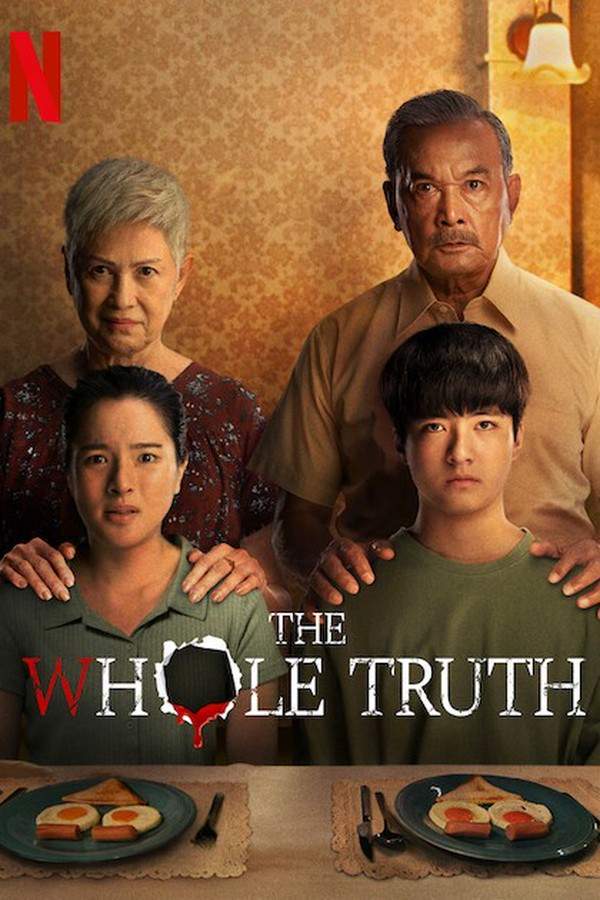
The Whole Truth 2021


When two siblings exploring their grandparents’ house discover a mysterious hole in the wall, they uncover a series of disturbing events. As they investigate, horrifying incidents reveal dark and sinister secrets about their family's past, forcing them to question everything they thought they knew. The siblings must confront the unsettling truth hidden within their family's history.


Does The Whole Truth have end credit scenes?
No!
The Whole Truth does not have end credit scenes. You can leave when the credits roll.
Where to Watch The Whole Truth
See current US streaming, rental, and purchase options for The Whole Truth (2021) via JustWatch.

Howdy Amazon Channel
HD
MovieSphere+ Amazon Channel
HD
Philo
HD
Fawesome
HD
Hoopla
SD
Kanopy
HD
Plex
HD
Plex Channel
HD
The CW
SD
The Roku Channel
HD
Tubi TV
SD
VIX
HD
Amazon Video
HD
Apple TV Store
HD
Fandango At Home
HD
Google Play Movies
SD
YouTube
SD Streaming availability powered by 
Meet the Full Cast and Actors of The Whole Truth
Explore the complete cast of The Whole Truth, including both lead and supporting actors. Learn who plays each character, discover their past roles and achievements, and find out what makes this ensemble cast stand out in the world of film and television.

Steven Isarapong Fuhrer
Chaiyut
Sutatta Udomsilp
Pim
Sompob Benjathikul
Phong
Surapol Poonpiriya
Police Captain
Nattapat Nimjirawat
Putt
Ronnaporn Kanivichaporn
Doctor
Nicole Theriault
Mai
Keetapat Pongruea
Pinya
Uthai Bangtamruaj
Nurse
Sadanont Durongkhaweroj
Fame
Tarika Thidathit
Wan
Atichart Lee
Krit
Thasorn Klinnium
Paew
Chalita Mangkornpunt
Coach Yui
Samut Nuamsetti
Sangar
Thanyalak Sermsap
Joy
Pakapong Thienthong
Chaiyut's Friend
Mapa Tunchotikul
Chaiyut's Girlfriend
Vasan Mahakiattikun
Male Co-worker
Tananan Kanjanakuha
Mr. Lee
Rasikarn Thongjirattikarn
Nurse
Thayaphon Wongsriwijit
Nurse
Prinda Techaiya
Mint
Avalyn Subsilp
Baby Pim
External Links and Streaming Options
Discover where to watch The Whole Truth online, including streaming platforms, rental options, and official sources. Compare reviews, ratings, and in-depth movie information across sites like IMDb, TMDb, Wikipedia or Rotten Tomatoes.





Ratings and Reviews for The Whole Truth
See how The Whole Truth is rated across major platforms like IMDb, Metacritic, and TMDb. Compare audience scores and critic reviews to understand where The Whole Truth stands among top-rated movies in its genre.

The Movie Echo Score
The Whole Truth delivers a mixed experience, with occasional strengths offset by recurring shortcomings. While its premise and occasional emotional moments draw some praise, the film suffers from uneven pacing, numerous plot inconsistencies, and uneven direction that dilute its impact. Visual elements receive sporadic commendation, yet lighting and sound design often appear flat. Acting ranges from competent to subpar, leading to an inconsistent audience engagement. Consequently, the movie offers limited rewatch appeal despite isolated highlights.
The Movie Echo Score Breakdown for The Whole Truth

Art & Craft
In terms of direction and visual craftsmanship, the film presents an uneven picture. Certain reviewers commend the cinematography and effective use of atmospheric photography, but many note flat lighting, sluggish pacing, and questionable editing choices that undermine tension. The production design receives limited attention, and several critiques highlight a lack of cohesive artistry. Overall, the artistic execution leans toward the lower side of the scale.

Character & Emotion
When evaluating performances and character development, opinions diverge. Some viewers highlight a compelling emotional core and nuanced portrayals that enhance the narrative, while others criticize wooden acting, melodramatic delivery, and inconsistent chemistry among the cast. The protagonist's journey garners modest empathy, yet gaps in depth persist. This blend of strengths and weaknesses results in a moderate character rating.

Story & Flow
The story’s structure oscillates between intrigue and frustration. The premise and occasional plot twists receive acknowledgment for originality, yet many find the pacing sluggish, filler scenes excessive, and continuity errors disruptive. The narrative’s attempt at blending horror with family drama yields mixed coherence, leading to an overall balanced yet unremarkable storytelling impression.

Sensory Experience
Sensory aspects such as sound and visual style draw mixed feedback. Positive remarks focus on effective atmospheric photography and occasional effective effects, whereas criticisms target flat lighting, uninspired sound design, and subpar special‑effects makeup. The soundtrack fails to heighten tension for several viewers. Consequently, the sensory experience settles in the lower-mid range.

Rewatch Factor
Rewatch value is limited by the film’s inconsistent pacing and uneven execution, though occasional twists and emotional beats may attract a second viewing for some. While certain audiences appreciate the lingering thematic metaphor and occasional scares, the overall lack of sustained tension and narrative flaws reduce its lasting appeal. Thus, the film offers modest incentive for repeat watches.
Full Plot Summary and Ending Explained for The Whole Truth
Read the complete plot summary of The Whole Truth, including all major events, twists, and the full ending explained in detail. Explore key characters, themes, hidden meanings, and everything you need to understand the story from beginning to end.
Pim and Putt are teenage siblings trying to navigate school, family secrets, and a house that seems to bend time. Pim is a popular cheerleader who lights up her world with school pride and social visibility, while Putt moves through days with a quiet intensity and a leg brace that keeps him grounded, both emotionally and physically. Their mother, Mai, is a working single mom who has just landed a higher-paying job, which leaves the siblings temporarily in the care of their aging grandparents, Wan and Phong, whose presence hints at a family history that has quietly cracked the surface.
The day Pim comes home from school, she finds Putt and his friend Fame playing video games. Fame, who already carries a reputation for trouble, follows Pim upstairs and tries to force his way into her room while she’s changing. Putt can’t assist—his leg keeps him from climbing the stairs in time. Fame toys with the situation, reminding Putt that he has something important—a mysterious video—that could be used to blackmail him. Pim phones Mai to warn her about Fame, but Mai’s reply is blunt: she must stay late for a meeting. The night grows heavy with rain, and Mai’s drive ends in a car accident, a catastrophe that binds the siblings to their grandparents’ house longer than planned.
At the hospital, Mai lies in a coma in the ICU, and Pim and Putt meet Wan, their grandmother, who seems both caring and unsettling. Wan insists the teens stay in their mother’s old room and hints they once lived there as children, though the memories feel foggy to Pim and Putt. Wan’s demeanor turns eerie and elusive, and she cautions the teens not to upset their grandfather, even as a sense of unease quietly takes root. The family’s dynamics darken when an unassuming hole appears in the wall between the grandparents’ house and the one next door. Putt discovers the hole first, peering through to a house that looks decayed and abandoned, with a dark-haired figure lurking inside. He shares the find with Pim, who dismisses it as a trick of the mind—until the hole reappears with a renewed hunger for attention.
As the days pass, Fame’s threats surface again. He wants to expose the video, and Pim’s intuition about Fame’s bad faith grows stronger. The hole becomes a fulcrum for fear: a wet scraping sound behind the wall, a glimpse of a girl with a deeply swollen, dark face, and a smeared trail of dark liquid that oozes from her mouth. Pim witnesses the girl through the hole, while Putt insists the vision is real, even as Fame himself is physically unable to perceive it. The tension erupts when Fame grabs for his phone, only to be met with a bloody nose after he attempts to peek through the hole. Pim confirms that Fame had been blackmailing Putt for access to the video of Pim in the gym shower, and she severs the blackmail contact.
Over time, the adults’ secrets start to spill. A newspaper headline confirms a grim turn of events: Chaiyut, the son of a wealthy real estate magnate named Apiwat, has “walked free” after his friend confessed to driving during a fatal hit-and-run. Phong, the grandfather, grapples with this news, advocating that justice be pursued by any means, even if it means taking matters into his own hands. The siblings uncover more about the house next door and the clockless wall that has become a corridor to another time. An important figure in the backstory, Pinya, enters the narrative as Wan and Phong’s daughter, whose face bears a heavy, swollen look that hints at a tragedy tied to poison and a closet—a tragedy that Wan refuses to fully reveal.
The plot thickens as Pim is chosen to be head cheerleader again, shattering the tension about the video, while Paew, another pupil, is exposed as the one who circulated it in her relentless pursuit of social standing. Pim’s victory is tempered by Putt’s worsening health; he coughs blood and grows sicker with each passing night. The hole’s whispers intensify, revealing more about the house across the hall than any of them suspected. Putt theorizes that the wall acts as a wormhole into a different time or dimension, while Phong tries to shield his family from the truth that lies beyond the wall’s gaping mouth.
As Phong investigates his old police case, he confronts the idea that the truth behind Chaiyut’s hit-and-run may have been buried by a powerful network. The siblings observe their grandparents’ strange behavior—Wan’s sudden calmness, Pim’s sudden reappearances of the cat Latte, and the renewed energy of the claim that a dark, ghostly girl wants to speak. A pivotal moment arrives when Wan confronts the limits of her own memory, admitting she has kept her pills to remain compliant under someone’s coercion. The twins realize that the wall does not just connect two houses; it connects the past to the present in a way that may decide who lives and who dies.
The revelations converge in a crescendo of memory and guilt. Mai reveals that Pinya, Wan’s daughter, and Krit, Mai’s partner, died in a sequence of tragic events that escalated after Pinya’s own mysterious illness and the family’s fragile ability to tell the truth. Pinya’s death is tied to a dangerous secret involving poison, a closet, and the possibility that Krit’s life spiraled into a web of denial and self-preservation. The narrative cuts between present-day struggle and a feverish montage of flashbacks: Mai’s act of shooting Krit in a moment of rage, Phong’s reluctant complicity in covering up the suicide, and Wan’s long moral compromise that kept Pinya and the truth hidden.
In the present, Wan’s hold on the past shatters. Phong’s attempt to confront Chaiyut’s fate reveals that the case was not as clean as it seemed, and the evidence points to a murder that was more about who held the power than who actually drove the car. As the family battles illness—the siblings’ bodies weakening under the strain of the haunting and the truth—the final act unfolds with an irreversible act of violence. Wan dies amid a storm of memories and a gunshot, while Phong, overwhelmed by guilt and fear, takes his own life in a moment of fatal release, creating the very hole in the wall that he never could truly see. The film’s last images pull us back to Mai, who appears composed and confident, preparing herself for what comes next.
In the end, Pim and Putt return to their home with Mai, the hole still visible as a doorway to the past. Pinya’s ghost appears as a quiet, sorrowful presence beside Pim, and the family’s history, once hidden in plain sight, remains a living testament to the ways memory, love, and fear can collide. Mai’s lipstick glints in a pale reflection as Pim holds the hand of Pinya’s specter, suggesting that the living and the dead are never truly separated here. The story leaves a lingering question about what truths have finally been faced, what lies were kept, and how a house can remember the sins of those who tried to forget.

Coming soon on iOS and Android
The Plot Explained Mobile App
From blockbusters to hidden gems — dive into movie stories anytime, anywhere. Save your favorites, discover plots faster, and never miss a twist again.
Sign up to be the first to know when we launch. Your email stays private — always.
Explore the mobile appWatch Trailers, Clips & Behind-the-Scenes for The Whole Truth
Watch official trailers, exclusive clips, cast interviews, and behind-the-scenes footage from The Whole Truth. Dive deeper into the making of the film, its standout moments, and key production insights.
The Whole Truth Themes and Keywords
Discover the central themes, ideas, and keywords that define the movie’s story, tone, and message. Analyze the film’s deeper meanings, genre influences, and recurring concepts.
The Whole Truth Other Names and Titles
Explore the various alternative titles, translations, and other names used for The Whole Truth across different regions and languages. Understand how the film is marketed and recognized worldwide.
Similar Movies To The Whole Truth You Should Know About
Browse a curated list of movies similar in genre, tone, characters, or story structure. Discover new titles like the one you're watching, perfect for fans of related plots, vibes, or cinematic styles.



Quick Links: Summary, Cast, Ratings, More

What's After the Movie?
Not sure whether to stay after the credits? Find out!
Check out our other apps:

SAT Sphere
Build confidence for the Digital SAT.

Mori Atlas
Discover wild places worth protecting.

Luntero
Search smarter for a home in Amsterdam.

Plot Explained
Unravel movie endings and hidden clues.

Pokechamp
Dive into Pokémon data and battle logic.

Driving Theory
Get ready for your European theory test.

Movie Dust
Plan your next cinema trip with ease.

Musemap
Find art and culture as you travel.

Selkobase
Compare credentials before committing.

Local Manual
Turn an unfamiliar country into practical next steps.

Lernavi
Compare school systems before your next move.

GymRoam
Find a workout stop wherever your plans take you.
Explore Our Movie Platform
New Movie Releases (2026)
Famous Movie Actors
Top Film Production Studios
Movie Plot Summaries & Endings
Major Movie Awards & Winners
Best Concert Films & Music Documentaries
Movie Collections and Curated Lists
© 2026 What's After the Movie. All rights reserved.
Privacy Policy