
Stopmotion (2024): Cast, Ratings, Box Office & Ending
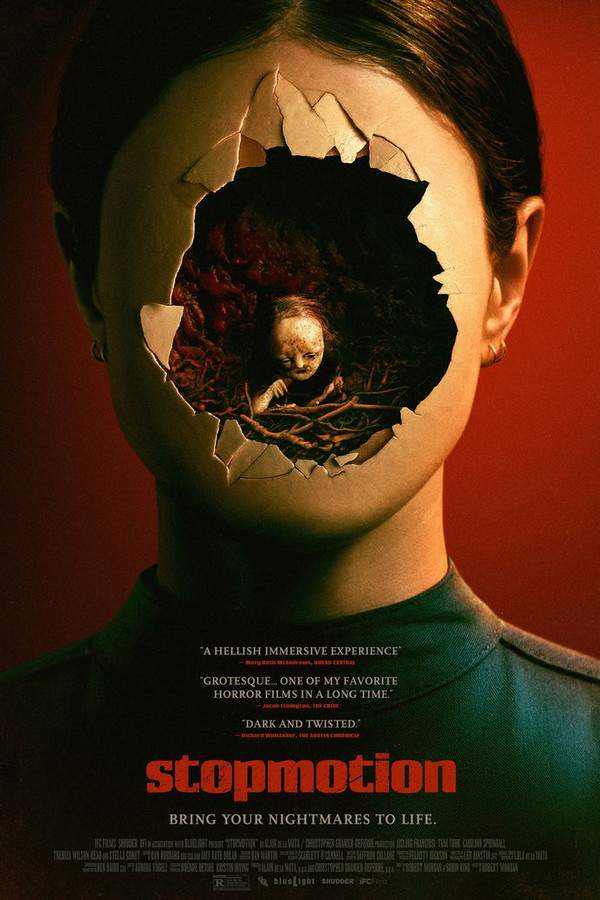
Stopmotion is a 2024 animated horror film directed by Robert Morgan, starring Aisling Franciosi as Ella Blake, Stella Gonet and Tom York. It runs 1 hour 33 minutes and earned $879,460 worldwide. Critics gave it 91% on Rotten Tomatoes and 65 on Metacritic.
- Released
- Runtime
- 1h 33m (93 min)
- Director
- Robert Morgan
- Original language
-
 English
 - Studio
- Blue Light
- After the credits
- No No extra scene
What Is Stopmotion About?
The premise of Stopmotion without spoilers. The whole story and the ending explained are in the plot summary further down.
A struggling animator is haunted by her past and overwhelmed by grief following the loss of her domineering mother. As she works, the lines between reality and nightmare begin to blur, and her inner demons threaten to take over. The film masterfully blends animation and horror, drawing the viewer into a disturbing and unsettling world.
Stopmotion Cast & Characters
Aisling Franciosi leads the cast as Ella Blake, with Stella Gonet as Suzanne Blake and Tom York as Tom. Directed by Robert Morgan; 8 actors are credited in all.
- Director Robert Morgan
-
 Aisling Franciosi as Ella Blake
 - Stella Gonet as Suzanne Blake
- Tom York as Tom
- Caoilinn Springall as Little Girl
Also Starring in Stopmotion
· 4 more- James Swanton Ash Man
- Jaz Hutchins Brett
- Bridgitta Roy Doctor Rai
- Joshua J Parker Will
Stopmotion Reviews & Ratings
Critics gave Stopmotion 91% on Rotten Tomatoes and 65 on Metacritic. Our Echo Score gives it 68/100, strongest in art & craft (90) and weakest in story & flow (40).
Stopmotion Echo Score Breakdown
Stopmotion offers a compelling visual showcase but struggles with narrative cohesion. Critical commentary highlights the film’s ability to build to a grotesque, darkly beautiful finale and its immersive stop-motion craftsmanship. However, many observers note that pacing issues and a meandering story weaken engagement, and certain genre tropes feel overly familiar. Despite strong individual components—such as dedicated performances—the film ultimately feels more impressive in style than in sustained narrative impact.
Our own 0–100 rating, built from five aspects: art, character, story, the sensory experience and how well a film rewatches.
- Art & Craft 90
The film’s stop-motion artistry stands out as its most striking element. In terms of direction and cinematography, critics praise the darkly beautiful finale, the meticulously crafted macabre creations, and the immersive camera movement. Production design and editing receive positive remarks for their contribution to a cohesive, haunting visual world. Overall, the craftsmanship elevates the film’s horror aesthetic.
- Character & Emotion 65
Character work in Stopmotion presents a mix of committed performances and limited depth. The central portrayal by Aisling Franciosi is noted as strong and emotionally invested, while supporting roles receive less development and occasional psychological ambiguity. Reviews highlight chemistry in key scenes but point out uneven dialogue and underwritten interactions. Consequently, the acting often rises above an otherwise underexplored character framework.
- Story & Flow 40
Narrative coherence and pacing prove to be the film’s weakest elements. Several reviewers describe the plot as forgettable or tedious, with genre tropes that resurface without significant reinvention and a slow, meandering rhythm. While some find originality in the meta intermingling of film-within-film sequences, most note that engagement suffers when suspense and character motivation do not consistently align. The uneven story structure undercuts overall immersion.
- Sensory Experience 85
Stopmotion delivers a potent sensory atmosphere through its design and soundscapes. Reviews uniformly highlight an immersive audio mix and a score that intensifies the unsettling tone, alongside a visual style that blends live action with meticulous stop-motion puppetry. Sound design punctuates key moments of tension, and the cohesive aesthetic reinforces the film’s eerie mood. Overall, the sensory elements combine to create a consistently haunting experience.
- Rewatch Factor 60
Rewatch appeal in Stopmotion is moderate, driven by its distinctive visual and atmospheric strengths. Observers note that the intricate stop-motion sequences and layered sound design invite further examination, revealing additional details on subsequent viewings. However, the uneven pacing and thin narrative undercut repeat engagement, as slower sections may feel less rewarding. Thus, while the film rewards curiosity about its craft, it may struggle to sustain interest beyond initial viewings.
-
 Rotten Tomatoes
 91% Tomatometer
Popcornmeter 49%
See on Rotten Tomatoes -
 Metacritic
 65 Metascore
User score 5.3
See on Metacritic -
 TMDB
TMDB 61% User score
See on TMDB -
 Letterboxd
 3.1 /5
68835 ratings
See on Letterboxd
Stopmotion Plot Summary & Ending Explained
What happens in Stopmotion from start to finish, spoilers included, with a timeline of 12 key events and the ending explained. The opening is below; the full summary is a 4-minute read.
Spoilers ahead
Ella Blake is a gifted yet burdened stop-motion animator whose arthritis makes hands tremble with every frame. She labors under the exacting eye of her mother, Suzanne Blake, a renowned filmmaker whose high standards often blur into pressure and control. When Suzanne suffers a stroke and slips into a coma, Ella vows to finish the film herself, hoping to honor her mother’s legacy even as the weight of abuse and exhaustion tightens around her.
Full summary
The whole story of Stopmotion, scene by scene, with the ending explained
Stopmotion Box Office
Stopmotion grossed $879,460 worldwide. $789,226 came from the US and Canada and $90,234 (10%) from the rest of the world.
Worldwide gross
$879.5K
- US & Canada
- $789.2K
- International
- $90.2K
Stopmotion Trailers & Videos
3 videos: 1 trailer and 2 clips.
- Clip Official Clip "Nightmare"
- Clip Official Clip "A New Tale"
How Well Do You Know Stopmotion?
10 questions about the story, each with a hint if you get stuck. Pick an answer to see whether you were right.
Question 1 of 10
- Question 1: not answered
- Question 2: not answered
- Question 3: not answered
- Question 4: not answered
- Question 5: not answered
- Question 6: not answered
- Question 7: not answered
- Question 8: not answered
- Question 9: not answered
- Question 10: not answered
Who is the renowned stop‑motion animator unable to use her hands because of arthritis?
Stopmotion Also Known As
9 alternative titles, including “Тьма играет в куклы” and “Вуду. Шёпот тьмы”.
- Also known as
-
- Тьма играет в куклы
- Вуду. Шёпот тьмы
- 定格恶魔
- 停格魔畫
- 스톱모션
- Stop kadras
- Лялькова анімація
- Кадар по кадар
- หลอน คลั่ง แอนิเมชันสยอง
Seen Stopmotion?
Stopmotion FAQ: Cast, Box Office & Runtime
Runtime, release date, director, cast, box office, ratings and post-credit scenes of Stopmotion, each answered in a sentence.
How long is Stopmotion?
Stopmotion runs 1 hour 33 minutes (93 minutes).
When was Stopmotion released?
Stopmotion was released on February 23, 2024.
Who directed Stopmotion?
Stopmotion was directed by Robert Morgan.
More films by Robert Morgan Who is in the cast of Stopmotion?
Stopmotion stars Aisling Franciosi as Ella Blake, Stella Gonet as Suzanne Blake and Tom York as Tom, among 8 credited actors.
How much did Stopmotion make at the box office?
Stopmotion grossed $879,460 worldwide ($789,226 domestic, $90,234 international).
How is Stopmotion rated?
Stopmotion has 91% on Rotten Tomatoes, 65 on Metacritic, 61% on TMDB and 3.1/5 on Letterboxd.
Does Stopmotion have a post-credit scene?
No. Stopmotion has no extra scene during or after the credits.
Coming soon to your phone
The Plot Explained Movie Summary App
From blockbusters to hidden gems: plot summaries, endings explained and timelines on your phone. Save your favorites and never miss a twist again.
Be the first to know when it launches. Your email stays private, always. Learn more about the app
