Mass 2021


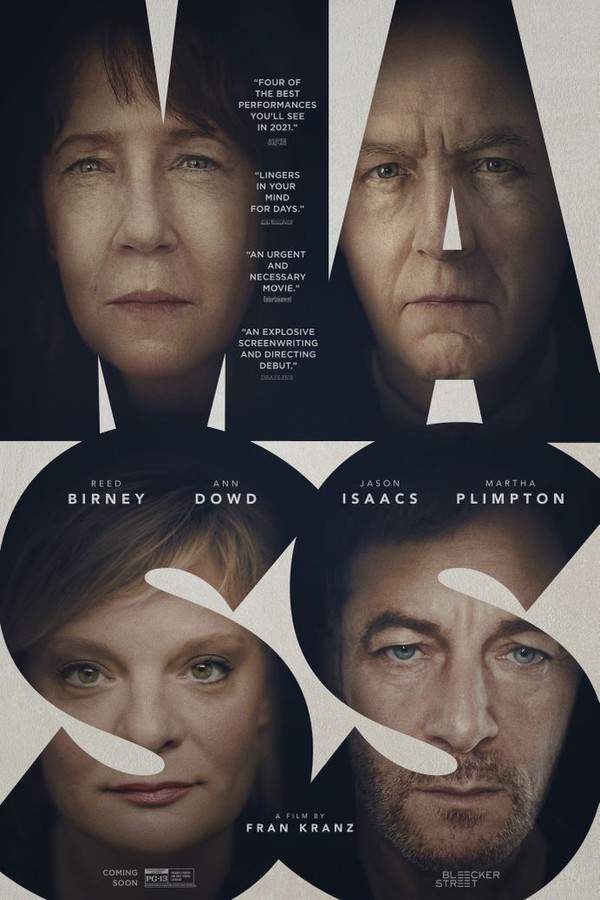
Following a tragic event, four parents—played by Jason Isaacs, Martha Plimpton, Reed Birney, and Ann Dowd—attend a support group to grapple with immense loss. The film explores their individual journeys through sorrow, anger, and a search for understanding. Director Fran Kranz examines the profound complexities of grief and the strength required to confront such devastating circumstances, offering a poignant and intimate portrait of resilience.

Does Mass have end credit scenes?
No!
Mass does not have end credit scenes. You can leave when the credits roll.
Where to Watch Mass
See current US streaming, rental, and purchase options for Mass (2021) via JustWatch.

Netflix
HD
Netflix Standard with Ads
HD
Hoopla
SD
Kanopy
HD
Fandango at Home Free
HD
Plex
HD
Plex Channel
HD
Tubi TV
SD
YouTube Free
HD
Amazon Video
HD
Apple TV Store
HD Fandango At Home
HD
Google Play Movies
SD
YouTube
SD Streaming availability powered by 
Meet the Full Cast and Actors of Mass
Explore the complete cast of Mass, including both lead and supporting actors. Learn who plays each character, discover their past roles and achievements, and find out what makes this ensemble cast stand out in the world of film and television.






External Links and Streaming Options
Discover where to watch Mass online, including streaming platforms, rental options, and official sources. Compare reviews, ratings, and in-depth movie information across sites like IMDb, TMDb, Wikipedia or Rotten Tomatoes.










Ratings and Reviews for Mass
See how Mass is rated across major platforms like IMDb, Metacritic, and TMDb. Compare audience scores and critic reviews to understand where Mass stands among top-rated movies in its genre.

The Movie Echo Score
Mass presents a tightly focused drama that hinges on the raw exchange between two grieving couples. Critics and viewers alike commend its unflinching emotional honesty and the potency of the quartet’s performances, while noting the static staging and occasional pacing lulls. The film’s thematic relevance and immersive atmosphere give it lasting impact, resulting in a strong overall impression. Its disciplined direction amplifies the claustrophobic setting, and the spare sound design reinforces the tension.
The Movie Echo Score Breakdown for Mass

Art & Craft
Direction and cinematography serve the screenplay’s confined setting with restrained yet purposeful choices. Reviewers highlight unobtrusive camera work that feels like eavesdropping and commend several striking shots that capture subtle reactions. Editing maintains a measured rhythm, though some critics note occasional stage‑like stiffness. Overall, the craft supports the narrative without drawing attention to itself.

Character & Emotion
Acting is uniformly praised as the film’s dominant strength, with the four leads delivering nuanced, emotionally resonant performances. Critics describe the ensemble as outstanding and capable of sustaining audience engagement through dialogue alone. A few personal viewer preferences introduce minor dissent, yet the consensus affirms the depth and chemistry of the characters.

Story & Flow
The screenplay relies on a dialogue‑driven structure that explores grief and forgiveness with measured pacing. Reviewers commend its originality and the way layers unfold, though some find the narrative slow to build and lacking unexpected twists. Overall, the story maintains engagement despite its minimalist approach.

Sensory Experience
The sound design is deliberately sparse, allowing ambient silence to heighten tension, while the absence of a guiding score reinforces realism. Visual composition includes focused close‑ups that reveal subtle emotional cues, earning praise for its understated yet effective style. Sensory choices complement the film’s intimate atmosphere.

Rewatch Factor
Despite its static setting, the film’s emotional intensity and strong performances encourage repeat viewings for deeper nuance. Critics note its lasting relevance and potential for theatrical adaptation, while some viewers acknowledge the demanding nature of its content. The overall rewatch value remains high for audiences seeking thoughtful drama.

81
Metascore
7.9
User Score


95%
TOMATOMETER

90%
User Score

7.6 /10
IMDb Rating

75
%
User Score

4.1
From 115 fan ratings

4.50/5
From 6 fan ratings
Awards & Nominations for Mass
Discover all the awards and nominations received by Mass, from Oscars to film festival honors. Learn how Mass and its cast and crew have been recognized by critics and the industry alike.


Full Plot Summary and Ending Explained for Mass
Read the complete plot summary of Mass, including all major events, twists, and the full ending explained in detail. Explore key characters, themes, hidden meanings, and everything you need to understand the story from beginning to end.
Jason Isaacs as Jay and Martha Plimpton as Gail are parents still bearing the weight of Evan’s death, the innocent boy who became a victim in a high school shooting. Ann Dowd as Linda and Reed Birney as Richard are the parents of Hayden, the teenage shooter who took his own life after the tragedy. Six years have passed, and the two couples agree to meet in a private room at an Episcopal Church to talk through the complex, painful aftershocks of that day. This meeting, born out of public pain and private longing for answers, becomes a careful, emotional attempt to understand what happened and why.
In the wake of public legal battles and frayed community narratives, Jay and Gail linger on the impulse to hurt back the people who have caused them so much pain. Yet the encounter slowly shifts toward a different kind of honesty: Jay has become a visible advocate for gun control, a stance that has sparked a brief, pointed exchange with Richard. The exchange opens the door to a longer, more truthful conversation about blame, responsibility, and what each family has endured since the event.
The conversation drifts back to their sons’ earlier years, when they were merely children in a world that felt possible and safe. Jay and Gail ask for details about Hayden’s upbringing that public reports have not fully captured, hoping to fill gaps in the narrative that haunt them. Richard and Linda answer with the humility that comes from years of living under a national spotlight, admitting that Hayden grew more withdrawn after family moves, the sense of losing footing, fewer friends, and persistent bullying at school. They also reveal that Hayden had friends who experienced bullying too, and that one of his friends had access to guns, facts that complicate the path from childhood to catastrophe.
A portion of the dialogue wrestles with motives and influence, including a brief debate over whether video games may have fed Hayden’s violent thoughts. The parents acknowledge failures in schools and therapists who did not recognize warning signs in time, and they speak openly about guilt and regret for not seeing the danger when it was present. The atmosphere is tense, respectful, and unflinchingly honest as they confront the boundaries between public perception and private life.
Tensions flare when Jay grows furious, venting his heartbreak in a way that underscores the fragility of their shared humanity. Amid the emotional storm, he breaks down as he recalls the moment Evan was taken from him, a memory that reaffirms why he has chosen a public stance on gun control. The others listen, and the room settles into a somber reflection on all the other families affected by the shooting—the victims, the survivors, and the long road of mourning.
Linda reveals a quiet, painful discovery: a notebook she found in Hayden’s room after the events, laying out his plans for the shooting and his suicide in the school library. She and Richard explain that, despite not condoning the act or erasing the harm, they still wanted to honor their son with a funeral that acknowledged the boy they loved before the violence changed everything. Linda speaks softly about wanting to remember the good memories of Hayden rather than erasing him entirely, a plea for nuance in a landscape of grief.
As their stories intertwine, Gail finds a gentler path to processing the loss. She recalls a memory of Evan when he was twelve, a moment that captures the warmth and potential that the parents once held onto. The act of sharing these memories helps them begin to forgive: Gail forgives Richard, Linda, and Hayden, and there is a cautious, hopeful sense that they might move forward without erasing the pain or pretending it never happened.
By the end, the four of them sit in quiet solidarity, hands joined in an unspoken pact to acknowledge each other’s pain without erasing it. Richard leaves for a business meeting, Linda stays briefly to speak once more with Gail and Jay, recounting a moment of fear when Hayden threatened her. She confesses that she would have liked to be confronted with the same fear to truly grasp the transformation Hayden underwent, a sentiment that moves Gail to offer comfort. A distant choir practice drifts through the church, and Jay, touched, becomes visibly emotional. Gail stands by him, offering support as they, too, prepare to part ways. What remains is a newly tempered sense of empathy and a fragile, tentative willingness to carry forward—together but differently—into the future.

Coming soon on iOS and Android
The Plot Explained Mobile App
From blockbusters to hidden gems — dive into movie stories anytime, anywhere. Save your favorites, discover plots faster, and never miss a twist again.
Sign up to be the first to know when we launch. Your email stays private — always.
Explore the mobile appWatch Trailers, Clips & Behind-the-Scenes for Mass
Watch official trailers, exclusive clips, cast interviews, and behind-the-scenes footage from Mass. Dive deeper into the making of the film, its standout moments, and key production insights.
Mass Themes and Keywords
Discover the central themes, ideas, and keywords that define the movie’s story, tone, and message. Analyze the film’s deeper meanings, genre influences, and recurring concepts.
Mass Other Names and Titles
Explore the various alternative titles, translations, and other names used for Mass across different regions and languages. Understand how the film is marketed and recognized worldwide.
Similar Movies To Mass You Should Know About
Browse a curated list of movies similar in genre, tone, characters, or story structure. Discover new titles like the one you're watching, perfect for fans of related plots, vibes, or cinematic styles.










-qUim83vQGP7CmQ.jpg)

Quick Links: Summary, Cast, Ratings, More

What's After the Movie?
Not sure whether to stay after the credits? Find out!
Check out our other apps:

SAT Sphere
Build confidence for the Digital SAT.

Mori Atlas
Discover wild places worth protecting.

Luntero
Search smarter for a home in Amsterdam.

Plot Explained
Unravel movie endings and hidden clues.

Pokechamp
Dive into Pokémon data and battle logic.

Driving Theory
Get ready for your European theory test.

Movie Dust
Plan your next cinema trip with ease.

Musemap
Find art and culture as you travel.

Selkobase
Compare credentials before committing.

Local Manual
Turn an unfamiliar country into practical next steps.

Lernavi
Compare school systems before your next move.

GymRoam
Find a workout stop wherever your plans take you.
Explore Our Movie Platform
New Movie Releases (2026)
Famous Movie Actors
Top Film Production Studios
Movie Plot Summaries & Endings
Major Movie Awards & Winners
Best Concert Films & Music Documentaries
Movie Collections and Curated Lists
© 2026 What's After the Movie. All rights reserved.
Privacy Policy