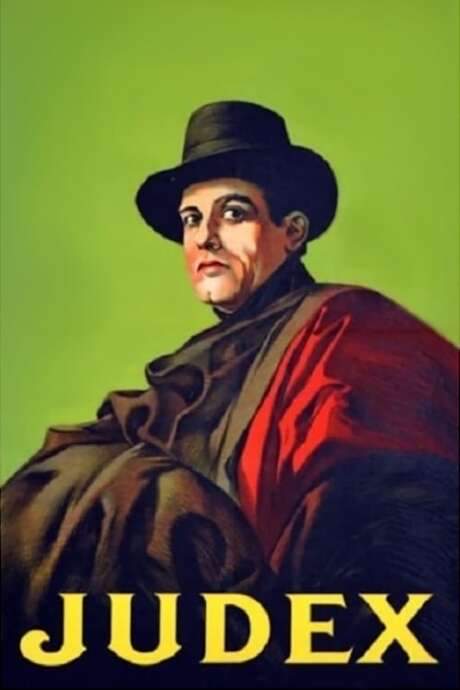
The story unfolds over twelve episodes. After a corrupt banker destroys his family, a determined young man adopts the masked persona of Judex to seek justice. Disguised and relentless, he tracks down criminals, punishes the guilty, and shields the innocent, embodying vigilant vengeance in a classic twelve‑part serial.

Does Judex have end credit scenes?
No!
Judex does not have end credit scenes. You can leave when the credits roll.
Where to Watch Judex
See current US streaming, rental, and purchase options for Judex (1916) via JustWatch.

Streaming availability powered by 
Meet the Full Cast and Actors of Judex
Explore the complete cast of Judex, including both lead and supporting actors. Learn who plays each character, discover their past roles and achievements, and find out what makes this ensemble cast stand out in the world of film and television.

Louis Feuillade
Yvette Andréyor
Jacqueline Aubry
Louis Leubas
Banker Favraux
René Poyen
The Boy Réglisse
Musidora
Diana Monti / Marie Verdier
Édouard Mathé
Roger de Tremeuse
Marcel Lévesque
Cocantin
Gaston Michel
Pierre Kerjean
Georges Flateau
Viscount de la Rochefontaine
René Cresté
Jacques de Tremeuse / Judex
Olinda Mano
Little Jean
Yvonne Dario
Countess de Tremeuse
Jean Devalde
Robert Moralés
Juliette Clarens
Gisèle
External Links and Streaming Options
Discover where to watch Judex online, including streaming platforms, rental options, and official sources. Compare reviews, ratings, and in-depth movie information across sites like IMDb, TMDb, Wikipedia or Letterboxd.




Take the Ultimate Judex Movie Quiz
Challenge your knowledge of Judex with this fun and interactive movie quiz. Test yourself on key plot points, iconic characters, hidden details, and memorable moments to see how well you really know the film.
Judex (1916) Quiz: Test your knowledge of the 1916 French silent film Judex.
Who is the masked vigilante protagonist of the film?
Full Plot Summary and Ending Explained for Judex
Read the complete plot summary of Judex, including all major events, twists, and the full ending explained in detail. Explore key characters, themes, hidden meanings, and everything you need to understand the story from beginning to end.
Banker Favraux Louis Leubas has built enormous wealth through swindles and blackmail, and his opulent mansion serves as the starting point for a web of danger and deception. A chilling note arrives, signed only with the name “Judex,” demanding that he return the stolen money to the victims. The threat unsettlesFavraux, prompting him to hire a discreet watchdog: Marcel Lévesque as Cocantin, who is tasked with keeping an eye on a high-society party where Favraux intends to publicly announce the engagement of his widowed daughter, Jacqueline Aubry Yvette Andréyor. The sense of looming peril thickens as the gathering of masked guests and hidden agendas unfolds.
At the heart of the household is Jacqueline, a mother to a small daughter named Alice, who moves through the story with a blend of warmth and quiet resilience. The governess in the home, Diana Monti, is not what she seems. Diana is actually Diana Monti / Marie Verdier, portrayed by Musidora, a calculated cat burglar who sees Favraux’s fortune as a means to secure her own future. Favraux himself is drawn to Diana, but she refuses to become his mistress and forces a dangerous bargain: they will marry, but only so she can unlock the fortune after his death. Diana’s true motive is plain—she plans to murder Favraux after the wedding to seize his wealth—yet she masks her intentions behind a veneer of charm and calculation.
Judex, a figure whose identity is known to be Jacques de Tremeuse, played by René Cresté, is not far from the events. He is a vigilante with a keen sense for justice, quietly watching Jacqueline and the family while pursuing his own form of retribution against those who abuse power. During the engagement party, a mysterious guest wearing a bird’s head entertains the masked attendees with magic tricks; what appears as spectacle turns out to be a reveal—the magician is Judex in disguise, quietly safeguarding Jacqueline and keeping Favraux under surveillance. The party reaches a tense crest when Favraux, as he begins to declare his engagement to Diana, appears to die of a heart attack.
The funeral of Favraux becomes a turning point. Jacqueline, having seen the letter from Judex, realizes the extent of her father’s illicit means and wealth. In a moment of moral clarity, she renounces most of her inheritance, choosing to reserve only enough to support Alice. The ethical choice signals a broader shift in the narrative’s moral arithmetic, reframing wealth as something to be reclaimed from crime rather than celebrated.
That night, Judex executes a bold rescue. Favraux is found alive but drugged in a coffin, and Judex brings him back into custody, imprisoning him in an abandoned castle as part of the intricate plan to dismantle the criminal web surrounding the family. Diana’s efforts to reclaim Favraux’s fortune through manipulation escalate into more desperate schemes, including attempts to kidnap Jacqueline and, later, Alice. These schemes are thwarted in part by Cocantin’s diligence and the relentless pursuit of Judex, who stays one step ahead of Diana’s dangerous plot.
With Favraux’s fate hanging in the balance, he sinks into despair over the loss of Diana and the collapse of his criminal empire, ultimately taking his own life. The struggle intensifies as Diana’s accomplices are confronted by Judex’s allies. On a building’s rooftop, Diana flees, and Daisy, a circus acrobat and friend of Cocantin, volunteers to help subdue the threat. Daisy climbs the exterior and confronts Diana in a dramatic duel—Diana, dressed in black, clashes with Daisy in white, and the confrontation ends with Diana’s death.
In the aftermath, Judex and Jacqueline are briefly, but profoundly, reunited. They walk along the beach as the film concludes with a tribute: a title card reading “In homage to Louis Feuillade, in memory of a time that was not happy: 1914.” The narrative emphasizes justice pursued through careful restraint, courage, and the reclaiming of truth from a world built on deceit.
This tale blends intrigue, charity, and steadfast vigilante justice, anchored by a cadre of memorable characters. Favraux’s downfall is not a simple fall from grace but a carefully orchestrated chain of revelations that culminate in moral clarity for Jacqueline and a vindicating triumph for Judex. The film’s mood oscillates between gothic atmosphere and restrained melodrama, late in the silent era’s tradition of grand set pieces, masked identities, and the quiet, unyielding resolve of those who refuse to let crime go unanswered.

Coming soon on iOS and Android
The Plot Explained Mobile App
From blockbusters to hidden gems — dive into movie stories anytime, anywhere. Save your favorites, discover plots faster, and never miss a twist again.
Sign up to be the first to know when we launch. Your email stays private — always.
Explore the mobile appDiscover Film Music Concerts Near You – Live Orchestras Performing Iconic Movie Soundtracks
Immerse yourself in the magic of cinema with live orchestral performances of your favorite film scores. From sweeping Hollywood blockbusters and animated classics to epic fantasy soundtracks, our curated listings connect you to upcoming film music events worldwide.
Explore concert film screenings paired with full orchestra concerts, read detailed event information, and secure your tickets for unforgettable evenings celebrating legendary composers like John Williams, Hans Zimmer, and more.


Judex Themes and Keywords
Discover the central themes, ideas, and keywords that define the movie’s story, tone, and message. Analyze the film’s deeper meanings, genre influences, and recurring concepts.
Judex Other Names and Titles
Explore the various alternative titles, translations, and other names used for Judex across different regions and languages. Understand how the film is marketed and recognized worldwide.
Similar Movies To Judex You Should Know About
Browse a curated list of movies similar in genre, tone, characters, or story structure. Discover new titles like the one you're watching, perfect for fans of related plots, vibes, or cinematic styles.







Quick Links: Summary, Cast, Ratings, More

What's After the Movie?
Not sure whether to stay after the credits? Find out!
Check out our other apps:

SAT Sphere
Build confidence for the Digital SAT.

Mori Atlas
Discover wild places worth protecting.

Luntero
Search smarter for a home in Amsterdam.

Plot Explained
Unravel movie endings and hidden clues.

Pokechamp
Dive into Pokémon data and battle logic.

Driving Theory
Get ready for your European theory test.

Movie Dust
Plan your next cinema trip with ease.

Musemap
Find art and culture as you travel.

Selkobase
Compare credentials before committing.

Local Manual
Turn an unfamiliar country into practical next steps.

Lernavi
Compare school systems before your next move.

GymRoam
Find a workout stop wherever your plans take you.
Explore Our Movie Platform
New Movie Releases (2026)
Famous Movie Actors
Top Film Production Studios
Movie Plot Summaries & Endings
Major Movie Awards & Winners
Best Concert Films & Music Documentaries
Movie Collections and Curated Lists
© 2026 What's After the Movie. All rights reserved.
Privacy Policy