Family Pack 2024

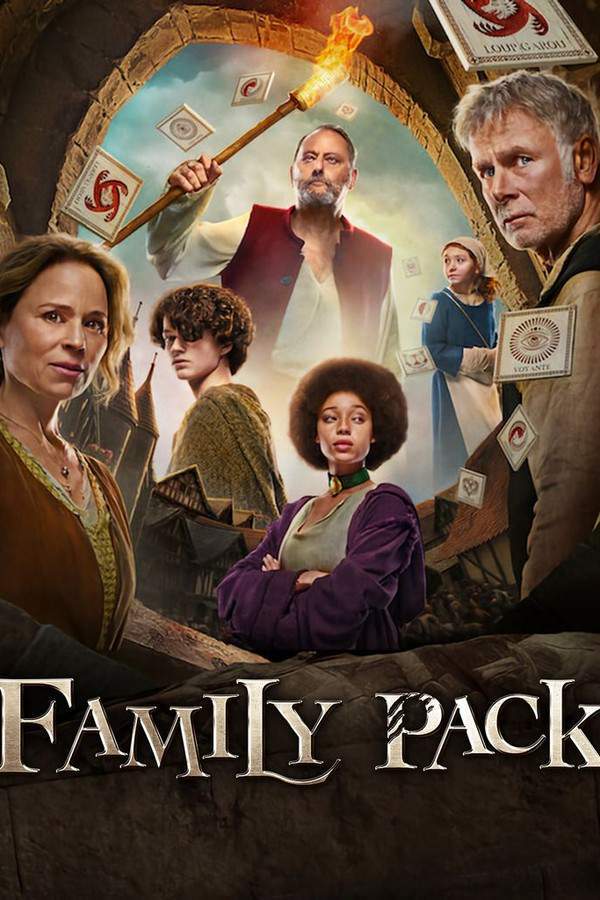
A grieving boy struggling with despair finds his life unexpectedly changed by an encounter with a ghost. As they navigate their connection, they discover their lives are intertwined in a way neither could have foreseen.

Does Family Pack have end credit scenes?
No!
Family Pack does not have end credit scenes. You can leave when the credits roll.
Meet the Full Cast and Actors of Family Pack
Explore the complete cast of Family Pack, including both lead and supporting actors. Learn who plays each character, discover their past roles and achievements, and find out what makes this ensemble cast stand out in the world of film and television.




External Links and Streaming Options
Discover where to watch Family Pack online, including streaming platforms, rental options, and official sources. Compare reviews, ratings, and in-depth movie information across sites like IMDb, TMDb, Wikipedia or Rotten Tomatoes.









Ratings and Reviews for Family Pack
See how Family Pack is rated across major platforms like IMDb, Metacritic, and TMDb. Compare audience scores and critic reviews to understand where Family Pack stands among top-rated movies in its genre.

The Movie Echo Score
Family Pack delivers a modestly entertaining family film but is hampered by uneven execution and polarized reception. While some viewers appreciate its playful spirit, practical costume work, and occasional humor, many criticize the thin plot, inconsistent character chemistry, and overt didactic elements. The mixed critical and user feedback reflects a film that satisfies younger audiences yet falls short of broader appeal. Consequently, its overall standing remains middling.
The Movie Echo Score Breakdown for Family Pack

Art & Craft
In terms of direction and visual craftsmanship, the film shows moments of effective production design, notably its practical werewolf costumes and set pieces that capture the board‑game aesthetic. Critics note the well‑packaged packaging and some reviewers praise the practical effects, yet others find the cinematography and editing unremarkable, describing the overall look as average. Thus, the art and craft receive a modest assessment.

Character & Emotion
When evaluating acting and character dynamics, the movie presents a mixed picture. Performances are described as mediocre, with several reviewers pointing out an unconvincing father‑son casting and overall lack of chemistry. A few viewers do note brief moments of empathy and effective humor from certain characters, but the majority find the cast unengaging. Consequently, character and emotional depth receive a low score.

Story & Flow
The narrative structure is frequently labeled as thin and predictable, with many critics highlighting contrived plot devices and a lack of originality. Some audience members, however, enjoy the straightforward pacing and occasional surprise twists that echo familiar adventure games. Despite these pockets of engagement, the overall consensus points to a story that fails to sustain interest, resulting in a below‑average rating.

Sensory Experience
Sensory elements, including the soundtrack and visual style, garner mixed reactions. Practical costume work and set design are praised for their realistic feel, and the English dub is considered serviceable. Conversely, visual effects are deemed average and some humor falls flat, leading to a perception of uneven auditory and visual cohesion. Overall, the sensory experience is judged as moderate.

Rewatch Factor
Rewatch value is limited, as many viewers describe the film as a one‑time family outing rather than a repeatable experience. While a subset of audiences appreciates its humor and nostalgic nods to board‑game adventures, the prevalent criticism of predictable plot and uneven tone diminishes its lasting appeal. Consequently, the movie offers modest replay potential, primarily for younger viewers.

5.6 /10
IMDb Rating

56
%
User Score

/5
Take the Ultimate Family Pack Movie Quiz
Challenge your knowledge of Family Pack with this fun and interactive movie quiz. Test yourself on key plot points, iconic characters, hidden details, and memorable moments to see how well you really know the film.
Family Pack Quiz: Test your knowledge about the 2024 film Family Pack.
Who is the family patriarch suffering from Alzheimer's?
Full Plot Summary and Ending Explained for Family Pack
Read the complete plot summary of Family Pack, including all major events, twists, and the full ending explained in detail. Explore key characters, themes, hidden meanings, and everything you need to understand the story from beginning to end.
In 2024, Jérôme Vassier travels with his family to visit his father, Gilbert, who is living with Alzheimer’s. He is accompanied by his wife, Marie, their daughter Louise, his daughter Clara from a previous union, and Théo, Marie’s son from a prior marriage. What begins as a playful nudge to play a game called Werewolves quickly spirals into an unsettling test of reality. When the family refuses the idea, the moment deflates, and an earthquake rattles the home.
As the tremor subsides, the house feels unfamiliar, and Clara vanishes. The Vassiers search for her and drift toward the village, noting eerie changes that initially seem tied to a medieval festival underway in the area. What they think might be staged appears to be something far more perilous: they witness the public execution of a shepherd condemned as a werewolf by the village captain, while reports of killings by beasts haunt the countryside. It becomes clear that the game has hurled them back to 1497, and the only way to win is to kill the four werewolves.
Their first obstacle is the captain and his retinue, who have seized Childéric’s house, an ancestor of the Vassiers suspected of witchcraft. The family manages a narrow escape when Jérôme frames them as a traveling troupe, “Daniel Baladin and the Baladettes,” a ruse strengthened by his musical skill. As a music teacher, he proves the claim by singing Mon fils ma bataille while playing the lute.
In this anachronistic world, Clara reappears as invisible and mute, tied to her role in the game as the “little girl” who can spy unseen. Only her father can hear her thoughts because he is a seer with telepathic gifts. That night, the werewolves prowl near the house, and Louise turns out to be one of them. By day, the little girl returns to normal, and the family slowly learns that each member of the clan has a role inherited from the game. Gilbert, the strong “hunter,” can fight, while Théo, the “thief,” can imitate others by using their belongings. Marie appears to have no powers, merely a common villager—yet she hides a deeper potential. With Louise revealed as the werewolf, the Vassiers reckon that killing the other three may spare the little girl.
Seeking clues, they question Childéric, who sits imprisoned as the crowd prepares for execution. He offers only a cryptic hint: the werewolves appeared after a “man with the skin of a wolf” departed the village. The clues multiply when the group encounters Piero, an Italian artist and scholar, who helps reveal Clara’s visibility with a rubber paste of his invention. Back in the village, a peasant woman about to be executed mutates into a werewolf and is shot dead. While saving her father from the beasts, Clara helps identify the last two monsters: a woman with whitened hands and a stout man who limps.
The Vassiers decide to use Louise’s sense of smell to track the remaining creatures during daylight. The stout man is killed by Gilbert, but Marie is soon imprisoned for witchcraft after defending a woman enduring domestic violence. The tension peaks when Childéric and Marie are slated for burning in the village square; Jérôme distracts the crowd by singing > Allumer le feu, allowing the others to free them. After escaping, Piero advises seeking refuge in a church through a secret tunnel, yet the tunnel remains elusive. The final werewolf arrives alongside the captain, who reveals himself to be “Cupid.” The werewolf is Cupid’s wife, and destroying her would mean Cupid’s death as well. United, the Vassiers face the monster, aided at times by Louise, who reverts to a werewolf before joining the fight as a form of shield and ally when the group sings > J’irai où tu iras, triggering a memory of parental love that helps her resist.
In a climactic turn, Marie unveils herself as the “witch” with the power to resurrect a player by killing another. She uses this power to slay the werewolf and simultaneously revive Clara. With three monsters eliminated, the game’s rule allows them to return to their own time by closing the game box. Before the transfer, Piero—who previously revealed his true self as an admirer of the art world—tells Jérôme that he has become his muse and dreams of returning to Florence to continue painting under his true name, “Leonardo Piero da Vinci.”
Back in the present, Jérôme discovers letters his father wrote at night, revealing that the game interrupted his illness and left him fully lucid. Their memory intact, the family visits the Louvre, where the Mona Lisa bears Jérôme’s likeness, a haunting reminder of the journey that linked love, memory, and time. The film closes on a meditation about family bonds, memory, and the way stories—whether games or memories—shape who we become.

Coming soon on iOS and Android
The Plot Explained Mobile App
From blockbusters to hidden gems — dive into movie stories anytime, anywhere. Save your favorites, discover plots faster, and never miss a twist again.
Sign up to be the first to know when we launch. Your email stays private — always.
Explore the mobile appWatch Trailers, Clips & Behind-the-Scenes for Family Pack
Watch official trailers, exclusive clips, cast interviews, and behind-the-scenes footage from Family Pack. Dive deeper into the making of the film, its standout moments, and key production insights.
Family Pack Themes and Keywords
Discover the central themes, ideas, and keywords that define the movie’s story, tone, and message. Analyze the film’s deeper meanings, genre influences, and recurring concepts.
Family Pack Other Names and Titles
Explore the various alternative titles, translations, and other names used for Family Pack across different regions and languages. Understand how the film is marketed and recognized worldwide.
Similar Movies To Family Pack You Should Know About
Browse a curated list of movies similar in genre, tone, characters, or story structure. Discover new titles like the one you're watching, perfect for fans of related plots, vibes, or cinematic styles.





Quick Links: Summary, Cast, Ratings, More

What's After the Movie?
Not sure whether to stay after the credits? Find out!
Check out our other apps:

SAT Sphere
Build confidence for the Digital SAT.

Mori Atlas
Discover wild places worth protecting.

Luntero
Search smarter for a home in Amsterdam.

Plot Explained
Unravel movie endings and hidden clues.

Pokechamp
Dive into Pokémon data and battle logic.

Driving Theory
Get ready for your European theory test.

Movie Dust
Plan your next cinema trip with ease.

Musemap
Find art and culture as you travel.

Selkobase
Compare credentials before committing.

Local Manual
Turn an unfamiliar country into practical next steps.

Lernavi
Compare school systems before your next move.

GymRoam
Find a workout stop wherever your plans take you.
Explore Our Movie Platform
New Movie Releases (2026)
Famous Movie Actors
Top Film Production Studios
Movie Plot Summaries & Endings
Major Movie Awards & Winners
Best Concert Films & Music Documentaries
Movie Collections and Curated Lists
© 2026 What's After the Movie. All rights reserved.
Privacy Policy