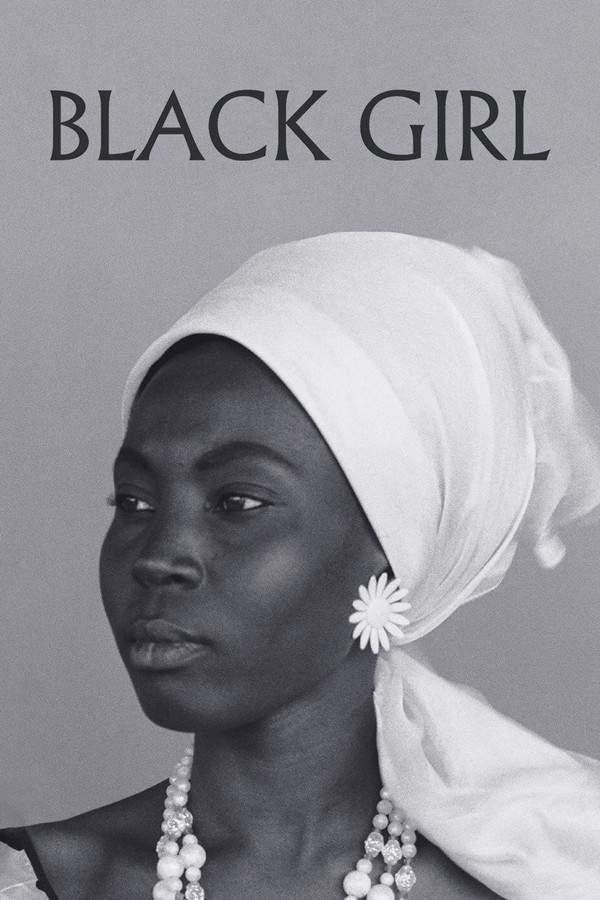
Black Girl 1966


Eager to find a better life abroad, a Senegalese woman becomes a mere governess to a family in southern France, suffering from discrimination and marginalization.

Does Black Girl have end credit scenes?
No!
Black Girl does not have end credit scenes. You can leave when the credits roll.
Meet the Full Cast and Actors of Black Girl
Explore the complete cast of Black Girl, including both lead and supporting actors. Learn who plays each character, discover their past roles and achievements, and find out what makes this ensemble cast stand out in the world of film and television.

Mbissine Thérèse Diop
Diouana
Robert Fontaine
Monsieur
Sophie
Couple's Daughter
Nar Sene
Diouana's Boyfriend
Ousmane Sembène
The Teacher (uncredited)
Toto Bissainthe
Diouana (voice)
Ibrahima Boy
Boy with Mask
Anne-Marie Jelinek
Madame
Bernard Delbard
Young Male Guest
Nicole Donati
Young Female Guest
Raymond Lemeri
Old Male Guest
Suzanne Lemeri
Old Female Guest
Philippe
Couple's Oldest Son
Damien
Couple's Youngest Son
Robert Marcy
Monsieur (voice)
Sophie Leclair
Madame (voice)
External Links and Streaming Options
Discover where to watch Black Girl online, including streaming platforms, rental options, and official sources. Compare reviews, ratings, and in-depth movie information across sites like IMDb, TMDb, Wikipedia or Box Office Mojo.





Take the Ultimate Black Girl Movie Quiz
Challenge your knowledge of Black Girl with this fun and interactive movie quiz. Test yourself on key plot points, iconic characters, hidden details, and memorable moments to see how well you really know the film.
Black Girl (1966) Quiz: Test your knowledge of the 1966 film Black Girl, exploring its characters, symbols, and key plot moments.
What occupation does Diouana assume after moving to France?
Full Plot Summary and Ending Explained for Black Girl
Read the complete plot summary of Black Girl, including all major events, twists, and the full ending explained in detail. Explore key characters, themes, hidden meanings, and everything you need to understand the story from beginning to end.
Diouana, Mbissine Thérèse Diop, grows up in a poor village just outside Dakar, where life is hard and opportunities are scarce. Illiteracy is common in her world, and she wanders the city in search of a stable job. One day, the couple arrives at the square—a refined doorway to a different life—and, through a quiet moment of judgment rather than insistence, Diouana is chosen. The selection is described as much by what she doesn’t do as by what she does: she isn’t pushy or loud, so she is noticed. The couple, Monsieur Robert Fontaine, and Madame Anne-Marie Jelinek, hire her to care for their children, and as a token of her new status, she gifts them a traditional mask she bought for 50 guineas. They place this mask on display in their home, a symbol that will come to haunt her future.
Back home in Senegal, Diouana’s world still hums with the simple rhythms of daily life. She spends time with her boyfriend, Nar Sene, and she savors a sense of freedom that seems possible through the new opportunity she’s earned. Her mind fills with dreams of a brighter life in France, where she imagines new vistas and a future far removed from the confines of her old village. The dream becomes a tangible plan, and Diouana is thrilled to begin a new chapter with the couple in Europe.
Yet the move to France reshapes the life she anticipated. In the country she once imagined as a land of possibility, she is confronted with a different fate: she is pressed into endless rounds of cooking and cleaning, serving the host and their circle of friends, with little room to breathe or to explore. Madame treats her with cool disdain, and the home becomes a cage rather than a gateway to freedom. Diouana, dressed in a fine dress and heels for work, is forced to shed the glamour of her new life as soon as the door closes behind her. The stark line between employer and employee is drawn in every corner of the apartment, and the mask they keep on display serves as a constant, silent reminder of a history she has tried to leave behind.
At one of the couple’s dinner parties, a guest crosses a line that underscores the racial dynamics at play: he leans in to kiss Diouana on the cheek, explaining, “I’ve never kissed a black girl before.” The moment is jarring and emblematic, a reminder that her presence in their home is both desired and exoticized. The tension deepens as Diouana receives a letter from her mother, read aloud by Monsieur, in which she asks why she hasn’t heard from home and requests money. The moment is painful in its simplicity, and Diouana’s rejection of the letter—tearing it up—speaks volumes about her stubborn determination to control her own fate.
A further struggle centers on the small, personal object she brought with her—her mask. When Diouana tries to reclaim it, a confrontation unfolds, revealing a power dynamic that treats her as disposable if she cannot perform the duties expected of her. Madame makes the demand explicit: if Diouana cannot work, she cannot eat. The moral economy of the household stares back at Diouana with merciless clarity.
As the pressure mounts and hope wanes, the tension collapses into a final act of despair. Diouana refuses to accept the salary Monsieur offers, choosing instead to reject the unequal bargain that binds her to a life of servitude in a country she hoped would welcome her. The tragedy culminates in a quiet, devastating act: Diouana slits her throat in the bathtub, a heartbreaking assertion of autonomy in the face of crushing oppression.
The film closes with Monsieur returning to Senegal to deliver Diouana’s suitcase, the mask, and the money from their failed arrangement. He offers money to Diouana’s mother, who refuses it, choosing to honor her daughter’s dignity in another way. As he leaves the village, a small boy—carrying the same mask that Diouana had given as a gift—trots along behind him, a stark, lingering image of memory and loss that haunts the story’s last note.
Don’t forget that you are a maid.
I’ve never kissed a black girl before!
In this haunting meditation on memory, migration, and the fraught exchange between desire and domination, the film uses intimate detail to reveal the larger forces at work — the pull of a promised future, the weight of racial and class expectations, and the quiet, devastating price paid when power and kindness fail to align. The performances ground the film in a restrained realism, with Diouana’s arc moving from hopeful anticipation to a tragic, unambiguous sense of wrongness faced head-on by a system that offers opportunity but imposes great cost. The mask that started as a humble gift becomes a symbol of memory, loss, and the enduring ache of a life disrupted by forces that cannot be easily named or escaped.

Coming soon on iOS and Android
The Plot Explained Mobile App
From blockbusters to hidden gems — dive into movie stories anytime, anywhere. Save your favorites, discover plots faster, and never miss a twist again.
Sign up to be the first to know when we launch. Your email stays private — always.
Explore the mobile appWatch Trailers, Clips & Behind-the-Scenes for Black Girl
Watch official trailers, exclusive clips, cast interviews, and behind-the-scenes footage from Black Girl. Dive deeper into the making of the film, its standout moments, and key production insights.
Black Girl Themes and Keywords
Discover the central themes, ideas, and keywords that define the movie’s story, tone, and message. Analyze the film’s deeper meanings, genre influences, and recurring concepts.
Black Girl Other Names and Titles
Explore the various alternative titles, translations, and other names used for Black Girl across different regions and languages. Understand how the film is marketed and recognized worldwide.
Similar Movies To Black Girl You Should Know About
Browse a curated list of movies similar in genre, tone, characters, or story structure. Discover new titles like the one you're watching, perfect for fans of related plots, vibes, or cinematic styles.






Quick Links: Summary, Cast, Ratings, More

What's After the Movie?
Not sure whether to stay after the credits? Find out!
Check out our other apps:

SAT Sphere
Build confidence for the Digital SAT.

Mori Atlas
Discover wild places worth protecting.

Luntero
Search smarter for a home in Amsterdam.

Plot Explained
Unravel movie endings and hidden clues.

Pokechamp
Dive into Pokémon data and battle logic.

Driving Theory
Get ready for your European theory test.

Movie Dust
Plan your next cinema trip with ease.

Musemap
Find art and culture as you travel.

Selkobase
Compare credentials before committing.

Local Manual
Turn an unfamiliar country into practical next steps.

Lernavi
Compare school systems before your next move.

GymRoam
Find a workout stop wherever your plans take you.
Explore Our Movie Platform
New Movie Releases (2026)
Famous Movie Actors
Top Film Production Studios
Movie Plot Summaries & Endings
Major Movie Awards & Winners
Best Concert Films & Music Documentaries
Movie Collections and Curated Lists
© 2026 What's After the Movie. All rights reserved.
Privacy Policy