Black Cat Mansion 1958


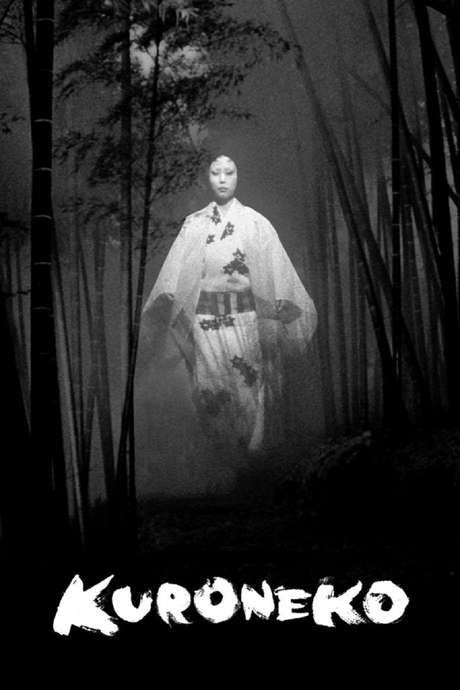
When the servant’s descendant returns to her birth town, she discovers that a vengeful cat — inhabited by the restless spirits of everyone the cruel samurai once murdered — is hunting her. The feline seeks retribution for the samurai’s brutal legacy.


Does Black Cat Mansion have end credit scenes?
No!
Black Cat Mansion does not have end credit scenes. You can leave when the credits roll.
Meet the Full Cast and Actors of Black Cat Mansion
Explore the complete cast of Black Cat Mansion, including both lead and supporting actors. Learn who plays each character, discover their past roles and achievements, and find out what makes this ensemble cast stand out in the world of film and television.

Sakutarō Yamakawa
Kichizou
Hiroaki Kurahashi
Kenichi (segment "Present Day")
Kan Sugi
Suizen
Noriko Kitazawa
Yae (segment "Period Drama")
Arata Shibata
Ishido Sakon (segment "Period Drama")
Fujie Satsuki
Old Woman (segment "Present Day")
Fumiko Miyata
Miyaji (segment "Period Drama")
Den Kunikata
Hachirota (segment "Period Drama")
Toshio Hosokawa
Tetsuichiro Kuzumi (segment "Present Day")
Rei Ishikawa
Saheiji (segment "Period Drama")
Eijirô Kawai
Driver (segment "Present Day")
Yuriko Ejima
Yoriko (segment "Present Day")
Midori Chikuma
Nurse (segment "Present Day")
Keinosuke Wada
Ishido Shinnojo (segment "Period Drama")
Ryūzaburō Nakamura
Ryutanji Kokingo (segment "Period Drama")
Yuko Tsuji
Osato (segment "Period Drama")
Akiko Mie
Satsuki (segment "Period Drama")
Kōji Hirose
Sudo (segment "Present Day")
External Links and Streaming Options
Discover where to watch Black Cat Mansion online, including streaming platforms, rental options, and official sources. Compare reviews, ratings, and in-depth movie information across sites like IMDb, TMDb, Wikipedia or Letterboxd.




Take the Ultimate Black Cat Mansion Movie Quiz
Challenge your knowledge of Black Cat Mansion with this fun and interactive movie quiz. Test yourself on key plot points, iconic characters, hidden details, and memorable moments to see how well you really know the film.
Black Cat Mansion Quiz: Test your knowledge of the 1958 Japanese horror film Black Cat Mansion, covering its plot, characters, and folklore elements.
What illness is Yoriko suffering from when she moves to Spiraea Mansion?
Full Plot Summary and Ending Explained for Black Cat Mansion
Read the complete plot summary of Black Cat Mansion, including all major events, twists, and the full ending explained in detail. Explore key characters, themes, hidden meanings, and everything you need to understand the story from beginning to end.
In a hospital during a power outage, Dr. Tetsuichiro Kuzumi [Toshio Hosokawa] finds his thoughts drifting to a chain of memories. A memory unfolds in which he and his wife, Yoriko, leave bustling Tokyo behind, moving to a centuries-old house in Kyushu to help cure her tuberculosis. They are not alone; Yoriko is accompanied by her elder brother Kenichi. As the car glides along the road, their driver [Eijir Kawai] notices a black cat cross their path, and a near accident sends them teetering toward a railing and the sea. They eventually reach Spiraea Mansion, a looming, spine-tingling estate, where Yoriko’s first impressions are filled with unease: a cat, a flock of crows, and a bloodstained wall, and a fleeting glimpse of an eerie old woman, Old Woman, who vanishes before others can confirm her presence.
Inside, Tetsuichiro transforms part of the mansion into a clinic, hoping the setting will aid Yoriko’s fragile health. The old woman reappears at the clinic, startling Tetsuichiro’s assistant and triggering the dog Taro to bark. When the assistant departs to fetch the doctor, the old woman vanishes—only to return moments later and choke Yoriko, though she does not kill her. Later, the same figure reappears and tells Tetsuichiro that a family has a sick child, prompting him to ride out on a rickshaw. He arrives and finds that the family did not summon him, and in his absence the old woman murders Taro and copies Tetsuichiro’s voice to gain entry, where she again strangles Yoriko. Yoriko later speaks of dreams in which cats bite her. Curious and unsettled, Tetsuichiro and Kenichi visit a Buddhist temple, where a priest begins to recount the mansion’s history and its dark reputation.
The story then slips back in time to the Sengoku period (c. 1467–1600). The house is revealed to be Spiraea Mansion, governed by the short-tempered lord Ishido Sakon no Shogen [Arata Shibata]. When Kokingo, a samurai, is ordered to teach Shogen how to play Go, Kokingo accuses the lord of cheating, and Shogen murders him with a sword. Miyaji, Kokingo’s blind mother, learns of her son’s death and Shogen’s role in it. In the wake of tragedy, Miyaji urges her cat Tama to avenge Kokingo and Miyaji. The cat licks up Miyaji’s blood as a cursed thread winds through the generations. Shogen’s son Shinnojo longs to marry a servant named Yae [Noriko Kitazawa], but their union faces class barriers. An attempted blessing from Shogen is refused, and Shogen’s abuse continues; Shinnojo confronts his father, and apparitions of Kokingo and Miyaji haunt the dining hall. The shape-shifting bakeneko (a supernatural cat) uses Miyaji’s appearance to strike, killing a servant named Sato, and ultimately both Shogen and Shinnojo perish in a sword fight. The tale—told by a temple priest—links Saheiji to Yoriko, revealing that Saheiji is Yoriko’s ancestor and offering a protective charm to ward off evil spirits.
As a storm rages that night, the wind tears away the charms. Tetsuichiro moves to close the shutters, and the old woman resurfaces to strangle Yoriko once more. The wall of Yoriko’s room crumbles, unveiling the mummified skeleton of Kokingo. Back in the present hospital, it’s explained that Yoriko and Tetsuichiro buried Kokingo’s remains properly, giving him a final rest. Yoriko, now sensing a new sense of peace, discovers a small cat and joyfully adopts it, a quiet and hopeful note after the long night of hauntings.
The film moves with an unhurried, steady rhythm that threads a medical crisis in the present with a tragic lineage from the past. The atmosphere blends clinical immediacy with an almost folkloric dread, as the house’s walls seem to whisper the stories of lovers and warriors, ghosts and go-sleep cat legends, and a family lineage that ties Yoriko to Saheiji and beyond. The performances fuse quiet, restrained emotion with supernatural suggestion, inviting viewers to feel the weight of history pressing down on a single family across centuries. In the end, the bone-deep resolve of Yoriko and Tetsuichiro to acknowledge and honor Kokingo’s memory offers a measure of closure, even as the mansion’s shadows linger in memory.

Coming soon on iOS and Android
The Plot Explained Mobile App
From blockbusters to hidden gems — dive into movie stories anytime, anywhere. Save your favorites, discover plots faster, and never miss a twist again.
Sign up to be the first to know when we launch. Your email stays private — always.
Explore the mobile appWatch Trailers, Clips & Behind-the-Scenes for Black Cat Mansion
Watch official trailers, exclusive clips, cast interviews, and behind-the-scenes footage from Black Cat Mansion. Dive deeper into the making of the film, its standout moments, and key production insights.
Black Cat Mansion Themes and Keywords
Discover the central themes, ideas, and keywords that define the movie’s story, tone, and message. Analyze the film’s deeper meanings, genre influences, and recurring concepts.
Black Cat Mansion Other Names and Titles
Explore the various alternative titles, translations, and other names used for Black Cat Mansion across different regions and languages. Understand how the film is marketed and recognized worldwide.
Similar Movies To Black Cat Mansion You Should Know About
Browse a curated list of movies similar in genre, tone, characters, or story structure. Discover new titles like the one you're watching, perfect for fans of related plots, vibes, or cinematic styles.




Quick Links: Summary, Cast, Ratings, More

What's After the Movie?
Not sure whether to stay after the credits? Find out!
Check out our other apps:

SAT Sphere
Build confidence for the Digital SAT.

Mori Atlas
Discover wild places worth protecting.

Luntero
Search smarter for a home in Amsterdam.

Plot Explained
Unravel movie endings and hidden clues.

Pokechamp
Dive into Pokémon data and battle logic.

Driving Theory
Get ready for your European theory test.

Movie Dust
Plan your next cinema trip with ease.

Musemap
Find art and culture as you travel.

Selkobase
Compare credentials before committing.

Local Manual
Turn an unfamiliar country into practical next steps.

Lernavi
Compare school systems before your next move.

GymRoam
Find a workout stop wherever your plans take you.
Explore Our Movie Platform
New Movie Releases (2026)
Famous Movie Actors
Top Film Production Studios
Movie Plot Summaries & Endings
Major Movie Awards & Winners
Best Concert Films & Music Documentaries
Movie Collections and Curated Lists
© 2026 What's After the Movie. All rights reserved.
Privacy Policy