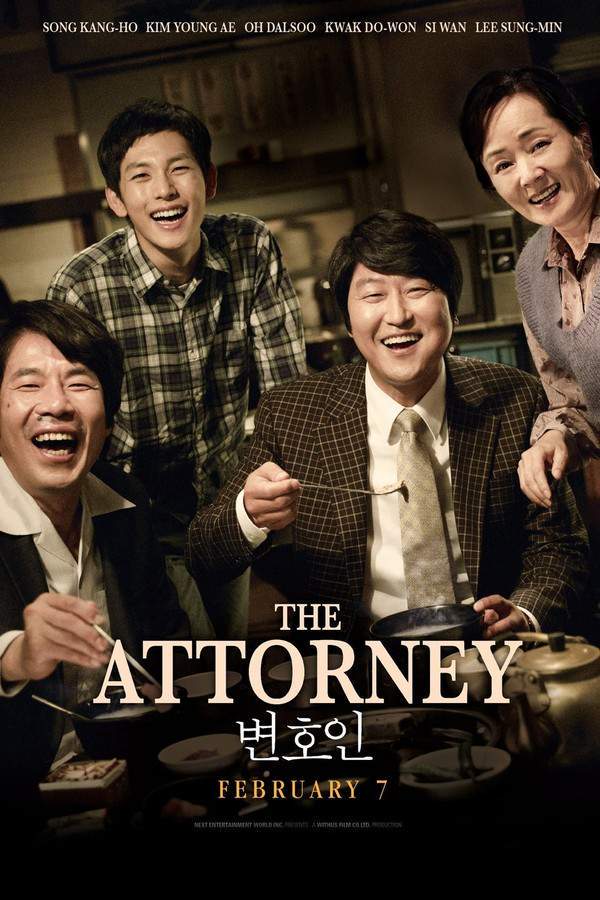
The Attorney 2014

Directed by

Woo-seok Yang
Made by

Well Go USA Entertainment
Where to Watch The Attorney
See current US streaming, rental, and purchase options for The Attorney (2014) via JustWatch.

Streaming availability powered by 
The Attorney Plot Summary
Read the complete plot summary and ending explained for The Attorney (2014). From turning points to emotional moments, uncover what really happened and why it matters.
In 1978, Song, a former judge with a distinctive and unconventional background, made a bold move by starting his own law firm in Busan. His unique journey to passing the bar exam was met with skepticism from many of his peers, who viewed him with contempt. Yet, Song’s unwavering determination and ingenuity eventually bore fruit, as he began to take on a myriad of high-profile cases that most shunned, particularly in lucrative real estate and taxation.
Meanwhile, Detective Cha was given directives from the upper echelons of the government to cleanse Busan of those considered to be communist sympathizers, resorting to any means necessary. His approaches often included deceit and manipulation. He was aided by Lieutenant Yoon, a medical officer assigned to a nearby military base, who helped him silence the victims of this oppressive regime.
Fast forward to 1981, Song’s reputation had ballooned. He had even purchased a sailboat in anticipation of competing in the prestigious Seoul Olympics. One fateful evening, while sharing a meal with old friends at his preferred restaurant, he engaged in a heated debate with Lee, a journalist who critically questioned the mass media’s integrity and supported the ongoing student protests disturbing Busan. This confrontation left a significant impression on Song, yet it was quickly eclipsed by a dire concern: the sudden disappearance of Park, the son of the restaurant’s owner.
Desperate for answers, Choi, Park’s anguished mother, spent nearly two months searching for her son, only to discover that he and several other students were slated to stand trial for sedition. Disturbed by the looming threat of torture-induced confessions, Song resolved to represent the students. During the trial, he observed grave constitutional violations but was met with staunch opposition from the prosecutors and judges, who proclaimed that standard laws were irrelevant when national security was at stake. The prosecution’s case hinged on the notion that the students had studied EH Carr’s What Is History?, alleging that it indicated communist leanings. Song fought back by presenting a note from the British consulate verifying Carr’s stature as a respected historian and diplomat, not a communist ideologue. To his shock, when Cha testified, he outright denied the students had suffered torture, attributing their injuries to self-harm.
However, when Lt. Yoon bravely stepped forward to testify, the courtroom atmosphere shifted dramatically. With remarkable integrity, he recounted the horrific tortures inflicted upon the students. Unfortunately, Cha was quick to inform his superiors, who spun a false narrative, ultimately pinning the blame on Lt. Yoon for desertion and invalidating his testimony. This led to dire repercussions as Lt. Yoon was promptly incarcerated, leaving the trial in disarray.
The innocence of the students was forever tarnished by the atrocities they endured. By 1987, Song had transformed into a fervent protest leader, propelled by an unquenchable desire for reform. His eventual arrest during a demonstration, where he faced sedition charges, drew an overwhelming show of support — an astounding 99 out of 142 lawyers in Busan united in solidarity, illustrating the undeniable strength of conviction and a steadfast commitment to justice.
Despite the impressive display of solidarity, the underlying issues of free speech and the rule of law continued to simmer ominously, poised to erupt at any moment. As the reverberations of these turbulent times continued to echo, it became increasingly evident that Korea’s quest for truth and transparency remains far from complete, leaving a haunting feeling of uncertainty that looms over the nation like a specter waiting to pounce.
The Attorney Timeline
Follow the complete movie timeline of The Attorney (2014) with every major event in chronological order. Great for understanding complex plots and story progression.
Song Establishes His Law Firm
In 1978, Song, a former judge, decided to break away from conventional legal practices and established his own law firm in Busan. His unique background and determination were met with skepticism, yet he aimed to tackle high-profile cases that other lawyers shunned.
Detective Cha's Orders
Around the same time, Detective Cha received directives from government officials to purge Busan of those suspected of being communist sympathizers. This mission often led him to adopt ruthless methods, utilizing deceit and manipulation to achieve his goals.
Rise to Prominence
By 1981, Song's law firm gained a formidable reputation for taking on challenging cases in real estate and taxation. His success allowed him to indulge in personal pursuits, including the purchase of a sailboat for the upcoming Seoul Olympics.
Confrontation with Journalist
During a dinner with friends in 1981, Song engaged in a heated debate with journalist Lee about the integrity of mass media. Their discussion was charged with tension as it addressed the ongoing student protests in Busan, foreshadowing greater conflicts ahead.
Park's Disappearance
Following the debate, Park, the son of the restaurant owner, mysteriously vanished. This alarming event triggered Choi, Park's distraught mother, to undertake a desperate search lasting nearly two months, ultimately revealing a harrowing truth.
Trial of the Missing Students
Choi discovered that her son and other students were facing trial for sedition. Disturbed by the possibility of torture-induced confessions, Song took it upon himself to defend the students, highlighting the severe violations of their rights during the trial.
Opposition in Court
During the trial proceedings, Song faced immense resistance from the prosecution, who claimed national security concerns nullified standard legal protections. Their argument against the students stemmed from their study of EH Carr's *What Is History?*, misinterpreted as a sign of communist ideology.
Cha Testifies
To Song's dismay, Detective Cha testified that the students' injuries were self-inflicted, denying any state-sponsored torture. This assertion demonstrated the extensive measures the oppressive regime took to protect its image and silence dissent.
Lt. Yoon's Brave Testimony
In a pivotal moment, Lieutenant Yoon spoke out in court, providing a detailed account of the horrific torture the students endured. His courageous stand shifted the courtroom dynamic, shedding light on the darker realities of the oppressive regime.
Consequences for Lt. Yoon
Tragically, Lt. Yoon's testimony came with severe repercussions. Cha informed his superiors, who created a false narrative to discredit Yoon, resulting in his incarceration and leaving the trial in chaos as the truth continued to be obscured.
Song's Transformation
By 1987, Song had evolved into a fervent leader advocating for reform and justice. His journey culminated in his arrest during a protest, where he faced sedition charges, reflecting the struggles for free speech in an oppressive political landscape.
Solidarity Among Lawyers
Song's arrest sparked an extraordinary response from the legal community, with 99 out of 142 lawyers in Busan voicing their support. This unprecedented display of unity illustrated the deep-seated commitment to justice among those who witnessed the unfolding atrocities.
Continued Struggles
Despite the overwhelming support, the fundamental issues of free speech and the rule of law remained unresolved. The events of the past left a haunting sense of uncertainty looming over Busan, as the quest for truth and transparency persisted in the face of oppression.
The Attorney Characters
Explore all characters from The Attorney (2014). Get detailed profiles with their roles, arcs, and key relationships explained.
Song
Song is a determined and resourceful former judge who transitions into a lawyer with an unyielding commitment to justice. Though initially met with skepticism, he rises to prominence by taking on high-profile cases that expose government corruption. His character evolves from a cautious attorney to a passionate protest leader, embodying the struggle for reform.
Detective Cha
Detective Cha represents the oppressive forces of government, tasked with silencing dissenters. His character is driven by orders from above, leading him to manipulate and deceive in service of a twisted notion of national security. Cha's moral ambiguity adds depth to the narrative, revealing the toll of blind allegiance to authority.
Lieutenant Yoon
Lieutenant Yoon is a medical officer who struggles with the moral implications of his duties. He is one of the rare voices of integrity who courageously testifies against the government's brutal tactics. Yoon's character arc highlights the conflict between personal ethics and institutional pressure, showcasing the sacrifices made for truth.
Choi
Choi, the anguished mother of Park, epitomizes the personal cost of political strife. Her relentless search for her son showcases the devastating impact of authoritarian rule on families. Choi's character brings a human element to the story, emphasizing the parental instinct to protect and seek justice.
Lee
Lee is a journalist who challenges the status quo, raising questions about media integrity and government narratives. His debates with Song illustrate the tension between activism and journalism, showcasing the role of the media in social movements. Lee's character reflects the broader societal struggle for truth and accountability.
The Attorney Settings
Learn where and when The Attorney (2014) takes place. Explore the film’s settings, era, and how they shape the narrative.
Time period
1978-1987
The late 1970s and early 1980s in South Korea were marked by political unrest and authoritarian rule. This period saw widespread protests against government oppression and human rights abuses, particularly in the context of calls for democratization. The actions taken by the government reflected a broader struggle for justice and reform that would ultimately shape the nation's future.
Location
Busan, Seoul
Busan is South Korea's second-largest city, known for its bustling ports and beautiful beaches. It's a place where traditional culture meets modern urban life, often serving as a backdrop for significant historical events. Seoul, the capital, symbolizes South Korea's rapid modernization and development, providing a stark contrast to the struggles depicted in the film.
The Attorney Themes
Discover the main themes in The Attorney (2014). Analyze the deeper meanings, emotional layers, and social commentary behind the film.
⚖️
Justice
Justice serves as a central theme, highlighting the fight against oppression and the struggle for legal rights. The character of Song embodies the pursuit of truth in a system rife with corruption, showcasing the importance of standing up for the voiceless. This theme resonates strongly with the societal context, reflecting a call for reform and accountability.
✊
Resistance
The theme of resistance is prevalent as characters stand against government tyranny. The students' plight and the tumultuous protests illustrate a collective yearning for change and freedom. This theme underscores the courage required to challenge injustice and the significant impact of grassroots movements in shaping societal norms.
📜
Truth
Truth is a vital theme, particularly in the courtroom conflicts where factual representation collides with governmental narratives. The struggle to reveal the truth about torture and the wrongful prosecution of students reflects a wider quest for transparency and honesty in leadership. As characters navigate this terrain, the importance of fidelity to facts emerges as a powerful incriminating force.

Coming soon on iOS and Android
The Plot Explained Mobile App
From blockbusters to hidden gems — dive into movie stories anytime, anywhere. Save your favorites, discover plots faster, and never miss a twist again.
Sign up to be the first to know when we launch. Your email stays private — always.
Explore the mobile appThe Attorney Spoiler-Free Summary
Discover the spoiler-free summary of The Attorney (2014). Get a concise overview without any spoilers.
In the simmering streets of 1970s‑80s Busan, a city caught between rapid development and shadowed politics, the ordinary rhythm of daily life is punctuated by whispers of dissent and the lingering scent of corruption. The bustling ports, cramped cafés, and looming government institutions create a backdrop where ambition and conscience constantly collide, giving the city a restless, almost electric atmosphere that feels both hopeful and foreboding.
Song Woo‑seok, a fiercely intelligent former judge turned lawyer, has built a reputation as the city’s most polished defender of lucrative real‑estate and tax disputes. His rise from a doubted bar‑exam candidate to a charismatic figure in the legal elite is marked by a blend of razor‑sharp wit, unconventional tactics, and a taste for the finer things—sailboats, fine dining, and the promise of a comfortable future. Yet beneath his confident exterior lies a lingering unease, sparked by a chance encounter that forces him to confront a truth far darker than any courtroom strategy.
When a teenage accusation surfaces, suggesting a grave miscarriage of justice, Song finds himself at a crossroads. The allure of power and prestige begins to feel hollow as he weighs the personal cost of stepping away from his thriving practice to champion a cause that threatens everything he has built. The film’s tone balances tense, brooding drama with moments of quiet reflection, inviting the audience to wonder how far a man will go when his sense of right battles the entrenched systems that shape his world.
Featured on this page

What's After the Movie?
Not sure whether to stay after the credits? Find out!
Check out our other apps:

SAT Sphere
Build confidence for the Digital SAT.

Mori Atlas
Discover wild places worth protecting.

Luntero
Search smarter for a home in Amsterdam.

Plot Explained
Unravel movie endings and hidden clues.

Pokechamp
Dive into Pokémon data and battle logic.

Driving Theory
Get ready for your European theory test.

Movie Dust
Plan your next cinema trip with ease.

Musemap
Find art and culture as you travel.

Selkobase
Compare credentials before committing.

Local Manual
Turn an unfamiliar country into practical next steps.

Lernavi
Compare school systems before your next move.

GymRoam
Find a workout stop wherever your plans take you.
Explore Our Movie Platform
New Movie Releases (2026)
Famous Movie Actors
Top Film Production Studios
Movie Plot Summaries & Endings
Major Movie Awards & Winners
Best Concert Films & Music Documentaries
Movie Collections and Curated Lists
© 2026 What's After the Movie. All rights reserved.
Privacy Policy