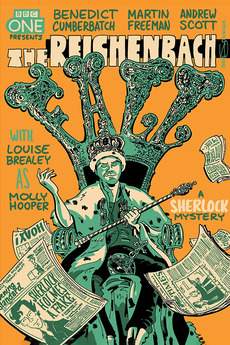
Sherlock: The Reichenbach Fall 2012

Directed by

Toby Haynes
Made by

Sherlock: The Reichenbach Fall Plot Summary
Read the complete plot summary and ending explained for Sherlock: The Reichenbach Fall (2012). From turning points to emotional moments, uncover what really happened and why it matters.
John Watson, Martin Freeman, sits in his first therapy session in eighteen months, trying to explain why he’s there, and he stumbles toward a devastating confession that frames the entire episode:
“My best friend, Sherlock Holmes, is dead.”
To understand how things spiraled there, the story rewinds to three months earlier, when Benedict Cumberbatch as Sherlock Holmes is riding high on a string of public praise. He has solved dangerous cases, recovered a valuable Turner painting of Reichenbach Falls, and helped Interpol trap a wanted criminal, all while a media circus swirls around him. The director of a project greets him with a wrapped gift, which Sherlock immediately deduces is a pair of diamond cuff-links—though he grumbles that he wears cuffs without buttons. The kidnapped banker’s son presents another wrapped gift, and Sherlock detects a tie pin, though he insists he does not wear ties. For the Interpol case, DI Lestrade offers a deerstalker cap as a present. The gifts feel like trophies and tests, all while Sherlock basks in attention that borders on fame.
Watson senses the danger in Sherlock’s growing notoriety. The press might turn on him, and the private detective’s days of quiet investigation could be over. So Watson counsels a low profile and a modest case to keep the spotlight from becoming overwhelming. Moriarty, ever the puppeteer, teases the edge of the crime world, nearly stealing the Crown Jewels to prove a point, then allows himself to be caught. He even brazenly taunts the security at the Bank of England and the Tower of London by exploiting his iPhone-powered tricks, all while work on the Tower burglary continues. Before smashing the Crown Jewels’ case, he writes the ominous words “Get Sherlock” on the outside to catch the cameras’ gaze, and then surrenders to the police wearing the jewels while sitting on a throne.
The tabloids explode with headlines about a “Crime of the Century,” framing a sequence of break-ins at the Tower, Pentonville Prison, and the Bank of England as the work of a single mastermind. A front door full of reporters and gawkers greets Sherlock and Watson as they head to court, and Kitty Riley, a sharp reporter, slips her business card into Sherlock’s jacket pocket while warning him that the press may soon turn on him and that he’ll need someone on his side.
In court, Sherlock testifies that Moriarty is a criminal genius who has threatened jurors into acquitting him. Moriarty has manipulated the system and the jurors through fear, claiming he can hack any bank, access nuclear launch codes, and wreak havoc—yet Sherlock cannot quite pin down the motive beyond Moriarty’s own desire to observe people and manipulate them for power. Moriarty casually admits that the break-ins were a publicity stunt designed to attract clients, confessing, “I owe you a fall.” A chilling line; the danger isn’t merely wealth or power, but the spectacle.
Meanwhile, Sherlock’s world is unsettled by the growing sense that someone is leaking his personal information. Mycroft, Mark Gatiss, unintentionally reveals details during interrogation with Moriarty, and those disclosures are weaponized to attack Sherlock’s reputation. Sherlock begins to notice a coded pattern—the anti-security code is hidden in the tapping of Moriarty’s fingers—and Moriarty’s aim is to corner him in a public collision.
The plot thickens as the team hunts for the source of the leak. They break into Kitty Riley’s home and discover Moriarty’s fake identity, Richard Brook (a.k.a. “Reichen Bach” in German), a ruse used to present himself as the mastermind behind every crime. With his cover now blown, Sherlock resolves to play a final gambit. He seeks help from Molly Hooper, Louise Brealey, a pathologist at St. Bartholomew’s, and confesses that he respects her and wants her assistance if he is to face Moriarty’s threats. Molly shares personal memories of her father’s death and the way people show happiness when others are nearby, offering Sherlock a rare chance to connect emotionally in the midst of danger.
As investigations pivot, Sherlock and Watson race to prevent further harm to a British ambassador’s children, Rufus Bruhl’s kin being abducted. Sherlock deciphers clues that help the police locate the children, but Moriarty has already manipulated events to mislead them, traumatizing one of the children to make her fear Sherlock herself. Sergeant Donovan, played by Vinette Robinson, grows suspicious, and the chief superintendent pushes Lestrade, Rupert Graves, toward making an arrest—only Sherlock escapes with Watson as a “hostage” during the confrontation. The world’s eyes turn toward the duo as they realize Moriarty’s “Get Sherlock” message has convinced the underworld that Sherlock is compromised and that the password to bypass security might exist.
In a tense pursuit, Sherlock and Watson infiltrate Kitty Riley’s newsroom and uncover Moriarty’s manipulation: the “master criminal” Richard Brook is just a front, and Moriarty has crafted a narrative designed to crash Sherlock’s credibility. With the trap closing in, Sherlock leaves John and seeks Molly’s help once more, admitting he knows someone betrayed him and that he is in grave danger. He also learns that Mycroft inadvertently disclosed sensitive information during earlier interrogations of Moriarty, a revelation that helps explain the public onslaught against him.
The final gambit hinges on Sherlock’s plan to erase the threat and outwit Moriarty once and for all. He arranges a rooftop rendezvous at St. Bartholomew’s Hospital, inviting Moriarty to face him one last time. Moriarty’s ultimatum is brutal: either Sherlock commits suicide, or Moriarty’s hitmen will finish the job for him, targeting John, Mrs. Hudson, and Lestrade. Sherlock, recognizing the deadly trap, feigns acquiescence but refuses to surrender. The two men acknowledge a profound similarity, and Moriarty swears that as long as he lives, Sherlock will be tested by danger. Then Moriarty overwhelms Sherlock with a choice that cannot be undone and ends his own life, saying, “As long as I am alive, you can save your friends.”
The moment of triumph is also a moment of tragedy. Sherlock calls John, explaining that the call was his “note” and leaps from the hospital roof, a decision that leaves John and Mrs. Hudson reeling with fear and grief as Sherlock’s body is carried away. John, stunned and heartbroken, watches as a cyclist knocks him to the ground before he reaches Sherlock’s side. The story returns to the therapy room, where John remains unable to open up fully, and Mycroft stands over The Sun, a tabloid revealing the headline “Suicide of Fake Genius.” Later, John visits Sherlock’s grave with Mrs. Hudson, affirming his faith that Sherlock is not truly gone, and then, in a quiet, haunting final beat, Sherlock is shown watching from a distance before stepping away again, leaving a sense of unresolved absence and the enduring bond between two friends.
The episode ends with the quiet ache of memory and the suggestion that the enigma of Moriarty—the man who could “solve” anything—has finally died with him, but the friendship between Martin Freeman and Benedict Cumberbatch remains, a knot of loyalty, fear, and genius that survives even the darkest hour.
Sherlock: The Reichenbach Fall Timeline
Follow the complete movie timeline of Sherlock: The Reichenbach Fall (2012) with every major event in chronological order. Great for understanding complex plots and story progression.
Present therapy session
John Watson attends his first therapy session in months, still struggling to articulate his purpose. He finally chokes out that Sherlock Holmes is dead, revealing the depth of his grief. The scene establishes the personal cost of the case on Watson's psyche.
Flashback begins: public acclaim for Sherlock
The story cuts back to three months earlier, where Sherlock basks in plaudits and gifts for solving high-profile cases. The press attention grows as he recovers the Reichenbach Falls painting and becomes a near-celebrity. Friends and institutions cheer his genius while the world starts to notice him.
Director's gift: cuff-links
The director presents a wrapped gift to Sherlock, which he immediately deduces to be a set of diamond cuff-links. He quips that his cuffs have buttons already, signaling his growing fame and his frustration with the trappings of success. The moment highlights Sherlock's sharp eye for detail even in casual exchanges.
Gift from a kidnapped man's son: a tie pin
A wrapped gift from the son of a kidnapped banker is revealed to be a tie pin, a gift Sherlock notes he does not wear yet again. He uses the small exchange to remind Watson that appearances and expectations have shifted around him. The exchange underscores how public perception is shaping Sherlock's choices.
Deerstalker cap from Lestrade
DI Lestrade gives Sherlock a barely-wrapped gift, a deerstalker cap, a tongue-in-cheek nod to his public image as a famous detective. Sherlock's reaction makes clear he still values work over celebrity, while the cap marks a transition from private to public life. The moment signals Moriarty's shadow looming over Holmes's career.
Public exposure and low-profile warning
Watson notices that Sherlock's fame brings intense media scrutiny and risk of a backlash. He urges Sherlock to keep a low profile and take on smaller cases to avoid becoming a target. Sherlock contemplates the price of his growing legend.
Moriarty's near-break-ins and the Get Sherlock note
Moriarty engineers near-simultaneous break-ins to test his reach, including the Crown Jewels theft attempt, while also infiltrating the Bank of England vault and even the prison system. Before smashing the Crown Jewels' case, he scrawls 'Get Sherlock' on the outside so security cameras reveal it. He then allows himself to be captured wearing the jewels and sitting on the throne.
Tabloid onslaught and Crime of the Century
The tabloids scream 'Crime of the Century' and question how all three institutions were broken into at once by the same criminal. The sensational coverage amplifies the perception that Sherlock Holmes might be involved or compromised. Public opinion begins to tilt toward suspicion rather than admiration.
Trial shadow: Moriarty's intimidation and acquittal
Sherlock testifies in court, presenting Moriarty as a criminal mastermind. Moriarty threatens the jurors with harm to their families, pushing them toward voting not guilty. The jurors acquit Moriarty under pressure, leaving Sherlock reeling and exposed.
Moriarty's philosophy and the final problem
Moriarty taunts Sherlock with his vast capabilities, claiming he can hack any bank and even has influence over nuclear launch codes. He reveals he enjoys observing people and their behavior to gain money and power, and that there is one last problem to solve. Sherlock struggles to decipher his motive or provide a counter-move.
Richard Brook: fake identity and reputational ruin
Sherlock discovers Moriarty has created a fake identity, Richard Brook (alias 'Reichen Bach' in German), as part of a master plan to ruin his reputation. The scheme intensifies when Sherlock and Watson confront Kitty Riley and public exposure looms. The constructed persona drives the public narrative toward doom for Holmes.
Final gambit: rooftop showdown and suicide
Sherlock and Moriarty stage a final confrontation on the hospital roof, with Moriarty offering Sherlock a choice to save his friends. Moriarty reveals there is no real anti-security code and that he has bribed guards; the choice collapses. Sherlock, recognizing there is no safe path, ultimately leaps to his death, ensuring Moriarty's identity dies with him.
Present-day wrap: tabloids and therapy
The scene returns to Watson's therapy, where he confronts the tabloid barrage and the sense that Sherlock's last note haunts him. A front-page article in The Sun proclaims 'Suicide of Fake Genius,' confirming the public scandal. Watson wrestles with grief and guilt while trying to reconcile the myth of Sherlock with the man he knew.
Present-day: Sherlock's grave and a glimmer of hope
Watson visits Sherlock's grave with Mrs. Hudson and reaffirms his faith that Sherlock is not truly gone. In a final quiet moment, Sherlock seems to observe from afar, reminding Watson that their bond remains. The scene closes with a sense of unresolved longing and the possibility that Sherlock's spirit still lingers.
Sherlock: The Reichenbach Fall Characters
Explore all characters from Sherlock: The Reichenbach Fall (2012). Get detailed profiles with their roles, arcs, and key relationships explained.
Sherlock Holmes (Benedict Cumberbatch)
A genius detective whose fame spirals into public spectacle. He thrives on puzzles but struggles with being a celebrity, press scrutiny, and the threat of public manipulation. The finale reveals a willingness to stake everything to outsmart Moriarty, even at the cost of his own life.
Dr. John Watson (Martin Freeman)
Holmes's loyal friend and physician, serving as the moral anchor and pragmatic counterweight to Holmes's swagger. He navigates the chaos of media sensationalism and tries to shield Holmes from self-destruction, serving as the emotional core of the story.
James Moriarty (Andrew Scott)
The criminal mastermind who uses the spectacle of crime to prove his superiority over Sherlock. He toys with public perception, hacking myths of power and control, and drives the narrative toward a climactic confrontation.
Kitty Riley (Katherine Parkinson)
A reporter who signals the press's appetite for scandal and uses Sherlock's image as a tool. Her presence foreshadows a larger expose that tests the detective's relationships and trust with the media.
Molly Hooper (Louise Brealey)
A pathologist who becomes a quiet confidante and ally to Sherlock. She reveals vulnerability in Holmes's world, offering support and insight at critical moments and guiding him toward a possible path of redemption.
Mycroft Holmes (Mark Gatiss)
Sherlock's older brother who operates in the shadows of government. He holds vast information and inadvertently feeds Moriarty, highlighting the tension between public service and personal loyalty.
DI Lestrade (Rupert Graves)
A police detective pressed by media and political pressure, trying to manage Sherlock's reputation as a suspect while chasing the truth. He stands at the crossroads of law, risk, and public opinion.
Mrs. Hudson (Una Stubbs)
The steadfast landlady who witnesses the unpredictable chaos around Sherlock and John's life. Her steady presence provides a thread of normalcy in the storm of events.
Sherlock: The Reichenbach Fall Settings
Learn where and when Sherlock: The Reichenbach Fall (2012) takes place. Explore the film’s settings, era, and how they shape the narrative.
Time period
2010s
Set in the present day, the events unfold within a media-saturated London. The plot relies on modern technology and real-time paparazzi culture, including tabloid sensationalism and cyber-enabled crimes. The timeline threads through a high-profile case that escalates quickly, culminating in a dramatic rooftop finale. The sense of immediacy and public spectacle defines the era.
Location
London, 221B Baker Street, St. Bartholomew's Hospital, Tower of London, Bank of England, Pentonville Prison, Diogenes Club
The action unfolds across modern-day London, weaving between iconic settings and the darker corners of the city. The story moves from the familiar 221B Baker Street to the medical halls of St. Bartholomew's Hospital and high-security sites like the Tower of London and the Bank of England. The Diogenes Club and the bustling media environment add atmospheric contrasts to Sherlock's investigations. These locations anchor the drama in a contemporary urban landscape driven by public curiosity and institutional power.
Sherlock: The Reichenbach Fall Themes
Discover the main themes in Sherlock: The Reichenbach Fall (2012). Analyze the deeper meanings, emotional layers, and social commentary behind the film.
📰
Media Spotlight
Public attention amplifies Sherlock's every move, turning genius into spectacle. The tabloids and paparazzi drive the plot as much as any clue, shaping alliances and decisions. Kitty Riley's exposé tease and the overall press frenzy threaten to define who Sherlock is, not what he does.
🧠
Intellect vs. Image
Sherlock's intellect is weaponized to create a public persona, while Moriarty mirrors him as a rival not just in crime but in fame. The case examines whether brilliance can survive when surrounded by notoriety and manipulation. The battle is as much about perception as it is about deduction.
🕯️
Sacrifice
The story culminates in a self-imposed ultimate decision where Sherlock's life becomes the currency of the finale. The idea of 'the final problem' is realized through a suicide that reshapes the detective's world and tests Watson's loyalties. It explores whether true closure requires a monumental personal sacrifice.

Coming soon on iOS and Android
The Plot Explained Mobile App
From blockbusters to hidden gems — dive into movie stories anytime, anywhere. Save your favorites, discover plots faster, and never miss a twist again.
Sign up to be the first to know when we launch. Your email stays private — always.
Explore the mobile appSherlock: The Reichenbach Fall Spoiler-Free Summary
Discover the spoiler-free summary of Sherlock: The Reichenbach Fall (2012). Get a concise overview without any spoilers.
In a bustling, tech‑savvy London where genius and celebrity collide, a brilliant consulting detective finds his reputation soaring beyond the dimly lit back‑streets that once defined his work. The city’s relentless media spotlight turns every triumph into a public spectacle, and the line between private investigation and fame begins to blur. Amid glittering accolades and unsolicited gifts, the atmosphere hums with a mix of admiration and unease, as the detective’s unconventional mind struggles to stay grounded in a world that now watches his every move.
His steadfast friend and partner, John Watson, serves as the emotional anchor, offering a steady, compassionate perspective that contrasts sharply with the detective’s razor‑sharp intellect. Their camaraderie is built on shared history, mutual respect, and an unspoken promise to look out for one another, even as external pressures mount. The partnership feels both familiar and tense, hinting at deeper questions about loyalty, identity, and the cost of brilliance.
Lurking behind the city’s glossy veneer, Jim Moriarty concocts a daring, city‑wide scheme designed to upend the detective’s newfound celebrity. His presence is felt as an unsettling undercurrent, a reminder that the very mind that solves puzzles can also devise chaos. The looming threat adds a palpable edge to the narrative, suggesting a battle of wits that could tip the balance of power across the capital.
The film’s tone balances sharp, witty dialogue with brooding, atmospheric moments, painting a portrait of modern London as both a playground for intellectual duels and a battlefield for reputation. Viewers are invited to wonder how far the detective can push his limits, how his partnership with Watson will endure, and whether the city’s admiration can survive the shadow of a mastermind’s machinations.
Featured on this page

What's After the Movie?
Not sure whether to stay after the credits? Find out!
Check out our other apps:

SAT Sphere
Build confidence for the Digital SAT.

Mori Atlas
Discover wild places worth protecting.

Luntero
Search smarter for a home in Amsterdam.

Plot Explained
Unravel movie endings and hidden clues.

Pokechamp
Dive into Pokémon data and battle logic.

Driving Theory
Get ready for your European theory test.

Movie Dust
Plan your next cinema trip with ease.

Musemap
Find art and culture as you travel.

Selkobase
Compare credentials before committing.

Local Manual
Turn an unfamiliar country into practical next steps.

Lernavi
Compare school systems before your next move.

GymRoam
Find a workout stop wherever your plans take you.
Explore Our Movie Platform
New Movie Releases (2026)
Famous Movie Actors
Top Film Production Studios
Movie Plot Summaries & Endings
Major Movie Awards & Winners
Best Concert Films & Music Documentaries
Movie Collections and Curated Lists
© 2026 What's After the Movie. All rights reserved.
Privacy Policy