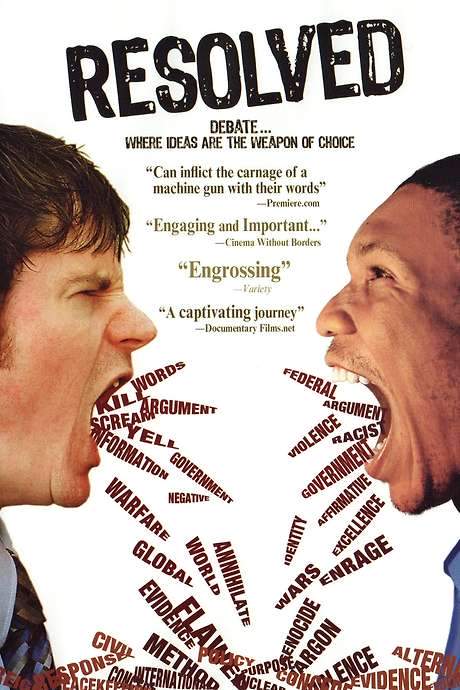
Resolved 2007


Directed by

Greg Whiteley
Made by

HBO Documentary Films
Where to Watch Resolved
See current US streaming, rental, and purchase options for Resolved (2007) via JustWatch.


Streaming availability powered by 
Resolved Plot Summary
Read the complete plot summary and ending explained for Resolved (2007). From turning points to emotional moments, uncover what really happened and why it matters.
Resolved follows the intimate, sometimes tense world of high school policy debate, tracing two pairs of young debaters as they push through contrasting environments and ideals to test the power and politics of argument itself.
The film opens by tracking the careers of Matt Andrews and Sam Iola, two standout competitors at Highland Park High School in Texas—an institution renowned for its policy debate prowess and the expectation that students will continue to college after graduation. The Highland Park team appears as a product of a wealthy, resource-rich community where the pathway to higher education feels almost inevitable, shaping their ambitions and their approach to debate from a young age. By contrast, the documentary shifts its lens to Louis Blackwell and Richard Funches of Jordan High School in Long Beach, California. This public school operates with far fewer resources, and its student body includes a smaller share who go on to a four-year college, a statistic that underscores the uphill battle faced by the Jordan High team.
Against the odds, Blackwell and Funches win the California state championship in an underdog victory that becomes a focal point of the film. Their triumph stakes a claim for Jordan High on the state stage and invites discussion about what it means to succeed within a system that can feel stacked against underfunded schools. The victory also sets the stage for a deeper philosophical turn in the narrative, as their coach Dave Wiltz introduces Paulo Freire’s Pedagogy of the Oppressed, inviting the team to rethink not only their strategy but the very framework of modern policy debate.
From Freire’s ideas, the Jordan High duo rethinks their approach. They begin to argue against the reigning method of high school debate by foregrounding pedagogy, oppression, and social justice. Their strategy shifts toward reading more slowly and prioritizing persuasion over rapid-fire argumentation. The documentary highlights how they weave hip-hop elements into their presentations and challenge the notion that policy debate inherently disadvantages minority students. This shift is presented as part of a broader critique inspired by The Louisville Project, which informs their challenge to the structure of the debate itself.
As the film unfolds, the Jordan High team faces a crucial test: competing under a transformed approach against a tradition-bound field. They ultimately face defeat against a more conventional, “traditional” team. The judge explains his decision by noting that while the Jordan High debaters had laid bare flaws in the overarching structure of policy debate, they also relied on that very structure to defend their points. In other words, their critique exposed inconsistencies within the framework, yet their use of it to advance their arguments undermined the coherence of their critique. The result is a bittersweet moment in which the triumph of critical theory collides with the practical demands of competition.
The loss has real consequences for the Jordan High team’s dreams: they had hoped to qualify for the Tournament of Champions, but the setback significantly curtails that path. The film thus balances a social-justice message with the realities of competitive debate, presenting a nuanced portrait of how ideas intersect with power, opportunity, and the pressures of performance.
Alongside the tournament narrative, Resolved features commentary that anchors its social message in broader public discourse. Throughout the film, esteemed voices weigh in on the issues at hand, including Samuel Alito, Jane Pauley, and Juan Williams. Their perspectives frame the documentary’s exploration of how debate, rhetoric, and policy intersect with concepts of fairness, influence, and equality in American civic life.
Overall, the documentary presents a thoughtful, balanced look at a high school debate scene that becomes a microcosm of larger societal questions. It tracks how a gifted, advantaged team from a well-resourced school navigates the expectations and pressures of competition, while a less affluent team from Long Beach navigates scarcity, systemic critique, and a desire to change the rules themselves. The film invites viewers to consider not only who wins or loses, but why the structure of debate matters, how power shapes opportunity, and what it means to use words to illuminate, challenge, or reinforce the social order.
Resolved Timeline
Follow the complete movie timeline of Resolved (2007) with every major event in chronological order. Great for understanding complex plots and story progression.
Highland Park's rising stars
The film opens by profiling Matt Andrews and Sam Iola, two standout debaters from Highland Park High School, a national policy debate powerhouse in Texas. Andrews is a rising sophomore and Iola a rising senior who has already earned recognition within the debate circuit. Their partnership foreshadows the high-stakes world they navigate.
Underdog shift to Long Beach
Attention shifts to Louis Blackwell and Richard Funches of Jordan High School in Long Beach, California, an underfunded program where only 12-18% of students go on to four-year colleges. The film contrasts their environment with Highland Park's resources, highlighting the stark disparities that shape their opportunities.
Underdog California state champions
In an improbable upset, Blackwell and Funches win the California state championship, drawing national attention to their under-resourced program. They achieve the title by pushing a different kind of argument and sticking to their unconventional approach.
Freire's Pedagogy enters the debate
Following their win, coach Dave Wiltz introduces Paulo Freire's Pedagogy of the Oppressed to the Jordan High team. The text becomes a catalyst for rethinking how they argue, emphasizing voice, oppression, and social critique.
Strategy shift: read slowly and persuade
The team shifts to a slower, more persuasive style, prioritizing argument quality over speed. They lean on cadence and clarity to explain systemic issues and to persuade audiences, sometimes incorporating hip-hop elements. This marks a deliberate departure from conventional high school debate tactics.
The Louisville Project inspires their method
The Louisville Project inspires their new method, framing debate as a site of power, voice, and marginalization. They integrate these themes into rounds, challenging the assumption that winning requires only quick, technical rebuttal.
New approach tested in a major competition
They debut the Freire-inspired approach in a major tournament, and their message is powerful, but the round reveals tensions between message and format. A traditional, more rigid team remains their opponent, illustrating the friction between critique and the rules of procedure.
Judges critique: structure vs consistency
During the judging, the panel questions the team’s reliance on a critique of the structure itself. The film shows the judge arguing that while the structure may be flawed, the Jordan team ends up using that structure to defend their own position, exposing inconsistency.
Attempt to qualify for the Tournament of Champions
Following their controversial run, the team tries to qualify for the Tournament of Champions. Their performance against traditional tactics helps them develop a broader message, but the loss blocks their path.
Public figures weigh in
Throughout the film, commentators including Supreme Court Justice Samuel Alito, Jane Pauley, and Juan Williams offer perspectives that connect the debate world to broader social issues. Their remarks situate the Jordan High story within a national conversation about power, voice, and inequality.
Debate as a lens on power and oppression
The documentary frames policy debate as a lens on power and oppression, inviting viewers to question how debate structures can privilege some students over others. It suggests that true persuasion may require challenging the system itself.
Resolution: dream curtailed but message endures
In its closing moments, Jordan High's dream to reach the national championships is left unresolved. The defeat underscores the film's critique of the system while honoring the team's courage to challenge it.
Resolved Characters
Explore all characters from Resolved (2007). Get detailed profiles with their roles, arcs, and key relationships explained.
Matt Andrews
A standout rising sophomore from Highland Park High School, Matt is portrayed as highly capable and ambitious. His early prominence sets up the pressure of competing at a national level and living up to the expectations of a prestigious program.
Sam Iola
A rising senior at Highland Park, Sam is renowned within the policy debate community for skill and charisma. He navigates the expectations of a top-tier program while balancing future scholarship opportunities and career prospects.
Louis Blackwell
From Jordan High School in Long Beach, Louis is a determined and resilient debater who demonstrates the underdog potential of an under-resourced program. He forms a crucial partnership with Funches that leads to the state championship win.
Richard Funches
Louis's teammate at Jordan High, Richard is a steady, strategic presence who helps drive their under-resourced team to a California state championship. His collaboration with Blackwell embodies the power of persistence.
Dave Wiltz
Jordan High's debate coach, Dave Wiltz guides the team through Freire-inspired tactics and a shift away from rapid-fire argumentation toward persuasion and pedagogy-based strategy.
Resolved Settings
Learn where and when Resolved (2007) takes place. Explore the film’s settings, era, and how they shape the narrative.
Time period
The film is set in the contemporary high school debate scene, focusing on real students and coaches within a modern season. It contrasts wealthier programs with under-resourced schools and follows their journeys through a California state championship toward national-level competition.
Location
Highland Park High School, Jordan High School (Long Beach, California)
Highland Park High School in Texas is portrayed as a well-funded, nationally recognized debate powerhouse set in an affluent community. Jordan High School in Long Beach is depicted as an underfunded public school with a smaller pathway to four-year colleges. The contrast between the two programs highlights how resources and environment shape opportunities in competitive policy debate.
Resolved Themes
Discover the main themes in Resolved (2007). Analyze the deeper meanings, emotional layers, and social commentary behind the film.
🏫
Education Inequality
The documentary foregrounds the gap between affluent, well-supported programs and underfunded schools, showing how access to coaching, facilities, and prep time shapes who can compete at the state and national level. It examines how resource disparities influence who gets entry to opportunities after high school. The juxtaposition makes the audience question fairness in the competitive education system.
📚
Oppressive Pedagogy
The team uses Paulo Freire's Pedagogy of the Oppressed to critique the current debate culture and its power dynamics. Coaches and students reference Freire and The Louisville Project to argue that debate can reinforce oppression rather than dismantle it. The film explores how knowledge is produced and who gets to define what counts as a persuasive argument.
⚖️
Debate Structure
The film examines how the rules and timing of policy debate shape persuasion, revealing a tension between form and substance. Jordan High's slower, more persuasive approach challenges the status quo and the judges' adherence to tradition. It asks whether reforming the structure is possible within a system that rewards speed and conventional tactics.
🏆
Underdog Victory
Jordan High's California state championship win demonstrates that unconventional methods can triumph against odds. However, their later defeat by a traditional team at a higher level shows the fragility of reform within the judging system. The theme captures the complexity of progress: victories can be temporary, but the critique persists.

Coming soon on iOS and Android
The Plot Explained Mobile App
From blockbusters to hidden gems — dive into movie stories anytime, anywhere. Save your favorites, discover plots faster, and never miss a twist again.
Sign up to be the first to know when we launch. Your email stays private — always.
Explore the mobile appResolved Spoiler-Free Summary
Discover the spoiler-free summary of Resolved (2007). Get a concise overview without any spoilers.
In the high‑stakes arena of high school policy debate, Matt Andrews and Sam Iola navigate a world where rigorous argumentation is almost a rite of passage. Their school, a well‑financed Texas private academy, offers a polished, resource‑rich environment that assumes college and success as the natural next steps. The atmosphere is one of polished preparation, where every round feels like a rehearsal for a future already mapped out.
Across the country, Louis Blackwell and Richard Funches confront a very different reality at a public school in Long Beach. Their classrooms echo with the challenges of limited funding and fewer guarantees of a four‑year college path. Yet the same passion for debate burns bright, as they seek to carve out space for their voices within a system that often feels stacked against them. The contrast between the two schools paints a vivid portrait of the broader inequities that shape everyday life in American education.
Guiding the Long Beach team is Dave Wiltz, whose introduction of critical pedagogy invites the students to question not just the topics they debate but the very structure of the debate format itself. This philosophical thread weaves together themes of oppression, social justice, and the power of rhetoric, hinting at a deeper, almost revolutionary undercurrent beneath the competitive surface. The documentary’s tone balances thoughtful observation with an undercurrent of urgency, using intimate interviews and expert commentary to frame the debate world as a microcosm of larger societal struggles.
Through steady, observational storytelling, the film immerses viewers in the intense preparation, the rhythmic clash of ideas, and the subtle dynamics that define each team’s identity. It hints at the personal stakes and collective hopes that drive the participants, offering a nuanced glimpse into a world where words become both weapons and bridges, and where the fight for recognition extends far beyond the courtroom‑like stage of high school debate.
Featured on this page

What's After the Movie?
Not sure whether to stay after the credits? Find out!
Check out our other apps:

SAT Sphere
Build confidence for the Digital SAT.

Mori Atlas
Discover wild places worth protecting.

Luntero
Search smarter for a home in Amsterdam.

Plot Explained
Unravel movie endings and hidden clues.

Pokechamp
Dive into Pokémon data and battle logic.

Driving Theory
Get ready for your European theory test.

Movie Dust
Plan your next cinema trip with ease.

Musemap
Find art and culture as you travel.

Selkobase
Compare credentials before committing.

Local Manual
Turn an unfamiliar country into practical next steps.

Lernavi
Compare school systems before your next move.

GymRoam
Find a workout stop wherever your plans take you.
Explore Our Movie Platform
New Movie Releases (2026)
Famous Movie Actors
Top Film Production Studios
Movie Plot Summaries & Endings
Major Movie Awards & Winners
Best Concert Films & Music Documentaries
Movie Collections and Curated Lists
© 2026 What's After the Movie. All rights reserved.
Privacy Policy