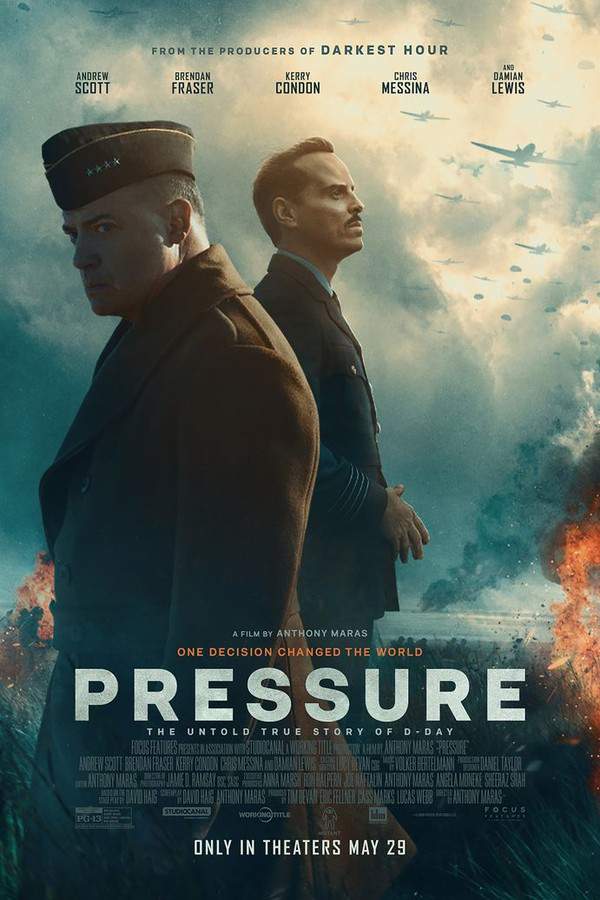
Pressure 2026


Directed by

Anthony Maras
Made by

StudioCanal
Where to Watch Pressure
See current US streaming, rental, and purchase options for Pressure (2026) via JustWatch.








Pressure Plot Summary
Read the complete plot summary and ending explained for Pressure (2026). From turning points to emotional moments, uncover what really happened and why it matters.
In June 1944, the Allied forces stand on the brink of Operation Overlord, a monumental bid to liberate Nazi-occupied Europe. The success of the invasion hinges on a tiny, 72-hour weather window over the English Channel. General Dwight D. Eisenhower [Brendan Fraser] consolidates command at Southwick House, where the fate of the assault rests on the meteorological briefings that fill the room with careful debate and high-stakes pressure.
At the heart of the drama are two lead forecasters with sharply different approaches. James Stagg [Andrew Scott], a meticulous Scottish meteorologist, reads real-time barometric data and identifies a massive storm system marching in from the Atlantic. By contrast, Irving P. Krick [Chris Messina], an American forecaster with a confident bedside manner, leans on historical weather patterns to predict a window of clear skies and “invasion-perfect” conditions, even as darker forecasts echo from the past.
As June 5 looms, the tension in the command centers thickens. Field Marshal Bernard Montgomery [Damian Lewis] worries about losing the element of surprise and presses for the plan to stay true to the timetable, while Stagg pushes for caution, grounding every move in precision science and the unsettling sway of the data. The room becomes a crucible where strategy, risk, and the unpredictable sea collide.
Personal stakes also thread through the story. Stagg’s mounting anxiety is intensified by the knowledge that his wife is in the hospital, a reminder that the clock’s tick-tock carries real lives beyond maps and forecasts. Kay Summersby [Kerry Condon], Ike’s trusted aide and confidante, serves as a steady voice in the chaos, helping the General weigh the mortal dangers of a fragile amphibious assault against the peril of waiting too long.
Haunted by the memory of Exercise Tiger, Ike makes a harrowing choice to delay the invasion by 24 hours. In the tense moments that follow, Stagg’s data takes on renewed gravity, and the possibility of a brief lull the next morning becomes the key thread that allows the final order to pivot toward action.
When the weather finally shifts toward that fragile window, the plan to strike on the morning of June 6 is set in motion, and the invasion proceeds, a turning point that would reshape the course of World War II. The film widens its lens beyond the forecasts, showing how the decision ripples through the war rooms and naval commands as the coordinated effort to launch requires more than science—it demands trust, resolve, and a collective will to push forward.
The narrative is anchored by a robust ensemble that includes Admiral Bertram Ramsay [Robert Portal] guiding naval operations and General Omar Bradley [Alexander Hanson] coordinating the American forces on the ground, illustrating how forecast, strategy, and frontline action converge under extraordinary pressure. The result is a measured, immersive portrait of a moment when weather, leadership, and courage intersect to alter history.
Pressure Timeline
Follow the complete movie timeline of Pressure (2026) with every major event in chronological order. Great for understanding complex plots and story progression.
Allied forces poised for a weather-critical invasion
In June 1944, the Allies await a 72-hour window of manageable weather to launch Operation Overlord. The outcome hinges on a narrow meteorological forecast rather than sheer force of arms. The stage is set at the command center as plans hinge on a favorable forecast.
Eisenhower assumes command at the planning site
General Eisenhower establishes his command at Southwick House. The final decision to launch or delay rests on the advice of his meteorological team. The atmosphere blends military urgency with scientific caution.
Two forecasters, two methods
Group Captain James Stagg and Colonel Irving P. Krick bring opposing approaches to predicting weather. Stagg reads real-time barometric pressure and storm patterns; Krick relies on historical patterns to claim clear skies. The clash foreshadows a high-stakes battle of data versus optimism.
Stagg detects a looming Atlantic storm
Stagg identifies a massive, volatile storm system building from the Atlantic. He uses barometric trends to warn that conditions will deteriorate. His careful data-driven analysis contrasts with Krick's optimism.
Krick's optimistic forecast of invasion-perfect weather
Krick argues for favorable conditions based on historical patterns. He predicts clear skies that would enable a timely invasion. His confidence adds pressure on Eisenhower to risk the assault.
High command resists delaying the invasion
Field Marshal Montgomery and other officers push back against postponement, fearing the loss of surprise. The pressure to proceed creates a tense atmosphere for the decision-makers. Stagg's forecast is tested against strategic insistence to strike.
Stagg carries personal stakes into the forecast
Stagg wrestles with the personal toll as his pregnant wife is hospitalized. The stakes extend beyond professional duty, intensifying his resolve to get the forecast right. The pressure compounds the controversy over whether to delay.
Kay Summersby offers counsel to Eisenhower
Eisenhower's aide Kay Summersby provides support and a confidante for the General. She helps him weigh the risks of a disastrous amphibious landing versus postponement. Her perspective anchors the human dimension of the strategic choice.
Exercise Tiger's shadow drives caution
The memory of Exercise Tiger's costly rehearsal looms over the decision. Eisenhower is haunted by the casualties and uses that fear to endorse caution. The storm forecast becomes a lifeline to minimize catastrophe.
Decision to delay by 24 hours
Eisenhower chooses to delay the invasion by 24 hours based on Stagg's data. The choice is a risky sacrifice of timing for potential safety and success. The plan hinges on weather breaking soon enough to deliver a window for the invasion.
The original D-Day date is tested by storms
The scheduled date of June 5 is met with violent storms that validate Stagg's forecast. His credibility starts to bloom as the forecast appears accurate under pressure. The storm reinforces the perception that science should guide strategic decisions.
A brief lull offers renewed opportunity
A brief lull in the storm the following morning provides the window Eisenhower needs to act. Stagg identifies the moment for a final order. The mood shifts from doubt to cautious optimism as the invasion becomes feasible.
Operation Overlord launches on June 6, 1944
The invasion launches across the English Channel on June 6, 1944. The weather window, finally exploited, allows the Allied forces to breach Nazi-occupied Europe. The operation marks a turning point in World War II.
Pressure Characters
Explore all characters from Pressure (2026). Get detailed profiles with their roles, arcs, and key relationships explained.
James Stagg (Andrew Scott)
A meticulous Scottish meteorologist who leads the weather forecasting effort for the invasion. He analyzes real-time barometric pressure data to detect a massive storm system and advises postponement. He endures personal strain as his pregnant wife is hospitalized and faces pushback from senior officers. His data-driven caution ultimately proves pivotal in securing a brief weather lull that enables the June 6 attack.
Irving P. Krick (Chris Messina)
A charismatic American forecaster who relies on historical weather patterns to predict clear skies and invasion-ready conditions. He promotes optimism in the face of uncertainty and advocates moving forward with the invasion. His approach contrasts with Stagg's, highlighting a clash between intuition and data. His forecast adds pressure for action.
Dwight D. Eisenhower (Brendan Fraser)
General Dwight D. Eisenhower serves as the Allied commander with the final say on whether to proceed with Overlord. He weighs the risks of delay against the need to preserve the surprise and success of the operation. He endures pressure from Montgomery and others while remaining focused on the bigger strategic objective. His choice to delay the invasion by 24 hours becomes the turning point that aligns weather with operational planning.
Bernard Montgomery (Damian Lewis)
Field Marshal Bernard Montgomery is a senior Allied commander who questions the pace of the invasion. He worries about losing the element of surprise if the assault is postponed too long. Montgomery's cautions reflect a broader tension between bold action and careful planning within the Allied leadership.
Kay Summersby (Kerry Condon)
Eisenhower's trusted aide and confidante, managing communications and serving as a sounding board during decisions. She helps the General navigate personal concerns, including his health and the strain of command. Her presence anchors the human side of high-stakes leadership in the film.
Admiral Bertram Ramsay (Robert Portal)
Head of naval operations coordinating the invasion, translating air and sea forecasts into actionable plans. He works closely with Eisenhower's staff to align naval bombardments and amphibious landings with the weather window. Ramsay embodies the logistical complexity behind a single-day operation.
General Omar Bradley (Alexander Hanson)
General Bradley commands ground forces and supports the invasion plan, contributing to the strategic synthesis of weather, intelligence, and logistics. He coordinates with other Allied leaders and helps implement orders on the battlefield. Bradley's role underscores the manpower and coordination required for a successful invasion.
Pressure Settings
Learn where and when Pressure (2026) takes place. Explore the film’s settings, era, and how they shape the narrative.
Time period
June 1944
The story unfolds during the run-up to D-Day in World War II. Planning spans a tense 72-hour window where meteorology could determine the invasion’s fate. The narrative culminates in a 24-hour delay to exploit a brief lull in a major storm, enabling the June 6 assault.
Location
Southwick House, England, English Channel
Southwick House in England serves as the Allied command hub where crucial Overlord decisions are made. The nearby English Channel is the operational theater for the planned invasion. The setting emphasizes a war room ambiance where weather and logistics intersect with high-stakes strategy.
Pressure Themes
Discover the main themes in Pressure (2026). Analyze the deeper meanings, emotional layers, and social commentary behind the film.
🧭
Decision
Decision under pressure drives the plot as forecasts, not bravado, dictate action. Stagg’s data-driven approach clashes with Krick’s optimism, highlighting conflicting methods under national stakes. The narrative treats a weather forecast as a moral test for leadership and judgment. The window of opportunity becomes a character in its own right.
⚖️
Leadership
Leadership is framed through Ike's weighing of risk, surprise, and outcome. He must manage divergent voices—from cautious forecasters to veterans worried about delaying the invasion. Kay Summersby provides a confidante presence, grounding the human cost of command. The decision hinges on steadiness and responsibility as much as meteorology.
🌧️
Weather
Weather is the central driving force, not mere backdrop. A severe Atlantic storm threatens the operation, while a brief lull becomes the only feasible window. The film turns meteorology into a narrative engine that precipitates decisive action. The storm-to-stillness transition mirrors the shift from doubt to determination.

Coming soon on iOS and Android
The Plot Explained Mobile App
From blockbusters to hidden gems — dive into movie stories anytime, anywhere. Save your favorites, discover plots faster, and never miss a twist again.
Sign up to be the first to know when we launch. Your email stays private — always.
Explore the mobile appPressure Spoiler-Free Summary
Discover the spoiler-free summary of Pressure (2026). Get a concise overview without any spoilers.
In June 1944, inside the historic walls of Southwick House, the fate of World War II hangs delicately in the balance. The Allied Forces are poised to launch Operation Overlord, the massive invasion of Nazi-occupied Europe, but the success of this monumental endeavor rests on a terrifyingly fragile variable: the weather conditions over the English Channel. With the largest seaborne invasion in history on the line, the decision to proceed or delay falls to General Dwight D. Eisenhower, a commander burdened by the knowledge that his choice will inevitably dictate the survival of thousands of soldiers.
As the critical 72-hour window begins to close, the atmosphere within the command center grows thick with tension, driven by a fierce clash of scientific philosophies. Group Captain James Stagg, a meticulous Scottish meteorologist, relies on real-time barometric data to warn of a volatile storm system approaching from the Atlantic. In stark contrast, Colonel Irving P. Krick, a charismatic American forecaster, argues for confidence based on historical weather patterns, predicting the “invasion-perfect” conditions the military leadership craves. Eisenhower finds himself caught between these conflicting methodologies, forced to weigh the caution of data against the seductive optimism of history.
Beyond the meteorological maps and tactical debates, the film explores the immense psychological strain weighing on every individual in the room. High-ranking officers, including Field Marshal Bernard Montgomery, add to the urgency, wary of losing the crucial element of surprise, while the forecasters battle for professional supremacy. Eisenhower’s personal assistant, Kay Summersby, serves as a quiet confidante to the General, witnessing the human cost of command as the hours slip away. As the deadline approaches, the “pressure” of the title evolves into a multifaceted force—meteorological, military, and deeply personal—threatening to fracture the resolve of the men tasked with turning the tide of history.
Featured on this page

What's After the Movie?
Not sure whether to stay after the credits? Find out!
Check out our other apps:

SAT Sphere
Build confidence for the Digital SAT.

Mori Atlas
Discover wild places worth protecting.

Luntero
Search smarter for a home in Amsterdam.

Plot Explained
Unravel movie endings and hidden clues.

Pokechamp
Dive into Pokémon data and battle logic.

Driving Theory
Get ready for your European theory test.

Movie Dust
Plan your next cinema trip with ease.

Musemap
Find art and culture as you travel.

Selkobase
Compare credentials before committing.

Local Manual
Turn an unfamiliar country into practical next steps.

Lernavi
Compare school systems before your next move.

GymRoam
Find a workout stop wherever your plans take you.
Explore Our Movie Platform
New Movie Releases (2026)
Famous Movie Actors
Top Film Production Studios
Movie Plot Summaries & Endings
Major Movie Awards & Winners
Best Concert Films & Music Documentaries
Movie Collections and Curated Lists
© 2026 What's After the Movie. All rights reserved.
Privacy Policy