
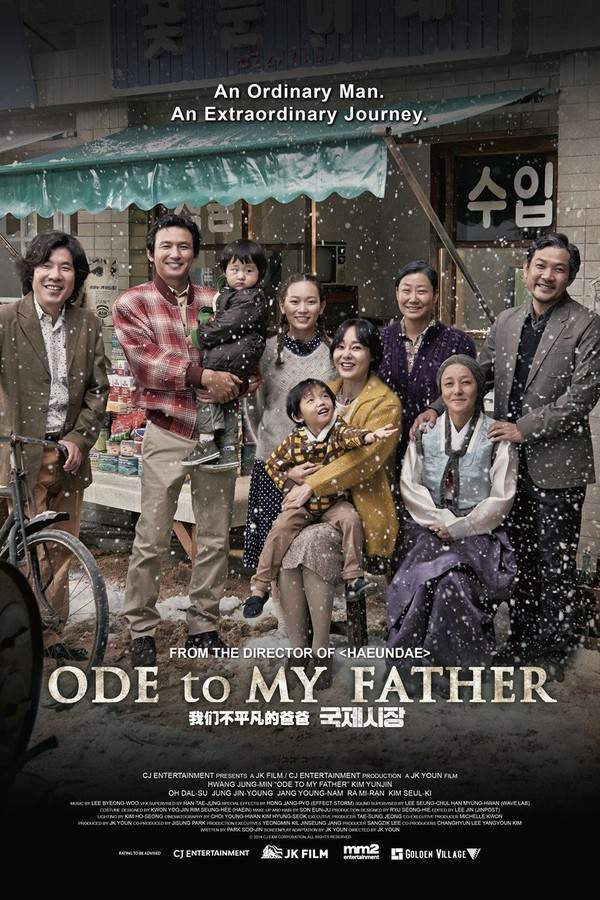
What Is Ode to My Father About?
The premise of Ode to My Father in 294 words, with nothing given away. The full story follows below.
In the waning days of a torn peninsula, a young boy named Deok‑soo is thrust into the role of caretaker as the world around him collapses into chaos. The film opens with the echo of artillery and the desperate scramble of families seeking safety, setting a tone that blends raw hardship with a quiet, lingering hope. Against this stark backdrop, Deok‑soo carries the weight of an absent sister, Mak‑soon, whose brief presence in memory fuels his resolve to protect those left behind.
As the years unfold, the story follows Deok‑soo’s relentless pursuit of stability for his mother and younger siblings. He drifts between modest jobs, each one a stepping stone toward a better future, while the lingering questions of his father’s hidden past linger like an unsolved puzzle. The narrative captures the rhythm of post‑war Korean life—crowded markets, cramped apartments, and the occasional glimpse of a brighter horizon—imbuing every scene with a melancholy optimism.
Amid the toil, a tender connection blossoms with Yeong‑ja, a compassionate nurse whose warmth offers a brief respite from relentless struggle. Their bond is less a dramatic romance than a quiet affirmation that love can endure even the harshest circumstances. Alongside them, Dal‑goo, a steadfast friend, provides both comic relief and steadfast loyalty, underscoring the importance of camaraderie in a world where survival often hinges on shared burdens.
The tone remains intimate and reflective, inviting viewers to feel the pulse of a family’s generational saga. Through lingering glances, whispered conversations, and the ever‑present hum of a nation rebuilding, the film paints a portrait of resilience. It asks how far a son will go to honor his lineage, to piece together fragments of a forgotten legacy, and to forge his own identity amid the echoing footsteps of those who came before.
What Happens in Ode to My Father?
The complete story of Ode to My Father, from the first scene to the last, in 599 words (about 3 minutes). Spoilers throughout.
Spoilers ahead
As the Hungnam Evacuation of 1950 unfolds against the chaotic backdrop of the Korean War, a young boy named Deok-soo faces a life-altering tragedy with the disappearance of his sister, Mak-soon. His father, consumed by desperation to find her, makes the agonizing choice to entrust his family’s fate to Deok-soo, assigning him the crucial task of guiding his mother and two younger siblings to safety in Busan.
With the weight of such responsibility resting heavily on his shoulders, Deok-soo becomes the primary provider for his family from a very young age, taking on numerous odd jobs just to make ends meet. As time goes on, the financial strain compels Deok-soo to embark on a dangerous journey to Germany alongside his loyal friend Dal-goo, where they work as Gastarbeiter in the hazardous coal mines of Hamborn.
Amidst the relentless challenges of their labor, Deok-soo finds comfort and love with Yeong-ja, a nurse whose warmth ignites a passionate romance between them, illuminating even their darkest days. However, fate intervenes when Deok-soo survives a near-fatal mining accident and must return to Korea due to the expiration of his visa. Reuniting with Yeong-ja, they begin to construct a new life together, filled with hopes and dreams.
Their modest wedding is quickly followed by the joyful arrival of two sons, bringing a renewed sense of purpose to their lives. Yet, tragedy strikes when Deok-soo’s aunt passes away, prompting a series of events that dramatically change his trajectory. When his uncle sells their family store, the opportunity to fulfill his childhood aspiration of becoming a sea captain slips through his fingers, leading Deok-soo to enlist in the Korean army during the turbulent 1970s.
While serving in the war-torn landscapes of Vietnam, he is caught in the struggle between his duties as a soldier and the needs of his family back home. In the midst of chaos, Deok-soo learns the profound nature of sacrifice as he returns to Korea, bearing the physical and emotional scars of combat. With a leg injured from enemy fire, he reclaims his role at the family store alongside Yeong-ja, where they strive to forge a hopeful future together.
As we reach 1983, the major broadcast stations in the nation touching hearts with stories of reunification from the Korean War draw Deok-soo into an unexpected opportunity: to star in one of these uplifting programs, spurred by the wishes of an elderly man from his hometown who claims to be his long-lost father. This twist of fate opens the door for Deok-soo to rediscover his familial connections, as he and Mak-soon come to learn about their biological bond. An American woman adopted during the war unwittingly holds the key to the family’s past; despite the barriers of language — with Deok-soo unable to speak English and Mak-soon struggling with Korean — they achieve a heartwarming reunion when she returns to Korea.
However, life’s unfortunate timing strikes again when Deok-soo’s mother passes away shortly thereafter, deepening the sorrow and complexity of his journey. Fast forward to the present, Deok-soo, now an elderly figure, faces the emotional turmoil of potentially leaving behind the family store that has been in his hands for decades, grappling with the memories and promises made long ago. As he prepares to part with this significant piece of his life, he confides in his wife about the likelihood that his father may no longer be alive to return home. This poignant farewell serves as a bittersweet reminder of the transient nature of life, leaving Deok-soo to confront the impermanence of memories and the fleeting bonds we share with those we love.
Ode to My Father Timeline: Every Key Event in Order
15 key events in the order they happen, from “The Korean War Begins” to “Facing Loss”. 7 events name a place, across 5 locations.
- 1
The Korean War Begins
The chaos of the Korean War unfolds in 1950, impacting countless lives. Among those affected is a young boy named Deok-soo, setting the stage for a series of profound personal tragedies that will follow.
When:1950 Where:Korea
- 2
Mak-soon's Disappearance
During the turmoil of war, Deok-soo's sister, Mak-soon, goes missing. This tragic event plunges Deok-soo's family into despair as they begin a desperate search for her.
- 3
A Father's Choice
In a moment of desperation, Deok-soo's father entrusts him with the safety of his mother and younger siblings. This decision burdens Deok-soo with immense responsibility, shaping his fate moving forward.
- 4
Journey to Busan
Deok-soo, now the family's primary provider, begins the trek to Busan. This journey symbolizes the hope of survival amidst the wartime chaos, as they seek refuge from the violence surrounding them.
Where:Busan
- 5
Working in Germany
To support his family, Deok-soo leaves for Germany with his friend Dal-goo. They work as Gastarbeiter in the coal mines of Hamborn, facing the harsh realities of labor abroad.
Where:Germany
- 6
Love in Adversity
During his time in Germany, Deok-soo meets Yeong-ja, a kind-hearted nurse. Their relationship blossoms, providing both solace and a passionate romance amidst the challenging life they lead.
Where:Hamborn
- 7
Returning to Korea
After a near-fatal mining accident forces him to return home, Deok-soo reunites with Yeong-ja. Together, they set out to build a life filled with dreams for the future.
Where:Korea
- 8
Starting a Family
Deok-soo and Yeong-ja celebrate their marriage and welcome two sons into their lives. These joyful events bring a renewed sense of purpose and hope to their small family.
- 9
Tragedy Strikes
The death of Deok-soo's aunt brings unexpected changes to his life. This loss leads to the sale of the family store, crushing Deok-soo’s dreams of becoming a sea captain.
- 10
Enlistment in the Army
Faced with limited options, Deok-soo joins the Korean army during the tumultuous 1970s. His commitment to serve draws him into the heart of conflict as he battles ethical dilemmas and familial obligations.
When:1970s Where:Vietnam
Show the other 5 events of Ode to My Father Hide the last 5 events
- 11
Return from War
After enduring the horrors of war, Deok-soo comes back to Korea bearing the scars of his experiences. His injuries serve as a constant reminder of the sacrifices made in service of his country and family.
Where:Korea
- 12
Reclaiming the Family Store
Upon returning, Deok-soo reclaims his role at the family store. Joined by Yeong-ja, they work hard to create a stable future for their children, reflecting their resilience and hope.
- 13
A Surprise Reunion
In 1983, Deok-soo gets a chance to appear on a television program about reunification. This opportunity arises from an elderly man’s claim of being his long-lost father, adding layers to his quest for identity.
When:1983
- 14
Finding Mak-soon
Deok-soo and Mak-soon learn about their familial bond through an American woman adopted during the war. Despite language barriers, they share a heartfelt reunion, reconnecting lost familial ties.
- 15
Facing Loss
Deok-soo's mother passes away shortly after the reunion, deepening his grief. The experience forces him to confront the transient nature of life, leaving him with bittersweet memories.
Who Are the Main Characters in Ode to My Father?
4 characters, among them Deok-soo, Mak-soon and Yeong-ja: who each one is and the part they play in the story.
- D
Deok-soo
Deok-soo is a resilient and dutiful young boy thrust into adulthood by the chaos of the Korean War. His unwavering commitment to his family's safety and well-being defines his character, as he navigates significant challenges both at home and abroad. The burden of responsibility weighs heavily on him, yet his capacity for love and hope shines through, making him a compelling protagonist.
- 👨💼 Provider
- 💔 Resilient
- 🪖 Soldier
- M
Mak-soon
Mak-soon, Deok-soo's sister, represents the poignant loss and longing that permeate the film. Her early disappearance sets the stage for Deok-soo's journey, showcasing how her absence profoundly affects their family's dynamics. The eventual search for familial connections underscores the significance of her character in the narrative.
- 👧 Sister
- 💔 Loss
- 🔍 Search
- Y
Yeong-ja
Yeong-ja is a nurturing nurse who embodies warmth and love during Deok-soo's harrowing journey. Her relationship with him not only brings comfort amidst the chaos but also introduces themes of hope and companionship. Together, they forge a path toward a better future, even in the face of adversity.
- 💖 Nurturer
- 🌟 Hope
- 👩⚕️ Caregiver
- D
Dal-goo
Dal-goo is Deok-soo's loyal friend who stands by him through both the harsh realities of working in Germany and the trials they encounter. His unwavering support highlights the bonds of friendship during difficult times, contributing to the film's exploration of camaraderie amidst struggle.
- 👫 Loyalty
- 💪 Friendship
- 🌍 Worker
Where and When Is Ode to My Father Set?
Ode to My Father is set in Hungnam, Busan, Germany, Hamborn and Vietnam (1950s to 1983). Here is why the time and place matter to the story.
When
1950s to 1983
The narrative spans from the early 1950s during the Korean War to 1983, a time marked by significant changes in Korea and around the world. The film encapsulates the emotional turmoil and struggles of families displaced by war, while also exploring the enduring theme of sacrifice. The 1970s serves as a critical period of conflict and personal growth for Deok-soo as he navigates the demands of military service and family obligations.
Where
Hungnam, Busan, Germany, Hamborn, Vietnam
The movie begins in Hungnam, where the chaos of the Korean War creates a backdrop for personal tragedies. Busan serves as a place of refuge and hope for Deok-soo and his family. The story then transitions to Germany, specifically Hamborn, where the harsh realities of life as Gastarbeiter unfold amidst labor challenges. Vietnam represents the war-torn backdrop of Deok-soo's military service, highlighting the global impact of the conflict.
- 🏙️ City
- 🛤️ Journey
- 🌍 Global
What Are the Themes of Ode to My Father?
3 ideas the story keeps returning to, among them Sacrifice, Hope and Family.
-
01
Sacrifice
Sacrifice is a central theme in the movie as Deok-soo shoulders immense responsibilities from a young age. His journey is driven by the need to provide for his family, illustrating the lengths one goes to protect loved ones amidst chaos. Each decision he makes reflects the notion that love often comes with the cost of personal dreams and aspirations.
-
02
Hope
Despite the overwhelming challenges, hope permeates Deok-soo's life. From his first breaths of love with Yeong-ja to the eventual reunion with family, moments of joy shine through the darkness. The film ultimately highlights the resilience of the human spirit in the face of adversity, encapsulating the belief that brighter days can emerge even from the most daunting circumstances.
-
03
Family
Family is a driving force behind Deok-soo's actions and decisions. The bonds of brotherhood, love, and loss shape his identity and journey throughout the film. As the story unfolds, the importance of reconnecting with family becomes paramount, showcasing the complexity of family ties against a backdrop of historical events.
What Kind of Film Is Ode to My Father?
Melancholic in tone, with steady pacing and a moderate story, going by the plot summary.
- Tone
- Melancholic
- Pacing
- Steady
- Story
- Moderate
- Intensity
- Medium
- Ending
- Bittersweet
A steady and emotionally heavy drama that follows one man's lifelong journey of sacrifice and resilience, painting a melancholic portrait of family, loss, and the bittersweet nature of memory.
- melancholic
- nostalgic
- resilient
- heartfelt
- somber
- reflective
- family saga
- intergenerational trauma
- war survival
- duty and sacrifice
Content notes: war violence, child separation, mining accident, combat injury, parental death.
Quiz
How well do you remember Ode to My Father? Test yourself on the story.
