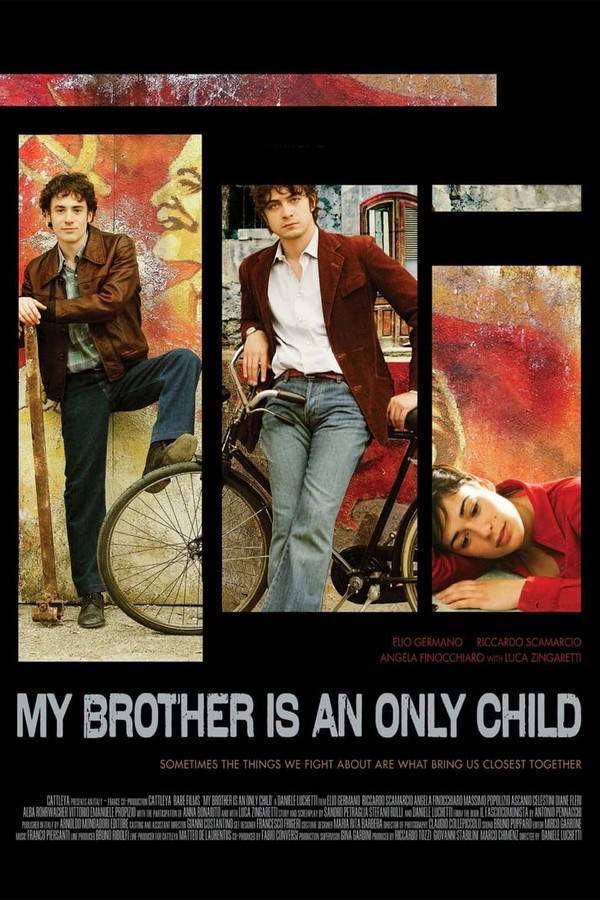
My Brother Is an Only Child 2008

Directed by

Daniele Luchetti
Made by

THINKFilm
My Brother Is an Only Child Plot Summary
Read the complete plot summary and ending explained for My Brother Is an Only Child (2008). From turning points to emotional moments, uncover what really happened and why it matters.
Accio (Elio Germano) and Manrico (Riccardo Scamarcio) are working-class siblings navigating life in Italy during the tumultuous 1960s. Accio, the impulsive younger brother, finds himself influenced by a market trader and eventually joins the Fascist party, taking pride in the nickname “Bully,” which lends him an air of toughness. This alarming shift deeply concerns Manrico and their sister Violetta, especially when they overhear Accio engrossed in Benito Mussolini’s speeches within the confines of his room. The sibling rivalry escalates with Manrico often resorting to physical torment, like submerging Accio’s head in a barrel beneath the drainpipe of their dilapidated home.
The tension builds when Accio, in a fit of rebellion, runs away upon discovering their mother’s support for the Houses Party, believing they’ll provide the aid needed to rebuild their crumbling house.
As they mature, Accio and Manrico become increasingly active in their respective political movements—the Fascist party and the Communist movement—exemplified by scenes depicting factory occupations and the temporary takeover of the Rome conservatoire, where Violetta studies the cello. The film tackles political themes with surprising fairness; while the young fascists appear ridiculous with their fervent chants of “Duce! Duce!” and a growing propensity for violence, the communists reveal their own absurdities when they replace Schiller’s final movement of Beethoven’s choral symphony with a hymn celebrating historical figures like Mao Zedong, Vladimir Lenin, and Joseph Stalin.
Francesca, Manrico’s girlfriend, unexpectedly forms a bond with Accio, who harbors secret feelings for her and doubts Manrico’s reliability. Complicated emotions emerge as Accio becomes involved with the wife of his imprisoned fascist friend, enjoying luxuries like a car she purchases for him via an installment plan.
Eventually, a turning point arrives for Accio when he renounces the Fascist party, dramatically tearing up his membership card after witnessing party members vandalize his brother’s car. His relationship with the older woman also crumbles as he admits his feelings for someone else, leaving her to ponder whether he is loved in return.
Contrastingly, Manrico descends deeper into the chaos of revolutionary violence. After a two-year absence, he reaches out to Accio, prompting him to meet in a café. During this reunion, Accio tries to call Francesca, who repeatedly hangs up. When they finally meet, Manrico spots Francesca’s unexpected arrival alongside police potentially tracking her. In a frantic escape attempt, he ultimately loses his life in a gunfight with the authorities.
The story concludes with Accio taking matters into his own hands, infiltrating a corrupt housing office to seize keys and records meant for the homeless. Distributing keys to desperate families in the dead of night symbolizes his newfound resolve. The film closes on a poignant note as Accio reunites with his family, now including his brother’s young son, embodying both personal loss and a commitment to a brighter future.
My Brother Is an Only Child Timeline
Follow the complete movie timeline of My Brother Is an Only Child (2008) with every major event in chronological order. Great for understanding complex plots and story progression.
Accio and Manrico's Early Life
Accio and Manrico grow up as working-class siblings in Italy during the turbulent 1960s. Their close yet contentious relationship is marked by rivalry and differing ideals, foreshadowing their future conflicts.
Accio Joins the Fascist Party
Influenced by a market trader, Accio impulsively decides to join the Fascist party. Embracing the nickname 'Bully,' он seeks validation through this affiliation, worrying his brother Manrico and their sister Violetta.
Siblings Overhear Mussolini's Speeches
Manrico and Violetta become alarmed when they overhear Accio listening to Benito Mussolini's speeches in his room. This moment highlights Accio's troubling political shift and deepens the concern for their family's values.
Escalating Rivalry in the Home
The siblings' rivalry grows as Manrico physically torments Accio, even submerging him in a barrel. Their home life becomes increasingly chaotic, encapsulating the discord of their differing political beliefs.
Accio Runs Away
In a rebellious act, Accio runs away after realizing that their mother supports the Houses Party. This decision marks a pivotal moment in his journey, showcasing his desperation for change amidst family turmoil.
Political Activism Grows
As they mature, Accio and Manrico engage in political movements; Accio with the Fascists and Manrico with the Communists. Their involvement is illustrated through vivid scenes of factory occupations and student protests.
Francesca and Accio's Connection
Manrico's girlfriend, Francesca, forms an unexpected bond with Accio, who secretly desires her. This complicated relationship adds layers to the brothers' rivalry, as Accio doubts Manrico's loyalty.
Accio's Affair
Accio becomes involved with the wife of his imprisoned fascist friend, enjoying the luxuries she provides. This affair complicates his emotional landscape, leading to self-reflection on love and loyalty.
Turning Away from Fascism
Accio undergoes a dramatic transformation as he renounces the Fascist party. The pivotal moment occurs when he tears up his membership card after witnessing the cruelty of party members vandalizing his brother's car.
Reunion in Chaos
After two years apart, Manrico reaches out to Accio, prompting a tense reunion at a café. Their meeting becomes chaotic when police arrive, intensifying the underlying tensions in their relationship.
Tragic End for Manrico
Manrico's life ends tragically during a violent confrontation with authorities. As he tries to escape with Francesca, he tragically loses his life, highlighting the cost of their political struggles.
Accio's Transformation
Following his brother's death, Accio takes decisive action by infiltrating a corrupt housing office. He seizes keys and records for the homeless, signaling his emergence as a person of purpose.
Helping the Homeless
In the dead of night, Accio distributes housing keys to desperate families in need. This act symbolizes his newfound resolve to make a difference in the world, contrasting his previous choices.
Reunion with Family
The film concludes with a poignant reunion between Accio and his family. They gather alongside Manrico's young son, embracing both loss and hope for a brighter future, closing the chapter of their tumultuous journey.
My Brother Is an Only Child Characters
Explore all characters from My Brother Is an Only Child (2008). Get detailed profiles with their roles, arcs, and key relationships explained.
Accio
Accio is the impulsive younger brother who initially finds camaraderie in the fascist party before realizing its dangers. His transformation from a follower of the extreme right to a figure of social justice illustrates a complex character arc filled with inner turmoil, rebellion, and ultimately redemption. His journey is marked by personal losses and a profound awakening to the needs of his community.
Manrico
Manrico embodies the spirit of rebellion against the establishment, often engaging in political activism aligned with communism. His deeply rooted ideals contrast starkly with Accio's earlier affiliations. Manrico's character experiences a tragic arc, ultimately losing his life amidst chaos, which serves as a tragic reminder of the costs associated with political extremism.
Violetta
Violetta is the sisters' presence in the film, representing the artistic and cultural aspects of their lives amidst political discord. As a cello student, she symbolizes beauty and hope in a chaotic environment. Her character adds depth to the sibling dynamics and illustrates the impact of political ideologies on personal ambitions.
Francesca
Francesca is caught in the emotional crossfire between Accio and Manrico, adding complexity to the sibling rivalry. Her romantic involvement with both brothers elevates the themes of love and betrayal. Francesca's character reflects the struggle women faced during tumultuous political times, balancing personal desires with external pressures.
My Brother Is an Only Child Settings
Learn where and when My Brother Is an Only Child (2008) takes place. Explore the film’s settings, era, and how they shape the narrative.
Time period
1960s
The 1960s were a turbulent decade characterized by social and political movements across Europe. In Italy, this era witnessed the clash between the fascist party and communist factions, as well as significant industrial labor struggles. Events from this period played a crucial role in shaping the ideologies and lives of the characters in the film.
Location
Italy
The film is set in Italy during the 1960s, a time marked by significant political upheaval. This period features the rise of both fascist and communist movements, deeply influencing the lives of the working class. The setting, encapsulating both urban and rural landscapes, reflects the struggles of individuals trying to navigate their political beliefs within a fractured society.
My Brother Is an Only Child Themes
Discover the main themes in My Brother Is an Only Child (2008). Analyze the deeper meanings, emotional layers, and social commentary behind the film.
⚔️
Conflict
The film explores the theme of conflict, particularly the intense sibling rivalry between Accio and Manrico. Their differing political affiliations create friction, leading to both verbal and physical confrontations. This theme is accentuated by the broader societal conflicts happening in Italy, highlighting how personal relationships can become battlegrounds for ideological struggles.
💔
Love and Betrayal
Romantic entanglements add complexity to the narrative, particularly through Accio's involvement with Francesca, who is also connected to Manrico. The theme of love intertwines with betrayal, as Accio's secret feelings complicate their relationships. This duality showcases how love can lead to both connection and division amid political chaos.
🏠
Hope and Community
The film concludes on a hopeful note, as Accio takes decisive action to help the homeless by distributing keys to them. This act symbolizes the theme of hope and community, emphasizing the importance of familial bonds and communal support during challenging times. Accio's transformation highlights a commitment to social justice and a brighter future for those in need.

Coming soon on iOS and Android
The Plot Explained Mobile App
From blockbusters to hidden gems — dive into movie stories anytime, anywhere. Save your favorites, discover plots faster, and never miss a twist again.
Sign up to be the first to know when we launch. Your email stays private — always.
Explore the mobile appMy Brother Is an Only Child Spoiler-Free Summary
Discover the spoiler-free summary of My Brother Is an Only Child (2008). Get a concise overview without any spoilers.
In the crowded streets and dimly lit factories of a restless 1960s Italian town, everyday life hums against a backdrop of political upheaval. The community is caught between the fervor of a resurging fascist movement and the hopeful clamor of a rising communist wave, each promising a different future for the working class. The film paints this era with a texture that feels both intimate and turbulent, letting the audience hear the echo of slogans through the clatter of machinery and the chatter of market stalls.
At the heart of the story are two brothers whose paths diverge as sharply as the ideologies surrounding them. The elder Manrico carries the weight of responsibility, his charisma drawing him into the leadership of the Communist Party, where he dreams of collective change. In stark contrast, the impulsive younger Accio is seduced by the allure of strength and order offered by the fascist ranks, earning him a tough‑spoken nickname that hints at his emerging bravado. Their rivalry is more than political; it becomes a daily contest of wills that reverberates through every corner of their modest home.
Their sister, Violetta, a sensitive soul who studies the cello, serves as a quiet anchor amid the discord, while Francesca, Manrico’s passionate girlfriend, weaves herself into the brothers’ tangled lives, introducing a subtle strain of affection and jealousy. The family’s bonds are tested by the ceaseless push and pull of loyalty, love, and the yearning for a better world, each character navigating the thin line between personal desire and collective duty.
The film’s tone balances gritty realism with moments of lyrical poignancy, capturing the chaotic optimism of a generation on the brink of transformation. Through richly drawn characters and an evocative setting, it invites viewers to contemplate how ideology can both unite and divide, leaving the audience poised on the edge of the brothers’ unfolding choices without revealing the outcomes that await them.
Featured on this page

What's After the Movie?
Not sure whether to stay after the credits? Find out!
Check out our other apps:

SAT Sphere
Build confidence for the Digital SAT.

Mori Atlas
Discover wild places worth protecting.

Luntero
Search smarter for a home in Amsterdam.

Plot Explained
Unravel movie endings and hidden clues.

Pokechamp
Dive into Pokémon data and battle logic.

Driving Theory
Get ready for your European theory test.

Movie Dust
Plan your next cinema trip with ease.

Musemap
Find art and culture as you travel.

Selkobase
Compare credentials before committing.

Local Manual
Turn an unfamiliar country into practical next steps.

Lernavi
Compare school systems before your next move.

GymRoam
Find a workout stop wherever your plans take you.
Explore Our Movie Platform
New Movie Releases (2026)
Famous Movie Actors
Top Film Production Studios
Movie Plot Summaries & Endings
Major Movie Awards & Winners
Best Concert Films & Music Documentaries
Movie Collections and Curated Lists
© 2026 What's After the Movie. All rights reserved.
Privacy Policy