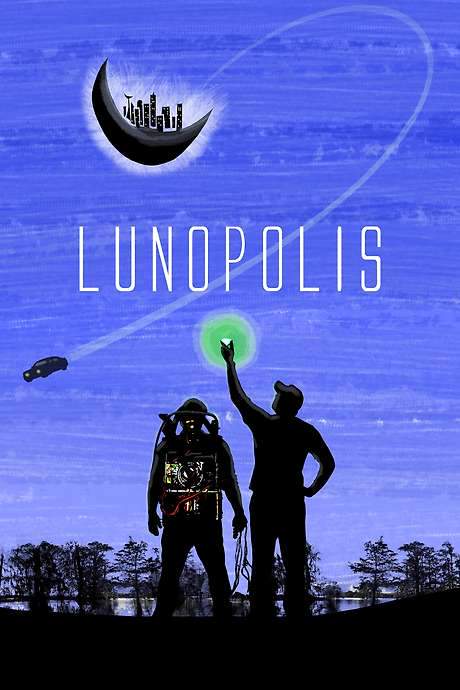


Where to Watch Lunopolis
See current US streaming, rental, and purchase options for Lunopolis (2010) via JustWatch.



Streaming availability powered by 
Lunopolis Plot Summary
Read the complete plot summary and ending explained for Lunopolis (2010). From turning points to emotional moments, uncover what really happened and why it matters.
Footage on the news suggests a paranormal event may be real, and the story unfolds like a creeping mystery that blends conspiracy theories with science fiction. Twelve days earlier, on December 9, 2012, a conspiracy-themed radio show receives a call from a man who claims to work at Area 51, describing a secret civilization on the Moon before the line is cut. George Larson, the host, is skeptical at first, dismissing it as a hoax until a photo album arrives that contains enough evidence to push him to hire a documentary crew to investigate. The crew is led by Matt and Sonny, who dive into the strange clues with a mix of curiosity and caution. Their investigation hinges on a decades-old Polaroid that shows a man in modern clothing, an image that should not exist in that context, and the back of the photo bears a cryptic series of numbers. Decoding these numbers reveals GPS coordinates dangerously close to their home in Louisiana, pulling them toward a mystery that feels both intimate and otherworldly.
When they reach the coordinates, a hidden hatch opens into an underground warehouse, a stark space that holds more questions than answers. Inside, they discover a mysterious device they cannot identify, a curious harness-like apparatus that seems to respond to their touch. Driven by a mix of bravado and scientific curiosity, they switch it on, and the experience quickly turns dangerous. The device seems to interact with the wearer in unpredictable ways, and Sonny, who is wearing the harness, experiences a disorienting moment that lands him in the hospital for a short time. The incident underscores the crew’s precarious position and raises the stakes of their reckless curiosity.
Seeking expertise, they bring the harness to Dr. Orin Raymond, a local professor who examines the odd device and a glowing green crystal found inside. He identifies the crystal as something extraterrestrial—material tied to lunar origins that raises even bigger questions about what mankind might be capable of and what has supposedly been hidden from the public. The discovery attracts attention from a group connected to the Church of Lunology, a movement that pushes a bold narrative: that a civilization exists on the Moon and that the government is concealing it. While the scientific questions swirl, the filmmakers and their team are themselves cornered by Lunology members who want the time machine device back, leading to tense confrontations and a high-speed chase that ends with a car lifting off into the sky and disappearing from view.
A note then guides them to David James, a former member of the lunar colony who provides crucial historical context. He explains the broader history: the lunar colony and Lunology are connected to a chain of experiments and ideologies, with the Moon’s crystal enabling immortality and time travel. In 2012, [J. Ari Hilliard] crafts a plan to push this technology back in time, sending the first mission back to 350 BC and setting in motion changes that ripple across timelines. The team learns that these changes have drawn a line between generations past and future, creating a dangerous tension between those who want to experiment with time and those who fear the consequences. As the narrative unfolds, the Lunology movement and the lunar colonists diverge, each pursuing the crystal’s power in different ways, and the boundaries between timelines begin to blur.
As dissidents resist the unintended consequences of these experiments, the story deepens into a meditation on power, immortality, and the fragility of reality itself. Hilliard, once convinced that immortality was a risk worth taking, becomes increasingly disillusioned, and his efforts to reveal the truth meet fierce resistance. His attempts to control or end the experiment run up against a broader force that seems determined to keep the moon-born technology out of earthly hands. In a sequence of pivotal moments, historical events like the Roswell incident become entangled with the pursuit of the crystal, showing how the past and future can collide when immortality and time travel are on the table. The crystal’s existence appears tethered to a single point across all timelines, making it a prize that both the lunar colony and Lunology must recover before more chaos erupts.
The pursuit culminates in a dramatic confrontation at the Lunarists’ table, where the immortal future version of Hilliard reveals himself and drives a shocking turn of events. He confronts the past self and, in a decisive moment, kills the older version to prevent further time travel, underscoring the ethical and existential dilemmas at the heart of this saga. In a final, visually striking beat, the Polaroid figure from the original photograph steps into the meeting room, and the timelines seem to intertwine behind him. He reaches for the crystal and the crew’s camera, his eyes briefly glowing green behind sunglasses, signaling that the mystery may be far from over and that the line between fact and fiction—between one timeline and another—remains dangerously thin.
This story, rooted in a grounded sense of realism through its detective tone, gradually unfurls into a layered meditation on memory, time, and humanity’s urge to reach beyond its limits. It asks whether the pursuit of knowledge is worth the personal and global risks it entails, and whether immortality is a gift or a trap. As the final images linger, viewers are left with a sense of unfinished business—a hint that the truth about the Moon, the crystal, and the timelines might resurface in future revelations, inviting new observers to pick up where this investigation left off.
Lunopolis Timeline
Follow the complete movie timeline of Lunopolis (2010) with every major event in chronological order. Great for understanding complex plots and story progression.
Radio show triggers investigation
News footage suggests a paranormal event may be real, creating a creeping sense of mystery. On December 9, 2012, a conspiracy radio show receives a call from a man claiming to work at Area 51 and describing a secret civilization on the Moon before the line is cut. Host George Larson remains skeptical at first but the strange information sticks with him, nudging him toward taking the tip seriously.
Photo album pushes investigation
A photo album arrives that contains a Polaroid showing a man in modern clothing—an anachronism that challenges reality. The back of the photo bears a cryptic series of numbers, convincing George to hire a documentary crew to investigate. The team is led by Matt and Sonny, who bring both curiosity and caution to the assignment.
Numbers point to a Louisiana location
Decoding the numbers reveals GPS coordinates suspiciously close to their home in Louisiana. The clue confirms this is more than a hoax and pushes the crew toward a dangerous search. The sense of unease grows as the puzzle tightens around their own doorstep.
Hidden hatch reveals otherworldly device
The coordinates lead to a hidden hatch that opens into an underground warehouse. Inside, a mysterious device and a harness-like apparatus await, humming with unknown potential. The discovery invites experimentation but warns of unpredictable consequences.
Device activation injures Sonny
They switch on the device, and its effects prove dangerous and disorienting. Sonny experiences a destabilizing moment that lands him in the hospital briefly, underscoring the risks of meddling with unknown technology. The crew realizes their recklessness could have real human costs.
Crystal identified as lunar extraterrestrial
The team seeks expert analysis from Dr. Orin Raymond, who examines the device and a glowing green crystal recovered from it. He identifies the crystal as extraterrestrial, lunar in origin, implying that mankind has access to artifacts beyond Earthly bounds. The find reframes the mystery from a curious gadget to a potential doorway into lunar science.
Lunology faction moves in
Attention from the Lunology movement grows as they press the claim that a Moon civilization exists and that the government is concealing it. They attempt to reclaim the time machine device, leading to tense confrontations and a high-speed chase that ends with a car lifting off into the sky and vanishing. The sequence shows how belief systems collide with scientific curiosity.
David James explains lunar history
David James, a former member of the lunar colony, provides crucial historical context. He explains how the lunar colony and Lunology are connected through a chain of experiments and ideologies, and how the crystal enables immortality and time travel. His account broadens the stakes from a standalone device to a long-running, global power struggle.
Hilliard's time-push plan revealed
The team learns that J. Ari Hilliard crafted a plan in 2012 to push the technology back in time, sending a mission to 350 BC and setting off ripples across timelines. The revelation explains why those with access to the crystal seek to control it rather than relinquish it. The past and future begin to tremble as timelines weave together.
Roswell ties into the lunar mystery
As the pursuit continues, historical events like the Roswell incident become entangled with the lunar technology. The past and present clash as immortality and time travel threaten to fracture reality. The crystal seems tethered to a single pivotal point across all timelines, making its recovery a high-stakes mission.
Future Hilliard confronts past self
In a climactic confrontation at the Lunarists’ table, the immortal future version of Hilliard reveals himself and kills the older version to stop further time travel. The act highlights the moral hazard of playing with time and immortality. The meeting scene ends with a symbolic moment as a Polaroid figure steps into the room.
Polaroid figure signals ongoing mystery
The Polaroid figure from the original photograph steps into the meeting room, reaching for the crystal and the crew’s camera, his eyes glowing green behind sunglasses. The scene signals that the timelines remain dangerously interconnected and that the mystery may resurface through new observers. The film closes on an unresolved note about memory, time, and what lies beyond.
Lunopolis Characters
Explore all characters from Lunopolis (2010). Get detailed profiles with their roles, arcs, and key relationships explained.
Matt (Matthew Avant)
A determined, pragmatic member of the documentary crew who helps lead the investigation alongside Sonny. He pushes the team to follow every clue, balancing curiosity with caution while keeping the mission focused on uncovering the truth behind the mysterious device.
Sonny (Hal Maynor)
Courageous and impulsive, Sonny is a key crew member who pushes the boundaries of risk. He wears the harness during testing, experiences the device's disorienting effects, and tests the crew's willingness to chase dangerous answers.
Dr. Orin Raymond
A local professor who examines the unusual device and the glowing crystal, interpreting their extraterrestrial origins and what they imply about lunar connection and hidden knowledge.
David James
A former member of the lunar colony who provides crucial historical context, linking the lunar project and Lunology to a broader history of experiments and timelines.
Dark Assailant
An antagonist who pursues the crew, adding danger and urgency to the investigation as the team uncovers evidence that attracts hostile forces.
Sarah
A crew member who contributes to the investigation through documentation and on-site observation, helping to piece together clues from the field.
Lunopolis Settings
Learn where and when Lunopolis (2010) takes place. Explore the film’s settings, era, and how they shape the narrative.
Time period
2012
Primary events take place in 2012, starting with a December radio show that sparks the investigation. The crew's pursuit unfolds in present-day settings, while the plot threads weave through past and future timelines via time-bending elements. The time-travel premise links ancient events and contemporary discoveries, underscoring the stakes around immortality and the consequences of altering history.
Location
Louisiana, Underground warehouse, Area 51, Moon
The action centers in rural Louisiana where the documentary crew's investigation begins. A hidden underground warehouse near their home becomes the pivotal evidence hub, housing a mysterious device and a glowing crystal. The story expands to lunar lore and extraterrestrial implications, with the Moon serving as a backdrop to the earthly mystery.
Lunopolis Themes
Discover the main themes in Lunopolis (2010). Analyze the deeper meanings, emotional layers, and social commentary behind the film.
⏳
Time
The narrative hinges on the manipulation of time and the lure of immortality. Time travel creates moral ambiguity as past, present, and future collide in unpredictable ways. Characters grapple with the cost of chasing knowledge that may rewrite history. The story uses time as a pressure valve that exposes human limits and ethical boundaries.
🕵️
Conspiracy
A fringe movement and a secret lunar program drive the central conflict, feeding paranoia and distrust. The Lunology group and hidden government agendas show how information can be suppressed behind a web of rumors. The investigators must distinguish credible clues from fiction stitched into a broader conspiracy. The tension escalates as evidence points to a concealed civilization and manipulative power structures.
🧠
Reality
Memory and perception blur as Polaroid clues morph into timelines and the line between truth and fiction grows thin. The discovery of extraterrestrial crystals challenges what the characters think they know about human limits. Visual motifs and narrative twists force the crew to reassess what counts as evidence. The film ultimately asks whether reality can withstand the lure of eternal life and altered history.

Coming soon on iOS and Android
The Plot Explained Mobile App
From blockbusters to hidden gems — dive into movie stories anytime, anywhere. Save your favorites, discover plots faster, and never miss a twist again.
Sign up to be the first to know when we launch. Your email stays private — always.
Explore the mobile appLunopolis Spoiler-Free Summary
Discover the spoiler-free summary of Lunopolis (2010). Get a concise overview without any spoilers.
In a world where the familiar sheen of modern news broadcasts can mask a deeper, more unsettling truth, two documentary filmmakers stumble across a fragment of evidence that suggests humanity’s greatest secret may be written in the dust of the Moon. The discovery—a puzzling photograph and a series of cryptic numbers—opens a doorway to a forgotten chapter of Earth’s past, hinting at a concealed lunar base that has never been officially acknowledged. From the moment the image lands in their hands, the pair are pulled into a sprawling, low‑key investigation that feels part journalistic curiosity, part quiet thriller.
The film’s tone is a slow‑burning blend of conspiratorial intrigue and grounded science‑fiction, set against a backdrop of everyday America that feels both ordinary and oddly charged. Ordinary places—radio studios, small‑town homes, university labs—become the unlikely stages for a search that hints at hidden histories, covert organizations, and technologies that could rewrite what we accept as reality. The atmosphere is thick with the hum of whispered theories, the flicker of old‑school Polaroids, and a persistent sense that something larger is humming just out of view.
At the heart of the story are the two creators of the documentary. Matt brings a methodical, almost academic rigor to the hunt, constantly cataloguing clues and questioning every detail. Sonny balances that with a restless, instinct‑driven curiosity, pushing the duo to chase leads that others might ignore. Their partnership is a dance of caution and daring, each complementing the other’s strengths. Along the way, they cross paths with George Larson, a skeptical radio host whose own doubts begin to shift, and Dr. Orin Raymond, a local professor whose expertise adds a layer of scientific credibility to the mounting mystery.
The film invites viewers to linger in the spaces between fact and speculation, to feel the pull of a hidden narrative that promises both wonder and risk. It asks whether the pursuit of a buried truth is worth the unsettling shadows it casts on what we think we know, leaving the audience with a lingering sense that the line between reality and the unknown is far thinner than it appears.
Featured on this page

What's After the Movie?
Not sure whether to stay after the credits? Find out!
Check out our other apps:

SAT Sphere
Build confidence for the Digital SAT.

Mori Atlas
Discover wild places worth protecting.

Luntero
Search smarter for a home in Amsterdam.

Plot Explained
Unravel movie endings and hidden clues.

Pokechamp
Dive into Pokémon data and battle logic.

Driving Theory
Get ready for your European theory test.

Movie Dust
Plan your next cinema trip with ease.

Musemap
Find art and culture as you travel.

Selkobase
Compare credentials before committing.

Local Manual
Turn an unfamiliar country into practical next steps.

Lernavi
Compare school systems before your next move.

GymRoam
Find a workout stop wherever your plans take you.
Explore Our Movie Platform
New Movie Releases (2026)
Famous Movie Actors
Top Film Production Studios
Movie Plot Summaries & Endings
Major Movie Awards & Winners
Best Concert Films & Music Documentaries
Movie Collections and Curated Lists
© 2026 What's After the Movie. All rights reserved.
Privacy Policy