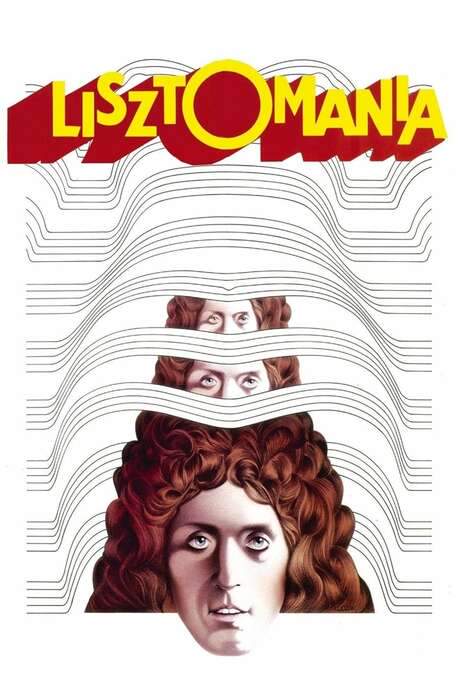
Lisztomania 1975


Made by

Goodtimes Enterprises
Where to Watch Lisztomania
See current US streaming, rental, and purchase options for Lisztomania (1975) via JustWatch.







Lisztomania Plot Summary
Read the complete plot summary and ending explained for Lisztomania (1975). From turning points to emotional moments, uncover what really happened and why it matters.
Through a series of surreal, dreamlike episodes that blend fact, fantasy, and time-bucking anachronisms, the life of the composer Franz Liszt unfolds in a cinematic memory palace. At the outset, Liszt is found in bed with Marie d’Agoult, pursued by her husband, Count d’Agoult, who issues a dare to a sabre duel. In a dark twist, the count’s staff traps Liszt and Marie inside the body of a piano and abandons it on a stretch of railroad tracks. This otherworldly calamity is revealed as a flashback, triggered by a backstage camera flash just before one of Liszt’s concerts.
Backstage, Liszt introduces a circle of legendary figures, including Richard Wagner, to his colleagues: Gioachino Rossini, Hector Berlioz, Frédéric Chopin, and Hans von Bülow. He even pays Wagner to permit a variation on a theme from Rienzi, setting the stage for a clash between crowd-pleasing virtuosity and serious musical craft. The audience—youthful, vocal, and raucous—erupts with excitement as Liszt’s performance explodes in choreographed frenzy, a spectacle that blurs the line between concert and spectacle.
In a maneuver that foreshadows the film’s surreal stakes, Liszt uses von Bülow to test the waters with wealthy admirers in the crowd, and one target emerges: Princess Carolyn, who tenderly gives Liszt her address in Russia. Meanwhile, Liszt and Marie’s domestic life grows tense under the weight of constant touring and Liszt’s infidelities. They raise three children, the eldest of whom is Cosima, a name that will echo through the story’s later chapters.
The narrative pivots on a perilous bargain. Carolyn tempts Liszt with the promise of renewed genius in exchange for control over his life, and in a startling, over-the-top sequence Liszt imagines a court of Carolyn’s women as she watches from a distance. The price of artistic rebirth unfolds before him as the women drag him toward a guillotine, with Carolyn revealing that the bargain requires surrendering his libertinism.
As Dresden erupts in the May Uprising, Liszt wrestles with whether to stand with friends or to retreat into isolation to compose. Rumor and implication mingle: Marie and his two youngest children may have perished, deepening his crisis. Wagner reappears, asking for money, drugs Liszt, and reveals himself as a vampire with a political mission to inspire a new German nationalism. Wagner leaves behind a stark political pamphlet that cheekily nods to Nietzsche’s famous idea, the Superman.
The plot threads pull Liszt toward Rome. He and Carolyn travel to the Vatican to marry after the Pope grants a divorce from her husband, though the wedding is ultimately voided by intervention from the Count and the Tsar. Carolyn, furious, threatens to publish an anthology detailing her conflicts with the church. Liszt, for his part, embraces the ecclesiastical life, joining the church as an abbé.
A bombshell arrives when the Pope informs Liszt that Wagner has married Cosima and now leads a devilish cult centered on his music. Liszt is tasked with exorcising him or risk excommunication and a ban on his own music. He travels to Wagner’s castle, where Wagner and Cosima perform a secret Nazi ritual in Superman costumes, revealing Wagner’s darker ambitions. Wagner unveils himself as a vampire and warns of the theft of Liszt’s music, a confrontation Liszt meets with a musical exorcism.
Cosima then imprisons Liszt and resurrects Wagner in a Frankenstein–Hitler tableau, complete with a machine-gun guitar. The Wagner–Hitler duo advances a brutal, antisemitic mass-killing frenzy through the town, and Liszt is killed by a voodoo doll in a harrowing twist of fate.
In the final act, Liszt’s spirit ascends to Heaven, where he is reunited with the women he loved, including Cosima, and they return to Earth in a spaceship to confront Wagner–Hitler. The film closes on Liszt’s voice, singing that he has found “peace at last.”
peace at last
Lisztomania Timeline
Follow the complete movie timeline of Lisztomania (1975) with every major event in chronological order. Great for understanding complex plots and story progression.
Opening scandal
The film opens with Liszt being found in bed with Marie d'Agoult by her husband, Count d'Agoult. The Count challenges him to a sabre duel. Marie pleads for mercy, but the Count's staff traps Liszt and Marie inside the body of a piano and leaves it on railroad tracks.
Flashback framed backstage
The moment is revealed as a flashback triggered by a camera flash backstage before one of Liszt's concerts. The memory frames the fall from grace in a surreal, dreamlike sequence. It sets the film’s blend of fact, fantasy, and memory.
Wagner introduced to Liszt's circle
Liszt introduces Richard Wagner to his circle of colleagues, including Gioachino Rossini, Hector Berlioz, Frédéric Chopin, and Hans von Bülow. The meeting shows Liszt as the central hub of a world where genius and ambition collide. The surreal setting hints at loyalties, rivalries, and future collaborations.
Rienzi variation commissioned
Liszt pays Wagner to allow him to perform a variation on a theme from Rienzi. The arrangement marks the uneasy mix of commercial spectacle and serious musicianship in Liszt's career. Their collaboration unfolds amid backstage feints and audience expectations.
Concert showmanship sparks crowd
During the concert, Wagner balks at Liszt's crowd-pleasing approach, including adding a playful touch by weaving Chopsticks into the Rienzi theme. The audience, mostly young screaming girls, erupts with enthusiasm and storms the stage. The moment blurs art and entertainment into a riotous spectacle.
Carolyn seduction and bargain
Carolyn seduces Liszt, offering him the power to compose brilliant music if he yields control of his life. He is torn as a hallucinatory dance sequence of Carolyn's court unfolds with her watching from a distance. The dreamlike moment signals a dangerous pledge that will reshape his life.
Guillotine bargain revealed
In an ostentatious turn, Liszt is drawn into a ritual world where the women drag him toward a guillotine. Carolyn reveals that the bargain with her will sacrifice his libertinism in exchange for artistic genius. The scene underscores the price of exceptional talent.
Dresden and the May Uprising
Back in Dresden during the May Uprising, Liszt wrestles with whether to stand with his friends or remain isolated to compose. The tension mirrors his creative crisis and personal neglect at home. It is implied that Marie and his two youngest children have been killed in the turmoil.
Wagner exposes vampiric nature
Wagner asks for money to flee with his family, then drugs Liszt and reveals himself to be a vampire with a mission to spark a new German nationalism. He drains Liszt’s blood and continues to compose on the piano. Before leaving, Wagner leaves a political pamphlet that nods to Nietzsche’s Superman.
Vatican marriage attempt
Liszt and Carolyn travel to the Vatican to marry after the Pope agrees to grant a divorce from her husband. The wedding is ultimately voided by intervention from the husband and the Tsar. Liszt joins the church as an abbé.
Pope's warning and Wagner's cult
The Pope informs Liszt that Wagner has married Cosima and now leads a devilish cult around his music. He orders Liszt to exorcise Wagner or face excommunication and a music ban. The revelation deepens Liszt’s burden and sets him on a dangerous path.
Confrontation at Wagner's castle
Liszt travels to Wagner’s castle to confront him; Wagner and Cosima perform a secret Nazi ritual in Superman costumes. Wagner reveals himself as a vampire and threatens to steal Liszt’s music. The castle also houses a mechanical Viking Siegfried built to rid the country of Jews.
Imprisonment and the death of Liszt
Cosima imprisons Liszt and resurrects Wagner in a Frankenstein-Hitler persona wielding a guitar-mounted machine gun for a ritual that culminates in violence against the town’s Jews. Liszt is killed by a voodoo doll as chaos erupts around them.
Heavenly peace and return to Earth
In Heaven, Liszt is reunited with the women he loved and Cosima. They fly to Earth in a spaceship to destroy Wagner-Hitler, and Liszt sings that he has found peace at last.
Lisztomania Characters
Explore all characters from Lisztomania (1975). Get detailed profiles with their roles, arcs, and key relationships explained.
Franz Liszt
Franz Liszt is depicted as a dazzling 19th-century virtuoso whose public persona eclipses his private life. The film frames his genius as both a gift and a peril, entangled with romantic exploits and a craving for creative vitality. His interactions with Carolyn reflect a dangerous bargain between artistic brilliance and personal liberty. The serialized, surreal portrayal emphasizes the tension between showmanship and soulful composition.
Marie d'Agoult
Marie is Liszt's partner and mother to Cosima, whose jealousy and desire for control intensify the couple's conflicts. Her presence drives power struggles and shapes Liszt's personal decisions. She pushes for influence over his life, complicating both romance and artistry. Her character embodies passion, manipulation, and the costs of devotion.
Cosima
Cosima is Liszt's eldest daughter, a figure who embodies family ties amid romantic and ideological upheaval. She expresses piety and concern for her father, even as she becomes a participant in the family's dramatic saga. Her presence anchors the domestic stakes and hints at the generational consequences of Liszt's choices.
Richard Wagner
Richard Wagner is portrayed as a charismatic yet dangerous figure with nationalist ambitions. He exerts influence over Liszt through manipulation and a vampiric metaphor, using music to advance a political vision. The character embodies artistic ambition fused with ideological extremism, challenging Liszt's moral and artistic stance.
Princess Carolyn
Princess Carolyn is a powerful figure who seduces Liszt, offering him inspiration and brilliance in exchange for control over his life. She represents the allure of fame and the lure of autonomy over the artist's hand. Her presence adds a seductive, manipulative dynamic to Liszt's creative journey.
Count d'Agoult
Count d'Agoult is Marie's husband, whose jealousy and authority propel the narrative's darker turns. His influence culminates in a dramatic moment where Liszt and Marie are entrapped in the body of a piano, symbolizing control and confinement. He embodies the social forces that constrain personal freedom and artistic impulse.
Lisztomania Settings
Learn where and when Lisztomania (1975) takes place. Explore the film’s settings, era, and how they shape the narrative.
Time period
19th century
The narrative is rooted in the Romantic era, tracing Liszt's career through the mid-1800s, including political upheavals like the May Uprising of 1849. The era is marked by grand concerts, aristocratic salons, and evolving ideas about art, faith, and nationalism. The film shifts between real historical moments and fantastical reinterpretations, maintaining a 19th-century sensibility amid surreal sequences.
Location
Backstage and concert venues across Europe, including Dresden, Vatican City, and St. Petersburg
The film unfolds across historic European locales, moving from Dresden during the May Uprising to the Vatican and performances in St. Petersburg. It blends opulent concert halls with backstage chaos and surreal dreamlike sequences, reflecting Liszt's public spectacle and private turmoil. The locations anchor a surreal narrative in a recognizable musical-romantic world.
Lisztomania Themes
Discover the main themes in Lisztomania (1975). Analyze the deeper meanings, emotional layers, and social commentary behind the film.
🎭
Genius and Price
Franz Liszt's extraordinary talent draws mass adulation and dramatic attention. The film portrays his life as a continuous performance, where public glory clashes with private freedoms. A bargain with Carolyn hints that artistic brilliance may come at the cost of personal liberty and hedonistic impulses. This theme presents genius as both luminous and costly, shaping his music and fate.
⚔️
Love and Jealousy
Marie d'Agoult's affair and Carolyn's manipulations spark intense jealousy and power struggles within Liszt's domestic life. The couple's fragility and Liszt's infidelities are shown as forces that threaten creativity and stability. The characters maneuver for influence over Liszt's choices, turning romance into a battleground of control. The turmoil fuels the film's emotional and dramatic energy.
⛪️
Religion and Nationalism
The Pope's authority and Wagner's nationalist ambitions pull Liszt into conflicts between faith, art, and power. Surreal rituals and a Nazi-like vision use music to probe questions of identity and political destiny. The narrative frames religion and nationalism as forces that instrumentalize art, challenging Liszt to reckon with the spiritual stakes of his work. The climax suggests a struggle between artistic integrity and ideological manipulation.

Coming soon on iOS and Android
The Plot Explained Mobile App
From blockbusters to hidden gems — dive into movie stories anytime, anywhere. Save your favorites, discover plots faster, and never miss a twist again.
Sign up to be the first to know when we launch. Your email stays private — always.
Explore the mobile appLisztomania Spoiler-Free Summary
Discover the spoiler-free summary of Lisztomania (1975). Get a concise overview without any spoilers.
In a neon‑lit, kaleidoscopic re‑imagining of 19th‑century Europe, the film plunges the viewer into a world where classical concert halls pulse like rock venues and history unfurls through psychedelic dreamscapes. Music is not merely heard but felt as a visual shockwave, and every turn of the camera treats the past with an electric, anachronistic flair. The tone is simultaneously reverent and irreverent, a satirical ballet that winks at grand Romantic myths while reveling in flamboyant excess.
At the heart of this feverish tableau is Franz Liszt, a virtuoso whose prodigious talent is matched only by his unapologetic hedonism. Determined to escape the self‑destructive patterns that have defined his life, he finds his resolve constantly tested by the magnetic presence of Richard Wagner. Their relationship crackles with a mixture of artistic rivalry and seductive allure, pulling Liszt between the promise of disciplined genius and the intoxicating pull of unbridled creativity. Alongside them, the headstrong Marie d’Agoult and the enigmatic Princess Carolyn embody contrasting visions of love, ambition, and the price of artistic freedom, each shaping Liszt’s yearning for redemption.
The narrative unfolds through a series of surreal, episodic vignettes that blend fact, fantasy, and time‑bending anachronisms. Legendary composers appear as flamboyant companions in Liszt’s orbit, turning every rehearsal into a theatrical spectacle where orchestral crescendos meet glitter‑splashed rock choreography. The film’s visual language is deliberately hyper‑stylized, casting familiar historical figures in bold, otherworldly hues that amplify the story’s mischievous commentary on fame, fame‑driven excess, and the myth of the tortured artist.
Against this dazzling backdrop, the central tension revolves around Liszt’s struggle to channel his prodigious gifts without succumbing again to the very pleasures he wishes to leave behind. The seductive spell of Wagner and the tantalizing offers of patronage and artistic rebirth loom large, promising both salvation and further entanglement. As the story spirals through mounting curiosities and electric performances, the audience is left to wonder whether Liszt can truly reinvent himself, or if the very brilliance that defines him will keep him forever caught in a dazzling, impossible dance.
Featured on this page

What's After the Movie?
Not sure whether to stay after the credits? Find out!
Check out our other apps:

SAT Sphere
Build confidence for the Digital SAT.

Mori Atlas
Discover wild places worth protecting.

Luntero
Search smarter for a home in Amsterdam.

Plot Explained
Unravel movie endings and hidden clues.

Pokechamp
Dive into Pokémon data and battle logic.

Driving Theory
Get ready for your European theory test.

Movie Dust
Plan your next cinema trip with ease.

Musemap
Find art and culture as you travel.

Selkobase
Compare credentials before committing.

Local Manual
Turn an unfamiliar country into practical next steps.

Lernavi
Compare school systems before your next move.

GymRoam
Find a workout stop wherever your plans take you.
Explore Our Movie Platform
New Movie Releases (2026)
Famous Movie Actors
Top Film Production Studios
Movie Plot Summaries & Endings
Major Movie Awards & Winners
Best Concert Films & Music Documentaries
Movie Collections and Curated Lists
© 2026 What's After the Movie. All rights reserved.
Privacy Policy