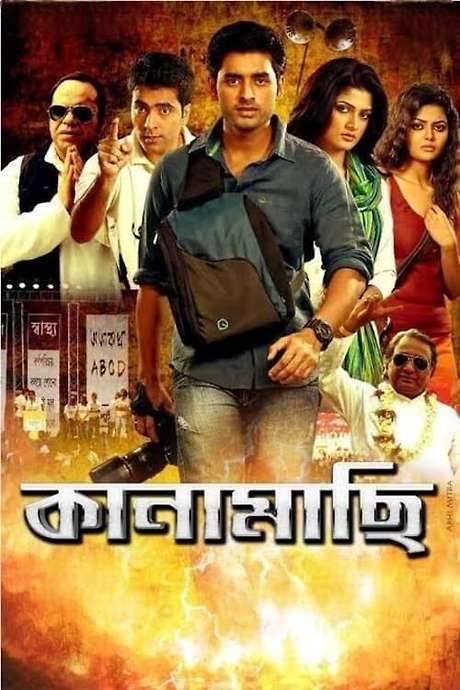
Kanamachi 2013
Directed by

Raj Chakraborty
Made by

Kanamachi Plot Summary
Read the complete plot summary and ending explained for Kanamachi (2013). From turning points to emotional moments, uncover what really happened and why it matters.
Abir [Ankush Hazra] is a young, energetic photojournalist at ABP who lives for the rush of frontline reporting. One day, he spots a group of Naxalites robbing a local bank and dives into the chaos, snapping close-up shots as the heist unfolds. His reflexes pay off when he tamps down the criminals’ escape and manages to secure the memory card, but a young woman, Naina [Srabanti Chatterjee], mistakes him for one of the robbers and helps the gang wrestle his camera away. The chaos attracts the attention of the police, who detain him, yet he uses the evidence—photos that clearly identify the participants—to prove he’s a journalist, not a criminal. The face of the gang leader is hidden behind a mask, leaving a crucial mystery at the center of the investigation.
Back at ABP, where the newsroom hums with the clatter of keyboards and the clamor of deadlines, Abir runs into Nayana [Srabanti Chatterjee], who has just joined as Article Editor. Payel [Saayoni Ghosh] works in the same office and quietly carries a quiet, tugging affection for Abir, though he treats her as a friend rather than a romantic possibility. The atmosphere is charged with ambition and rivalry, as the editorial team strives to publish stories that will shake up the political landscape.
The plot thickens when Naina writes a cover story that targets Tarakeshwar Dutta [Supriyo Dutta], the leader of the opposition, accusing him of attempting to marry a minor. Tarakeshwar storms the newspaper office in a rage, demanding answers, and an audio recording of his interview vanishes—courtesy of manipulation from higher-ups—earning Naina dismissal for alleged falsified reporting. Undeterred, Abir risks everything to capture new photographs of Tarakeshwar in a temple at midnight, where the truth about his alleged child-marriage practices starts to surface. The paper runs with the explosive photos, and for the first time, Abir and Naina find themselves on the path to real notoriety and real love, as their audacious reporting draws them closer.
Meanwhile, Abhimanyu Mukherjee [Abir Chatterjee], a fresh graduate and determined engineer, dedicates himself to a cause: educating and empowering the poor. He and his team of graduates launch a political effort under the party name Borno Porichoy (Grammar Introduction), challenging seasoned politicians who rely on freebies to win votes. Their earnest campaign, though noble, struggles against the entrenched political machinery. One night, Abhimanyu’s volunteers are attacked, and the incident quick-pins Abhimanyu into a direct appeal for help to ABP. The newsroom’s staff protect him, and he becomes a focal point of coverage as Abir and the ABP team rally behind his reformist push, much to the annoyance of Tarakeshwar and the sitting Chief Minister.
During a high-stakes election rally, a bomb is rumored to be hidden under the stage. Abir, ever watchful, receives a text from Payel warning about danger and manages to pull Abhimanyu from danger just in time. The stage explodes moments later, and Payel is fatally wounded nearby. As she lies dying, Payel fights to share a final truth with Abir and Naina, hinting that the killer was embedded within the political machine. A later review of footage suggests the Naxalite gang’s leader bore a striking resemblance to the unknown killer, pointing to a web of conspiracy that connects violence, politics, and press freedom.
As Abir and Naina dig deeper, they notice a troubling discrepancy: a photo of Abhimanyu in a college class shot has been cut, erasing a key link in a chain of allies. Abir explains that he and Abhimanyu studied together and were close friends, and he emphasizes his unwavering support for Abhimanyu’s political career. The election landslide ushers Abhimanyu into the role of Chief Minister, raising hopes for a better governance model and the celebration of a new political era. But the euphoria is short-lived.
Inside the Chief Minister’s office, Abir discovers that the Naxalite leader who claimed Payel’s life has taken shelter there, while Abhimanyu appears to ignore Abir’s accusations. The journalist follows the leader to a hidden lair, where a tense confrontation unfolds. Abir obtains a confession from Shankar [Shantilal Mukherjee], the Naxalite liaison, detailing a shocking arrangement: Abhimanyu had struck a backdoor deal with the insurgents to secure victory, orchestrating acts of sympathy—the burning hut, the staged rescue, and even the staged bomb at the rally—to manipulate public sentiment. Payel had begun to uncover this truth and attempted to warn Abir and Naina before she was silenced fatally.
With evidence in hand, Abir records Shankar’s confession on his mobile and hands it to Naina, who plans to publish a hard-hitting exposé. Abhimanyu storms the hideout and, in a wildly dangerous moment, confronts Shankar. He shoots Shankar after a tense standoff, then turns his ire toward Abir. A desperate bomb blast is triggered, and although Abir barely escapes, Abhimanyu is killed in the ensuing chaos.
The aftermath is fraught with political tremors. Abir and Naina face a moral crucible: the party’s supporters, blissfully ignorant of the full truth, could be ruined if the public learns that their hero had dark, transactional aims. Abir urges Naina to withhold the explosive article to spare innocent colleagues from catastrophe, and she reluctantly agrees to avoid a wholesale collapse of their political careers—choosing instead to frame Abhimanyu’s death as a martyr’s sacrifice in the press.
The film closes on a quietly defiant note. Abir and Nayana present their resignations to the Chief Editor, hoping to purge themselves of false reporting and start anew. The editor, however, refuses the resignations, urging them to stay and continue covering the forthcoming elections. The last image lingers on the fragile line between truth and power, as the two journalists brace themselves for the turbulent political season ahead, compelled to navigate a world where information can mold reality just as easily as it can destroy it.
- Roles and performances weave a dense tapestry of courage, ambition, and the cost of speaking truth to power. The film builds a tense, political-thriller atmosphere while keeping a human focus on the journalists who chase the real story, even when it puts them at risk.
Kanamachi Timeline
Follow the complete movie timeline of Kanamachi (2013) with every major event in chronological order. Great for understanding complex plots and story progression.
Bank robbery captured by Abir
Abir, a photojournalist, chases a local bank robbery staged by Naxalites and manages to click the robbers on camera. A young woman named Naina intercepts him, assuming he is the culprit and even helps the robbers take his camera. He manages to secure the memory card and later shows the photos to the police to prove his press credentials.
Evidence puts Abir on the record
After the confrontation, Abir shows the photos to the police to prove he is a press photographer. The cops identify everyone in the shots except the masked gang leader, establishing Abir's credibility as a journalist. This moment takes place as the investigation unfolds at the police station.
Naina joins ABP; Payel's feelings emerge
Naina settles into her role as Article Editor at ABP, marking a new chapter in the newsroom. Payel also works there and harbors feelings for Abir, who does not initially reciprocate. The love triangle begins to shape newsroom dynamics.
Tarakeshwar scandal and firing
Naina writes a cover story accusing Tarakeshwar Dutta of attempting to marry a minor, triggering a furious confrontation at the office. Tarakeshwar’s people tamper with the audio recording to discredit her, and Naina is fired for falsified reporting. The incident escalates newsroom tensions and jeopardizes ABP’s credibility.
Midnight temple revelation
Abir takes a real risk to photograph Tarakeshwar at a midnight temple scene, catching him in the act of child marriage. The images bolster ABP’s investigative stance and intensify political pressure against Tarakeshwar. The moment is marked by danger and determination.
Print fuels romance and ambition
The newspaper prints the Tarakeshwar photographs, bringing public attention to the case. Naina’s respect for Abir deepens into romance as they share the professional spotlight and success. The event strengthens their bond even as the political water becomes murkier.
Abhimanyu's youth campaign
Abhimanyu, a fresh graduate engineer, leads a reform-minded youth campaign under the banner Borno Porichoy, aiming to educate and uplift the poor. He faces apathy and strong opposition from established politicians, who exploit freebies and power. Abir and Naina begin backing his campaign with extensive media coverage.
Bomb threat during rally
During a late-night campaign meeting, Payel warns of a bomb under the stage. Abir acts quickly, saving Abhimanyu from the blast, but Payel is fatally wounded at the scene. Before dying, she hints at a larger conspiracy, hinting that the danger goes beyond a single attacker.
Payel's death and new clues
Payel dies and struggles to convey a crucial message to Abir and Naina. A video surface suggests a higher-level conspiracy behind the attack, implying the killer could be linked to broader interests. Abir begins to connect the dots between the Naxalites and the political machine.
Confession, hideout, and the final clash
Abir records Shankar's confession and sends the clip to Naina. He tracks the trio to a hideout where Abhimanyu confronts Shankar and kills him, while Shankar’s presence escalates the tension. Abir then triggers a bomb to escape, unintentionally killing Abhimanyu in the ensuing explosion.
Cover-up and martyr narrative
With Abhimanyu dead and the political camp ignorant of his true deeds, Abir and Naina decide not to reveal the full truth. They publish a martyr narrative for Abhimanyu, preserving political reputations and avoiding a larger scandal. The newsroom and party members remain largely unaware of the real machinations.
Resignations and election coverage continues
The film ends with Abir and Naina submitting their resignations to the Chief Editor for falsified reporting, though the editor rejects their resignations and insists they cover the upcoming election. The duo remains on staff to pursue ongoing political reporting and accountability. The stage is set for a continuing political saga.
Kanamachi Characters
Explore all characters from Kanamachi (2013). Get detailed profiles with their roles, arcs, and key relationships explained.
Abir (Ankush Hazra)
A young, energetic photojournalist for ABP who chases a bank robbery and secures the memory card of the robbers' camera. He proves his credentials to the police by showing the photos that identify almost everyone but the masked leader. He risks his life to photograph Tarakeshwar's alleged misdeeds and later uncovers a conspiracy involving the CM. He sends a confession video to Naina, and after a bomb blast, he and Nayana resign to reveal the truth.
Nayana (Srabanti Chatterjee)
The Article Editor who newly joins ABP. She is fired after Tarakeshwar disrupts the newsroom by suppressing a story; she develops a partnership with Abir as they pursue the truth about the CM and the Naxalites. She falls in love with Abir and ultimately publishes Payel's truth and the truth about Abhimanyu, choosing to resign rather than stay silent.
Payel (Saayoni Ghosh)
A colleague who harbors feelings for Abir and becomes a casualty of the political plot. She is fatally wounded near the blast site and dies while trying to reveal the truth. Her death exposes the link between the staged incidents and the political machine, pushing Abir to pursue the deeper conspiracy.
Abhimanyu Mukherjee (Abir Chatterjee)
A recent graduate-turned-engineer who leads a new political party, promising education and reform. He becomes Chief Minister through manipulation and deals with the Naxalites, orchestrating events to win public sympathy. In the end, his schemes unravel as Abir exposes his true character, and he dies in a confrontation at the Naxalite hideout.
Tarakeshwar Dutta (Supriyo Dutta)
The opposition leader whose public image is tangled with the CM's schemes. Tarakeshwar blasts at the newsroom after a story about the CM’s alleged misdeeds and the audio of the interview disappears, signaling how political power can erase inconvenient truths. He becomes a recurring foil to the journalist's efforts to publish the truth.
Shankar (Shantilal Mukherjee)
The Naxalite leader who is the focal point of the political conflict. He is used to manipulate the public and is later confronted by Abir as the truth about the CM's deals emerges. He dies during the final confrontation, revealing the extent of the political manipulation.
CM Surojit Sarkar (Rajatabha Dutta)
The Chief Minister who embodies the central political machine in the film. He is involved in calculations with the Naxalites and uses staged incidents to win an election. His manipulation is exposed by Abir and Naina, contributing to the film's critique of power and governance.
Kanamachi Settings
Learn where and when Kanamachi (2013) takes place. Explore the film’s settings, era, and how they shape the narrative.
Time period
Contemporary era
The events unfold in present-day Kolkata, leveraging modern journalism, social dynamics, and political campaigning. The plot centers on an election season, with timely incidents like a Republic Day backdrop and media-driven public opinion. The timeframe emphasizes current political maneuvering and the consequences of reporting in a digitized age.
Location
Kolkata, West Bengal, India
Set in Kolkata, the film unfolds across the city's bustling newsrooms, government offices, and crowded streets during a tense election season. The backdrop features a media-driven political landscape where journalists chase truth amid corruption and power struggles. The city serves as a microcosm of modern Indian democracy, with secretariats, protests, and high-stakes media coverage shaping the narrative.
Kanamachi Themes
Discover the main themes in Kanamachi (2013). Analyze the deeper meanings, emotional layers, and social commentary behind the film.
🗞️
Media vs Power
The film follows Abir and Naina as they chase a breaking story, highlighting the power of journalism to reveal corruption. It also shows how political interests attempt to manipulate reporting and suppress inconvenient truths. Payel's death underscores the risks journalists face when truth challenges those in power. Ultimately, the story tests whether the press can stay objective or be compromised by ambition.
🏛️
Political Corruption
Abhimanyu's ascent to Chief Minister reveals a web of manipulation with the Naxalites and staged incidents designed to win sympathy. The characters orchestrate fires, bomb plots, and deals that blur the line between governance and crime. The film exposes how power brokers trade legitimacy for electoral gains. The consequence is a citizenry left to question what counts as a 'healthy government'.
🎭
Moral Ambiguity
Abir and Naina confront a landscape where truth and appearances conflict. The media's role in shaping narratives is compromised by selective reporting and strategic disclosures. The revelation about Abhimanyu's double-crossing and Payel's murder forces viewers to reevaluate who deserves to be called a hero. The ending suggests that moral clarity is hard-earned in a system saturated with deceit.
🤝
Friendship & Betrayal
Abir and Abhimanyu were college friends whose paths diverge under pressure from political ambition. The story explores trust, loyalty, and how personal bonds bend under the weight of power. Abir's decision to withhold the full truth to protect others shows how loyalty can compromise integrity. The film ultimately tests whether friendship can survive a corrupt political machine.

Coming soon on iOS and Android
The Plot Explained Mobile App
From blockbusters to hidden gems — dive into movie stories anytime, anywhere. Save your favorites, discover plots faster, and never miss a twist again.
Sign up to be the first to know when we launch. Your email stays private — always.
Explore the mobile appKanamachi Spoiler-Free Summary
Discover the spoiler-free summary of Kanamachi (2013). Get a concise overview without any spoilers.
In a restless city where the pulse of everyday life is amplified by the relentless chatter of television studios and the clatter of keyboards, a young photojournalist strides through the chaos with a camera slung over his shoulder. Abir thrives on the adrenaline of being on the front lines, his instinct to capture truth in a single frame driving him into the heart of whatever tremor disturbs the city’s fragile equilibrium. The newsroom at ABP thunders with ambition, deadlines, and a fierce dedication to stories that can shift the political balance, setting the tone for a world where information is both weapon and shield.
Within that buzzing environment, Naina arrives as a fresh voice in the editorial team, her sharp eye for angles and a willingness to challenge the status quo instantly clicking with Abir’s restless curiosity. Their partnership is a blend of professional rivalry and an undercurrent of something more, each pushing the other to dig deeper into the stories that matter. Beside them, Payel works quietly in the same space, her unspoken affection for Abir adding a subtle layer of personal tension to the high‑stakes atmosphere of the newsroom.
Beyond the newsroom’s glass walls, the city’s political arena pulses with competing ambitions. A seasoned opposition figure, Tarakeshwar Dutta, looms large, while a newly graduated engineer, Abhimanyu Mukherjee, launches an earnest reform movement that threatens to upset the entrenched order. Their aspirations intersect with the journalists’ quest for truth, weaving a tapestry where personal convictions, public expectations, and hidden agendas constantly collide.
The film settles into a gritty, political‑thriller mood, balancing the urgency of breaking news with the quiet, ethical dilemmas faced by those who chase it. As alliances form and doubts surface, Abir and his colleagues find themselves caught between the imperative to reveal what lies beneath the surface and the perilous forces that prefer those truths stay buried. The story promises a tense, immersive journey through a world where every click of the shutter can echo far beyond the page.
Featured on this page

What's After the Movie?
Not sure whether to stay after the credits? Find out!
Check out our other apps:

SAT Sphere
Build confidence for the Digital SAT.

Mori Atlas
Discover wild places worth protecting.

Luntero
Search smarter for a home in Amsterdam.

Plot Explained
Unravel movie endings and hidden clues.

Pokechamp
Dive into Pokémon data and battle logic.

Driving Theory
Get ready for your European theory test.

Movie Dust
Plan your next cinema trip with ease.

Musemap
Find art and culture as you travel.

Selkobase
Compare credentials before committing.

Local Manual
Turn an unfamiliar country into practical next steps.

Lernavi
Compare school systems before your next move.

GymRoam
Find a workout stop wherever your plans take you.
Explore Our Movie Platform
New Movie Releases (2026)
Famous Movie Actors
Top Film Production Studios
Movie Plot Summaries & Endings
Major Movie Awards & Winners
Best Concert Films & Music Documentaries
Movie Collections and Curated Lists
© 2026 What's After the Movie. All rights reserved.
Privacy Policy