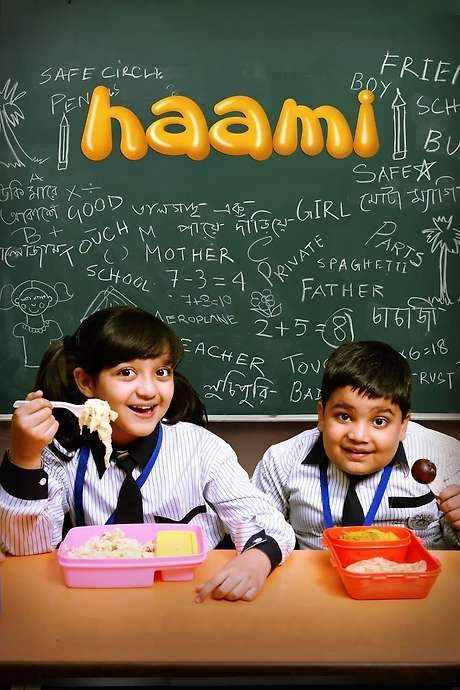
Haami 2018
Directed by

Nandita Roy
Made by

Windows Production House
Haami Plot Summary
Read the complete plot summary and ending explained for Haami (2018). From turning points to emotional moments, uncover what really happened and why it matters.
Haami Timeline
Follow the complete movie timeline of Haami (2018) with every major event in chronological order. Great for understanding complex plots and story progression.
Bhutu befriends Chini at a top Kolkata school
Bhutu studies at a prestigious Kolkata school and meets Chini, a new classmate from an upper-class background. They quickly strike a friendship despite their different upbringings. The school becomes the setting where their bond starts to grow.
A classroom scuffle sparks parental conflict
Bhutu's antics lead to a scuffle with Ajatshotru, triggering a brawl between Bhutu's mother Mitali and Shyamoli, the wife of the local councillor. The incident fuels tensions between the two families and sets a charged tone for their interactions. The school becomes the arena where adult rivalries surface.
Bhutu's innocent gesture leads to trouble
Bhutu gives Chini a peck on the cheek out of pure friendship. Chini tells the class teacher what happened, which puts the adults on alert. The incident becomes a flashpoint for misinterpretation and school intervention.
School calls for both sets of parents
The school summons both Chini's and Bhutu's parents to discuss the incident and the growing tensions. The confrontation reveals underlying class prejudices and reputations that color their judgments. The adults start to shape the narrative more than the children did.
Chini is kept away from Bhutu
Driven by classist attitudes and Mitali's tarnished reputation, Chini is kept away from Bhutu and Bhutu is discouraged from speaking to her. The pair lose daily contact, and Chini feels the absence of their friendship. The school environment reflects adult biases more than the children's needs.
Section changes to separate the children
Following parental pressure, Bhutu and Chini's sections are rearranged, effectively ending their daily proximity. The division mirrors social prejudice more than personal dislike. This move deepens the sense of separation between the two families.
Bhutu fantasizes a wedding and acts on playtime
Inspired by a television wedding, Bhutu decides to marry Chini and places sindoor on her during playtime. The gesture is childish but charged with emotional significance for their bond. The moment triggers surprise and confusion among the onlookers.
Ajatshotru reports the sindoor incident
Ajatshotru witnesses Bhutu's sindoor gesture and reports it to the class teacher. The teacher and principal reopen the discussion, bringing the parents back into the debate. The episode rekindles tensions about boundaries and innocence.
A climate of mistrust intensifies rumors
The school faces a backdrop of mistrust following a false alarm about a student being sexually assaulted by a non-teaching staff member, which colors the teachers' and parents' perceptions. Gossip fuels the misinterpretation of Bhutu's actions as harassment. The atmosphere sets the stage for a new round of accusations.
Parents demand Bhutu's expulsion
Chini's parents and the school principal demand Bhutu be expelled, while Mitali accuses Chini of seducing Bhutu. The confrontation centers on protecting reputations rather than understanding the children's friendship. The fault lines of class and fear of scandal dominate the debate.
The families quarrel with the principal
The two families clash with the principal, who tries to mediate. The quarrel reveals adult biases and social prejudices rather than the children's innocence. The school becomes a battleground for adults' anxieties.
Realization of innocence and reconciliation
Eventually, the parents realize Bhutu and Chini's bond is innocent and pure. They understand they judged the children from an adult perspective and begin to reconcile. The children's friendship is restored as trust slowly returns.
Resolution and return to normalcy
With reconciliation, Bhutu and Chini are allowed back into each other's lives and the school environment regains balance. The story closes on the theme that children can blur social boundaries when adults choose empathy. Timeframe: end of term.
Haami Characters
Explore all characters from Haami (2018). Get detailed profiles with their roles, arcs, and key relationships explained.
Bhutu (Broto Banerjee)
A cheerful, curious child from a middle-class family who befriends Chini at a top Kolkata school. His innocent act of kissing Chini becomes a catalyst for adult-led conflict, exposing how quickly childhood affection can be misread. He is caught between parental rules and the desire to maintain a genuine friendship.
Chini (Tiyasha Pal)
A new student from an upper-class background whose parents are academics. Chini's friendship with Bhutu triggers tension due to class differences and misinterpretation of their interactions. She experiences both the pull of friendship and the scrutiny of adult expectations.
Laltu Biswas
Bhutu's father, a middle-class furniture showroom owner. He embodies practical concerns and familial loyalty, navigating pride, reputation, and parental guidance as events unfold at school and home.
Mitali Biswas
Bhutu's mother and a homemaker who is outspoken and quick to react. Her initial clash with Shyamoli reflects the strength of her convictions and the pressure she faces from social judgments.
Srinjoy Sen
Chini's father, an academic who values knowledge. His attitudes alongside Rina's shape the parents' response to Bhutu and Chini's bond, reflecting a tension between intellectual ideals and social perception.
Rina Sen
Chini's mother, one of the academically-inclined parents. She embodies propriety and concern for reputation, influencing how the family handles the growing closeness between Bhutu and Chini.
Shyamoli Rakshit
Wife of the local councillor and a key social figure whose actions spark a rivalrous clash with Mitali, illustrating the impact of social standing and gossip on school life.
Dilip Rakshit
The local councillor and husband of Shyamoli, whose position adds to the undertones of political and social influence in the school community.
Tanusree Shankar
The school Principal who mediates between families and faculty, guiding decisions and helping to resolve conflicts.
Aparajita Adhya
The Vice-principal who assists in school governance and supports reconciliation when tensions rise.
Ajatshotru
A classmate whose actions trigger the incident and set the conflict in motion through misunderstanding.
Haami Settings
Learn where and when Haami (2018) takes place. Explore the film’s settings, era, and how they shape the narrative.
Time period
Present day
The story unfolds in contemporary Kolkata, reflecting current urban school life and family dynamics. The events revolve around modern classrooms, playground dynamics, and social expectations that today’s families navigate. The narrative centers on everyday, relatable incidents that resonate with a current-middle-class Indian setting.
Location
Kolkata
Haami is set in Kolkata, focusing on life around a top school where Bhutu and Chini become friends. The city’s middle-class neighborhoods and educational environment shape the characters’ choices and the conflicts they face. The school and its surroundings act as the arena where social hierarchies and parental anxieties unfold.
Haami Themes
Discover the main themes in Haami (2018). Analyze the deeper meanings, emotional layers, and social commentary behind the film.
🤝
Class Divide
The friendship between Bhutu and Chini crosses social boundaries, challenging the prejudices held by their parents. Tensions at school and at home arise from perceived differences in background and status. The film exposes how adults’ judgments can distort and complicate genuine childhood connections.
✨
Innocence & Friendship
Childhood friendship is portrayed as pure and uncomplicated, with Bhutu’s innocent kiss symbolizing the strength of a simple bond. Misunderstandings and adult concerns threaten to sever this bond, highlighting the gulf between a child’s intent and grown-ups’ interpretations. The resolution reaffirms the importance of nurturing innocent connections.
💬
Gossip & Misunderstanding
Gossip fueled by adult worries and social anxieties drives much of the central conflict. Rumors and accusations arise from misread signals and class-based judgments, creating a rift between families. The climax emphasizes recognizing the truth of the children’s bond over supporting unverified rumors.

Coming soon on iOS and Android
The Plot Explained Mobile App
From blockbusters to hidden gems — dive into movie stories anytime, anywhere. Save your favorites, discover plots faster, and never miss a twist again.
Sign up to be the first to know when we launch. Your email stays private — always.
Explore the mobile appHaami Spoiler-Free Summary
Discover the spoiler-free summary of Haami (2018). Get a concise overview without any spoilers.
In the bustling streets of Kolkata, two children from opposite ends of the social spectrum find a friendship that feels both simple and extraordinary. Bhutu, a bright‑eyed boy from a modest, middle‑class family, meets Chini, a gentle girl whose life is shaped by an affluent, academic household. Their worlds converge in a prestigious school where childhood curiosity blossoms alongside the subtle pressures of status and expectation.
The school itself becomes a microcosm of the city’s layered society, where teachers, classmates, and parents all carry unspoken judgments. Within this environment, a moment of innocent affection—an unexpected kiss—sends ripples through the tightly knit community, exposing the fragile line between playfulness and scandal. The incident quietly underscores how quickly a child’s pure intent can be reframed by adult anxieties.
At home, Laltu and Mitali, Bhutu’s parents, navigate the challenges of raising a son in a world that often equates respectability with material comfort. Across the divide, Srinjoy and Rina, Chini’s parents, grapple with their own expectations for their daughter, while the local council’s influence adds another layer of scrutiny. Even peers like Ajatshotru and figures such as Shyamoli contribute to an atmosphere where misunderstanding is easy to nurture.
The film moves with a gentle, observational tone, inviting viewers to contemplate how societal pressures can distort innocent bonds. Its mood is a blend of warmth and subtle tension, painting a portrait of childhood that is both joyous and precarious. As the story unfolds, the audience is left pondering the delicate balance between protecting youth and allowing them the freedom to simply be children.
Featured on this page

What's After the Movie?
Not sure whether to stay after the credits? Find out!
Check out our other apps:

SAT Sphere
Build confidence for the Digital SAT.

Mori Atlas
Discover wild places worth protecting.

Luntero
Search smarter for a home in Amsterdam.

Plot Explained
Unravel movie endings and hidden clues.

Pokechamp
Dive into Pokémon data and battle logic.

Driving Theory
Get ready for your European theory test.

Movie Dust
Plan your next cinema trip with ease.

Musemap
Find art and culture as you travel.

Selkobase
Compare credentials before committing.

Local Manual
Turn an unfamiliar country into practical next steps.

Lernavi
Compare school systems before your next move.

GymRoam
Find a workout stop wherever your plans take you.
Explore Our Movie Platform
New Movie Releases (2026)
Famous Movie Actors
Top Film Production Studios
Movie Plot Summaries & Endings
Major Movie Awards & Winners
Best Concert Films & Music Documentaries
Movie Collections and Curated Lists
© 2026 What's After the Movie. All rights reserved.
Privacy Policy