What Is Grandma About?
The premise of Grandma in 257 words, with nothing given away. The full story follows below.
In the sweltering sprawl of Los Angeles, Elle, a poet‑turned‑grandmother still echoing the loss of her longtime partner, finds her quiet routine upended when her eighteen‑year‑old granddaughter arrives with a desperate request. Sage needs a sizable sum before nightfall, and the two women are thrust into a frantic scramble across the city’s eclectic neighborhoods, seeking whatever cash they can cobble together.
The film moves with a restless, almost improvisational rhythm, letting the city’s neon‑lit streets and sun‑baked avenues become a backdrop for both comedy and raw emotion. Tone balances sharp humor with tender melancholy, inviting viewers to feel the urgency of a ticking clock while also savoring moments of unexpected levity.
Elle carries a history of love, loss, and artistic rebellion—her late partner Violet still haunts the spaces between verses, while a recent, tentative romance with Olivia lingers in the corners of her heart. Sage, determined yet vulnerable, brings a youthful urgency that challenges her grandmother’s guarded poise. Around them swirl figures from Elle’s past—a tattoo‑artist friend, a pragmatic café owner, and even her estranged ex‑husband Karl—each hinting at layers of memory that may surface as the day unfolds.
As the duo darts from one possibility to the next, the journey becomes as much about uncovering hidden chapters of Elle’s life as it is about meeting the immediate financial need. The promise of surprising revelations, the clash of generations, and the gentle humor that sprinkles their frantic quest keep the narrative both grounded and hopeful, painting a portrait of resilience amid a city that never stops moving.
What Happens in Grandma?
The complete story of Grandma, from the first scene to the last, in 805 words (about 4 minutes). Spoilers throughout.
Spoilers ahead
Elle, a lesbian poet, is still processing the recent death of her long-time life partner, Violet, when she becomes entangled in a fragile web of improvisation and urgency. She ends a four‑month relationship with a younger admirer, Olivia, telling herself and the world that their romance meant nothing. The news is delivered in a way that feels blunt and defensive, a shield against the ache of loss and the fear of being alone. Not long after, Elle’s granddaughter Sage, who is eighteen, arrives with news that changes everything: Sage is pregnant and needs $630 for an abortion that is scheduled for that very afternoon. Sage’s mother is controlling and has already confiscated her credit card, leaving the two women with only their wits and whatever money they can scrape together. What follows is a tense, improvised road trip across Los Angeles, a city that mirrors their unsettled emotions and the precarious path they must navigate to secure a future Sage never anticipated.
The plan to raise money unfolds in fits and starts, each stop revealing a new layer of desperation and complexity. Elle confronts the father of Sage’s unborn child and forces him to cough up $50, a small fraction of what is needed, but it is something. She then tries to leverage another debt from Deathy, a tattoo artist who is also a friend—yet even Deathy’s help is limited. Deathy can offer only around $60 from the register, and in the process she gives Elle a fresh tattoo that looks like the letter “O.” Sage interprets this as Olivia’s initial, a memory that tugs at both of them, though Elle insists the mark is only a circle—a symbol more about possibility than ownership. As the clock ticks and the car hums along the freeway, Elle attempts to monetize her rare books by selling them to Carla, the café owner who seems practical and sharp. A confrontation erupts between Elle and Olivia at Carla’s café, exposing tensions that were simmering beneath the surface. Carla’s tech-savvy approach—checking prices on eBay—suggests the modern marketplace’s cold calculus, and the price she quotes feels insulting to Elle. The result is a volatile mix of embarrassment, anger, and stubborn pride on the sidewalk outside the cafe.
With options running thin, Elle and Sage turn to those who have been part of Elle’s life for years. They locate Elle’s ex-husband Karl, someone she hasn’t spoken to in decades, hoping he might lend a hand for rent and survival. He agrees to help only after he is drawn into a question about whether Elle’s need is really about a home or about the abortion itself. The conversation becomes charged with history: Elle admits she once terminated a pregnancy they share memories of, and she later explains that she wanted a child but not a husband. Karl’s reaction is a mix of anger and hurt, culminating in a firm stance that he will not finance the abortion, a moment that pushes Elle and Sage back toward the uncertain road ahead.
Finally, Sage and Elle face Sage’s mother, Judy, a busy single parent who is initially reluctant to part with money but eventually provides enough to ease the immediate crisis. With the clock still ticking, Elle drives Sage to the abortion clinic, and the act that follows becomes a quiet, intimate moment of release and relief, accompanied by a lingering complexity about what has been sacrificed and what remains.
After Sage’s procedure, Judy forgives her daughter and returns her to the care of home and family. The journey home is offset by a personal moment for Elle: she allows herself a small, almost carefree giggle, recalling memories of Violet and feeling a shimmer of joy in the midst of the ache. Before reaching their final destination, Elle makes a brief stop at Olivia’s house to offer a sincere apology for the earlier words that diminished their relationship, and the two share a tentative kiss—a brief reconnection that hints at the unresolved feelings still simmering between them. As the night closes in, Elle walks alone down the sidewalk, a slender thread of laughter tracing her steps, carrying both the ache of loss and the stubborn, stubborn spark of hope.
In this intimate drama, the characters collide with questions about love, responsibility, and the choices that shape a life. The film threads together moments of tenderness and stubbornness, showing how people reach for connection even when the path is thorny and the clock is running out. It is a story that refuses to sugarcoat hardship, yet it also refuses to surrender to despair, balancing grief with small, human acts of care and reconnection. The result is a narrative that feels lived-in and raw, anchored by a central figure whose artful, searching voice keeps guiding the viewer through a day that becomes a lifetime in the making.
Grandma Timeline: Every Key Event in Order
12 key events in the order they happen, from “Elle copes with the death of her partner” to “Elle walks home, laughing and reflecting”. 12 events name a place, across 11 locations.
- 1
Elle copes with the death of her partner
Elle, a lesbian poet, is coping with the recent death of her long-term life partner. She struggles with memories of Violet and the loneliness that follows. The film frames her grief as the emotional backdrop for the events to come.
When:present Where:Elle's home, Los Angeles
- 2
Elle ends her relationship with Olivia
Elle ends her four-month relationship with Olivia, telling her that their relationship meant nothing. The breakup highlights her unsettled state after Violet's death. This rupture pushes her toward Sage and the desperate plan to find money.
When:immediately after breakup Where:Elle's apartment, Los Angeles
- 3
Sage reveals she is pregnant and abortion is planned
Sage arrives, revealing she is pregnant and asking for $630 to cover an abortion scheduled for that afternoon. The two decide to drive around Los Angeles to scrounge the money, turning the day into a desperate fundraising road trip. Their journey marks the start of a fraught search that tests their bond.
When:afternoon Where:Los Angeles
- 4
Elle extorts money from Sage's baby's father
On the road, Elle forcefully extorts $50 from the father of Sage's child to contribute to the abortion fund. The maneuver shows how far she is willing to go to meet the urgent need. The exchange foreshadows the mounting moral compromises of their plan.
When:early afternoon Where:on the road, Los Angeles
- 5
Deathy provides a partial loan and a tattoo
Seeking more funds, Elle visits Deathy, a tattoo artist, hoping to borrow money. Deathy can't cover the debt fully but slips Elle about $60 from the till and gives her a new tattoo that looks like the letter 'O'. Sage suspects it's Olivia's initial, though Elle insists it's only a circle. The moment adds a cryptic symbol to their tense day.
When:afternoon Where:Deathy's tattoo studio
- 6
Elle tries to sell rare books; confrontation with Carla and Olivia
Elle attempts to sell several rare books to Carla, owner of a busy café, hoping for cash. Carla gauges prices on eBay and offers a paltry sum, which enrages Elle. Olivia is present and berates her as they leave, deepening the day’s sense of failure.
When:daytime Where:Carla's café
- 7
Elle and Sage visit Karl for a loan
Desperate, Elle and Sage visit Elle's ex-husband Karl, who hasn't spoken to her in years. He agrees to hand over the cash after a kiss in return, sparking an argument about their breakup. They reveal that they need money for an abortion, and Karl becomes angry and refuses to pay.
When:evening Where:Karl's home
- 8
Karl refuses after learning about the abortion
Karl erupts in anger when he learns Elle previously aborted his child without telling him. Elle explains that she wanted a child but not a husband, highlighting the reasons behind their split. He still refuses to pay, leaving them without the money they expected.
When:evening Where:Karl's home
- 9
Judy provides the money and the clinic trip
Sage and Elle confront Sage's single mother Judy, who is furious about the pregnancy but reluctantly hands over the needed funds. Elle drives Sage to the abortion clinic to proceed with the scheduled procedure. The day edges closer to its resolution as they push through this final hurdle.
When:afternoon Where:Judy's home
- 10
The abortion occurs; memories of Violet surface
At the abortion clinic, Sage has the procedure and Judy forgives her, taking Sage home afterward. Elle quietly giggles at memories of her late partner Violet, a small moment of bittersweet joy amid the day's chaos. The relief is tempered by the ongoing emotional fallout of the day.
When:afternoon Where:Abortion clinic
- 11
Elle apologizes to Olivia and they kiss
On her way home, Elle stops by Olivia's house to apologize for saying their relationship meant nothing. The visit leads to a reconciliation and a kiss, reopening a possible path back to Olivia. The moment is tender and suggests uncertain hope for Elle's future.
When:late afternoon Where:Olivia's house
- 12
Elle walks home, laughing and reflecting
After the kiss, Elle walks down the sidewalk, laughing at memories of Violet as she heads home. The walk frames the film's ending with a mix of joy, grief, and unresolved longing. Her steps carry a sense of moving forward amid the remnants of loss.
When:evening Where:Los Angeles sidewalk
Who Are the Main Characters in Grandma?
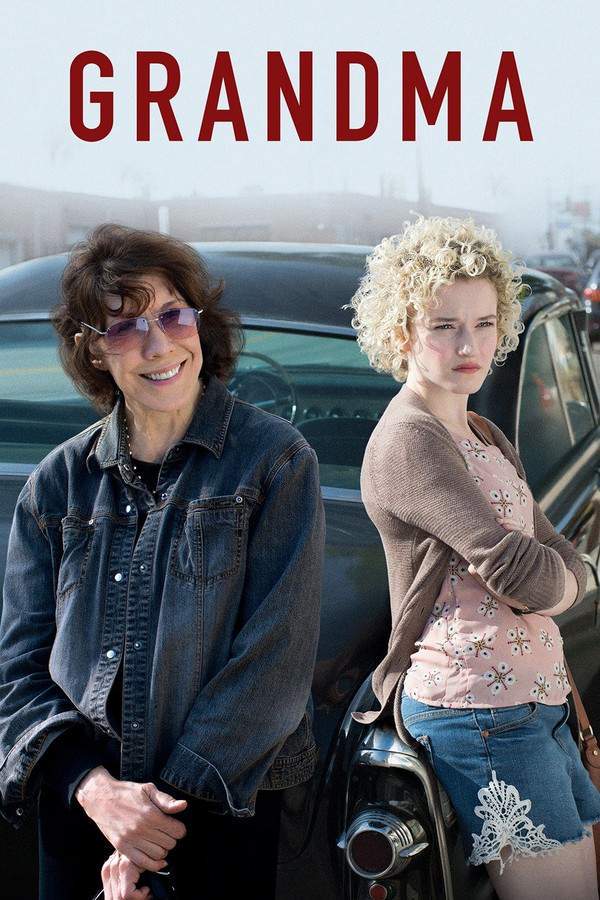
6 characters, among them Elle (Lily Tomlin), Sage (Julia Garner) and Judy (Judy Greer): who each one is and the part they play in the story. 4 of them link to the actor’s page.
-

Elle (Lily Tomlin)
Played by Lily Tomlin
A witty, stubborn poet who has recently endured the death of her long-term partner. She is broke and morally complex, sometimes extorting money or negotiating debts to help Sage. Beneath her prickly exterior lies fierce loyalty to family and a longing for connection.
- 🎭 Drama
- 📝 Poet
- 💔 Grief
-

Sage (Julia Garner)
Played by Julia Garner
An 18-year-old granddaughter who is pregnant and uncertain about becoming a mother. She leans on Elle but clashes with her mother Judy while navigating the abortion decision. Despite anxiety and fear, she shows resilience and a desire to protect her future.
- 👶 Teen
- 🧭 Road trip
- 💪 Resilience
-

Judy (Judy Greer)
Played by Judy Greer
Sage’s mother, a single parent who balances protectiveness with practicality. She fights to support her daughter while confronting her own feelings about the pregnancy and the past. Her eventual willingness to help signals the complexity of forgiveness in family life.
- 👩 Parent
- 💬 Conflict
- ❤️ Forgiveness
-

Deathy (Nat Wolff)
Played by Nat Wolff
A tattoo artist and friend of Elle who offers practical support during the crisis. Deathy provides a small cash contribution and tattoos a symbol that becomes a point of her and Elle’s shared memory. Their dynamic blends blunt realism with a cautious tenderness.
- 🎨 Artist
- 💵 Help
- 🤝 Friendship
- O
Olivia
A younger admirer and former lover of Elle. Their relationship is complicated, and they share a kiss that hints at a possible reconciliation by the end of the ordeal.
- 💘 Love
- K
Karl
Elle’s ex-husband, whose past and present reactions to Elle’s abandonment storyline complicate the money negotiations. He refuses to be a reliable partner in Elle’s life again, and the encounter exposes raw feelings about their breakup and her decisions.
- 💔 Ex-husband
Where and When Is Grandma Set?
Grandma is set in Los Angeles and California (Mid-2010s). Here is why the time and place matter to the story.
When
Mid-2010s
The events unfold in contemporary Los Angeles during the mid-2010s, a period marked by shifting attitudes toward family, sexuality, and reproductive rights. The urgency of Sage’s abortion and the scramble for money reflect a present-day reality where personal stakes and moral choices collide. The setting emphasizes immediacy over nostalgia, grounding the drama in everyday life.
Where
Los Angeles, California
Los Angeles serves as a sprawling urban backdrop for a raw, intimate journey. The city’s neighborhoods become stages for a tense, money-driven quest that threads through sunlit streets and tucked-away cafes. Its varied urban landscape highlights the characters’ pursuit of independence and survival within a contemporary setting.
- 🏙 City
- 🧭 Road trip
- 💔 Drama
What Are the Themes of Grandma?
3 ideas the story keeps returning to, among them Choice, Family Ties and Grief.
-
01
Choice
Sage’s pregnancy triggers a desperate quest for funds to end the pregnancy, highlighting how financial strain shapes reproductive decisions. Elle’s willingness to bend rules reveals a conflicted morality amid urgency and care for her granddaughter. The abortion clinic scene acts as a turning point that tests autonomy, responsibility, and family loyalties. The film treats the topic with unflinching honesty, avoiding simplistic judgments.
-
02
Family Ties
The road trip brings old and new family tensions into focus, from Sage and Elle to Judy’s protective role as a single mother. Secrets surface, forgiveness is offered, and boundaries are renegotiated as money, love, and responsibility collide. The film probes what family means when lives intersect at a moment of crisis, and who gets to decide its terms.
-
03
Grief
Elle’s memory of her late partner Violet colors her judgments and moments of tenderness. Grief threads through her impulsive choices and sharp humor, shaping how she relates to Sage and the world around her. The character’s vulnerability is balanced by a stubborn resilience that drives her to protect family, even as she navigates loss.
What Kind of Film Is Grandma?
Bittersweet in tone, with fast pacing and a moderate story, going by the plot summary.
- Tone
- Bittersweet
- Pacing
- Fast
- Story
- Moderate
- Intensity
- Medium
- Ending
- Bittersweet
A bittersweet and urgent road trip comedy-drama that finds moments of wry humor and quiet tenderness within a challenging day defined by grief, regret, and the complexities of love and responsibility.
- urgent
- introspective
- improvised
- regretful
- tender
- witty
- grief and loss
- abortion
- family conflict
- road trip
Content notes: abortion.
Quiz
How well do you remember Grandma? Test yourself on the story.
Where to Watch Grandma
Stream it on fuboTV and Tubi TV, or rent or buy it from Amazon Video and Apple TV Store. US availability and prices from JustWatch.
Stream 2
 fuboTV
  Tubi TV





Streaming availability in the US, powered by