
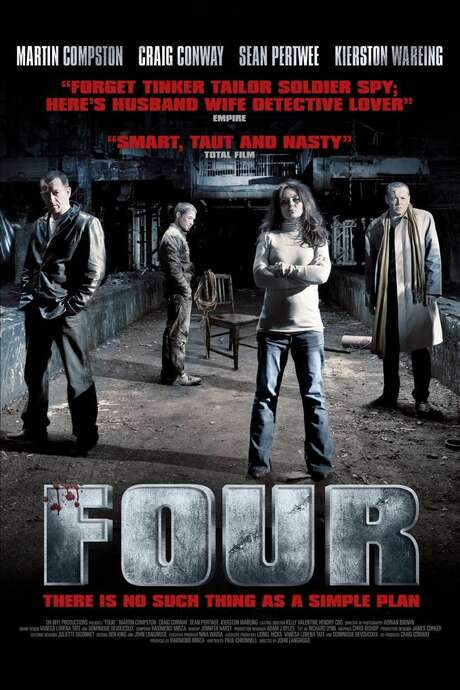
What Is Four About?
The premise of Four in 324 words, with nothing given away. The full story follows below.
In a stark, isolated warehouse that feels more like a stage than a crime scene, a meticulously planned intimidation unfolds. A successful businessman, Craig Conway, has arranged for his wife’s lover to be seized and taken to this hidden location. His goal is simple on the surface: a brief, controlled confrontation that will shock the other man into abandoning any further involvement with his marriage. The plan hinges on the idea that fear can be measured, that terror can be administered with surgical precision, and that he can remain a detached observer while the mess is handled by someone else.
Sean Pertwee is the professional the husband enlists to carry out the dirty work. A seasoned detective with a reputation for getting results, he brings a cold, methodical edge to the operation. Their partnership is built on a mutual understanding that the husband will stay hands‑off while the detective executes the punishment, creating a tense power dynamic that constantly threatens to tip into chaos. The lone, fluorescent‑lit space amplifies each breath, each muffled sound, turning the warehouse into a pressure cooker where control is as fragile as the thin rope binding the captive.
The lover, portrayed by Martin Compston, is thrust into a bewildering nightmare that offers little certainty beyond the immediate threat. His presence adds a volatile mix of confusion and desperation, magnifying the psychological game at play. Though he is the target, the true focus of the film becomes the shifting alliances and hidden motives that surface when the simple plan collides with the reality of human unpredictability.
The tone is taut, gritty, and laced with a dark, almost clinical humor. As the characters circle each other in this confined arena, the audience is left questioning who is truly in control and what unseen forces may be pulling the strings. The film thrives on tension, ambiguity, and the unsettling notion that even the most carefully plotted scheme can unravel in unexpected ways.
What Happens in Four?
The complete story of Four, from the first scene to the last, in 958 words (about 4 minutes). Spoilers throughout. Names in the text link to 4 cast member pages.
Spoilers ahead
In a grim, suspenseful opening, Lover is dragged to an abandoned warehouse, bound to a chair, hooded, and subjected to a brutal, measured beating. The scene is stark and clinical, punctuated by the muffled sounds of fists and the echo of gruff instructions, as the man tries to piece together why he’s been chosen and what he’s done to incur such a fate. Meanwhile, back in a sleek, well-appointed office, a sharp-dressed Husband sits at his desk, twisting his wedding ring and watching the memory of his own betrayed trust flicker in his eyes. He has invited this brutal confrontation as a way to police a betrayal that has torn at the fabric of his marriage, and he is prepared to see it through to the bitter end.
The revelation comes with a cold, hard clarity: the kidnapped man has been involved with the Wife, the wife of the man who stands before him, and the motive behind the kidnapping is to punish the lover for breaking the bonds of fidelity. The Detective explains that a simple beating won’t suffice; if the lover is to learn his lesson, the wife must also be dealt with, and the plan expands to include her as well. The detective’s justification is steeped in a bleak logic: fear, control, and the unsettling belief that the private lives of others deserve harsh, punitive tuning heads into a moral grey zone where lines blur and consequences multiply. The detective then carries out the next shocking step: he abducts the Wife and confines her in another room, turning the warehouse into a stage where two separate acts of coercion unfold side by side.
As the husband and the detective wheel the restrained lover into the main room, the two men alternate between taunts, terse interrogations, and blows that punctuate the air with breaths of panic and rage. The lover remains terrified and confused, insisting that he knew nothing of any marriage involved and that he never meant to hurt anyone—an answer that only stirs the detective’s temper further. The tension heightens as the hood over the lover’s head is finally lifted, revealing the toll of fear and the fragility of memory under threat. With the room emptied except for the two men, the detective imparts a grim, intimate piece of guidance to the husband: keep the hood on the wife, disguise your voice, and continue the psychological siege to cement the message of domination.
The husband, increasingly unsettled by the hidden geometry of what’s happening, moves into the room where his supposed wife is kept, finding her hooded and bound in a way that makes him pause. He hurls insults and threats, but she remains defiant, and when a desperate urge to strike overrules him, he considers using an iron bar. Before he can act, the hood is torn away, and the man who stood as his wife’s husband—yet appears to be an entirely different person to him—stands before him. The woman who faces him is a stranger in every meaningful sense: bold, unafraid, and quickly probing to uncover who this man really is and why the detective, who boasted about his ruthless efficiency, could have abducted the wrong person.
The narrative then circles back to the other room, where the lover pleads for release, insisting he didn’t know his partner was married and that he isn’t the enemy here. The detective’s temper snaps back into place, and the man’s pleas only fan the flames of a situation that has grown far beyond a simple moral showdown. The husband’s nerves fray further as a failed lighter and a failing attempt at normal conversation underline the surreal, almost operatic nature of the night’s events. The Wife proposes a tense bargain—a cigarette if she’s untied—and a threat that, if released, she will not hesitate to go to the police and tell a story that could ruin him. The husband agrees to untie her, a move that becomes pivotal as the power balance shifts once more.
In a shocking sequence of revelations, it becomes clear that the captive wife is not simply a victim of a misguided plan but the detective’s own spouse, and the lover is her partner in a complicated web of infidelity that the detective anticipated and acted upon. As the lover’s drug stash is scattered and the offending drug inventory is exposed, the dynamics of blame and loyalty tilt unexpectedly. The husband realizes that he is not the primary target of the conspiracy; this is a private matter among the detective, his wife, and the wife’s lover, and the husband’s role is more about witnessing the fallout than controlling the outcome. The room erupts in a furious chorus of accusations, anger, and the raw nerves of jealousy laid bare.
The tension erupts in a brutal, final act of violence as the wife reappears, bleeding from a head wound, and rises to confront the detective who had orchestrated so much chaos. In a devastating turn, the wife strikes back with a ferocity that leaves no room for doubt: the lover is killed by an improvised blow, and the woman uses the iron bar to transfer the crime, effectively laying the fingerprints on the weapon that condemn the men who thought they controlled her fate. The wife then crouches by the dead man’s side, playing the role of devastated observer while secretly ensuring that the authorities will see the victims as the culprits of a treacherous triangle. The police arrive to a scene that has already redefined loyalty, power, and the meaning of justice, and the woman—bloodied, unsentimental, and resolute—ensures that the detectives, husbands, and lovers all learn a brutal truth about how far people will go to protect the intimate fiction they call their own.
Four Timeline: Every Key Event in Order
12 key events in the order they happen, from “Kidnapping and transport to the warehouse” to “Final twist: framing and police arrival”. 12 events name a place, across 5 locations.
- 1
Kidnapping and transport to the warehouse
A man is abducted and bundled into the boot of a car, then driven to an abandoned warehouse. He is tied to a chair with a hood over his head, left to sweat under the dim light while his captors prepare the interrogation. The scene establishes a tense, controlled confinement that will drive the rest of the action.
Where:Abandoned warehouse
- 2
The plan to punish the lover
In a well-appointed office, the husband reveals he has arranged for the lover to be abducted and beaten by a hired detective. He intends to punish the affair and deter further contact with his wife. The plan shifts the movie from a private grievance to a public, brutal display of power.
Where:Office building
- 3
The detective expands the plan
The detective argues that mere punishment isn't enough; he also kidnaps the wife to make the lesson comprehensive. The husband, initially reluctant, agrees that this might be the right course. The warehouse becomes a stage for a double kidnapping and coercion.
Where:Warehouse
- 4
Interrogation begins
The lover is wheeled into a separate room and the two men take turns interrogating him, insulting him and whacking him with fists. The man is terrified and doesn’t understand why he is being punished. The interrogation is meant to extract truth and break his resolve.
Where:Warehouse
- 5
The wife is revealed to be the lover’s partner
During the interrogation, the husband reveals that the lover’s girlfriend is in fact his wife. The lover denies knowing she was married and protests that he didn’t know about the marriage. The revelation intensifies the confusion and moral ambiguity.
Where:Warehouse
- 6
The hood falls
After more beatings, the hood finally falls from the lover's head, and he seems to lapse into unconsciousness. The captors debate what to do next as tension lingers in the room. The power dynamic remains unsettled.
Where:Interrogation room
- 7
The husband is told to confront the wife
The detective tells the husband he should go into the room with the wife and continue the intimidation. He refuses to accompany him, noting that whatever happens is private between them. The husband finally enters, ready to confront the captive woman.
Where:Wife's room
- 8
A twist: the wrong woman
When the hood is removed, the captive turns out to be a stranger, Kierston Wareing's character, not the husband’s wife. The husband realizes a grave mistake has been made, and the captive woman challenges him with aggressive words. The discovery shatters the planned ritual of punishment.
Where:Wife's room
- 9
The feisty captive refuses to cooperate
The woman, now revealed as the detective's wife, behaves defiantly, throwing insults and taunts at the husband while trying to bargain for her freedom. She hints at telling the police if he harms her. The scene heightens the danger and blurs who is really the victim.
Where:Wife's room
- 10
The lover's plea and the detective's rage
In another part of the warehouse, the lover begs the detective to release him, insisting he didn’t know about the wife’s marriage. The detective's temper grows, and his control starts to crack as the situation spirals. The atmosphere remains volatile and dangerous.
Where:Warehouse
- 11
The escape attempts and the betrayal
The lover makes a bolt for freedom but is blocked by the detective. The husband returns to argue that the plan has gone wrong and accuses the detective of kidnapping the wrong woman. The 'wife' reappears with a bleeding head, intensifying the emotional chaos.
Where:Warehouse
- 12
Final twist: framing and police arrival
The detective’s wife reveals the truth: she staged the whole thing, and the lover is her partner. The lover is killed by the wife with an iron bar, and she plants the detective’s and husband’s fingerprints to frame them. The police arrive as the deception collapses, and the moral bill comes due.
Where:Warehouse
Who Are the Main Characters in Four?
4 characters, among them Husband (Craig Conway), Wife (Kierston Wareing) and Lover (Martin Compston): who each one is and the part they play in the story. Every profile links to the actor’s page.
-

Husband (Craig Conway)
Played by Craig Conway
A smartly dressed businessman who orchestrates the abduction of the lover and initially the wife, using the detective as a blunt instrument to punish perceived betrayal. His plan is built on control and reputation, but it begins to crumble as the twist reveals the private stakes behind the public display of anger. He remains morally ambiguous, choosing to walk away as the others fall deeper into the scheme.
- 🧑💼 Businessman
- 🔒 Controlling
- 🧠 Calculating
-

Wife (Kierston Wareing)
Played by Kierston Wareing
A feisty and assertive woman who becomes the pivot of the plot, discovered to be the lover of the other man and the apparent target of the plan. She resists passive treatment, challenges the characters who try to manipulate her, and in a final twist uses the situation to frame both husband and detective. She is both a victim and a provocateur.
- 💃 Feisty
- 🧠 Resourceful
- 🔥 Defiant
-

Lover (Martin Compston)
Played by Martin Compston
The man having an affair with the wife, portrayed as fearful and confused under pressure. He denies knowledge of the marriage when pressed and becomes a pawn in the escalating confrontation. His fate turns on the brutal dynamics between the other two players.
- 💔 Affair
- 😨 Fearful
- 🕰️ Vulnerable
- D(
Detective (Sean Pertwee)
Played by Sean Pertwee
A confident, methodical investigator who orchestrates the violent scenario, initially reveling in his perceived skill. His plan unravels when the wife is revealed to be the wrong person and his own complicity is exposed through the twist. He embodies the film’s moral gray area, where professional pride clashes with ruthless action.
- 🕵️ Investigator
- 🗡️ Ruthless
- 🧠 Calculating
Where and When Is Four Set?
Four is set in Abandoned warehouse and Office building (Modern day). Here is why the time and place matter to the story.
When
Modern day
The story unfolds in contemporary times, blending a corporate environment with a grim warehouse setting. It relies on present-day dynamics of infidelity, fear, and coercion, rather than historical events. The tense sequence between office and warehouse feels immediate and current.
Where
Abandoned warehouse, Office building
Most of the film unfolds in an abandoned warehouse, whose stark, echoing space becomes the stage for abduction, interrogation and escalating violence. The warehouse's cold, industrial corridors heighten tension as loyalties crumble. An upscale office setting is shown earlier, hinting at the corporate world behind the personal betrayals.
- 🏚️ Industrial
- 🔒 Thriller
- 🕰️ Urban
What Are the Themes of Four?
4 ideas the story keeps returning to, among them Power & Control, Betrayal and Deception & Identity.
-
01
Power & Control
The film centers on who holds power and how it is exercised through fear, manipulation, and coercion. The husband and the detective use threats and interrogation to bend others to their will, revealing a precarious moral line. The twist involving the wife tests who truly commands the situation, exposing vulnerability beneath authority.
-
02
Betrayal
Betrayal threads through every relationship: marital infidelity, professional deception, and the contrived vendetta. Trust dissolves as secrets are weaponized and loyalties shift under pressure. The characters' actions reveal how far people will go to protect their status or reputation.
-
03
Deception & Identity
Misidentification and misdirection drive the plot, showing how appearances can mask dangerous truths. The detective’s plan spirals as motives blur and the true relationships emerge. The narrative plays with who is really in control of their own story.
-
04
Violence & Consequences
Brutal acts escalate from intimidation to a deadly confrontation, forcing characters to confront the results of their choices. The brutality serves to expose moral compromise and accountability. In the end, the violent schemes unravel into a calculated cover-up.
What Kind of Film Is Four?
Dark in tone, with steady pacing and a complex story, going by the plot summary.
- Tone
- Dark
- Pacing
- Steady
- Story
- Complex
- Intensity
- High
- Ending
- Bleak
A tense and brutal thriller that traps its characters in a claustrophobic warehouse, where a simple plan for revenge unravels into a dark psychological game of shifting identities and fatal consequences.
- claustrophobic
- anxious
- brutal
- unsettling
- paranoid
- grim
- revenge
- betrayal
- marital infidelity
- mistaken identity
Content notes: torture, kidnapping, physical violence, domestic themes, blood.
Quiz
How well do you remember Four? Test yourself on the story.
