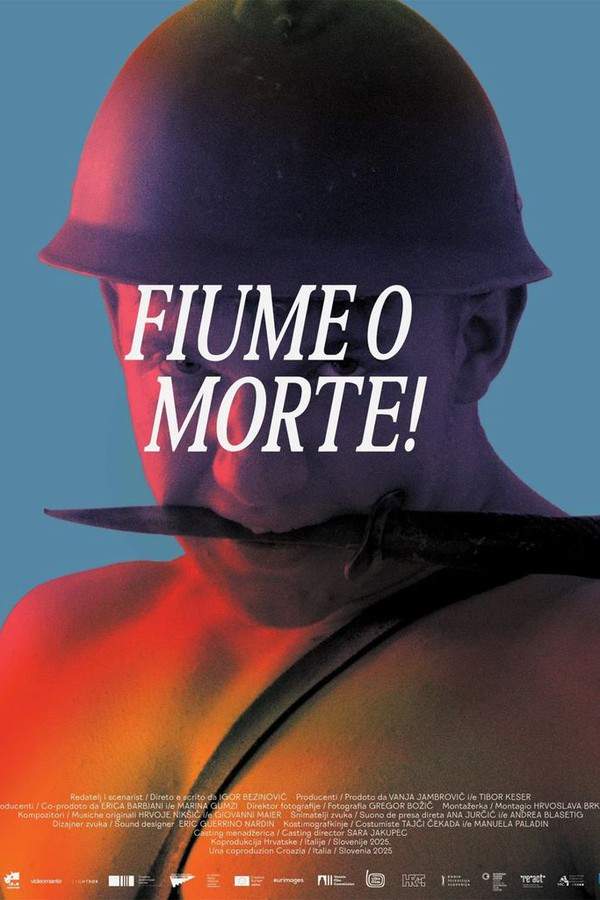
Fiume o morte! 2026

Directed by

Igor Bezinovic
Made by

Restart
Where to Watch Fiume o morte!
See current US streaming, rental, and purchase options for Fiume o morte! (2026) via JustWatch.



Streaming availability powered by 
Fiume o morte! Plot Summary
Read the complete plot summary and ending explained for Fiume o morte! (2026). From turning points to emotional moments, uncover what really happened and why it matters.
In present-day Rijeka, director Igor Bezinović asks local residents what they know about Gabriele d’Annunzio, the Italian poet and nationalist who occupied the city, then known as Fiume, after the First World War. Their responses weave a layered map of memory, revealing how the figure’s presence has lingered in streets, plaques, and conversations, and how the past continues to surface in the city’s everyday life. The film then builds its narrative through a careful blend of archival photographs and footage, a measured documentary voiceover, and staged reenactments performed largely by Rijeka residents. In these sections, a number of participants step into the roles of D’Annunzio himself, as well as soldiers and ordinary people connected to the events, creating a living collage that sits between history and collective memory. The production also offers a behind-the-scenes look at the process: auditions, rehearsals, preparations, and ongoing discussions about which material to use and how to present it to the audience.
The story follows the arrival of D’Annunzio in Fiume in September 1919 and his bold campaign to annex the contested city to Italy. By grounding the drama in recognizable, contemporary locations and weaving in archival material, the film recreates speeches, military gatherings, and ceremonial moments from the occupation, giving viewers a tangible sense of the atmosphere and stakes of the period. It also delves into the establishment of the Italian Regency of Carnaro, and the friction between D’Annunzio and the Italian government that shaped the city’s fate during those tumultuous months.
The occupation culminates in December 1920 with a confrontation between D’Annunzio’s forces and the Italian military. The documentary then returns to present-day Rijeka, closing the loop by focusing again on the residents who contributed to the reenactments and showing how their personal memories intersect with the city’s physical landscape. Through this intimate, participatory approach, the film invites viewers to consider how history is reconstructed, remembered, and re-told through community art that binds place to memory.
Fiume o morte! Timeline
Follow the complete movie timeline of Fiume o morte! (2026) with every major event in chronological order. Great for understanding complex plots and story progression.
Present-day inquiry about D’Annunzio
Director Igor Bezinović begins by asking Rijeka residents what they know about Gabriele D’Annunzio and the Fiume episode. Their varied answers frame the film’s investigation into how history is remembered. The scene establishes memory as fragmented and personal, setting up the documentary’s core question.
Residents share memories and perspectives
Locals recount recollections, legends, and gaps in historical memory. Their testimonies reveal how different communities interpret the same events. The film uses these fragments to map memory across the city.
Archival reconstruction begins
The filmmakers assemble archival photographs and footage, accompanied by narration and documentary sequences. These sources reconstruct the historical context of the occupation and provide a foundation for the reenactments. The process links documentary material with living memory.
Auditions and rehearsals
Participants audition for roles and begin rehearsals for the reenactments. The process explores cast dynamics as locals portray D’Annunzio, soldiers, and other figures. The workshops reveal how memory and performance shape historical representation.
Discussions about historical material
Cast and crew discuss what sources to use and how to present them responsibly. The conversations emphasize ethics in reenactment and the negotiation between documentary evidence and theatrical interpretation. The stage becomes a space for shaping memory.
D’Annunzio arrives in Fiume (Sept 1919)
The narrative timeline shifts to September 1919 as D’Annunzio lands in Fiume and begins the occupation. The city becomes a stage for public speeches and a display of military presence. The event is recreated through a blend of archival material and staged scenes.
Campaign to annex Fiume to Italy
D’Annunzio launches a campaign to annex the city to Italy, rallying followers and articulating political aims in mass gatherings. The film recreates speeches, parades, and strategic meetings, interleaving documentary evidence with performance. The sequence highlights nationalism and the fragility of political legitimacy.
Establishment of the Italian Regency of Carnaro
The occupation consolidates as the Italian Regency of Carnaro is established, with ceremonial rituals and governance structures depicted in reenactments. The scenes convey how authority was organized, enforced, and symbolically presented. The footage blends archival documents with contemporary performance to explain how legitimacy was constructed.
Conflict with the Italian government
Tensions mount between D’Annunzio and the Italian government over legitimacy and strategy. The film portrays political clashes, negotiations, and external pressure that challenge the occupation’s durability. The scene underscores the contradictions at the heart of the venture.
Decisive confrontation ends the occupation
In December 1920, D’Annunzio’s forces confront the Italian military in a pivotal clash. The outcome disbands the occupation and reshapes the city’s future. The reenactment and archival footage converge to mark a turning point in memory.
Return to present-day Rijeka
The film returns to present-day Rijeka, closing the loop between past and present. The participating residents reflect on how the reenactments altered their understanding of the city’s history. The closing segments connect memory to contemporary place and identity.
Memory as living dialogue
Throughout the film, memory is treated as a living dialogue rather than a fixed record. The performances, discussions, and archival materials invite viewers to question how history is told. The community-driven approach positions Rijeka as a site where personal memory and national history intersect.
Fiume o morte! Characters
Explore all characters from Fiume o morte! (2026). Get detailed profiles with their roles, arcs, and key relationships explained.
Gabriele D'Annunzio
A central historical figure portrayed in the reenactments, D’Annunzio’s charisma and nationalist rhetoric drive many scenes. The film stages his speeches and leadership through local performers, turning a historical symbol into a shared memory project. Multiple actors inhabit this role, underscoring the fluid, performative nature of historical memory.
Gabriele D'Annunzio
Another portrayal emphasizes D’Annunzio as a narrator of events, reminding viewers that memory can be constructed from various perspectives. The layered performances reflect how the city interprets its past. The presence of different actors reinforces the fragmented nature of historical memory.
Gabriele D'Annunzio
A further interpretation of the poet-leader appears through a different performer, highlighting how multiple voices shape the story. The reenactments invite viewers to question who gets to tell history and how it is remembered.
Gabriele D'Annunzio
Yet another portrayal showcases D’Annunzio in ritualized scenes that echo the era’s political theater. The series of performances suggests that memory runs through the body as much as through records.
Gabriele D'Annunzio
This portrayal adds yet another facet to the multi-voiced memory of D’Annunzio, emphasizing the lasting impact of his rhetoric on the city’s identity.
Guglielmo Marconi
A figure from the period represented in the film, Marconi’s presence in the reenactments points to the era’s technological and political shifts during the occupation era.
Guido Keller
A participant in the reenactments who helps illuminate the events’ social circles and the dynamics of power and memory in the city.
Dancer
The dancer-narrator contributes movement and performance to the retelling of history, blending art with memory. Their presence demonstrates how body language can convey emotional truth about the occupation.
Lady Reading Poetry
A narrator who introduces passages of poetry and reflective commentary, anchoring the film’s meditative tone and linking the historical material to contemporary contemplation.
Deserter
A participant who embodies the chaos and divisions of the period, illustrating how ordinary people navigated wartime loyalties.
Vittorio Emanuele Pittaluga
A historical figure represented in the reenactments, connected to the events around the occupation and its aftermath.
Antonio Copetti
A participant in the staged material, reflecting the local community’s engagement with the events and memory.
Antonio Grossich
Another figure in the reenactments who helps illustrate the broader network of people connected to the occupation.
Luisa Baccara
A character performed by Tonka Mrsic, whose presence adds a human, personal dimension to the historical events.
Fiume o morte! Settings
Learn where and when Fiume o morte! (2026) takes place. Explore the film’s settings, era, and how they shape the narrative.
Time period
1919-1920, present-day
The occupied period runs from September 1919 to December 1920, when D’Annunzio’s forces clash with the Italian military. The narrative then returns to present-day Rijeka to show how residents and participants remember and perform these events. The film uses archival materials to link the era's speeches, ceremonies, and confrontations with current memory.
Location
Rijeka, Fiume
In present-day Rijeka, the city known historically as Fiume, the film centers on the location where the occupation unfolds. The production recreates the period through archival photos and on-site reenactments by local residents. Scenes shift between contemporary streets and historical settings to connect past events with the city’s memory.
Fiume o morte! Themes
Discover the main themes in Fiume o morte! (2026). Analyze the deeper meanings, emotional layers, and social commentary behind the film.
🧠
Memory
The film reconstructs memory through archival photographs and contemporary reenactments by Rijeka residents. Personal recollections mingle with staged performances, blurring lines between documentary and theater. This approach shows how a city’s past persists in present-day memory and identity.
🎭
Performance
Auditions, rehearsals, and staged reenactments reveal how history is performed rather than simply observed. Residents take on roles of D’Annunzio, soldiers, and other connected figures, turning the past into a living tableau. The meta-narrative underscores the process of building memory through collective action.
🏛️
Identity
The occupation’s memory highlights contested identities around Fiume’s fate and national belonging. By juxtaposing Italian nationalist gestures with local recollections, the film examines how history is interpreted and claimed by different communities. The Italian Regency of Carnaro and the subsequent conflict frame identity as a battleground of memory.

Coming soon on iOS and Android
The Plot Explained Mobile App
From blockbusters to hidden gems — dive into movie stories anytime, anywhere. Save your favorites, discover plots faster, and never miss a twist again.
Sign up to be the first to know when we launch. Your email stays private — always.
Explore the mobile appFiume o morte! Spoiler-Free Summary
Discover the spoiler-free summary of Fiume o morte! (2026). Get a concise overview without any spoilers.
markdown In the coastal city now known as Rijeka, director Igor Bezinović wanders through streets layered with history, asking ordinary residents what they remember — or think they remember — about Gabriele D’Annunzio, the Italian poet and nationalist whose bold actions once put this port at the center of European attention. Their answers are hesitant, fragmentary, sometimes surprising, painting a picture of a figure whose presence lingers in faded plaques, whispered family stories, and the texture of daily life. What emerges is less a portrait of certainty than a meditation on how a city holds — or forgets — its past.
The film weaves together archival photographs, measured voiceover, and staged reenactments performed largely by the city’s own inhabitants. Locals step into the shoes of soldiers, dignitaries, and even D’Annunzio himself, transforming familiar corners of Rijeka into a living collage where history and memory blur. Cameras also linger on the often-unseen labor behind such a project: auditions, rehearsals, debates about tone and truth, and the delicate negotiations that shape how a community chooses to represent itself. The result is a documentary that feels both intimate and inquisitive, less interested in delivering verdicts than in tracing the process by which stories get told at all.
At the heart of the inquiry lies a provocative question: was D’Annunzio an egotistical dreamer chasing a personal kingdom, a sincere utopian intoxicated by poetry and nationhood, or something darker — a proto-fascist whose ambitions helped pave the way for a more devastating future? The film offers no rush to judgment, instead letting archival spectacle, contemporary reflection, and the charged atmosphere of post–Great War Europe sit uneasily side by side. As the reenactors rehearse speeches and military rituals in settings that locals pass every day, the past feels less like a closed chapter and more like an ongoing conversation — one that the present-day city is still learning how to have.
Featured on this page

What's After the Movie?
Not sure whether to stay after the credits? Find out!
Check out our other apps:

SAT Sphere
Build confidence for the Digital SAT.

Mori Atlas
Discover wild places worth protecting.

Luntero
Search smarter for a home in Amsterdam.

Plot Explained
Unravel movie endings and hidden clues.

Pokechamp
Dive into Pokémon data and battle logic.

Driving Theory
Get ready for your European theory test.

Movie Dust
Plan your next cinema trip with ease.

Musemap
Find art and culture as you travel.

Selkobase
Compare credentials before committing.

Local Manual
Turn an unfamiliar country into practical next steps.

Lernavi
Compare school systems before your next move.

GymRoam
Find a workout stop wherever your plans take you.
Explore Our Movie Platform
New Movie Releases (2026)
Famous Movie Actors
Top Film Production Studios
Movie Plot Summaries & Endings
Major Movie Awards & Winners
Best Concert Films & Music Documentaries
Movie Collections and Curated Lists
© 2026 What's After the Movie. All rights reserved.
Privacy Policy