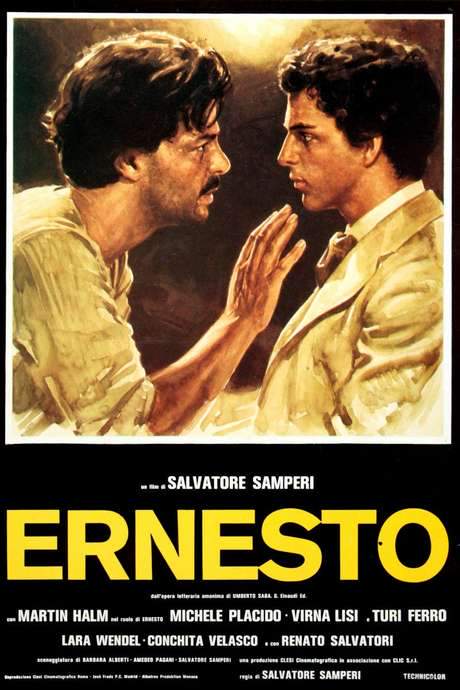
Ernesto 1979

Directed by

Salvatore Samperi
Made by

Albatros Filmproduktion
Ernesto Plot Summary
Read the complete plot summary and ending explained for Ernesto (1979). From turning points to emotional moments, uncover what really happened and why it matters.
Ernesto Timeline
Follow the complete movie timeline of Ernesto (1979) with every major event in chronological order. Great for understanding complex plots and story progression.
Ernesto's early life in Trieste
In 1911, Ernesto is a 17-year-old living with his widowed mother in his violin-loving Jewish uncle's house and working a routine office job. He begins to voice socialist views largely to provoke his uncle, showing a restless temperament. The setting is framed as socially constrained, shaping his choices.
Ernesto challenges family with socialist views
To upset his uncle, Ernesto openly espouses socialist beliefs, creating friction at home. The family tensions foreshadow the conflict between his desires and traditional expectations.
Meeting the stableboy and a secret romance
Ernesto meets a stableboy and they form an intense, secret romance that develops despite societal norms. Their bond deepens into an emotional and physical relationship.
Romance is discovered; Ernesto loses his job
The relationship is discovered, leading to Ernesto losing his job. He also reveals to his mother the nature of his relationship, further straining the family.
Reaction at home
Ernesto's mother reacts with distress, illustrating the era's moral judgments. He wrestles with guilt and the weight of his family's disapproval.
The relationship ends; he turns to prostitution
Disillusionment from the affair pushes Ernesto toward prostitution, ending his relationship with the stableboy. He becomes more detached from his earlier self.
Violin lessons bring Rachel and Emilio into his life
Ernesto takes violin lessons and encounters 15-year-old Rachel and her twin Emilio, who are both depicted by the same actress. They become significant figures as they fall for him.
The twins fall in love; Ernesto marries the sister
Both Rachel and Emilio fall in love with Ernesto, and he ends up marrying the sister, forming a new family dynamic. The marriage resolves tensions with his mother and uncle and with his former employer.
Ernesto outgrows spontaneity, denies past
Having outgrown his years of spontaneity, he begins to deny his earlier sexual past. He encounters his first lover again but refuses to recognize him, signaling a deliberate erasure of that history.
Marriage as a turning point toward conventional life
The marriage marks a shift toward a conventional life, centering Ernesto's attention on family and social acceptance. The narrative frames this as a response to time's pressures.
Setting and social constraints in 1911 Trieste
The story remains anchored in Trieste in 1911, highlighting the social constraints shaping Ernesto's choices. The setting emphasizes the tension between desire and duty.
Resolution: transformation through denial
The arc concludes with Ernesto reorganizing his life around marriage and conventional ties, while denying his past desires. The ending suggests memory and social constraint define his present identity.
Ernesto Characters
Explore all characters from Ernesto (1979). Get detailed profiles with their roles, arcs, and key relationships explained.
Ernesto
A 17-year-old who pursues socialist ideas and secretly explores his sexuality before marrying, torn between personal desire and family expectations.
Cesco
The unnamed stableboy with whom Ernesto forms a passionate, clandestine bond, challenging social norms and testing his loyalty to his family.
Ilio / Rachele
15-year-old twins who captivate Ernesto’s affections; both are portrayed by Lara Wendel, complicating boundaries of gender and romance.
Ernesto's Mother
A widowed mother distressed by her son's sexuality and social standing, whose expectations shape the family dynamics.
Uncle Giovanni
Violin-loving uncle who provides intellectual and emotional influence, whose disapproval adds tension to Ernesto's journey.
Aunt Regina
Ernesto’s aunt who anchors the family’s concerns about propriety and respectability within the social circle.
The Man
The unnamed stableboy lover in Ernesto’s early affair, illustrating the era's tendency to obscure intimate partners.
Signora Luzzato
Mother of Ilio and Rachele, part of the household that forms the twins' upbringing and social world.
Ernesto's Friend Andrea
A figure in Ernesto’s circle who observes or influences him within his social milieu.
Carlo Wilder
A character in Ernesto's world who contributes to its political or social dimensions.
Prostitute Sandra
A prostitute figure Ernesto visits, illustrating his attempts to reconcile desires with a strict social code.
Ernesto Settings
Learn where and when Ernesto (1979) takes place. Explore the film’s settings, era, and how they shape the narrative.
Time period
1911
The events unfold in 1911, a period of strict social codes and evolving ideas about sexuality. The Austro-Hungarian context informs attitudes toward class, family honor, and public morality. Ernesto's secret relationship unfolds against this conservative backdrop and the looming pre-war tensions. The era's expectations push the characters toward secrecy and self-denial.
Location
Trieste
Trieste is a port city on the Adriatic Sea with a mosaic of cultures. In 1911 it belonged to Austria-Hungary, shaping the social backdrop of Ernesto's world. The urban setting includes family homes, offices, and streets that frame the characters' lives. The city serves as a stage where tradition meets the beginnings of modern attitudes.
Ernesto Themes
Discover the main themes in Ernesto (1979). Analyze the deeper meanings, emotional layers, and social commentary behind the film.
🌈
Sexual Identity
Ernesto's awakening occurs within a society that censors non-normative desires. His intense relationship with a stableboy challenges family and community norms, highlighting the vulnerability of youth coming to terms with attraction. The narrative uses intimate moments to explore longing, secrecy, and the social consequences of desire in a restrictive era.
🕊️
Societal Norms
Public morality dictates private lives, pressing characters to hide and rationalize their actions. Ernesto hides his relationship from his mother and uncle, illustrating the heavy weight of reputation. The shift from a forbidden romance to a marriage underscores how people navigate norms and expectations.
💼
Family and Duty
The family circle—mother, uncle, and aunt—shapes Ernesto's sense of belonging and obligation. Seeking approval drives him to marry, blending love with duty and the hope of harmony within the household. The story probes the costs and resilience of family loyalty under social surveillance.

Coming soon on iOS and Android
The Plot Explained Mobile App
From blockbusters to hidden gems — dive into movie stories anytime, anywhere. Save your favorites, discover plots faster, and never miss a twist again.
Sign up to be the first to know when we launch. Your email stays private — always.
Explore the mobile appFeatured on this page

What's After the Movie?
Not sure whether to stay after the credits? Find out!
Check out our other apps:

SAT Sphere
Build confidence for the Digital SAT.

Mori Atlas
Discover wild places worth protecting.

Luntero
Search smarter for a home in Amsterdam.

Plot Explained
Unravel movie endings and hidden clues.

Pokechamp
Dive into Pokémon data and battle logic.

Driving Theory
Get ready for your European theory test.

Movie Dust
Plan your next cinema trip with ease.

Musemap
Find art and culture as you travel.

Selkobase
Compare credentials before committing.

Local Manual
Turn an unfamiliar country into practical next steps.

Lernavi
Compare school systems before your next move.

GymRoam
Find a workout stop wherever your plans take you.
Explore Our Movie Platform
New Movie Releases (2026)
Famous Movie Actors
Top Film Production Studios
Movie Plot Summaries & Endings
Major Movie Awards & Winners
Best Concert Films & Music Documentaries
Movie Collections and Curated Lists
© 2026 What's After the Movie. All rights reserved.
Privacy Policy