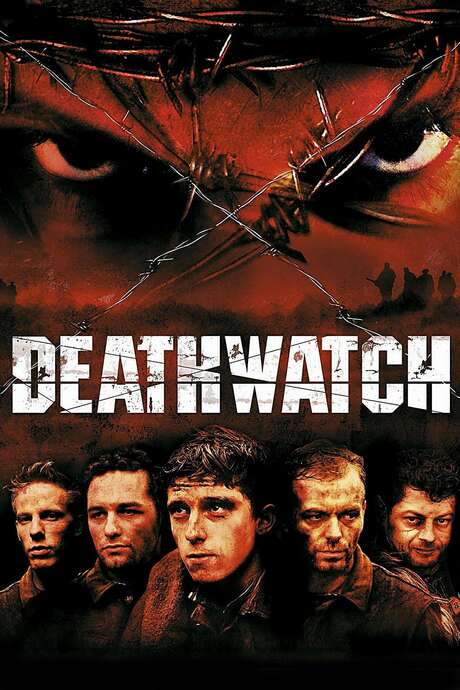
Deathwatch 2002

Directed by

M.J. Bassett
Made by

Q&Q Medien
Where to Watch Deathwatch
See current US streaming, rental, and purchase options for Deathwatch (2002) via JustWatch.








Deathwatch Plot Summary
Read the complete plot summary and ending explained for Deathwatch (2002). From turning points to emotional moments, uncover what really happened and why it matters.
During World War I, the soldiers of the British 5th Battalion’s Y Company under Capt. Bramwell Jennings Laurence Fox push into a grim trench assault, only to find the battlefield quickly devolving into a tests of nerve and fate. The mission centers on the hesitant but determined Pvt. Charlie Shakespeare Jamie Bell, who is nudged forward by Sgt. David Tate Hugo Speer as the company threads through fog, shellfire, and the claustrophobic maze of dugouts. The group fights its way forward, but what begins as a tactical push turns into a haunting ordeal as machines guns and artillery swallow comrades, leaving the survivors scattered, exhausted, and suddenly deeply isolated in the choking mud.
Carrying Pvt. Colin Chevasse Rúaidhrí Conroy on a stretcher, the unit stumbles into a maze of trenches that seems to stretch into infinity. They encounter three terrified Germans who react with a strange, almost parasitic fear as if something otherworldly lurks deeper within the earth. In a tense exchange, Thomas Quinn Andy Serkis shoots one of the Germans, another flees, and the third, Friedrich Torben Liebrecht, surrenders. The incident convinces the men they have breached enemy lines, and they resolve to hold the trench, thinking they have emerged into a fragile moment of control. Yet the trove of unsettling discoveries follows: bodies decayed and strangled by barbed wire, abandoned kits frozen in time, torn watches and broken compasses—an eerie symmetry with the soldiers’ own unraveling morale. When detonations close passages, a demon-like growl rumbles through the mud and blood stains the earth, hinting at a danger far beyond conventional combat.
The fighting intensifies as Pvt. Jack Hawkstone [Hans Matheson] is ambushed by a second German hidden in the ooze. He and Pvt. Barry Starinski [Kris Marshall] falter, and Thomas even executes the captured foe with a pistol, a brutal act that unnerves the already fragile unit and draws the ire of the others. When radio contact with command reveals that White Company may already have been wiped out, the remaining soldiers must shoulder the burden of leadership in a place where rules crumble and fear becomes a weapon of its own.
As night falls, the mood turns heavier. Cpl. Doc Fairweather [Matthew Rhys] tends the wounded, but the sense of menace grows; Barry keeps his distance, then stumbles upon three German corpses wrapped in barbed wire, positioned upright as if mockingly saluting the living. One of the corpses suddenly animates, attacking. Charlie and Tate arrive to find Barry’s corpse suspended by wire, a brutal reminder that something unseen is manipulating the trench from within. When they force Friedrich to speak, he reveals that the others turned on each other and that there is indeed something evil inhabiting the trenches, a force that seems to feed on fear and fracture.
Morning brings a brittle calm that shatters quickly. Jennings’s leadership fractures under stress, and the men clear the dugouts with grenades while the noises of artillery and advancing infantry echo as if the earth itself is moving. In a moment of tragic misperception, Jack is mistakenly shot in the chaos. Despair festers into distrust, and Willie McNess fantasizes about desertion, his nerves unraveling with every echoing step through the trenches. That night, a red mist drifts through the line, voices whisper, and Willie is drenched in blood, chased into no-man’s-land, and finally killed by Bradford after a desperate chase. Doc attempts a rescue but Willie’s condition worsens, and he drags himself toward safety only to be pulled under by something tunneling below.
Anthony Bradford [Hugh O’Conor] enters the narrative more directly as madness tightens its grip: convinced that both the trench and death itself are possessed, he pleads with Charlie to shoot him so he won’t kill again. When Charlie refuses, Anthony leaves, ultimately dragging Doc into a trap of barbed wire and forcing a grim choice on the chaplain. The tension between duty and mercy seems to fracture with every breath, as the men either act or wither under the pressure.
The next day casts a brutal crescendo. Thomas crucifies Friedrich alive on a wooden beam in no-man’s land and is himself stabbed in a fevered, frenzied struggle with Tate, who becomes entangled in barbed wire. Thomas ultimately kills Tate and taunts Charlie when the latter refuses to shoot him, only to be impaled by living strands of wire that rise from the mud. Charlie must decide whether to end his comrade or risk becoming a casualty of the trench’s ravenous, inexplicable power. He ultimately frees Friedrich and arms him with a rifle to defend himself, then rushes toward help.
In a heartbreaking turn, Charlie discovers Colin, pale and covered in flies, whose legs have already been gnawed by rats. Charlie’s tears mark a devastating realization: the boy’s legs are gone, and he must euthanize him. The tension escalates as Anthony ties Doc up with barbed wire and implores Charlie to kill the chaplain as well. Charlie’s resolve wavers, and Anthony shoots Doc, leaving Charlie to confront the moral weight of mercy versus survival. In a final, grim reconnaissance, Charlie chooses to end Anthony’s rampage with his own hands, a moment that seals the fate of the unit in a trench where pain and doubt have become the only constants.
The trench’s earth begins to cave, passages become blocked by the relentless embrace of barbed wire, and Charlie is dragged into a subterranean labyrinth. He wakes in a cave filled with corpses and sees living versions of his men, including himself, sitting around a macabre campfire of memory. Panicked, he escapes back to the trench—and there, Friedrich, now healthy and calm, points his rifle toward him with quiet menace. Friedrich’s offer to let Charlie go, and his enigmatic remark about freedom, suggests a return to the surface is possible, but at a terrible price. The ladder back to no-man’s-land appears, inviting Charlie to climb toward an uncertain fate as the fog swallows the trench and the world above.
In the aftermath, a fresh team of British soldiers arrives at the slaughtered trench. They find Friedrich sitting alone, a chilling calm in his expression as he lifts his hands to surrender, the same gesture of submission that began the nightmare turning into a possible repeat. The film ends on this ominous note: the cycle, the trench, the evil, and the choices made in the murk of war ready to recur, as if history itself is condemned to relive the same horrors over and over again.
Deathwatch Timeline
Follow the complete movie timeline of Deathwatch (2002) with every major event in chronological order. Great for understanding complex plots and story progression.
Charge and fog of no man's land
Charlie Shakespeare initially refuses to advance and is coaxed along by Sgt. Tate as the unit charges a German trench. Thick fog and the artillery barrage cause chaos, and many soldiers fall to machine-gun fire. The British company quickly becomes lost in the battlefield gloom.
Maze-trench encounter and surrender
They stumble into a maze-like network of trenches and meet three terrified Germans. Thomas shoots and kills one; another flees; the third, Friedrich, surrenders. Convinced they have broken through the lines, the unit decides to secure the trenches.
Ominous signs emerge in the trenches
As they move deeper, they find rot-filled bodies, barbed wire, and corpses with broken equipment; compasses and watches have stopped working. They detonate charges to close off passages, and an unseen demon-like growl reverberates, with blood pouring from the mud. The eerie discoveries hint that something more than soldiers haunts these tunnels.
Ambush and brutal execution in the mud
Jack Hawkstone is ambushed by the second German hiding in the mud. He and Barry fight the assailant, but Thomas executes the prisoner with a pistol and even scars him, despite Tate’s objections. The acts reveal the unit's moral collapse under pressure.
Radio reality: White Company wiped out?
Attempts to contact command via radio reveal that White Company was believed obliterated during the assault, and communications fall silent soon after. The isolation deepens as the men face the trench's horrors without relief. The fear of being surrounded by enemies seems to grow.
The first night: uneasy routine and a life-rested corpse
Cpl. Doc Fairweather tends the wounded while Willie isolates himself, unsettled by strange sounds. Barry discovers three German corpses bound in barbed wire; one suddenly animates and attacks him. Charlie and Tate arrive to find Barry's corpse lashed to the wall, a chilling sign that the enemy may be closer than expected.
Interrogation reveals 'evil' in the trenches
The men rough-handle Friedrich to learn what is happening; he explains the other Germans turned on each other and warns that there is 'evil' in the trenches. Charlie understands Friedrich through his French, and they realize survival depends on deciphering the trench's mystery. The tension among the soldiers continues to escalate.
Morning reveals the toll and Jennings' breakdown
The next morning, they pile up German dead and clear dugouts with grenades. Phantom artillery and the clamor of approaching infantry unsettle Jennings, who cracks and accidentally shoots Jack. Morale continues to deteriorate as Willie contemplates desertion.
Willie’s flight and a deadly pursuit
That night, Willie is chased by a red mist and hears voices, finding himself drenched in blood. He flees into no man's land but is shot by Anthony Bradford; Doc attempts a rescue, but Willie crawls and is pulled under by a tunneling force, dying in the mud.
Anthony seeks relief through a sacrifice
Haunted by possession, Anthony asks Charlie to shoot him so he won't kill anyone else; Charlie refuses and Anthony runs off, leaving the fate of the trenches in limbo.
The crucifixion and the fall of the tyrant Thomas
Friedrich is crucified alive by Thomas on a wooden beam in no man's land, a brutal act that mirrors the brutal regime that has taken hold of the unit. Thomas then subdues and stabs the insane Jennings to death; Tate attacks Thomas but is ensnared in barbed wire, and Thomas kills Tate. Finally, living barbed wire rises from the mud, and Charlie is forced to shoot his former comrade.
Colin, Friedrich, and Doc: a fragile relief ends in tragedy
After Thomas's death, Charlie frees Friedrich and arms him with a rifle. He searches for Doc and finds Colin Chevasse, whose legs have been gnawed by rats; Charlie euthanizes him in tears. He then confronts Anthony, who has Doc bound with barbed wire; both plead for Charlie to kill Anthony, but Charlie refuses and Anthony shoots Doc. Shakespeare finally kills the chaplain.
The collapse and the underground nightmare
The soil under the German corpse pile caves in and barbed wire blocks every passage. Charlie is sucked down into a pit and wakes in a cavern filled with corpses, where living versions of his unit sit eating together. He flees back to the trenches, only to be confronted by Friedrich, now healthy again, who points a rifle at him.
A wary breakthrough and a retreat into the fog
Friedrich, now calm, tells Charlie he is free to go and gestures toward a ladder leading to no man's land before fading away. Charlie climbs out into the fog of no man's land, stepping into an uncertain fate beyond.
The cycle resumes: a new team arrives
A later British team reaches the trench and spots Friedrich sitting alone. He surrenders with a chilling, ominous stare, suggesting that this nightmare will begin again for another group of soldiers. The film closes on the same terrors returning to the surface world.
Deathwatch Characters
Explore all characters from Deathwatch (2002). Get detailed profiles with their roles, arcs, and key relationships explained.
Pvt. Charlie Shakespeare (Jamie Bell)
Reluctant at first, Charlie becomes a core moral center under extreme pressure. He grapples with obedience versus mercy, often choosing to protect others even when it endangers himself. His resolve edges between compassion and necessity as the trench hell presses in. By the end, he must confront impossible choices and the cost of survival.
Pvt. Colin Chevasse (Rúaidhrí Conroy)
A paralyzed young soldier whose condition underscores the fragility of life in the trenches. His presence highlights the emotional weight of caring for the wounded when resources are scarce. Though physically diminished, his fate drives others to reflect on mercy and duty.
Pvt. Willie McNess (Dean Lennox Kelly)
A vigilant and anxious presence who is drawn into escalating danger. He experiences the trench's terror firsthand, and his fear becomes a catalyst for the unit's deteriorating morale. His fate underscores the unpredictability and cruelty of war.
Pvt. Barry Starinski (Kris Marshall)
Curious and alert, Barry notices strange, unsettling signs in the trenches. His quick perceptions put him at the center of escalating threats, including encounters with German soldiers entangled in barbed wire. His death marks a turning point in the unit's grip on reality.
Cpl. Doc Fairweather (Matthew Rhys)
The unit's medic, trusted for care and steady presence. Doc's compassion stands in contrast to the brutality around him, even as he is forced into perilous compromises. His capture and eventual death epitomize the expendability felt by soldiers in the trench hell.
Capt. Bramwell Jennings (Laurence Fox)
A once-commanding officer who succumbs to paranoia and madness under sustained bombardment. His slip into instability destabilizes the unit and accelerates the breakdown of order. His demise comes as a consequence of his own unraveling leadership.
Pvt. Jack Hawkstone (Hans Matheson)
A capable fighter who is ambushed by a hidden German, then killed as the struggle tightens around the men. His death illustrates the ever-present danger of an unseen enemy and the fragility of frontline camaraderie.
Sgt. David Tate (Hugo Speer)
Part of the leadership that clashes with Thomas over how to handle the conflict. He is entangled in barbed wire during the confrontation, symbolizing how the trenches ensnare and destroy those who try to maintain order.
Pvt. Thomas Quinn (Andy Serkis)
A fiercely loyal but increasingly brutal soldier whose actions drive the most brutal events of the film. His insistence on force and domination culminates in a climactic downfall as the environment and fate itself seem to recoil against him.
Friedrich (Torben Liebrecht)
The German soldier who surrenders and is initially cautious, later found to be resilient and adaptable. His presence, survival, and eventual ambiguous fate complicate notions of enemy and ally in the trenches.
Pvt. Anthony Bradford (Hugh O'Connor)
A volatile figure who embodies the stripping away of morality under fire. His brutal acts and questioning of coercion collide with Charlie and Doc, challenging them to decide whether mercy can exist in such conditions.
German Soldier (Roman Horák)
Represents the unseen enemy in the trenches—the constant threat across no man's land. His presence alongside other concealed soldiers underscores the perpetual danger that defines the frontline experience.
Martin Plummer (Mike Downey)
A member of the unit whose specific actions aren't deeply detailed in the summary, but who shares the same perilous environment and ultimate fate as his comrades.
Mudman (Pavel Tesař)
A symbolic presence representing the trench’s mutated, suffocating environment—embodied by the mud-drenched figures and the claustrophobic atmosphere that encroaches on every scene.
Soldier (Trevor Bennett, uncredited)
An unnamed member of the unit whose presence reinforces the crowded, impersonal nature of war on the line.
Deathwatch Settings
Learn where and when Deathwatch (2002) takes place. Explore the film’s settings, era, and how they shape the narrative.
Time period
World War I
The events take place during World War I, a period defined by trench warfare, gas, and brutal frontline assaults. The soldiers operate under constant threat from artillery and machine-gun fire, with communication and morale deteriorating as the hours pass. The story emphasizes the grim, stagnant nature of the conflict and the toll it takes on those fighting in the trenches.
Location
Western Front trenches, No Man's Land
The action unfolds within a claustrophobic network of WWI trenches on the Western Front, where mud, barbed wire, and ruined dugouts shape the soldiers' daily reality. No Man's Land isolates the men between enemy lines, heightening fear and uncertainty as shells, whispers, and unseen threats loom. The environment functions almost as a character itself, trapping the group in a labyrinth that blurs the line between civilization and death.
Deathwatch Themes
Discover the main themes in Deathwatch (2002). Analyze the deeper meanings, emotional layers, and social commentary behind the film.
💀
War Horror
The film foregrounds the brutal, dehumanizing aspects of trench warfare. Death lingers in every scene—from shelling and ambushes to the macabre scavenging in the dugouts. Fear and violence erode distinctions between friend and foe, turning survival into a grim, unchecked force. The setting itself amplifies the sense that war corrupts humanity at a fundamental level.
🌀
Madness
As the siege wears on, sanity frays among the soldiers and command. Unexplainable phenomena—the red mist, living barbed wire, and shifting loyalties—blur the line between reality and perception. Power struggles within the unit escalate into brutal acts that betray any lingering sense of order. The trench becomes a stage for collective psychological breakdown.
🛡️
Survival
Characters are forced into life-and-death decisions under extreme duress. Wounded comrades, delayed rescues, and hard choices about killing or mercy reveal what people are willing to do to endure. The film scrutinizes the moral costs of survival when authority collapses and chaos takes over. Hope is fragile, often crushed by the next threat that emerges from the mud.
👁️
Supernatural
The narrative introduces eerie, inexplicable elements—phantom sounds, a malevolent red mist, and sentient barbed wire—that hint at forces beyond human control. Time seems to loop as characters witness repeated phenomena and encounters with dead or dying soldiers. The ending suggests the cycle may recur, leaving the fate of the men and Friedrich open to interpretation.

Coming soon on iOS and Android
The Plot Explained Mobile App
From blockbusters to hidden gems — dive into movie stories anytime, anywhere. Save your favorites, discover plots faster, and never miss a twist again.
Sign up to be the first to know when we launch. Your email stays private — always.
Explore the mobile appDeathwatch Spoiler-Free Summary
Discover the spoiler-free summary of Deathwatch (2002). Get a concise overview without any spoilers.
In the mud‑choked labyrinth of World War I’s Western Front, a British infantry company becomes stranded after a chaotic assault. The men stumble into a shattered German trench, its walls scarred by explosions and its few remaining occupants bewildered by the sudden intrusion. Isolated from their own lines and cut off from any clear command, they decide to hold the position, hoping that reinforcements will arrive before the enemy can regroup. The setting itself—narrow, dimly lit dugouts, endless corridors of earth and barbed wire—creates a claustrophobic atmosphere where the ever‑present roar of artillery feels both distant and immediate, and the line between friend and foe begins to blur.
Leading the group is Capt. Bramwell Jennings, a seasoned officer whose calm exterior masks the weight of responsibility thrust upon him in the face of uncertainty. At the heart of the story is Pvt. Charlie Shakespeare, a reluctant yet determined soldier whose youthful outlook clashes with the grim realism of trench warfare. Beside him, Sgt. David Tate provides a hardened, pragmatic counterpoint, while other members of the company bring a mix of nervousness and quiet resolve. Together they form a fragile micro‑society, each personality testing the limits of loyalty, fear, and survival as they try to maintain order in a place designed to erode it.
As night falls and the stale air grows heavier, an unsettling presence seems to seep from the very walls of the trench. It is not a visible enemy but a creeping malaise that amplifies doubt and fuels mistrust among the soldiers. The film’s tone shifts between stark, visceral realism and a slow‑building, psychological dread, suggesting that the true horror may lie not in the weapons of war but in the mind’s capacity to turn isolation into paranoia. The stage is set for a tense confrontation between duty and the unseen forces that threaten to unravel the fragile thread holding the men together.
Featured on this page

What's After the Movie?
Not sure whether to stay after the credits? Find out!
Check out our other apps:

SAT Sphere
Build confidence for the Digital SAT.

Mori Atlas
Discover wild places worth protecting.

Luntero
Search smarter for a home in Amsterdam.

Plot Explained
Unravel movie endings and hidden clues.

Pokechamp
Dive into Pokémon data and battle logic.

Driving Theory
Get ready for your European theory test.

Movie Dust
Plan your next cinema trip with ease.

Musemap
Find art and culture as you travel.

Selkobase
Compare credentials before committing.

Local Manual
Turn an unfamiliar country into practical next steps.

Lernavi
Compare school systems before your next move.

GymRoam
Find a workout stop wherever your plans take you.
Explore Our Movie Platform
New Movie Releases (2026)
Famous Movie Actors
Top Film Production Studios
Movie Plot Summaries & Endings
Major Movie Awards & Winners
Best Concert Films & Music Documentaries
Movie Collections and Curated Lists
© 2026 What's After the Movie. All rights reserved.
Privacy Policy