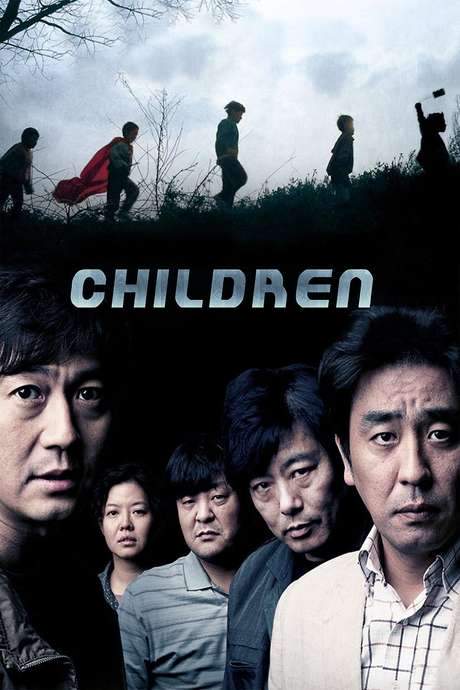
Children… 2011

Directed by

Lee Kyu-man
Made by

Lotte Entertainment
Children… Plot Summary
Read the complete plot summary and ending explained for Children… (2011). From turning points to emotional moments, uncover what really happened and why it matters.
On March 26, 1991, during local elections, five boys vanish while exploring a nearby mountain on a day off from school. Their parents push for an immediate police investigation, but the authorities are distracted by safeguarding the polling stations. Days turn into weeks, and thousands of officers scour the mountain for clues, yet nothing materializes. The nation follows the parents’ desperate pleas as their story captures hearts and minds, sparking a wave of theories—from North Korean spies to alien abductions—about what might have happened to the children.
In 1996, Kang Ji-seung, a career-driven documentary maker Park Yong-woo who has just been reassigned to the small town after a high-profile setback, returns with a single aim: to resurrect his name by solving the case. He teams up with a determined professor Jeon Kuk-hwan who is eager to prove himself by cracking a crime that the police could not solve. The professor’s theory starts to gain momentum when he uncovers a telephone recording of someone claiming to be one of the missing boys calling his own home. The mother Kim Yeo-jin does not seem shocked to hear her son’s voice, which unsettles the investigator and pushes the professors’ line of inquiry toward questions about what the boy’s family might be concealing. As they press, the entire household—parents and even the grandmother—appears to behave with strange, unsettled reluctance. The professor convinces authorities to dig up the boy’s home, but finds nothing conclusive. The accusation shatters the family’s reputation, and the father Sung Ji-ru dies without ever clearing his name. Soon after, Kang Ji-seung is reassigned back to the city, and the professor loses his university position, both casualties of a case that refuses to be put to rest.
Then, in September 2002, the remains of the children are discovered in the woods on the same mountainside the youngsters had described visiting. Two skulls show large holes and one bears strange indentations from an unidentified instrument, while their clothes are knotted in sailor-like knots and the scene yields bullet casings. The discovery rattles the country anew, and Seoul is shaken by news of two more children missing in the capital. Kang Ji-seung reconnects with the police officer who investigated the original disappearance a decade earlier, who reveals a chilling detail: on the night after the boys vanished, he encountered a mysterious young man who is always seen fishing nearby. The officer kept this quiet because Korea’s statute of limitations would bar any prosecution, even if the killer were caught years later. He chose to wait and watch for another crime to trap the suspect, hoping to finally bring closure.
Using a traced license plate, Kang Ji-seung locates the man and breaks into his apartment when he’s away. A disturbing cache awaits—a box of items belonging to children and stacks of books tied into sailor’s knots. He waits outside the building, intending to confront the suspect when he returns home. The next morning, Kang Ji-seung’s own daughter vanishes, only to reappear moments later, claiming a man driving a passing truck helped her. He races the truck to a slaughterhouse, where he confronts the suspect. The man refuses to confess but hints that he might be the killer. With no rock-solid evidence to arrest him, Kang Ji-seung watches as the suspect saunters away, leaving the mystery unresolved and the danger lingering over the city.
The case lingers in memory, a careful balance of pursued truth and the limits of justice, as the investigators chase a thread that refuses to untangle neatly.
Children… Timeline
Follow the complete movie timeline of Children… (2011) with every major event in chronological order. Great for understanding complex plots and story progression.
Disappearance of five boys during local elections
On March 26, 1991, five boys vanish while exploring a mountain on a day off from school. Their parents push for an immediate police investigation, but authorities are distracted by safeguarding polling stations. Thousands of officers scour the mountain, yet no clues materialize, and the nation watches with growing dread.
Public pursuit and nationwide attention
The disappearances capture hearts and minds as theories surge from North Korean spies to alien abductions. Families campaign tirelessly for answers, and the case becomes a nationwide obsession. The authorities are stretched thin and the truth remains elusive.
Ji-seung returns to small town life
In 1996, Kang Ji-seung, a documentary maker who has just been reassigned after a career setback, returns to a small town to rebuild his name. He teams up with professor Jeon Kuk-hwan, who hopes to prove himself by solving a crime the police could not. The partnership begins a renewed look at old clues with fresh eyes.
Telephone recording sparks new theory
The professor's theory gains traction after uncovering a telephone recording of a boy claiming to be one of the missing children calling his own home. The mother's reaction unsettles the investigator and hints at secrets the family might be concealing. Authorities agree to investigate the boy's home again, though nothing conclusive is found.
Family under scrutiny and reputational damage
As the investigation presses forward, the entire household—parents and even the grandmother—appears reluctant and unsettled. The family's reputation is shattered, and the father dies without ever clearing his name. The professor loses his university position as the case drains both men of their standing.
Remains found on the mountainside
In September 2002, the remains of the children are discovered in the woods on the mountainside they described visiting. Two skulls show large holes and one bears indentations from an unidentified instrument, while their clothes are tied with sailor knots and bullet casings are found at the scene. The discovery shocks the country anew.
Seoul is shaken by new disappearances
Soon after the discovery, Seoul is rattled by news of two more children missing in the capital. The country contends with renewed fear and a reminder that the killer may still be at large. The case reignites public demand for answers and accountability.
Old investigator shares a chilling lead
Kang Ji-seung reconnects with the police officer who investigated the original disappearance. He learns of a mysterious young man who is always seen fishing nearby, suggesting a connection to the crimes. The officer admits he kept silent to see if another crime would yield an opportunity to trap the suspect.
License plate trace and break in
Using a traced license plate, Ji-seung locates the suspect and breaks into his apartment while he is away. He finds a disturbing cache of items belonging to children and stacks of books tied into sailor knots. He waits outside the building, intending to confront the suspect when he returns.
Daughter vanishes and reappears; slaughterhouse confrontation
The next morning, Ji-seung’s daughter vanishes and reappears moments later claiming a passing truck helped her. He races the truck to a slaughterhouse to confront the suspect, who refuses to confess but hints that he might be the killer. With no solid evidence, the confrontation leaves the case unresolved.
The killer remains at large
The suspect offers no confession and the evidence remains inconclusive, leaving the case unresolved. The city continues to fear that the killer is still active, and the investigation lingers in memory. The pursuit of truth clashes with the limits of justice.
Memory and unresolved pursuit
The case endures as a careful balance between truth and justice. Investigators chase threads that refuse to untangle, while the public memory of the disappearances shapes future inquiries. The story closes with a haunting sense that some questions may never be fully answered.
Children… Characters
Explore all characters from Children… (2011). Get detailed profiles with their roles, arcs, and key relationships explained.
Kang Ji-seung (Park Yong-woo)
A career-driven documentary maker who is transferred to a small town after a disgraceful past incident. He aims to revive his career by re-opening the missing boys case and is willing to press beyond official resistance. His pursuit blends relentless investigation with a growing fixation on the truth, even at personal cost.
Professor Cha (Jeon Kuk-hwan)
An ambitious professor who believes he can crack the case with a theory that outpaces police work. He provides seemingly compelling evidence and pushes the investigation in new directions. His assertions threaten reputations and challenge established conclusions, fueling tension with authorities and Ji-seung.
Jung-ho's Mother (Kim Yeo-jin)
The mother of one of the missing boys, whose calm response to receiving a call claimed to be from her son fuels suspicion about what she knows. Her family becomes a focal point for rumors and media scrutiny as the case drags on. She bears the pressure of public attention while seeking truth for her son's return.
Jung-ho's Father (Sung Ji-ru)
The father who bears the weight of accusations during the investigation and is ultimately unable to clear his name before his death. His tragedy illustrates how rumor and doubt can destroy a family. His story highlights the human cost of public forensic controversy.
Remains Finding Reporter (Woo Young-taek)
A reporter who covers the discovery of the children's remains and the unfolding investigation. His coverage helps shape public perception and keeps the case in the national spotlight. He follows the twists of the story as new clues emerge years later.
PD Kim (Oh Dong-ju)
A film crew PD who documents the investigation, capturing the atmosphere of a case that blends mystery with media production. His presence underscores the documentary nature of the pursuit and the way journalism intersects with policing.
Children… Settings
Learn where and when Children… (2011) takes place. Explore the film’s settings, era, and how they shape the narrative.
Time period
1991-2006
The narrative spans the 1990s into the mid-2000s: it begins with the 1991 local elections, follows a 1996 transfer of the investigator, notes a 2002 discovery of remains, and references a 2006 statute of limitations that colors the pursuit of justice.
Location
Seoul, South Korea, Mountainside
The story moves between Seoul and a remote mountainside in Korea, where a disappearance and its aftermath unfold. The mountainside is depicted as a rugged, wooded landscape that becomes the central stage for searches, discoveries, and rumors. The urban setting of Seoul contrasts with rural, atmospheric woods, highlighting how public attention travels from city to countryside.
Children… Themes
Discover the main themes in Children… (2011). Analyze the deeper meanings, emotional layers, and social commentary behind the film.
🔎
Investigation
A disgraced documentary maker teams with a determined professor to reopen a cold case. They pursue leads, phone recordings, and shifting testimonies, challenging official conclusions. The pursuit raises questions about methods, ethics, and whether truth justifies personal and professional risk.
💔
Grief
The families endure a painful, public ordeal as rumors and media attention swirl around the disappearances. The investigation damages reputations and strains relationships, culminating in tragedy for the father who dies under the weight of suspicion. The film shows how private sorrow can become a public spectacle.
🕰️
Time & Memory
Events unfold across years, with remains discovered long after the disappearance. Memory and rumor intertwine with forensic clues, shaping public perception and questionably solving the case. The looming statute of limitations adds a sense of urgency and murkiness to justice.

Coming soon on iOS and Android
The Plot Explained Mobile App
From blockbusters to hidden gems — dive into movie stories anytime, anywhere. Save your favorites, discover plots faster, and never miss a twist again.
Sign up to be the first to know when we launch. Your email stays private — always.
Explore the mobile appChildren… Spoiler-Free Summary
Discover the spoiler-free summary of Children… (2011). Get a concise overview without any spoilers.
The quiet mountain town where five boys vanished on a spring day in 1991 becomes a reluctant stage for a national obsession. Their disappearance, occurring while the boys were frog‑hunting, halts a local election and sends waves of speculation across the country—ranging from political intrigue to the supernatural. As weeks turn into years, the empty mountain slopes and the unanswered phone calls turn the case into a lingering ghost that haunts the public consciousness and keeps the community under a perpetual, uneasy spotlight.
Into this atmosphere steps a trio of unlikely investigators, each driven by a personal crossroads. Kang Ji‑seung, a documentary filmmaker whose recent setback has left his reputation in tatters, sees the cold case as a chance to rebuild his name by uncovering the truth. Jeon Kuk‑hwan, a university professor whose academic credibility hinges on solving a puzzle no one else can, brings a methodical curiosity that borders on obsession. Alongside them, a seasoned police detective who first chased the boys’ trail carries the weight of unfinished business, hoping the passage of time might finally reveal what was once hidden.
The film unfolds with a brooding, almost tactile sense of place—mist‑cloaked forests, humming power lines, and town squares that echo with whispered theories. It balances the stark realism of investigative work with the almost mythic quality of a story that refuses to be solved. Relationships fray and tighten as the investigators confront each other’s motives, the town’s collective memory, and the unsettling feeling that some answers may always lie just beyond reach. The tone is one of measured tension, inviting the audience to linger in the same uneasy curiosity that has kept the case alive for decades.
Featured on this page

What's After the Movie?
Not sure whether to stay after the credits? Find out!
Check out our other apps:

SAT Sphere
Build confidence for the Digital SAT.

Mori Atlas
Discover wild places worth protecting.

Luntero
Search smarter for a home in Amsterdam.

Plot Explained
Unravel movie endings and hidden clues.

Pokechamp
Dive into Pokémon data and battle logic.

Driving Theory
Get ready for your European theory test.

Movie Dust
Plan your next cinema trip with ease.

Musemap
Find art and culture as you travel.

Selkobase
Compare credentials before committing.

Local Manual
Turn an unfamiliar country into practical next steps.

Lernavi
Compare school systems before your next move.

GymRoam
Find a workout stop wherever your plans take you.
Explore Our Movie Platform
New Movie Releases (2026)
Famous Movie Actors
Top Film Production Studios
Movie Plot Summaries & Endings
Major Movie Awards & Winners
Best Concert Films & Music Documentaries
Movie Collections and Curated Lists
© 2026 What's After the Movie. All rights reserved.
Privacy Policy