
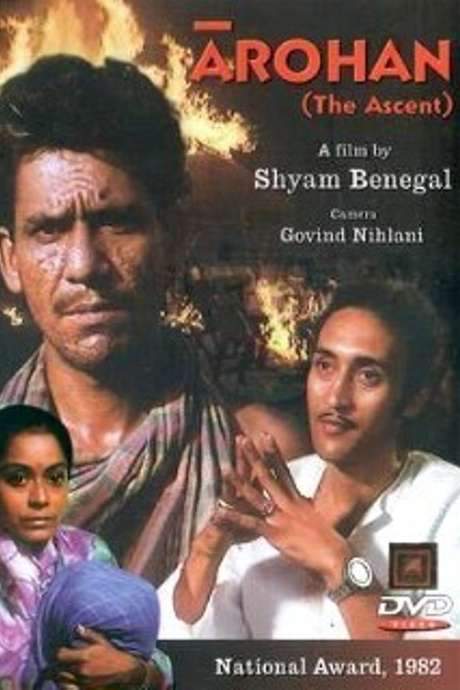
What Is Arohan About?
The premise of Arohan in 327 words, with nothing given away. The full story follows below.
In the lush, river‑lined fields of mid‑sixties Bengal, a quiet hamlet clings to ancient rhythms while the distant rumble of the Naxalbari uprising begins to stir the air. The world of the film is one of cracked mud paths, weather‑worn thatched roofs, and a social order that has long balanced on the fragile backs of tenant farmers. An undercurrent of political idealism threads through the village, hinting at a larger struggle for a socialist future that feels both distant and impossibly close.
Hari Mondal is a modest farmer whose life revolves around the land he tills and the family that shares his modest home. He lives with his wife, two sons, his brother, the widowed aunt Kalidashi and her daughter Panchi. Their daily existence is shaped by the customs of tenancy, the lingering pressure of a powerful landlord family, and the ever‑present need to secure enough to survive. The bonds between the family members are warm yet tinged with the unspoken anxieties that come from living on the edge of poverty and subservience.
The younger generation—Bolai and Panchi—feel the tug of the new political wave more acutely. They are drawn to ideas of equality, to the promise of a society where the landless might finally have a voice, and to the bright allure of the city that seems to hold possibilities far beyond the fields. Their aspirations create a quiet tension with Hari’s more cautious, lived‑in approach, revealing the clash between tradition and the yearning for change that defines the era.
Against this backdrop, the village hums with a mix of hope and unease. The tone is contemplative, painted in earthy hues and punctuated by the soft crackle of radios broadcasting revolutionary slogans. As the community navigates the slow grind of everyday labor, the looming promise of reform hangs over each decision, setting the stage for a story that examines dignity, resilience, and the cost of pursuing justice in a world poised on the brink of transformation.
What Happens in Arohan?
The complete story of Arohan, from the first scene to the last, in 659 words (about 3 minutes). Spoilers throughout. Names in the text link to 4 cast member pages.
Spoilers ahead
Hari Mondal is a poor farmer living in the remote Bengal village of Giripur in Birbhum district, sharing his modest life with his wife, two sons, his brother, and their old widowed aunt Kalidashi and her daughter Panchi. Set in the mid‑sixties, the story unfolds as the Naxalbari uprising sparks a wave of change across Bengal, uniting oppressed farmers with a new generation of youths who dream of a socialist republic and a fairer voice for the landless.
In this tense landscape, Hari and his brother Bolai till land that belongs to the Jotdars, a powerful landlord class led by Jotdar Bibhutibhushan Ganguly. The young landowner has just lost his father and proposes new rules designed to maximize profit, while his estate agent, Karmakar, keeps the villagers intimidated and compliant. When Hari asks for a loan to support his sister’s marriage, he is pressured to avoid formal Registering Bargadari rights in government offices—a bureaucratic snare that strips farmers of legal protections. Hari remains naïve and swept up in generations of subservience, even as Bolai grows restless at a system that benefits the few at the expense of the many. Bolai and Panchi fall in love, complicating family loyalties amid mounting political tension.
As the communist movement strengthens, Hari finds himself increasingly crushed by the Jotdar’s whims: he becomes a paid laborer on his own land, and Bolai is pushed out of the field altogether. Bolai leaves for Calcutta in search of better work, only to drift into a rough urban life where he becomes entangled with wagon breakers and, eventually, a local political muscle. Panchi and her mother also move to the city with help from strangers who promise opportunities, while Kalidashi takes a low-paying job as a cook in a middle‑class home. Panchi is lured by luxury—cosmetics, silk sarees, and a big bed—an alluring but dangerous escape from rural poverty. A stark moment arrives when the middle‑aged businessman who brought her into this life asks whether she has ever slept on a bed before, underscoring the commodification and precariousness of her new world.
Driven by a sense of justice, Hari persists in his fight. He obtains a court case with help from a sympathetic village master Village Master and a free‑lance lawyer who volunteers his time. The district district magistrate approaches Hari’s case with humanity, but the Jotdar retaliates with force—burning Hari’s house, beating him, and taking the bullocks that sustain his livelihood, leaving the family cornered and vulnerable.
The dispute climbs to the High Court, where the balance of power remains elusive. While the political winds shift with the advent of a leftist government in Bengal, Hari’s case is ultimately decided in favor of the Jotdar. Undeterred, Hari channels his energy into Panchayat politics and defeats Karmakar in the local election, earning the Bargadari certificate that would affirm his rights—but at a heartbreaking price: a broken leg, a shattered home, and the disappearance of his brother Bolai.
Hari’s search for Bolai in Calcutta yields no clear answers about his fate. Bolai has received a life sentence for a political murder, while Panchi’s life in the city spirals into hardship: she is expelled from her flat, discovers she is pregnant, is forced to terminate the pregnancy, and slides into a fragile mental state. Kalidashi dies, likely from heartbreak after seeing her daughter’s downfall and her own sacrifices go unrewarded. Hari himself dies a few months later in 1980, leaving behind a village that has changed through land reform and political transformation but at a heavy personal and familial cost.
The film paints a patient, nuanced portrait of rural life under pressure, where centuries of tenancy and social hierarchy collide with political awakening and reform. It traces a family’s steadfast endurance against oppression, the costs of seeking justice, and the quiet, lasting impact of a struggle for dignity and land—an intimate saga that asks what people sacrifice in the name of rights, and what remains when the dust settles.
Arohan Timeline: Every Key Event in Order
13 key events in the order they happen, from “Uprising and oppression in Giripur” to “Hari's death closes the saga”. 13 events name a place, across 6 locations.
- 1
Uprising and oppression in Giripur
In the mid-1960s the Naxalbari-inspired uprising spreads across Bengal, uniting oppressed farmers. Hari and his brother Bolai work as Borgadars under the landlord system, while Bibhutibhushan tightens his grip on Bargadari rights. The villagers sense a long-seated servility being challenged, even as exploitation continues.
When:mid-1960s Where:Giripur, Birbhum
- 2
Bargadari rights blocked by the landlord
Hari asks for a loan to support his sister’s marriage, but Bibhutibhushan refuses to register Bargadari rights under the government. The estate agent Karmakar enforces the landlord’s will and keeps villagers scared. Hari, naive to his legal rights, begins to realize the depth of oppression.
When:mid-1960s Where:Giripur
- 3
Bolai and Panchi's forbidden love
Bolai protests against the landlord’s abuses, but is repeatedly reprimanded. Hari remains caught in the old hierarchy, while Bolai and Panchi fall in love. Their relationship foreshadows the larger struggle between the landless and the landowners.
When:mid-1960s Where:Giripur
- 4
From subservience to street-level resistance
As the communist movement strengthens, Hari is pushed into labour on his own land, and Bolai loses his job. The Jotdar uses muscle and fear to suppress dissent, deepening the hardship for the Borgadars. The family begins to fracture under the weight of systemic exploitation.
When:late 1960s Where:Giripur
- 5
Bolai heads to Calcutta and joins the political game
Bolai leaves the village for Calcutta in search of work, slipping into a dangerous street economy. He becomes involved with wagon-breaking and ends up as a political goon for urban electoral campaigns. The rift between rural and urban struggles widens.
When:late 1960s Where:Calcutta, West Bengal
- 6
City life pulls Panchi and Kalidashi into Calcutta
Panchi and Kalidashi relocate to the city for employment. Kalidashi works as a cook and servant, while Panchi is drawn into city temptations, wearing cosmetics and silk and staying in a wealthy man's flat. The lure of a glamorous life begins to erode her ties to home.
When:late 1960s Where:Calcutta
- 7
Panchi's peril in the city
Panchi's life in Calcutta exposes her to exploitation by a pimp who treats her as a mistress. The businessman asks whether she has slept on a bed before, highlighting the commodification she faces. The fragile family ties fray further.
When:early 1970s Where:Calcutta
- 8
Hari files a case against the Jotdar
Hari fights back by filing a case against the Jotdar in the district court, aided by a sympathetic village master and a free lawyer. The district magistrate is fair, but the Jotdar uses his muscle to strike back, burning Hari's house and destroying his bullocks. The struggle tests the limits of justice.
When:early 1970s Where:District court and village
- 9
High Court defeat deepens despair
The case reaches the High Court, where the verdict goes in favor of the Jotdar. Hari's hope for legal redress is dashed as the system again favors the powerful. The villagers see little protection for the landless.
When:mid-1970s Where:High Court
- 10
Leftist governance and Hari becomes village Panch
A left-wing government takes power in Bengal and a Panchayat election follows. Hari defeats Karmakar to become the village Panch, signaling a political victory for the oppressed. Yet the victory costs him dearly, including physical injuries and personal losses.
When:mid- to late-1970s Where:Giripur
Show the other 3 events of Arohan Hide the last 3 events
- 11
Bargadari certificate comes at a price
Hari finally receives his Bargadari certificate after years of struggle. The victory comes at a heavy personal price: a broken leg, a ruined house, and the loss of a brother. The cost of land rights becomes painfully clear.
When:late 1970s Where:Giripur
- 12
Bolai and Panchi's fates diverge; Kalidashi dies
Hari searches Calcutta for Bolai but finds little trace; Bolai is serving life imprisonment for political murder. Panchi is pregnant, forced to abort, and ends up destitute on the streets. Kalidashi dies in Calcutta while working for her master, crushed by the upheavals.
When:1970s–1980 Where:Calcutta
- 13
Hari's death closes the saga
Hari returns to his village, haunted by the losses around him. He dies a few months later in 1980, leaving behind a shattered family and a village marked by struggle. The film closes with the heavy toll of the peasant’s fight against exploitation.
When:1980 Where:Giripur
Who Are the Main Characters in Arohan?
5 characters, among them Hari Mondal (Om Puri), Jotdar Bibhutibhushan Ganguly (Victor Banerjee) and Village Teacher (Pankaj Kapur): who each one is and the part they play in the story. Every profile links to the actor’s page.
-

Hari Mondal (Om Puri)
Played by Om Puri
A poor farmer from Giripur trapped in a feudal system, Hari undergoes a transformation from obedient farmer to determined rights-seeker. He endures violence and betrayal while pushing for Bargadari recognition. His courage grows as he fights for dignity and a fair share of his land, even at great personal cost.
- 🌾 Farmer
- 🛡️ Oppressed
- ⚖️ Rights seeker
- 💪 Resilient
- JB
Jotdar Bibhutibhushan Ganguly (Victor Banerjee)
Played by Victor Banerjee
The young landlord who uses wealth and muscle to dominate villagers. He drives the economic and social agenda of the estate, resisting reforms that threaten his profit. His calculated cruelty exposes the brutal edge of feudal power as it collides with rising social movements.
- 🏛️ Landlord
- 💼 Power broker
- 🗡️ Oppressor
- 🤝 Calculated
- VT
Village Teacher (Pankaj Kapur)
Played by Pankaj Kapur
A sympathetic village master who provides legal help and moral support to Hari. He embodies the potential for education and community leadership to counter oppression. His presence offers a practical channel for resistance within the village.
- 👨🏫 Teacher
- 🕊️ Ally
- ⚖️ Legal advocate
- 🧭 Guide
- SD
Senior District Magistrate Jayant Kripalani (Jayant Kripalani)
Played by Jayant Kripalani
A fair-minded official who navigates the tension between justice and political pressure. He represents the law's promise of impartiality while contending with the Jotdar's power. His sympathy underscores the complexities of administering reform in a volatile era.
- 🏛️ Official
- 🗝️ Gatekeeper
- 💬 Mediator
- 🤝 Moderate
- P(
Panchi (Sreela Majumdar)
Played by Sreela Majumdar
Kalidashi's daughter who moves to Calcutta and experiences a harsh, exploiting urban world. She chases luxury but pays a heavy price with pregnancy, abandonment, and eventual mental decline. Her arc illustrates the exploitation and fragility of dreams under upheaval.
- 💃 Victim of exploitation
- 🌀 Tragic arc
- 💔 Heartbreak
Where and When Is Arohan Set?
Arohan is set in Giripur, Birbhum district, Bengal and India (Mid-1960s). Here is why the time and place matter to the story.
When
Mid-1960s
The story unfolds during the mid-1960s Bengal, a period of rising peasant agitation and the spread of leftist ideas. Uprisings like Naxalbari begin to mobilize farmers and youth, setting the stage for legal battles and social upheaval. The era marks a transition from feudal oppression to attempts at socialist reforms.
Where
Giripur, Birbhum district, Bengal, India
Giripur is a remote Bengal village in the Birbhum district where Bargadars till land owned by Jotdars. The landscape is rural and agrarian, with family structures tightly bound to the landlord system.
- 🌾 Rural setting
- 🏘️ Village life
What Are the Themes of Arohan?
3 ideas the story keeps returning to, among them Class Struggle, Rural Oppression and Reform & Change.
-
01
Class Struggle
The film centers on the clash between landowning Jotdars and landless Bargadars. Hari's fight to secure his Bargadari certificate highlights the systemic inequality and the use of law as a battleground. The narrative shows how poverty limits access to justice, even when the law appears on paper.
-
02
Rural Oppression
The landlord system weaponizes violence and intimidation to keep peasants subservient. Hari, Bolai, and their family endure eviction, debt, and manipulation by middlemen like Karmakar. The film paints a bleak portrait of how rural exploitation permeates daily life.
-
03
Reform & Change
As a left-leaning government emerges, political change offers a glimmer of justice. The village Panchayat elections, the shifting power dynamics, and Hari's ultimate win reflect the potential for systemic reform. Yet the cost is high, with personal losses and broken lives illustrating the human toll of upheaval.
What Kind of Film Is Arohan?
Bleak in tone, with slow pacing and a moderate story, going by the plot summary.
- Tone
- Bleak
- Pacing
- Slow
- Story
- Moderate
- Intensity
- High
- Ending
- Bleak
A patient and somber portrayal of a farmer's brutal struggle against systemic oppression, marked by escalating tension and profound personal losses, which creates a deeply melancholic and harsh viewing experience.
- oppressive
- somber
- patient
- gritty
- melancholic
- desperate
- farmer poverty
- political uprising
- social injustice
- land rights
Content notes: beatings, arson, forced pregnancy termination, mental breakdown, exploitation of poverty.
Quiz
How well do you remember Arohan? Test yourself on the story.
