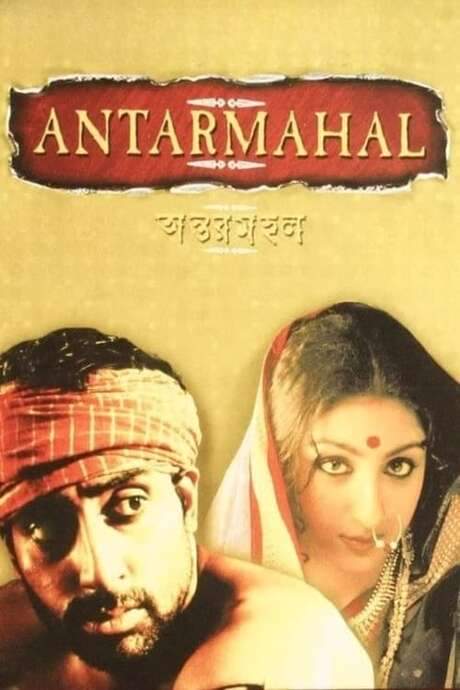

Antarmahal Plot Summary
Read the complete plot summary and ending explained for Antarmahal (2005). From turning points to emotional moments, uncover what really happened and why it matters.
Bhubaneswar Chaudhury [Jackie Shroff] is a zamindar of Bakuldanga in late 19th-century Bengal who plots to win the prestigious Raibahadur title by pleasing the British. To stand out amid a crowd of contenders, he engineers a provocative royal tribute: placing Queen Victoria’s face on the body of the goddess Durga, a clay idol crafted anew each year for the Durga Puja festival, a bold display that unsettles tradition and power alike.
In his relentless bid for an heir, he blames his elder wife for the family’s misfortunes and takes a much younger wife, Jashomati [Soha Ali Khan], who becomes embroiled in a tense ego contest with Mahamaya. The feud between the two women plays out under the shadow of Bhubaneswar’s obsession with succession, as he coaxes conception through a blend of ritual hymns administered by a priest and coercive control.
The troubling marriage routines unfold with brutal insistence: Bhubaneswar rapes Jashomati each night, while a priest recites hymns to aid conception, and Mahamaya—drugged—appears compelled to satisfy the carnal desires of five Brahmin priests. The brutality of these acts underscores the harsh grip of power and domination that threads through the household, even as the household’s public facade seeks prestige and alliance with imperial authority.
Although Jashomati narrowly escapes the worst fate, the trauma of these events lingers, leaving her isolated and vulnerable. In this vulnerable space, she is drawn toward a young sculptor, the figure played by Abhishek Bachchan, whose presence becomes central to the evolving drama. He channels the turmoil into his art, turning the moment into a potent, silent tribute that resonates beyond personal grievance.
As the sculptor’s masterpiece takes shape, it embodies the complex mix of desire, power, guilt, and memory that defines the narrative, casting a long shadow over Jashomati’s fate and the family’s standing. The story draws from Protima, Tarashankar Bandopadhyay’s esteemed work, weaving a dense tapestry of love, ambition, and the costs of colonial-era ambition on intimate lives. The result is a work that remains faithful to its historical milieu while offering a sobering meditation on power, artistry, and the human price of political ambition.
Antarmahal Timeline
Follow the complete movie timeline of Antarmahal (2005) with every major event in chronological order. Great for understanding complex plots and story progression.
Setting: late 19th-century Bengal
The story unfolds in Bengal toward the end of the 19th century. Bhubaneswar Chowdhury, a zamindar of Bakuldanga, seeks to curry favor with the British in hopes of being awarded the Raibahadur title. The social and political climate of the time provides the backdrop for his schemes.
Bhubaneswar plots Durga idol with Queen Victoria's face
Facing stiff competition, he hatches a radical plan to win favor by altering the annual Durga idol. He orders the clay Durga idol, crafted for Durga Puja, to bear Queen Victoria’s visage. The act is intended to bridge colonial prestige with local ritual.
Contenders and the need for a show of uniqueness
With many rivals for the Raibahadur honor, Bhubaneswar decides that a sensational gesture could tip the scales. The Queen Victoria Durga idea is chosen as his bold, attention-grabbing move. The plan elevates his ambitions above mere political maneuvering.
The second marriage to Jashomati
To secure an heir, Bhubaneswar marries the younger Jashomati, while his elder wife Mahamaya remains part of the household. He blames Mahamaya for prior failures in bearing him a son. The family dynamics become a contest of ego and desire.
Wives' rivalry escalates
The two wives engage in a constant ego struggle as Bhubaneswar’s ambition puts pressure on them. Each seeks to outmaneuver the other for power, affection, and influence over his plans. The tension colors every aspect of life in the household.
Pursuit of a son turns violent
In his relentless bid for an heir, Bhubaneswar rapes Jashomati nightly, while a priest recites hymns to aid conception. Concurrently, Mahamaya is drugged and forced to satisfy the carnal desires of five Brahmin priests. The scene highlights brutality and coercive ritual under imperial and patriarchal pressures.
Untimely ending foils the plot
The plot against Jashomati is foiled by an untimely ending, allowing her to escape the immediate danger. The escape leaves her traumatized and reeling from the abuse she endured. This turn of events shifts the focus onto her personal resilience and the consequences of the household's actions.
Trauma leads Jashomati to a sculptor
In her loneliness and pain, Jashomati is drawn toward a young sculptor who appears as a new center in her life. The sculptor looks to capture the complexity of her experiences in his work. Their developing relationship becomes a hinge for the next phase of the story.
The sculptor's masterpiece takes shape
The sculptor creates a powerful sculpture that acts as his tribute to Jashomati. The artwork embodies the emotional charge of the events around her life. It stands as a tangible monument to her suffering and resilience.
The sculpture seals Jashomati's fate
The sculpture’s creation and its reception become inseparable from Jashomati’s fate. The work offers a metaphoric and literal culmination of the story’s tragedy. The convergence of art and life marks the end of her arc in the narrative.
Origin of the story: Protima by Tarashankar Bandopadhyay
The screenplay is based on Protima, a celebrated work by Tarashankar Bandopadhyay, which informs the themes of power, gender, and ritual. The adaptation translates the literary tale into a cinematic exploration of exploitation and art. The source material grounds the film's social critique.
Antarmahal Characters
Explore all characters from Antarmahal (2005). Get detailed profiles with their roles, arcs, and key relationships explained.
Brij Bhushan (Abhishek Bachchan)
The zamindar of Bakuldanga who wields authority to curry favor with the British and to control his household. He schemes to produce an heir and to display power through ritual symbolism. His ruthless manipulation drives the tragedy surrounding Jashomati.
Jashomati (Soha Ali Khan)
The younger wife chosen to bear an heir, she endures coercive treatment and traumatic events orchestrated by her husband and ritual practices. Her vulnerability and quiet strength drive the story as she navigates danger and desire.
Mahamaya (Roopa Ganguly)
The elder wife who is blamed for the lack of an heir. She remains in a precarious position within the polygamous household, her agency constrained by ritual obligation and patriarchal control.
The Sculptor
A young sculptor who creates the masterpiece that becomes a tribute and a counterpoint to the surrounding cruelty. Through his art, he becomes a pivotal figure in Jashomati’s fate and in the film’s meditation on beauty and resistance.
Tarini (Dola Chakraborty)
One of the zamindar’s wives, Tarini is part of the household dynamics and political maneuvering around succession and status.
Antarmahal Settings
Learn where and when Antarmahal (2005) takes place. Explore the film’s settings, era, and how they shape the narrative.
Time period
Late 19th century
The events take place in Bengal under British rule, where zamindars exercise vast local power within a tradition-bound society. The pursuit of an heir and the prominence of ritual display reflect the era’s gender and class dynamics, showing how personal lives are entangled with politics and empire.
Location
Bakuldanga, Bengal
Set in the zamindari milieu of Bakuldanga in Bengal during the late 19th century, the story unfolds under British influence and local hereditary power. The household is steeped in ritual, caste rules, and social ambition as the zamindar seeks prestige from the colonial authorities. A Durga Puja idol bearing Queen Victoria's face symbolizes the fusion—and conflict—between tradition and imperial power.
Antarmahal Themes
Discover the main themes in Antarmahal (2005). Analyze the deeper meanings, emotional layers, and social commentary behind the film.
👑
Power
A central thread is how power is exercised—by the zamindar to gain favor with the British and to control his household. The pursuit of status drives political and personal maneuvers, often at others’ expense.
♀️
Gender & Control
The narrative exposes gendered domination within a patriarchal society: multiple wives, coercion, and sexual exploitation under the guise of lineage. Jashomati's trauma and moral complexities highlight women's vulnerability and resilience within rigid social structures.
🎨
Art & Obsession
Art is used as both tribute and weapon: the sculptor's creation becomes a focal point of beauty, desire, and revolt against oppression. The masterwork offers a channel for agency through art in the midst of cruelty.
⚖️
Colonialism & Tradition
The setting juxtaposes imperial symbolism with local ritual, epitomized by the image of Queen Victoria on a Durga idol. The zamindar’s bid for prestige reveals how colonial dynamics reshape tradition and social hierarchy.

Coming soon on iOS and Android
The Plot Explained Mobile App
From blockbusters to hidden gems — dive into movie stories anytime, anywhere. Save your favorites, discover plots faster, and never miss a twist again.
Sign up to be the first to know when we launch. Your email stays private — always.
Explore the mobile appAntarmahal Spoiler-Free Summary
Discover the spoiler-free summary of Antarmahal (2005). Get a concise overview without any spoilers.
In the waning years of the 19th century, Bengal’s aristocratic world is a tapestry of grandeur and quiet ambition. Amidst sprawling estates and the ritual of Durga Puja, a powerful zamindar seeks a singular distinction: a deity idol that bears the likeness of Queen Victoria herself. The looming festival becomes a canvas for his desire to impress colonial patrons and solidify his prestige, casting a luminous yet uneasy glow over the region’s cultural heartbeat.
Bhubaneswar Chowdhury, the estate’s imposing master, is driven by a restless urge to secure a legacy both personal and political. His household is divided between two women whose lives orbit the same ambition. Mahomaya, his first wife, carries the weight of tradition and the subtle authority of age, while Jashomati, newly wed and considerably younger, embodies fresh hope and fierce yearning. Their relationship is a delicate balance of rivalry and fragile alliance, each striving to protect the other even as their aspirations clash.
Into this charged atmosphere arrives a talented young sculptor, whose artistry is tasked with bringing the extraordinary idol to life. His presence introduces a quiet tension that ripples through the household, offering a glimpse of beauty and possibility amid the looming expectations. The film weaves these intersecting desires—political, familial, and creative—into a richly textured portrait of a society poised on the brink of change, where every gesture hints at deeper currents beneath the ceremonial splendor.
Featured on this page

What's After the Movie?
Not sure whether to stay after the credits? Find out!
Check out our other apps:

SAT Sphere
Build confidence for the Digital SAT.

Mori Atlas
Discover wild places worth protecting.

Luntero
Search smarter for a home in Amsterdam.

Plot Explained
Unravel movie endings and hidden clues.

Pokechamp
Dive into Pokémon data and battle logic.

Driving Theory
Get ready for your European theory test.

Movie Dust
Plan your next cinema trip with ease.

Musemap
Find art and culture as you travel.

Selkobase
Compare credentials before committing.

Local Manual
Turn an unfamiliar country into practical next steps.

Lernavi
Compare school systems before your next move.

GymRoam
Find a workout stop wherever your plans take you.
Explore Our Movie Platform
New Movie Releases (2026)
Famous Movie Actors
Top Film Production Studios
Movie Plot Summaries & Endings
Major Movie Awards & Winners
Best Concert Films & Music Documentaries
Movie Collections and Curated Lists
© 2026 What's After the Movie. All rights reserved.
Privacy Policy