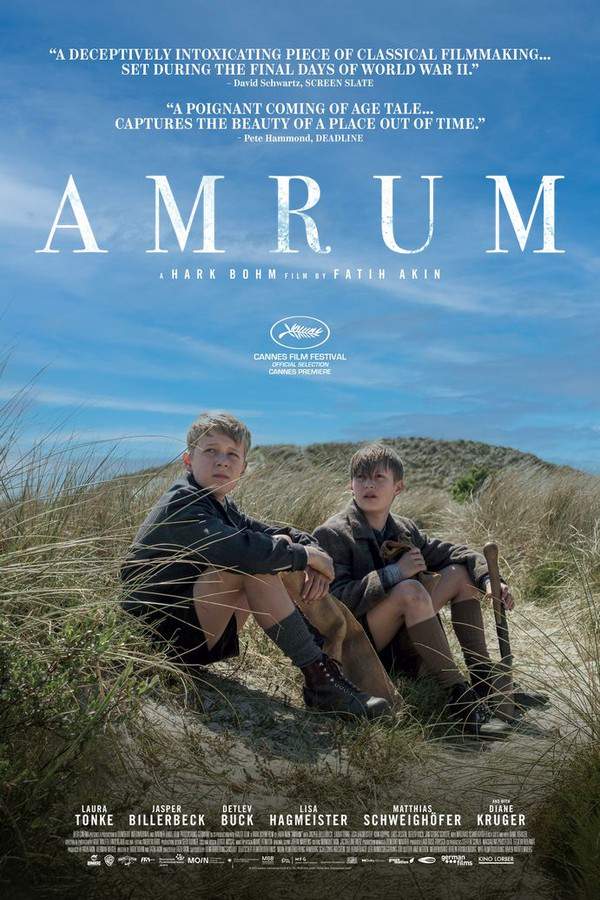
Amrum 2026


Directed by

Fatih Akin
Made by

Bombero International
Where to Watch Amrum
See current US streaming, rental, and purchase options for Amrum (2026) via JustWatch.









Amrum Plot Summary
Read the complete plot summary and ending explained for Amrum (2026). From turning points to emotional moments, uncover what really happened and why it matters.
In the final weeks of World War II, a small village on the island of Amrum off Germany’s North Sea coast becomes the backdrop for a coming‑of‑age story. Twelve-year-old Nanning Bohm, Jasper Billerbeck, the eldest child in a family marked by conflict, toils in the potato fields and gathers driftwood to help feed his mother, who is pregnant and deeply devoted to the Nazi cause. They had fled bombed‑out Hamburg to the island, seeking safety among neighbors who secretly listen to prohibited jazz on the radio. The father, an SS‑Obersturmbannführer, is away at war, while the mother struggles to keep the household together as fear, scarcity, and a spreading gloom press in.
As the war winds down, Nanning’s mother sinks into a stubborn depression and refuses to eat. He tries to soothe her cravings for white bread with butter and honey, a luxury made scarce by the island’s shortages, trading what little they have in a tense barter economy to obtain the essentials. The boy begins to learn the rhythms of island life: the people, the Frisian language spoken by locals, and the fragile networks that keep a community alive when supplies are thin and fear is thick in the air.
Through his daily tasks—helping with seal hunting, gutting a rabbit, and navigating the rough edges of frontier life—Nanning brushes against danger and the ever‑present shadow of war. He discovers unsettling truths about his family’s past: his uncle Theo, who gave him a whaling knife at birth, was forced to stay in America because of the Nazis, and Ruth, Theo’s fiancée, was murdered. Theo sometimes visits Nanning in dreams, confronting him with a difficult message: > “You are not to blame, but you are still involved.”
The island’s landscape becomes a living classroom where guilt, memory, and responsibility collide. Nanning is the elder child who bears heavy questions about the Nazi era and how a family’s choices ripple outward, shaping the future of the children who inherit the aftermath. He is joined by his aunt Ena, Lisa Hagmeister, and two younger siblings in their flight from a bombed city, seeking shelter and a sense of normalcy on the coast. Yet the calm of Amrum remains fragile, cracked by scarcity, whispered histories, and the constant presence of war’s lingering echoes.
As the seasons turn, Nanning grows more skilled at reading people and negotiating the world around him. He learns to read between the lines of kindness and cruelty in the island’s inhabitants, to listen not only with his ears but with his heart, and to hold fast to moments of ordinary life—sharing bread, tending a fire, and dreaming of a future where the past no longer defines the present. The story unfolds with quiet conviction, tracing a boy’s resilient spirit as he navigates a landscape where love, loss, and moral complexity intertwine.
In the end, the film leaves us with a tempered portrait of growth under pressure: a young boy who cannot escape the shadows of his parents’ past, yet who finds his own path forward by staying attentive to the people around him, the language they speak, and the small, stubborn acts of care that sustain a family in crisis.
Amrum Timeline
Follow the complete movie timeline of Amrum (2026) with every major event in chronological order. Great for understanding complex plots and story progression.
Flee from Hamburg to Amrum
Twelve-year-old Nanning Bohm, his mother, Aunt Ena, and his two younger siblings flee the bombed city of Hamburg and relocate to the island of Amrum off Germany's North Sea coast. Nanning becomes the eldest child and begins shouldering chores to help feed the family. The move places them in a war-weary community where shortages and suspicion linger.
Father away at war; Nazi wife and island life
Nanning's father is an SS-Obersturmbannführer and is away at war, leaving his wife to fend for herself on Amrum. The villagers secretly listen to jazz on the radio, defying the regime's prohibitions. The family lives under the shadow of Nazi loyalty and wartime hardship.
Birth of his sister and Hitler's death trigger depression
With the birth of his sister and the death of Adolf Hitler, Nanning's mother falls into a deep depression and refuses to eat. Nanning strains to fulfill her craving for white bread with butter and honey, a rare luxury during the siege economy. He begins bartering to obtain such scarce comforts.
Bartering for essentials to feed the family
Bartering becomes Nanning's main strategy to secure butter, sugar, and other staples, navigating the island's shortages. He trades with neighbors and harvesters to keep his mother fed. The constant quest highlights the fragility of civilian life in wartime Amrum.
Nanning learns the island and Frisian language
As he helps with daily tasks—gathering driftwood, working in the potato fields, and helping with seal hunting—Nanning becomes intimately familiar with Amrum's landscape and the Frisian language spoken by its inhabitants. The island's rhythms shape his growing sense of community and belonging.
Close calls with death in island tasks
While assisting with seal hunting and gutting a rabbit, Nanning faces dangerous situations that bring him close to death. These experiences force him to confront mortality in a war-scarred landscape.
Uncle Theo's backstory and the whaling knife
Nanning learns about his uncle Theo, who was forced to stay in America because of the Nazis. Theo had given him a whaling knife at birth, linking Nanning to a family history marked by persecution and displacement.
Ruth and the Nazi crimes heard through Theo
Theo reveals that Nazis murdered his fiancée Ruth, deepening the sense of inherited guilt within the family history. The revelation broadens Nanning's awareness of the consequences of his parents' past.
Theo's dream confrontation: not to blame, but still involved
Theo appears in a dream to confront Nanning with a difficult message: 'You are not to blame, but you are still involved.' The encounter emphasizes the distinction between personal guilt and inherited responsibility.
The burden of legacy on the younger generation
As the younger child, Nanning bears no personal guilt for his parents' Nazi past, but the questions and legacy linger. He cannot escape the history that frames his choices and sense of duty.
War's end approaches; life continues with shortages
The war draws to a close and Amrum remains a place of scarcity and resilience. Nanning and the islanders persevere through hunger, barter, and small acts of defiance, including listening to banned radio broadcasts.
Quiet resilience and a fragile future
The story closes with Nanning recognizing the weight of history on his life and the uncertain path ahead for him and his family. He remains determined to protect and care for those around him while carrying the island's memory forward.
Amrum Characters
Explore all characters from Amrum (2026). Get detailed profiles with their roles, arcs, and key relationships explained.
Nanning Bohm (Jasper Billerbeck)
Twelve-year-old Nanning is the eldest child who shoulders family duties in war-torn Amrum. He is resourceful, resilient, and haunted by his parents’ Nazi past, while trying to feed and protect his mother and siblings. His curiosity about the island and its people drives him to navigate danger and moral ambiguity as the war ends.
Tante Ena (Lisa Hagmeister)
Nanning’s aunt who fled bombed Hamburg and remains a practical, protective presence in the family. She helps keep the household together under extreme scarcity and supports the children as they cope with the war’s final days.
Onkel Theo (Matthias Schweighöfer)
Nanning’s uncle who was forced to stay in America because of the Nazis. He gave Nanning a whaling knife at birth and appears in dreams to challenge Nanning with the legacy of their family’s past and complicity in history.
Der alte Mann am Meer (Hark Bohm)
An old man by the sea who surfaces in Nanning’s dreams, embodying memory and the lingering trauma of war. He represents a voice from the past and the weight of experience that informs the boy’s choices.
Opa Arjan (Lars Jessen)
A grandfatherly figure on the island who embodies local tradition and the day-to-day rhythms of Frisian island life. He offers quiet guidance and a link to the community’s language and customs.
Hille Hagener (Laura Tonke)
Nanning’s mother, a staunch Nazi who falls into deep depression as the war ends and Hitler has died. Her fragility and withdrawal intensify the family’s struggle to survive and care for a hungry household.
Amrum Settings
Learn where and when Amrum (2026) takes place. Explore the film’s settings, era, and how they shape the narrative.
Time period
1945
The story unfolds in the final weeks of World War II, when Nazi Germany is collapsing and daily life is shaped by rationing and fear. Bombed cities forced families to flee to safer places, and Amrum becomes a remote frontline of survival. The narrative notes the death of Adolf Hitler and the broader sense that the war is drawing to a close, even as hardship intensifies.
Location
Amrum
Amrum is a small village on a North Sea island off Germany's coast. The setting is defined by winds, salt spray and scarce resources during the final weeks of World War II. The island community speaks Frisian and relies on close-knit routines of fishing and barter to survive.
Amrum Themes
Discover the main themes in Amrum (2026). Analyze the deeper meanings, emotional layers, and social commentary behind the film.
🪖
War Survival
In the face of wartime deprivation, Nanning learns to improvise and endure. The family relies on barter and careful resource management to survive shortages of bread, butter, and sugar. The war's pressures also test loyalties and force difficult choices in a child’s world.
🧭
Legacy Guilt
The story centers on how a family’s Nazi past casts a long shadow over a new generation. Nanning grapples with the idea that he is not personally guilty but is still implicated by his lineage. Dreams of his uncle Theo confront him with the burden of inherited history.
🌊
Coming of Age
Living on Amrum exposes Nanning to island life, language, and danger that push him toward grown-up responsibility. He learns Frisian customs and navigates life-threatening moments, from hunting to close calls with death. The journey pushes him to define who he is beyond his parents’ past and his own fears.

Coming soon on iOS and Android
The Plot Explained Mobile App
From blockbusters to hidden gems — dive into movie stories anytime, anywhere. Save your favorites, discover plots faster, and never miss a twist again.
Sign up to be the first to know when we launch. Your email stays private — always.
Explore the mobile appAmrum Spoiler-Free Summary
Discover the spoiler-free summary of Amrum (2026). Get a concise overview without any spoilers.
On the windswept shores of the German North Sea island of Amrum, the spring of 1945 unfolds with a deceptive sense of calm. Twelve-year-old Nanning moves through his days with a quiet determination, tending to the farm and fishing the chilly waters to keep his family fed. Though the war still rages in the distance, the island feels like a world apart—a place of rugged beauty where the hardships of the time are met with resilience rather than despair, offering an almost idyllic backdrop to a world on the brink of change.
Life on Amrum, however, is not entirely untouched by the era’s turmoil. Nanning’s family has sought refuge here after fleeing the destruction of Hamburg, living under the roof of a mother who remains steadfast in her convictions even as the political landscape threatens to shift. With his father away serving as an SS officer, the boy shoulders the heavy burden of providing for his younger siblings and pregnant mother, navigating a home environment defined by strict ideology that stands in sharp contrast to the peaceful surroundings.
When farmer Tessa speaks of the war’s imminent end, Nanning clings to the hope of peace, unaware of the complex reckoning that lies ahead. As he interacts with the island’s inhabitants and learns the local Frisian ways, he begins to perceive the undercurrents of a society moving toward an uncertain future. Caught between the innocence of his daily routine and the looming weight of his parents’ legacy, Nanning must find his own path in a landscape where the promise of a fresh start is complicated by the shadows of the past.
Featured on this page

What's After the Movie?
Not sure whether to stay after the credits? Find out!
Check out our other apps:

SAT Sphere
Build confidence for the Digital SAT.

Mori Atlas
Discover wild places worth protecting.

Luntero
Search smarter for a home in Amsterdam.

Plot Explained
Unravel movie endings and hidden clues.

Pokechamp
Dive into Pokémon data and battle logic.

Driving Theory
Get ready for your European theory test.

Movie Dust
Plan your next cinema trip with ease.

Musemap
Find art and culture as you travel.

Selkobase
Compare credentials before committing.

Local Manual
Turn an unfamiliar country into practical next steps.

Lernavi
Compare school systems before your next move.

GymRoam
Find a workout stop wherever your plans take you.
Explore Our Movie Platform
New Movie Releases (2026)
Famous Movie Actors
Top Film Production Studios
Movie Plot Summaries & Endings
Major Movie Awards & Winners
Best Concert Films & Music Documentaries
Movie Collections and Curated Lists
© 2026 What's After the Movie. All rights reserved.
Privacy Policy