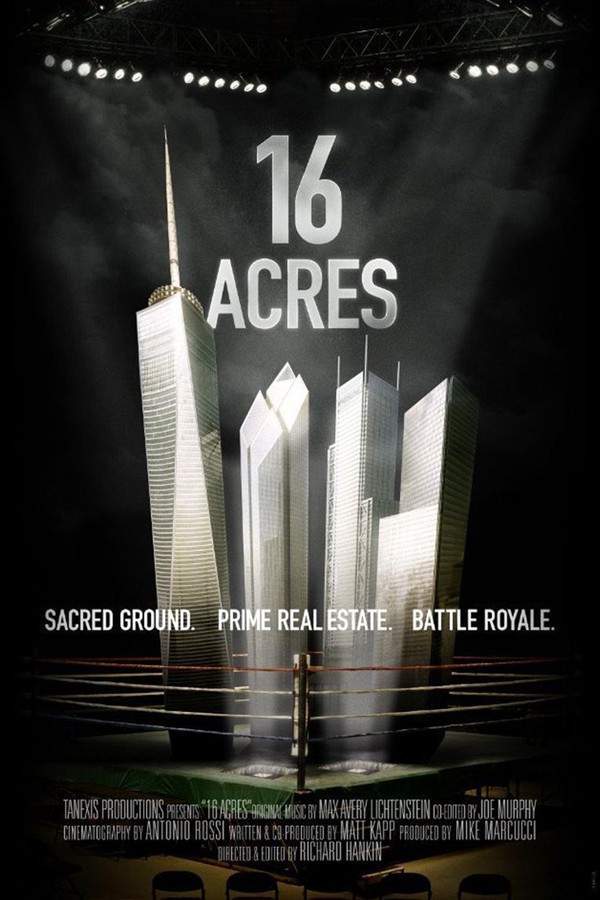
16 Acres 2012

Directed by

Richard Hankin
Made by

Where to Watch 16 Acres
See current US streaming, rental, and purchase options for 16 Acres (2012) via JustWatch.



Streaming availability powered by 
16 Acres Plot Summary
Read the complete plot summary and ending explained for 16 Acres (2012). From turning points to emotional moments, uncover what really happened and why it matters.
The rebuilding of the World Trade Center stands as one of the most intricate and emotionally charged urban renewal endeavors in American history. This landmark project, which has unfolded over several years, has been riddled with controversies, delays, and intense political discourse. It represents a monumental struggle that has spanned eleven years, involved nineteen government agencies, and required funding that exceeds $20 billion.
A significant obstacle in this ambitious rebuilding process has been the overwhelming number of stakeholders. Numerous parties including politicians, developers, architects, insurance companies, local residents, and the families of 9/11 victims all assert a claim to the site, frequently leading to conflicts. According to a report from The New York Times, opinions diverge sharply: “Where some saw lucrative real estate, others saw a graveyard.” In this dynamic, where some individuals envision iconic landmarks like Rockefeller Center, others perceive something akin to Gettysburg.
What was once referred to as Ground Zero has transformed into a bustling construction zone, with approximately three thousand workers erecting four of the tallest skyscrapers in the nation, alongside an intricate train station, a vibrant performing arts center, and a solemn memorial and museum. The evolution of this site over the coming years will significantly reshape the identity of downtown Manhattan, impacting the city and the country for decades.
16 Acres tells the nuanced tale of how and why this pivotal project came to fruition. Central to this narrative is the compelling conflict between the highest aspirations of those involved and the underlying forces of politics, ego, and ideology that define New York City. It provokes reflection on what these elements reveal about us, both as New Yorkers and as Americans.
As with all monumental urban endeavors throughout history, from the Pyramids to the Colosseum in Rome, the narrative is ultimately steered by a small cadre of influential individuals. Through exclusive access to the project and the principal players involved, 16 Acres unveils the motivations driving these key figures. Who are these men and women? What drives them? How will their characteristics influence the eventual outcome? And, crucially, will the project culminate in success? The film also captures the urgency to finalize the memorial ahead of the 10th anniversary, featuring those pivotal figures as they prepare to gather at the site.
16 Acres Timeline
Follow the complete movie timeline of 16 Acres (2012) with every major event in chronological order. Great for understanding complex plots and story progression.
Initiation of the Rebuilding Project
The rebuilding of the World Trade Center began shortly after the tragic events of 9/11. This project aimed to restore the site while honoring the memories of those lost, marking the start of an extensive urban renewal effort in Manhattan.
Formation of Stakeholder Groups
As the project began, numerous stakeholders formed, including politicians, developers, architects, and families of 9/11 victims. Each group had differing visions for the site, leading to a complex web of interests and conflicts that would dominate the rebuilding process.
Controversies Emerge
The rebuilding efforts quickly became marred by controversies as various factions clashed over their plans for the site. The divergence of opinions illustrated the emotional weight of Ground Zero, with some viewing it as a space for memorialization and others as prime real estate.
Political Discourse Intensifies
Intense political discourse arose among local, state, and federal officials regarding the direction of the rebuilding efforts. The negotiations highlighted the complex interplay of politics and personal interests at play, proving challenging for project leaders.
Funding Challenges
The financial requirements for the reconstruction escalated, surpassing $20 billion. Securing funds from various sources proved difficult as the project gained national attention, and various entities raised objections, complicating the funding landscape.
Approval of Architectural Designs
After years of debates, the final designs for the new World Trade Center were approved. The proposed structures symbolized resilience and hope, capturing the aspirations of those who had fought hard for their vision to become a reality.
Construction Begins
In 2006, the reconstruction officially commenced with the groundbreaking ceremony. Thousands of workers were mobilized to commence the construction of the four tallest skyscrapers alongside a memorial and cultural center, signifying a new chapter for the site.
Building the Memorial and Museum
Alongside the skyscrapers, the construction of the September 11 Memorial and Museum began. This part of the project aimed to provide a dignified space for remembrance, honoring those lost and educating future generations about the significance of the events of 9/11.
Creation of a Performing Arts Center
Plans for a vibrant performing arts center were included in the revival of the World Trade Center site, aiming to bring cultural life back to the area. The center was intended to complement the memorial, creating a dynamic space for both reflection and celebration.
Heightened Urgency Ahead of 10th Anniversary
As the 10th anniversary of 9/11 approached, there was an intensified effort to complete the memorial and commemorate the occasion. Key figures in the project rallied to ensure that the memorial would be ready to honor the victims on this significant date.
Completion of the Memorial
The September 11 Memorial was officially opened to the public in September 2011, just in time for the 10th anniversary. The memorial serves as a powerful reminder of the tragedy while also celebrating resilience and recovery in the years since.
Ongoing Developments in the Site
Even after the memorial's completion, the remaining buildings continued to undergo construction. The site evolved into a bustling narrative of rebirth, showcasing the ambitious skyscrapers and cultural institutions that emerged from its ashes.
Influential Individuals Revealed
The film *16 Acres* dives deeper into the influential individuals behind the rebuild, revealing their motivations, ideals, and conflicts. This analysis sheds light on how both character and circumstance shaped the project's trajectory.
Cultural Significance of the Site
As the construction neared completion, the revamped World Trade Center site became a symbol of national recovery and renewal. It represented not just skyscrapers, but a resilient spirit among New Yorkers and Americans alike, fostering reflection on the past.
16 Acres Settings
Learn where and when 16 Acres (2012) takes place. Explore the film’s settings, era, and how they shape the narrative.
Time period
11 years post-9/11
The rebuilding of the World Trade Center has taken place over an eleven-year span, highlighting a period marked by reflection, recovery, and a push towards renewal in the wake of national tragedy. This time has been characterized by political debates and communal struggles as diverse stakeholders vie for their vision of the site. The approach to urban renewal during this time reflects broader themes of resilience and conflict within American identity.
Location
World Trade Center, Ground Zero, downtown Manhattan, New York City
The World Trade Center site, often referred to as Ground Zero, has undergone significant transformation in the wake of the September 11 attacks. This area is known for its complex blend of memorial, commercial, and cultural spaces, including skyscrapers, a train station, and performing arts center. The site encapsulates the resilience and spirit of New York City, symbolizing both tragic loss and hopeful renewal.
16 Acres Themes
Discover the main themes in 16 Acres (2012). Analyze the deeper meanings, emotional layers, and social commentary behind the film.
🏗️
Urban Renewal
The film explores the complexities of urban renewal through the lens of the World Trade Center reconstruction. It delves into how various stakeholders influence the project's direction, reflecting broader societal values and conflicts. The theme underscores the tensions between memory and progress as the site evolves from a place of tragedy to a beacon of hope.
⚖️
Political Discourse
Intense political discourse emerges as a central theme in the narrative of rebuilding Ground Zero. The film highlights how differing perspectives among politicians, developers, and community members create conflict, complicating the urban renewal process. It raises questions about governance, representation, and the decision-making processes involved in significant national projects.
🤝
Stakeholder Conflict
The various claims and expectations of stakeholders reflect the complex nature of collective memory and progress. Families of 9/11 victims, local residents, and commercial interests all engage in a struggle for the site's future. This theme emphasizes the clash of ideals and interests that are inevitable in any large-scale urban project, underscoring the challenges of consensus-building.

Coming soon on iOS and Android
The Plot Explained Mobile App
From blockbusters to hidden gems — dive into movie stories anytime, anywhere. Save your favorites, discover plots faster, and never miss a twist again.
Sign up to be the first to know when we launch. Your email stays private — always.
Explore the mobile app16 Acres Spoiler-Free Summary
Discover the spoiler-free summary of 16 Acres (2012). Get a concise overview without any spoilers.
In the wake of the September 11 attacks, a monumental task unfolded on the sixteen acres once known as Ground Zero. The film follows the painstaking effort to redesign and rebuild Lower Manhattan, where towering ambitions clash with the weight of collective grief. Architects, city officials, developers, families of victims, and countless other voices each stake a claim on the vacant lot, turning the rebuilding process into a delicate dance of vision, politics, and personal resolve. The documentary’s tone is both investigative and reverent, inviting viewers to feel the pulse of a city trying to honor its past while daring to imagine its future.
The setting is a sprawling construction zone that hums with the activity of thousands of workers raising some of the nation’s tallest skyscrapers, weaving an intricate train hub, and carving out spaces for art and remembrance. Concrete and steel rise amid solemn memorial gardens, creating a landscape where the relentless march of progress meets moments of quiet reflection. Sun‑splashed towers contrast with shaded plazas, underscoring the film’s atmosphere of hopeful tension—a place where every beam placed carries the echo of a profound loss.
Commissioner David Alvarez emerges as the municipal steward tasked with balancing political pressure and public expectation, while architect Maya Patel champions a bold, forward‑thinking design that seeks to redefine the skyline. Opposite them, developer Robert Sinclair pushes for commercial viability, and family liaison Sarah Goldberg represents the voices of those most directly affected by the tragedy. Their interactions are marked by earnest collaboration, clashing egos, and the ever‑present undercurrent of New York’s fast‑moving ideology. The documentary captures their conversations, negotiations, and private moments, painting a portrait of a small cadre whose decisions will shape the city for generations.
As the tenth anniversary of the attacks looms, the urgency to complete the memorial heightens the stakes for every stakeholder. The film leaves the audience poised on the brink of revelation, curious whether the convergence of ambition, grief, and civic duty will culminate in a harmonious tribute or a contested battleground, inviting reflection on what the reconstruction of this sacred ground says about the city—and the nation—itself.
Featured on this page

What's After the Movie?
Not sure whether to stay after the credits? Find out!
Check out our other apps:

SAT Sphere
Build confidence for the Digital SAT.

Mori Atlas
Discover wild places worth protecting.

Luntero
Search smarter for a home in Amsterdam.

Plot Explained
Unravel movie endings and hidden clues.

Pokechamp
Dive into Pokémon data and battle logic.

Driving Theory
Get ready for your European theory test.

Movie Dust
Plan your next cinema trip with ease.

Musemap
Find art and culture as you travel.

Selkobase
Compare credentials before committing.

Local Manual
Turn an unfamiliar country into practical next steps.

Lernavi
Compare school systems before your next move.

GymRoam
Find a workout stop wherever your plans take you.
Explore Our Movie Platform
New Movie Releases (2026)
Famous Movie Actors
Top Film Production Studios
Movie Plot Summaries & Endings
Major Movie Awards & Winners
Best Concert Films & Music Documentaries
Movie Collections and Curated Lists
© 2026 What's After the Movie. All rights reserved.
Privacy Policy