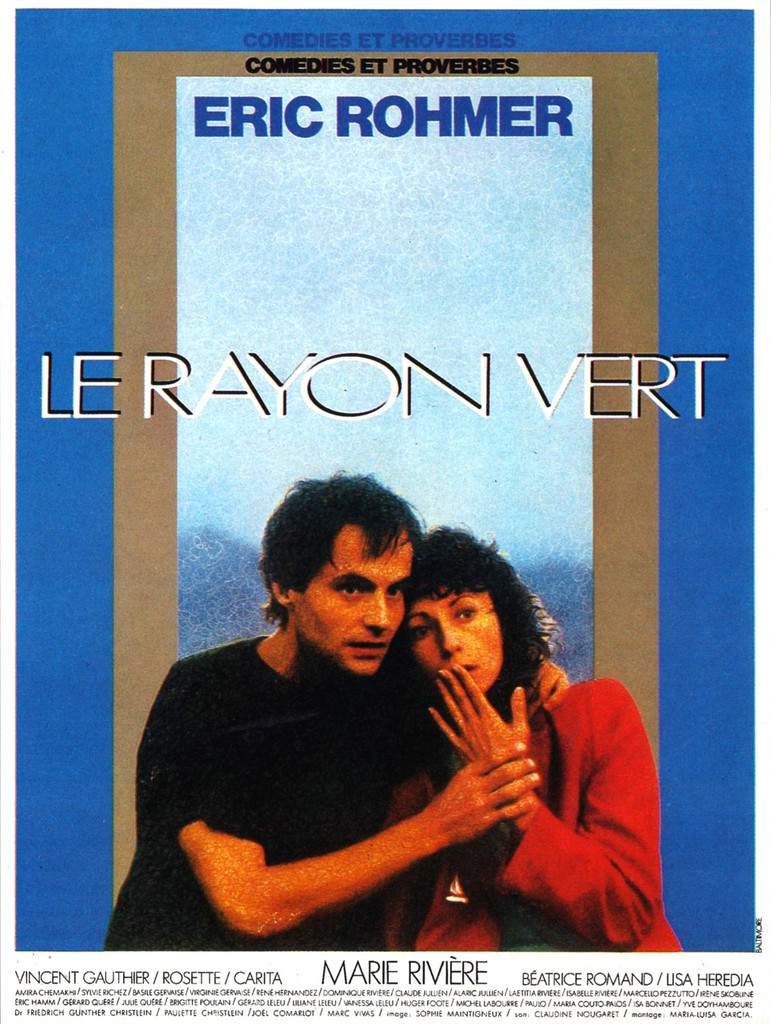
The Green Ray 1986


A lonely Parisian woman comes to terms with her isolation and anxieties during a long summer vacation.

Does The Green Ray have end credit scenes?
No!
The Green Ray does not have end credit scenes. You can leave when the credits roll.
Meet the Full Cast and Actors of The Green Ray
Explore the complete cast of The Green Ray, including both lead and supporting actors. Learn who plays each character, discover their past roles and achievements, and find out what makes this ensemble cast stand out in the world of film and television.

Béatrice Romand
Béatrice

Marie Rivière
Delphine

Rosette
Françoise in Paris
Éric Rohmer
Paulão
in La Plagne
María Luisa García
Manuella in Paris
Julie Quéré
in Cherbourg
Vincent Gauthier
Jacques in Biarritz
Irène Skobline
in Paris
Amira Chemakhi
in Paris
Sylvie Richez
in Paris
Virginie Gervaise
in Paris
Basile Gervaise
in Paris
René Hernandez
in Paris
Dominique Rivière
in Paris
Claude Jullien
in Paris
Alaric Jullien
in Paris
Laetitia Rivière
in Paris
Isabelle Rivière
in Paris
Marcello Pezzutto
in Paris
Gérard Quéré
in Cherbourg
Eric Hamm
Edouard in Cherbourg
Brigitte Poulain
in Cherbourg
Gerard Leleu
in Cherbourg
Liliane Leleu
in Cherbourg
Vanessa Leleu
in Cherbourg
Huger Foote
in Cherbourg
Michel Labourre
in La Plagne
Maria Couto-Palos
in Biarritz
Yve Doyhamboure
in Biarritz
Isa Bonnet
in Biarritz
Friedrich Günther Christlein
in Biarritz
Paulette Christlein
in Biarritz
Marc Vivas
Pierrot in Biarritz
Joël Comarlot
Joel in Biarritz
Carita
Lena in Biarritz
External Links and Streaming Options
Discover where to watch The Green Ray online, including streaming platforms, rental options, and official sources. Compare reviews, ratings, and in-depth movie information across sites like IMDb, TMDb, Wikipedia or Box Office Mojo.





Full Plot Summary and Ending Explained for The Green Ray
Read the complete plot summary of The Green Ray, including all major events, twists, and the full ending explained in detail. Explore key characters, themes, hidden meanings, and everything you need to understand the story from beginning to end.
Delphine Marie Rivière has just suffered the breakup of a relationship, and her traveling companion has ditched her so that his new boyfriend can accompany him to Greece instead. She is left without plans at a time when Paris is emptying for the summer. Another friend invites Delphine to join a beach party in Cherbourg for the weekend, but she finds that she is the only one amongst the group who is single, so she quickly returns to Paris. Her family presses her to spend the holidays with them in Ireland, but she resists. She travels alone to the Alps, but is put off by hordes of vacationers and turns around. Traveling restlessly, the theme of the movie (characterized by Roger Ebert) becomes clear:
Delphine is incapable of playing the dumb singles games that lead to one-night stands.
She meets a new girlfriend who flirts with two young men, and she flees in anger. She recoils from the chat-up lines of the guys she meets in bars and on trains. She simply cannot engage in that kind of mindless double-talk any longer. Beneath her boredom lies a genuine anger at the roles that single women are sometimes expected to play. While in Le Rayon Vert (The Green Ray) she eavesdrops on a conversation about Jules Verne’s novel, which places the theme in a broader, almost magical frame. According to Verne’s idea, when a rare green flash appears at sunset, it seems to reveal the thoughts of those present as if by magic.
At the Biarritz railway station, Delphine meets a young man traveling to Saint-Jean-de-Luz. She chooses to accompany him, and together they watch the elusive light—le rayon vert—as the sun sinks. In that shared moment, the film seems to suggest, appearances thin and the possibility of genuine connection glimmers, even if only for a fleeting instant. The journey is less about reaching a destination and more about the act of choosing possibility over convention, preference over obligation, and true interest over the predictability of casual encounters. Through Delphine’s restless wandering—from Cherbourg to Paris, to Ireland, to the Alps, and finally to the coast of the Basque region—what emerges is not just a personal quest for companionship, but a quiet ethical stance: a refusal to pretend that single life is a game to be played on someone else’s terms.
Across these vignettes, the film maintains a restrained, observational tone. The landscapes—the beaches, the stations, the seaside towns—aren’t backdrops but agents in the story, reflecting Delphine’s inner weather: a mix of longing, suspicion, and a stubborn insistence on authenticity. The mood remains gentle yet pointed, inviting viewers to notice how social scripts shape desire and how small, intimate acts of choice can feel revolutionary when lived with sincerity. The narrative does not push toward a conventional romance or a tidy resolution; instead, it lingers on the possibility that a moment of shared perception—like the green flash at sunset—can illuminate a new way of seeing one another, however briefly.
In the end, the movie paints a portrait of a woman who refuses to reduce her life to the scripted roles offered to single people. She is not afraid to walk away from empty conversations or empty conventions, and she remains open to real connection when a moment of mutual recognition appears, even if it arrives just as the day is fading. The final observation—of a sky touched by the rare, revealing green light—reads as both a wish and a promise: that clarity, warmth, and meaningful contact can still surprise someone who has spent a summer of self-discovery resisting easy answers.

Coming soon on iOS and Android
The Plot Explained Mobile App
From blockbusters to hidden gems — dive into movie stories anytime, anywhere. Save your favorites, discover plots faster, and never miss a twist again.
Sign up to be the first to know when we launch. Your email stays private — always.
Explore the mobile appWatch Trailers, Clips & Behind-the-Scenes for The Green Ray
Watch official trailers, exclusive clips, cast interviews, and behind-the-scenes footage from The Green Ray. Dive deeper into the making of the film, its standout moments, and key production insights.
The Green Ray Themes and Keywords
Discover the central themes, ideas, and keywords that define the movie’s story, tone, and message. Analyze the film’s deeper meanings, genre influences, and recurring concepts.
The Green Ray Other Names and Titles
Explore the various alternative titles, translations, and other names used for The Green Ray across different regions and languages. Understand how the film is marketed and recognized worldwide.
Similar Movies To The Green Ray You Should Know About
Browse a curated list of movies similar in genre, tone, characters, or story structure. Discover new titles like the one you're watching, perfect for fans of related plots, vibes, or cinematic styles.







Quick Links: Summary, Cast, Ratings, More

What's After the Movie?
Not sure whether to stay after the credits? Find out!
Check out our other apps:

SAT Sphere
Build confidence for the Digital SAT.

Mori Atlas
Discover wild places worth protecting.

Luntero
Search smarter for a home in Amsterdam.

Plot Explained
Unravel movie endings and hidden clues.

Pokechamp
Dive into Pokémon data and battle logic.

Driving Theory
Get ready for your European theory test.

Movie Dust
Plan your next cinema trip with ease.

Musemap
Find art and culture as you travel.

Selkobase
Compare credentials before committing.

Local Manual
Turn an unfamiliar country into practical next steps.

Lernavi
Compare school systems before your next move.

GymRoam
Find a workout stop wherever your plans take you.
Explore Our Movie Platform
New Movie Releases (2026)
Famous Movie Actors
Top Film Production Studios
Movie Plot Summaries & Endings
Major Movie Awards & Winners
Best Concert Films & Music Documentaries
Movie Collections and Curated Lists
© 2026 What's After the Movie. All rights reserved.
Privacy Policy