
Perfect Days 2023

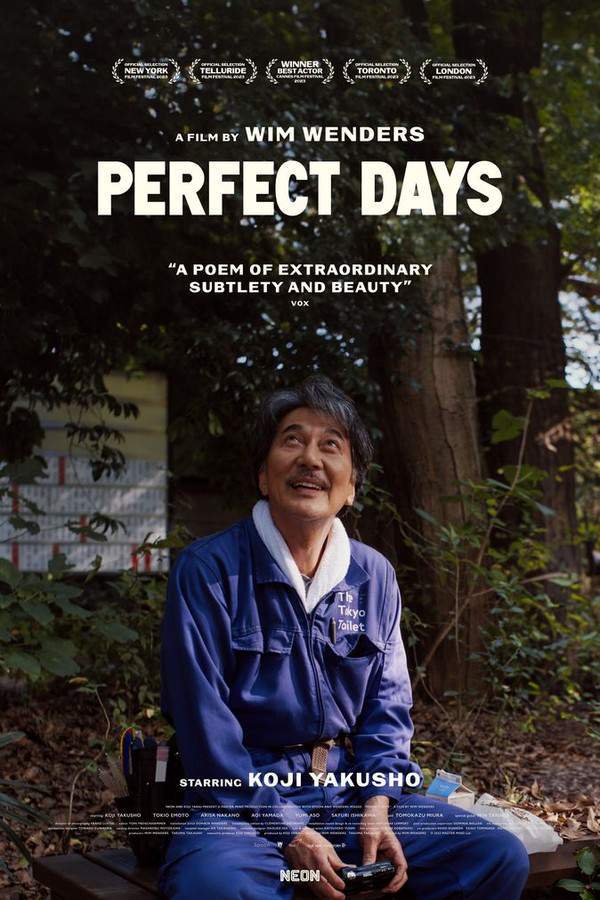
Hirayama finds solace and purpose in his quiet life as a cleaner in Tokyo. His meticulous routine, filled with beloved books, music, and photography, is unexpectedly altered by new connections and unexpected events. Through these encounters, he begins to appreciate the subtle beauty of everyday moments and discovers a deeper understanding of himself and the world around him. It’s a gentle exploration of happiness found in simplicity.


Does Perfect Days have end credit scenes?
No!
Perfect Days does not have end credit scenes. You can leave when the credits roll.
Meet the Full Cast and Actors of Perfect Days
Explore the complete cast of Perfect Days, including both lead and supporting actors. Learn who plays each character, discover their past roles and achievements, and find out what makes this ensemble cast stand out in the world of film and television.

External Links and Streaming Options
Discover where to watch Perfect Days online, including streaming platforms, rental options, and official sources. Compare reviews, ratings, and in-depth movie information across sites like IMDb, TMDb, Wikipedia or Rotten Tomatoes.










Ratings and Reviews for Perfect Days
See how Perfect Days is rated across major platforms like IMDb, Metacritic, and TMDb. Compare audience scores and critic reviews to understand where Perfect Days stands among top-rated movies in its genre.

The Movie Echo Score
Perfect Days offers a thoughtful exploration of everyday existence through disciplined minimalism and attentive pacing. The film’s refined direction and photography consistently capture the texture of Tokyo life, while Koji Yakusho’s restrained performance enriches the emotional core. Although its episodic flow and sparse narrative may test some viewers’ patience, the serene tone and consistent thematic resonance establish a memorable meditation on appreciation. The result is a quietly resonant work that sustains its contemplative impact.
The Movie Echo Score Breakdown for Perfect Days

Art & Craft
In terms of art and craft, Perfect Days excels in its precise visual composition and deliberate editing. The cinematography frequently lingers on everyday textures, from swaying branches to atmospheric night sequences rendered in black and white. Production design remains unobtrusive yet thoughtfully detailed, reflecting the protagonist’s perspective in each frame. This consistent visual harmony highlights the film’s refined aesthetic approach.

Character & Emotion
When it comes to character and emotion, Perfect Days relies on a subtly drawn central performance to sustain its emotional resonance. Koji Yakusho’s portrayal communicates depth through restrained gestures and thoughtful glances. Supporting interactions remain modest but genuine, illustrating quiet compassion and human connection. The result is a nuanced emotional core that anchors the film’s contemplative tone.

Story & Flow
When considering story and flow, Perfect Days adopts an episodic structure that emphasizes reflective moments over conventional narrative momentum. The pacing is measured, allowing for thematic meditation, though some viewers may find the repetitions testing. Plot developments arrive subtly through brief encounters, lending originality at the expense of dramatic tension. Overall, the narrative coheres as a gentle exploration rather than a driving plot.

Sensory Experience
In terms of sensory experience, Perfect Days emphasizes understated audio and visual coherence. Ambient soundscapes and period cassette selections underscore the protagonist’s routine without overwhelming the narrative. Sound design remains subtle, drawing attention to everyday presence. Visually, the film’s palette and textural contrasts create a cohesive atmosphere. This restraint fosters immersive simplicity rather than spectacle.

Rewatch Factor
When it comes to rewatch factor, Perfect Days offers a deliberately paced experience that rewards attentive viewing. Its focus on quotidian detail and thematic consistency encourages reflection more than repeat entertainment. Some may revisit for its visual motifs and serene tone, while others may find the minimal drama less conducive to multiple viewings. Overall, it provides thoughtful but selective replay value.

80
Metascore
8.1
User Score


96%
TOMATOMETER

93%
User Score

7.9 /10
IMDb Rating

78
%
User Score

4.3
From 39K fan ratings

0.00/5
Take the Ultimate Perfect Days Movie Quiz
Challenge your knowledge of Perfect Days with this fun and interactive movie quiz. Test yourself on key plot points, iconic characters, hidden details, and memorable moments to see how well you really know the film.
Perfect Days Quiz: Test your knowledge about the movie Perfect Days with this 10-question quiz.
What is Hirayama's profession?
Awards & Nominations for Perfect Days
Discover all the awards and nominations received by Perfect Days, from Oscars to film festival honors. Learn how Perfect Days and its cast and crew have been recognized by critics and the industry alike.
Full Plot Summary and Ending Explained for Perfect Days
Read the complete plot summary of Perfect Days, including all major events, twists, and the full ending explained in detail. Explore key characters, themes, hidden meanings, and everything you need to understand the story from beginning to end.
In the bustling Shibuya ward of Tokyo, Hirayama diligently serves as a public toilet cleaner, showcasing an unwavering commitment to his work that highlights his meticulous nature. His home, situated across the Sumida River, feels worlds apart from the vibrant district he tends to daily. Rising with the dawn, Hirayama embarks on a structured routine that includes indulging in his love for music cassettes while commuting in his van. His literary tastes lean towards the works of noted authors like William Faulkner and Patricia Highsmith, alongside philosophical essays by Aya Kōda, providing him solace through their profound insights. As twilight descends, Hirayama’s dreams unfold like impressionistic images, hinting at the depth of his inner struggles.
In his spare moments, Hirayama finds joy in nurturing his cherished trees, capturing the ephemeral beauty of komorebi (木漏れ日) — the delicate interplay of sunlight filtering through leaves — with his camera. His respect for nature’s artistry is apparent in the careful attention he gives to these living masterpieces. Conversely, his assistant, Takashi, often disrupts the tranquility of their environment with his tardiness and boisterous demeanor, much to Hirayama’s annoyance. However, fate takes a turn when Takashi encounters a young woman named Aya at their workplace, setting off a chain of events that profoundly affect Hirayama’s life.
The recklessness of Takashi’s lateness leads him to rush through his tasks, prompting him to borrow Hirayama’s van in a moment of desperation. Unbeknownst to him, this act will trigger repercussions that neither he nor Hirayama could foresee. After realizing the worth of Hirayama’s treasured music cassettes, Takashi attempts to persuade his boss to part with them, only to be met with resolute refusal. As time trudges on, Hirayama finds himself at a crucial juncture, contemplating the true nature of his life and the choices he faces.
Amid these turbulent changes, Hirayama engages in a spontaneous game of tic-tac-toe with a stranger, each move revealing strategies that echo the unpredictability of life. In these moments of quiet introspection, he steals glances at a mysterious woman who seems to symbolize the deeper possibilities of existence, hinting at a life beyond his well-ordered daily routine. When Aya returns Hirayama’s Patti Smith cassette, she requests one last ride in his van, her gentle kiss on his cheek leaving him visibly unsettled. Following this interaction, Hirayama immerses himself in self-care, dedicating time to laundry, film development, and new literary adventures. He even dines at a local eatery, where the warmhearted proprietor shares tantalizing gossip, providing a stark contrast to the turmoil brewing within him.
Out of the blue, Niko, Hirayama’s niece, arrives at his doorstep, having fled from the lavish yet stifling surroundings of her estranged mother, Keiko. Graciously, Hirayama welcomes Niko, introducing her to the beauty of their surroundings by taking her to work with him. Together, they share joy-filled moments capturing the park’s arboreal splendor and riding bicycles — experiences that strengthen their familial bond.
However, the fleeting joy is soon overshadowed when Keiko arrives in a luxurious car, her sorrowful demeanor signaling the gravity of her visit: their father’s condition has tragically declined due to dementia, stripping him of the ability to recognize those he once loved. This revelation devastates Hirayama, his heartbreak spilling forth in a torrent of tears, rendering him vulnerable.
The difficulties compound when Takashi abruptly resigns, leaving Hirayama to shoulder the burden amidst his already fragile emotional state. Seeking solace in familiar surroundings, he visits his favorite restaurant, only to stumble upon a heartbreaking reality — the proprietor reconnecting with a man she hasn’t seen in years. Overwhelmed, Hirayama retreats, seeking refuge by the riverbank with cigarettes and canned drinks in hand.
In a moment of serendipity, Hirayama encounters a stranger who shares his cigarette, unfolding a conversation that reveals the truth about the restaurant’s owner: she is his ex-wife. The man implores Hirayama to take care of her as he faces his own cancer diagnosis, a conversation that imbues Hirayama with a fleeting sense of purpose as they part ways.
As dawn breaks on a new workweek, Hirayama is greeted by the soothing sounds of Nina Simone’s Feeling Good, a balm for his troubled heart. Driving through the city’s streets, the conflict of emotions — grief, sorrow, and regret — plays across his face, highlighting the profound reckoning that awaits him. It becomes undeniable that Hirayama’s world stands on the brink of transformation, compelling him to confront the core of his human experience.

Watch Trailers, Clips & Behind-the-Scenes for Perfect Days
Watch official trailers, exclusive clips, cast interviews, and behind-the-scenes footage from Perfect Days. Dive deeper into the making of the film, its standout moments, and key production insights.
Perfect Days Themes and Keywords
Discover the central themes, ideas, and keywords that define the movie’s story, tone, and message. Analyze the film’s deeper meanings, genre influences, and recurring concepts.
Perfect Days Other Names and Titles
Explore the various alternative titles, translations, and other names used for Perfect Days across different regions and languages. Understand how the film is marketed and recognized worldwide.
Similar Movies To Perfect Days You Should Know About
Browse a curated list of movies similar in genre, tone, characters, or story structure. Discover new titles like the one you're watching, perfect for fans of related plots, vibes, or cinematic styles.









Quick Links: Summary, Cast, Ratings, More

What's After the Movie?
Not sure whether to stay after the credits? Find out!




Explore Our Movie Platform
New Movie Releases (2026)
Famous Movie Actors
Top Film Production Studios
Movie Plot Summaries & Endings
Major Movie Awards & Winners
Best Concert Films & Music Documentaries
Movie Collections and Curated Lists
© 2026 What's After the Movie. All rights reserved.