




A cozy mystery movie should give you something to work out without making sustained suffering its principal attraction. Start with Murder She Said for an amateur detective who refuses to be dismissed, The Thin Man for affectionate sparring, or See How They Run for a contemporary comedy about old-fashioned theatrical murder. Those three offer different kinds of company for a winter evening.
“Cozy” is a viewing preference here, not a promise that nothing upsetting happens. These films involve murder, threats, prejudice, and sometimes real fear. The selection favors observation, personality, contained social worlds, and the pleasures of explanation over graphic violence. Some entries sit near the thriller end of that range, and their notes explain why. None of the recommendations below identifies a culprit or gives away a final solution.
This is a curated route through twelve films, not a ranking of every whodunit or a list restricted to winter settings. A sunny island can offer an excellent escape during a cold weekend. The titles and years identify the specific versions represented in ATM’s catalog; they matter particularly for The Lady Vanishes and Murder on the Orient Express, which have multiple screen adaptations.
Which cozy mystery should you start with?
| Your preferred mystery evening | First choice | A reason to choose another |
|---|---|---|
| A confident amateur detective | Murder She Said | The opening still involves a witnessed killing. |
| Witty company and an established couple | The Thin Man | Guns, drinking and dated physical comedy are prominent. |
| A noisy group comedy | Clue | Farce, multiple deaths and innuendo make it far from quiet. |
| A modern backstage whodunit | See How They Run | Genre commentary may distance you from the case. |
| An attentive Christie puzzle | Evil Under the Sun | Its leisurely pace needs more patience than Clue. |
| A contemporary social edge | Knives Out | Blood, suicide discussion and family hostility sharpen the tone. |
Miss Marple mysteries: an underestimated investigator
1. Murder She Said (1961): confidence without official permission
Margaret Rutherford’s Miss Marple sees a killing from a train and discovers that being a witness is different from being believed. That distinction supplies the movie’s most welcoming quality: its central investigator has no intention of waiting for everyone else to recognize her competence. The mystery proceeds through persistence and access, giving her a reason to enter a household whose inhabitants would prefer to control what outsiders know. BritBox’s account of the Rutherford films confirms the witnessed strangling and the authorities’ initial dismissal.
Choose this when you want comic determination rather than a detective’s tortured private life. Rutherford’s forceful presence makes investigation feel like a practical activity, not a glamorous gift available only to exceptional men. The pleasure is partly in the imbalance between how people size her up and how firmly she pursues her own judgment. There is a murder at the outset, so “gentle” describes the handling and comic emphasis rather than the premise. Viewers seeking solemn fidelity to a literary character may prefer a different Marple interpretation; this version makes eccentricity an organizing strength.
2. Murder at the Gallop (1963): a change of scenery, with the same stubborn energy
Rutherford returns in a case that takes a suspicious death into a world of inheritance and equestrian respectability. That setting offers a different social texture from the first film without requiring a complicated continuity lesson. BritBox’s description identifies the starting problem as an apparently accidental fatal fall. The narrative question is therefore not simply which suspect is lying, but whether the accepted explanation deserves acceptance in the first place. Marple’s readiness to question an easy answer makes a comfortable counterpart to the surrounding self-assurance.
Pair it with Murder She Said if your ideal double feature means returning to an investigator rather than escalating the danger. The films reward familiarity with Rutherford’s manner, but the cases have independent premises. Their shared appeal is the spectacle of a woman declining to stay in the place other people assign her. The limitation is also clear: if you want rigorous realism in police procedure, their comic machinery may feel conspicuous. For a weekend built around character, social friction, and a manageable puzzle, that machinery is part of the attraction rather than an obstacle.
For company as enjoyable as the investigation
3. The Thin Man (1934): marriage as a conversational partnership
Nick and Nora Charles make a murder mystery feel like an invitation to spend time with a couple. William Powell and Myrna Loy supply the partnership; a disappearance and subsequent crimes supply the reason to keep introducing people into their orbit. The AFI catalog identifies the film’s 1934 release, cast, and Dashiell Hammett source novel. Those are useful bearings, but the recommendation rests on a more specific distinction: the romantic relationship is already established, leaving room for jokes, curiosity, and negotiation instead of another courtship obstacle course.
That settled relationship changes the suspense. The question is less whether these two can learn to like each other than how they respond together to an untidy world. Their elegance also creates distance from the criminal material, which can be appealing if you want a whodunit with buoyancy. It is not an entirely mild film: guns and alcohol are prominent, and some physical behavior belongs to dated comic conventions. Choose it for verbal rhythm and companionship, while recognizing that its glamorous surface does not erase the rougher conduct underneath.
4. After the Thin Man (1936): holiday visiting becomes a case
The second Nick and Nora film relocates the couple to San Francisco and pulls them into trouble involving Nora’s relatives. AFI’s synopsis places their arrival on New Year’s Eve, when the quiet homecoming they want promptly becomes impossible. That makes it a particularly apt winter choice. The appeal is recognizable even before the mystery develops: returning home does not necessarily mean obtaining rest, especially when a family assumes it can allocate your attention.
Watch the original first if possible. Understanding the couple’s ordinary rapport helps you appreciate how their surroundings disrupt it, and there is little benefit in beginning a comfortable weekend with the sequel. This entry broadens the social obligations around the detectives rather than simply reproducing the first film’s introduction. Its more involved web of relatives and nightclub connections asks for attention, so it is less suitable as background entertainment. The reward is a second kind of coziness: familiar people encountering unfamiliar complications. Its holiday setting supplies atmosphere without requiring the film to become a sentimental seasonal lesson.
For laughter that keeps interrupting the deductions
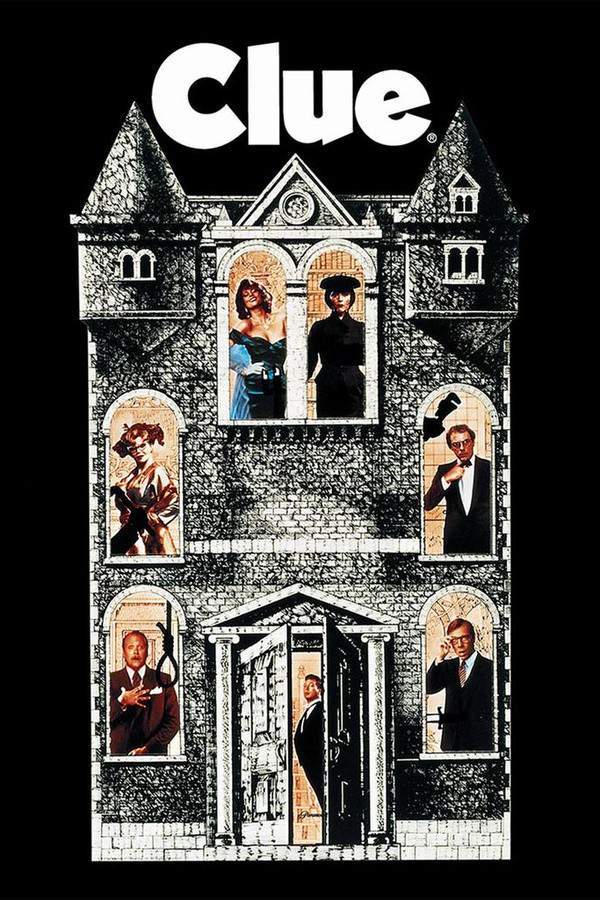
5. Clue (1985): the country-house mystery becomes physical comedy
A remote mansion, a dinner invitation, and a collection of suspicious strangers make Clue look like a conventional enclosed whodunit. Jonathan Lynn instead pushes that arrangement toward farce, with Tim Curry’s Wadsworth central to its hurried explanations and shifting group dynamics. Paramount’s official film page confirms the board-game basis and identifies the ensemble, including Madeline Kahn, Eileen Brennan, and Christopher Lloyd. Knowing the game is helpful recognition rather than required homework.
This is the choice for a group that enjoys the performance of suspicion as much as a perfectly composed chain of proof. The house gives the characters a shared arena, while the comic rhythm makes moving through it feel like part of the puzzle. Compared with Marple’s persistence, the energy is deliberately excessive: the pleasure comes from people struggling to impose explanations on a situation that keeps becoming less manageable. Multiple deaths and sexual innuendo are part of the material. If your version of cozy requires quiet, choose a different entry; if it means a theatrical game that can absorb laughter, this is a strong starting point.
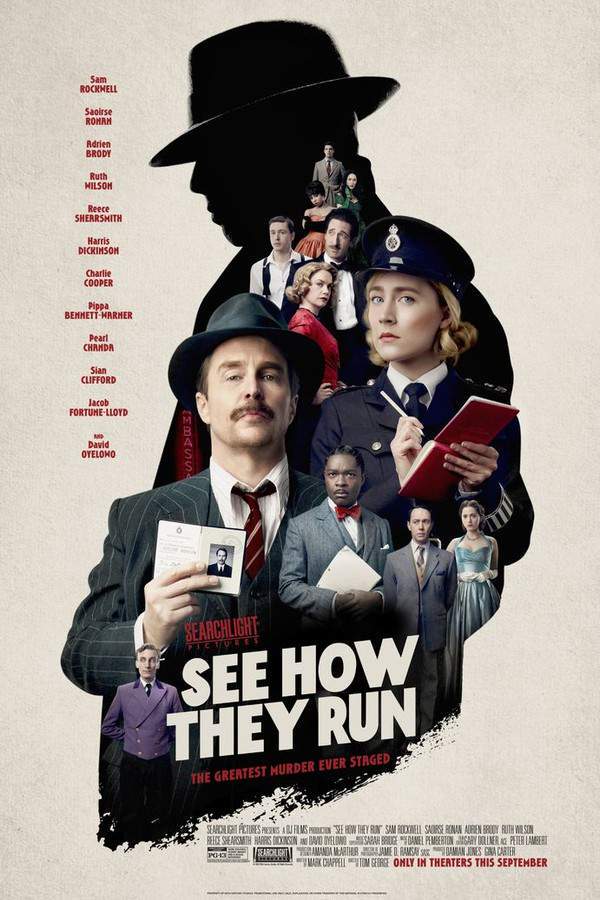
6. See How They Run (2022): detecting among people who know the conventions
A murder connected to a successful West End play gives See How They Run a ready-made community of performers, collaborators, and interested parties. The Searchlight synopsis and official clips establish the 1950s London setting and the investigating pair: Sam Rockwell’s experienced Inspector Stoppard and Saoirse Ronan’s eager Constable Stalker. That partnership makes the film an accessible option even if you have never attended the theatrical mystery it references. Professional weariness and enthusiastic attention provide different ways of approaching the same evidence.
Its distinguishing pleasure is the overlap between people who create stories and people attempting to establish what actually happened. An attractive narrative is not automatically an accurate account, which gives the backstage setting more purpose than decorative nostalgia. Choose it after Clue if you want another comic ensemble, but expect a less breathless rhythm. Its self-awareness can also become a limitation: viewers who want the mystery to remain completely absorbed in its own world may find the genre commentary distancing. There are violent incidents and adult jokes, although the dominant register is comic investigation rather than punishment.
For a puzzle in luxurious surroundings
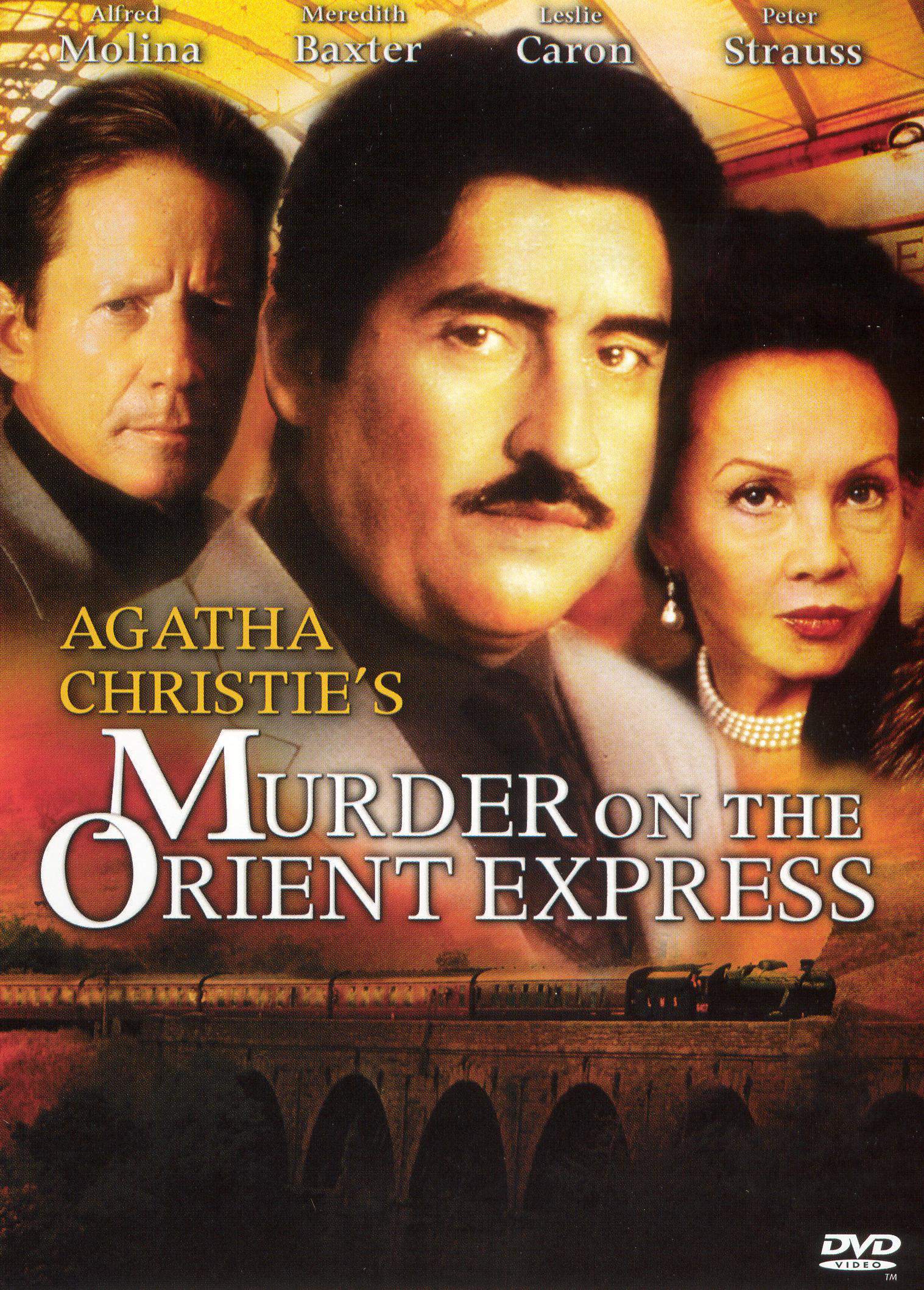
7. Murder on the Orient Express (1974): an enclosed route with uncomfortable moral questions
Sidney Lumet’s version stars Albert Finney as Hercule Poirot, an identification worth making because ATM also carries later adaptations. Agatha Christie’s official classic-adaptation guide distinguishes the 1974 film from those other versions. The railway setting offers the winter pleasure of a contained world: compartments, shared facilities, and a passenger group whose movements can become evidence. Luxurious surroundings do not simplify the people occupying them.
This is a better choice for concentrated deduction than for the lightest possible evening. The investigation gives individual accounts room to register, encouraging you to compare speech, behavior, and practical possibility. It also introduces a darker moral weight than the comfortable furnishings suggest. The story’s background includes violence against a child, and the murder is not treated as an emotionally weightless exercise. No solution details are needed to flag that distinction. Choose it when the pleasure of gathering evidence is compatible with discomfort about what a final explanation might mean, rather than when you want reassurance untouched by grief.
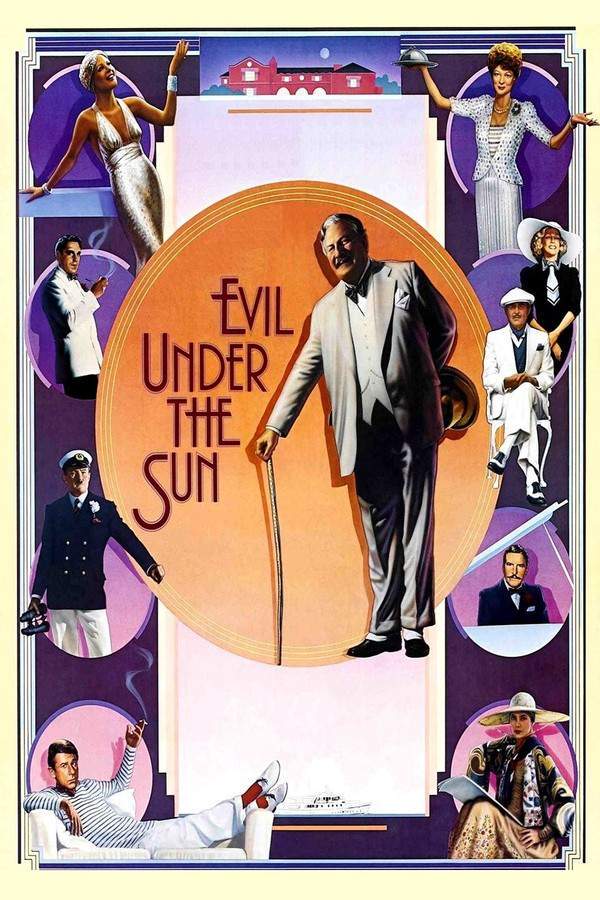
8. Evil Under the Sun (1982): a holiday escape organized around observation
Peter Ustinov’s Poirot investigates a death at an island resort in this different Christie adaptation. Kino Lorber’s film description identifies the victim as a stage performer, placing public personality and private hostility in the same confined social world. The setting makes an effective winter alternative precisely because it is not wintry: a sunny holiday location offers a visual change while preserving the boundaries that make an enclosed mystery appealing.
Its particular invitation is to pay attention to everyday vacation behavior. Who goes where, who notices whom, and how confidently people describe an ordinary interval can become more interesting than an overtly sinister gesture. Compared with Orient Express, its social display has a more leisurely surface, although the death remains serious. Select it for a puzzle that turns apparent leisure into an arrangement worth examining. The limitation is that its leisure can feel slow if you prefer constant jeopardy. That measured pace is also why it works for an attentive afternoon: observation has time to become an activity rather than an instruction shouted by the plot.
For viewers who want the room a little less comfortable
9. The Lady Vanishes (1938): a disappearance nobody else will acknowledge
Choose the 1938 Alfred Hitchcock film, not a later remake with the same name. Its central situation is immediately engaging: a young traveler remembers an older woman whom other passengers deny having seen. The BFI’s film record verifies the train setting, Margaret Lockwood and Michael Redgrave’s involvement, and the combination of mystery with comic characterization. The recommendation is for that mixture, not because the journey stays harmless.
The enclosed train makes social cooperation a suspense mechanism. Solving a disappearance is difficult enough; solving it while people contest the basic premise adds a more personal uncertainty. For a viewer who likes mysteries built around noticing, that is an especially clean invitation to participate. Unlike the settled ease of Nick and Nora, the partnership here has friction and develops under pressure. Threats and armed danger eventually take it beyond the gentlest whodunit territory. Watch it when you want comfort and unease to alternate, and save the Marple films for an evening when the investigator’s secure confidence matters more than the possibility of disbelief.
10. Green for Danger (1946): a closed circle under wartime pressure
A hospital might seem an unlikely destination for a cozy weekend, and this is deliberately the list’s sharper recommendation. The wartime setting and a suspicious death during treatment give the puzzle concrete stakes. Criterion’s edition identifies Sidney Gilliat as director and Alastair Sim as Inspector Cockrill, with Trevor Howard and Sally Gray among the suspected medical staff. The appeal lies in the friction between a detective’s eccentric manner and a workplace where error has consequences.
Unlike a country-house gathering, this group has a shared practical task. Professional competence, interpersonal tension, and the need to continue working complicate the closed-circle arrangement. That makes the investigation more than an excuse to collect colorful strangers. It also explains the warning: medical peril and the surrounding war can make the film an uncomfortable choice for someone seeking complete escape from anxiety. Consider it after the lighter entries if you want comedy to puncture tension without dissolving it. The title belongs here as a boundary marker, showing how far a witty puzzle can move toward genuine dread before the label “cozy” becomes questionable.
For a modern route into familiar mystery pleasures
11. Enola Holmes (2020): an amateur investigator defines her own assignment
This first Enola Holmes film follows Sherlock’s younger sister as she searches for her missing mother and becomes involved with a young runaway. Netflix’s production synopsis identifies the 1884 setting and Nancy Springer’s books as its source. The amateur-detective appeal is direct: the people arranging Enola’s future do not necessarily understand her abilities or accept her priorities. Mystery becomes a way to resist being assigned a life.
Choose it when you want more travel and youthful momentum than a seated interrogation can provide. Compared with Rutherford’s Marple, Enola is establishing her independence rather than relying on a confidence already fully formed. That difference makes an interesting pairing across generations without suggesting the films have identical aims. The adventure element also means physical peril and fighting, not merely harmless riddles. It is less suitable for someone seeking a strictly enclosed, talk-driven whodunit. No later installment is needed to understand the starting situation, so this recommendation does not commit the weekend to an entire franchise.
12. Knives Out (2019): the house is comfortable for some people more than others
Rian Johnson’s mystery brings Benoit Blanc to the aftermath of a wealthy novelist’s birthday celebration. Lionsgate’s official synopsis identifies Daniel Craig’s detective, Christopher Plummer’s Harlan Thrombey, and the family-and-staff circle under scrutiny. The central appeal is a familiar country-house structure applied to people whose descriptions of themselves deserve examination. Listening to how a person claims to behave can be as revealing as listening to an alibi.
This is the best starting point here if you want a contemporary film with a strong social edge. The mansion creates visual warmth, but the relationships inside it complicate who gets to feel at home. That makes its coziness conditional in a productive way: a comfortable setting is not proof of generous behavior. The film includes blood, discussion of suicide, hostile family exchanges, and prejudice. Choose it for an energetic puzzle whose emotional loyalties matter alongside its mechanism. If those notes sound heavier than your ideal Saturday, begin with Marple and return to Blanc when you want sharper elbows.
Build a weekend around contrast, not exhaustion
For two relatively companionable evenings, start with Murder She Said and follow it with The Thin Man. The contrast is between an investigator insisting on access and a married couple turning access into social ease. If your group wants comedy, use Clue and See How They Run, allowing room for the difference between frantic farce and backstage self-awareness. For closer attention to enclosed geography, put Orient Express beside Evil Under the Sun, but keep their darker material in mind.
Use the individual ATM pages above to compare each film’s credited cast, version, and available catalog details before choosing. The point is not to finish all twelve. A satisfying mystery weekend leaves enough attention for the explanation to matter. If one film gives you exactly the atmosphere you wanted, its paired recommendation is a next step, not another obligation. Keep the solution unsearched, choose the tone first, and let the questions develop at the film’s own pace.