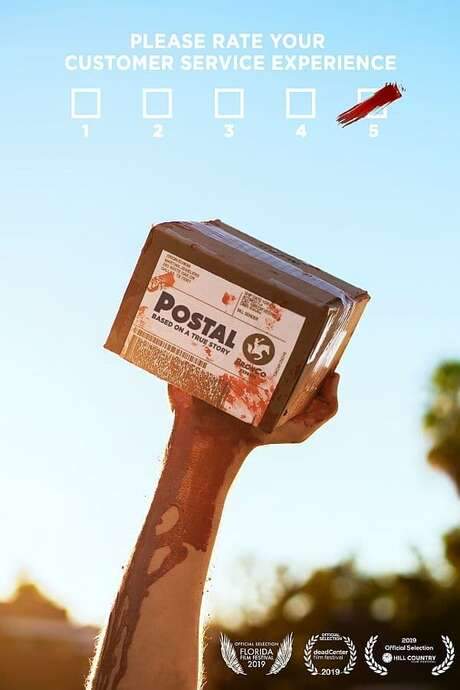
Postal 2019


Directed by

Tyler Falbo
Made by

Catador Film Co
Where to Watch Postal
See current US streaming, rental, and purchase options for Postal (2019) via JustWatch.

Amazon Prime Video
HD
Amazon Prime Video with Ads
HD
Hoopla
SD
Fandango at Home Free
HD
Tubi TV
SD
YouTube Free
HD
Amazon Video
SD
Apple TV Store
HD Fandango At Home
SD
Google Play Movies
SD
YouTube
SD Streaming availability powered by 
Postal Plot Summary
Read the complete plot summary and ending explained for Postal (2019). From turning points to emotional moments, uncover what really happened and why it matters.
Postal 2 invites players into the world of the Postal Dude, a tall, slim red‑headed man with a goatee, sunglasses, a black leather trench coat, and a T‑shirt bearing a grey alien’s face. He lives in a shabby caravan behind a house in the small town of Paradise, Arizona, with his wife, who is credited simply as “The Bitch.” The game divides its action into days of the week—Monday through Friday—with an optional mode called A Week In Paradise that stretches the week from Monday to Sunday.
Each day begins with a set of tasks, ranging from simple errands like “get milk” to more personal duties such as “confess sins.” Players are free to tackle these tasks in any order and to pursue a peaceful, civil approach or a chaotic, violent one. The objective is to finish all tasks, and the game’s tagline makes its core idea explicit: > Remember, it’s only as violent as you are!
Throughout the week, the Postal Dude faces regular provocation from the town’s residents and various factions. He endures being given the finger, mugged, and harassed by protesters, and he runs into a pushy convenience store owner and his customers who cut ahead in the money line. The encounters expand into a surreal, hyperbolic world filled with a broad cast of oddball figures: a marching band, a murderous toy mascot named Krotchy, and the Paradise Police Department with its SWAT team; the story also features overzealous ATF agents, the National Guard, a large, eccentric religious cult, cannibalistic butcher shop workers, and fanatical terrorists (including Osama bin Laden) alongside a cameo from former child actor Gary Coleman, among many others.
The game’s cast is presented in the accompanying notes, with several characters linked to their performers for quick reference: Forest (played by Justin Miles), Bronco Charley (played by Jonathon Pawlowski), Young Phil (played by Chase Wainscott), Brittany (played by Elyse Dufour), Chelsea (played by Sarah Alexandria), Young Ben (played by Reid Meadows), Phil (played by Michael Shenefelt), Richard Dumont (played by William Blaylock), Lawyer (played by Jon Barash), Kid at party (played by Charlie Dicey), Kid at party (played by Aja Farber), Teen at Party 1 (played by Dusty Fields), Kid at party (played by Christian Savin), Teen at Party 2 (played by Victor Castroverde), and Kevin (played by Eric Vega).
As the week advances, the town’s world grows stranger and tenser. The Postal Dude must navigate a landscape where order collapses, violence blooms, and the line between nuisance and danger grows blurrier by the hour. By Friday afternoon, the town seems to erupt into chaos, with law and order breaking down and society slipping toward an apocalyptic mood. People arm themselves, gunfights erupt in the streets, and the familiar world of Paradise becomes a surreal battleground. Yet Postal Dude continues to return to his trailer, engaging in a final, heated exchange with his wife over a trivial quarrel—the missing “rocky road” treat at the start of the week—before a gunshot is heard and the credits roll, leaving the fate of Paradise open to interpretation.
Postal Timeline
Follow the complete movie timeline of Postal (2019) with every major event in chronological order. Great for understanding complex plots and story progression.
Week begins with a task briefing
Postal Dude wakes in his dilapidated caravan behind a house in Paradise, Arizona, and the week-long loop of tasks begins. The player learns the objective is to finish all tasks by Friday, starting with mundane chores like 'get milk' and later others including confessing sins. The daily goals can be pursued in any order, and players can choose peaceful or violent methods to complete them.
Provoked on the streets
As he leaves home, Postal Dude is repeatedly provoked by locals who flip him off, mug him, and harass him with protests. The constant harassment tests his patience and sets the tone for a town that thrives on chaos. These interactions illustrate the game's satirical take on social confrontations.
The money line confrontation
At the local convenience store, Postal Dude faces a smug owner and patrons who cut in line and ignore basic courtesy. This petty humiliation foreshadows the unpredictable violence the game permits if pushed. He must decide whether to react peacefully or lash out, shaping the week’s tone.
The gonorrhea task activates
One of the week’s tasks is triggered when Postal Dude urinates and discovers he has gonorrhea. The objective then becomes seeking treatment, adding a personal health quest to the otherwise mundane errands. This task demonstrates the game’s dark humor and willingness to address taboo topics.
Cannibal butcher shop encounter
Postal Dude crosses paths with cannibal butcher shop workers who present a grotesque threat. The encounter showcases the game's surreal and macabre humor, while giving players the option to navigate or confront the danger. The encounter contributes to the escalating sense of danger in Paradise.
The Gary Coleman cameo
The town is populated by eccentric characters, including a cameo from former child actor Gary Coleman. Interactions with such odd figures highlight the surreal, chaotic tone of Paradise. These moments punctuate the week with unexpected humor alongside menace.
Police, SWAT, and federal attention
As the week progresses, the Paradise Police Department and its SWAT team grow increasingly aggressive. Overzealous ATF agents and National Guard units arrive, signaling the city’s slide toward total law-and-order breakdown. The expanding law enforcement presence foreshadows the imminent collapse of normalcy.
Terrorists make their appearance
Fanatical al-Qaeda terrorists, including Osama bin Laden, are encountered in the town's crisis tableau. Postal Dude must navigate this surreal threat as violence becomes normalized in the collapsing town. The game's satire places him amid an increasingly absurd battleground of factions.
Apocalypse hits Paradise
On Friday afternoon, society collapses and chaos erupts as cats fall from the sky and guns fill the streets. Normal routines completely break down as random gun battles explode across town. The day marks the literal descent into anarchy that defines the finale of the week.
Postal Dude returns home amid chaos
Despite the chaos, Postal Dude stubbornly returns to his trailer behind the house. Inside, he argues with his wife about a missing 'rocky road' she wanted earlier, adding a deeply personal thread to the week’s escalating violence. The domestic scene underscores the game's blend of the banal and the brutal.
Ending moment and credits
The sequence culminates with a gunshot heard, and the end credits roll. The abrupt finale leaves the consequences of the week’s chaos open to interpretation. The ending reinforces the game's signature dark humor and nihilistic tone.
Postal Characters
Explore all characters from Postal (2019). Get detailed profiles with their roles, arcs, and key relationships explained.
Postal Dude
The tall, red-haired protagonist who must complete a week of seemingly mundane tasks while navigating provocation and violence. He wears a goatee, sunglasses, and a black leather trench coat, embodying a flexible moral stance that the player can steer toward peace or chaos.
The Bitch (Wife)
Postal Dude's nagging spouse who triggers frustration and conflict throughout the week. Her demands and constant tension push the plot toward escalating confrontations.
Gary Coleman
The former child actor Gary Coleman makes a satirical cameo in the town, embodying celebrity presence amid the chaotic events.
Osama bin Laden
A satirical, over-the-top antagonist figure encountered in the town, used to critique extremist propaganda within the game's chaotic landscape.
Postal Settings
Learn where and when Postal (2019) takes place. Explore the film’s settings, era, and how they shape the narrative.
Time period
Monday to Friday
The action unfolds across a single workweek, with daily tasks starting Monday and ending Friday. The tone shifts from mundane errands to escalating mayhem, culminating in societal collapse by Friday afternoon.
Location
Paradise, Arizona
Paradise, Arizona is a sun-baked desert town. The postal Dude lives in a dilapidated caravan trailer behind a residence, forming a rough, small-town backdrop for the weekly tasks and escalating chaos.
Postal Themes
Discover the main themes in Postal (2019). Analyze the deeper meanings, emotional layers, and social commentary behind the film.
⚖️
Moral Choice
Players can choose peaceful or violent approaches to completing tasks, highlighting how personal ethics shape outcomes. The game's tagline emphasizes that violence is a product of the player's choices. As chaos grows, the line between order and disorder becomes a mirror for the player's own impulses.
🧨
Societal Collapse
By Friday, law and order break down and the town descends into armed chaos. The game satirizes modern civilization, showing how quickly institutions fail under pressure and how fear drives crowds to violence.
🎭
Satire of Everyday Life
The day-to-day errands and provocations—getting milk, facing hecklers, dealing with bureaucratic absurdity—are depicted to mock suburban pettiness and media sensationalism. The extreme scenarios amplify real-world issues to critique modern life.

Coming soon on iOS and Android
The Plot Explained Mobile App
From blockbusters to hidden gems — dive into movie stories anytime, anywhere. Save your favorites, discover plots faster, and never miss a twist again.
Sign up to be the first to know when we launch. Your email stays private — always.
Explore the mobile appPostal Spoiler-Free Summary
Discover the spoiler-free summary of Postal (2019). Get a concise overview without any spoilers.
In a world where the mundane rhythms of modern life mask a deepening sense of isolation, Philip Tress drifts through the streets of Jacksonville, his days defined by repetitive interactions at a shipping company’s call center. The film captures the quiet desperation of a millennial caught between the expectations of a digital age and the yearning for something more tangible, a connection that continues to elude him. The setting feels both familiar and slightly off‑kilter, with fluorescent office lights and the hum of endless customer service queues serving as a backdrop to a story that edges toward the uncanny.
The tone walks a careful line between empathetic observation and unsettling tension, allowing viewers to feel the weight of Philip’s internal struggle without ever exposing the full extent of his despair. Subtle visual cues—cluttered desktops, the soft glow of a computer screen late into the night—underscore a pervasive sense of entrapment, while an ambient score weaves a thread of melancholy through each scene. The film’s style leans into a quiet, almost documentary‑like realism, inviting the audience to peer into the ordinary moments that can spiral into something far more complex.
At the heart of the narrative is Philip’s fragile psyche, hinted at through fragmented phone calls and fleeting glances that hint at an unreciprocated fixation. His interactions become a mirror reflecting his own disintegration, a descent hinted at rather than shown outright. The relationship dynamics—between Philip and the indifferent customer service agent, the peripheral figures who populate his world, and the unseen forces of his own mind—create a subtle, growing unease.
While the story remains rooted in the everyday, an undercurrent of dread suggests that the ordinary can quickly become something more disquieting. The film leaves viewers with a lingering curiosity about how far Philip will travel down this path, and what unseen forces might be pulling him toward a breaking point, all without revealing the climax that awaits.
Featured on this page

What's After the Movie?
Not sure whether to stay after the credits? Find out!
Check out our other apps:

SAT Sphere
Build confidence for the Digital SAT.

Mori Atlas
Discover wild places worth protecting.

Luntero
Search smarter for a home in Amsterdam.

Plot Explained
Unravel movie endings and hidden clues.

Pokechamp
Dive into Pokémon data and battle logic.

Driving Theory
Get ready for your European theory test.

Movie Dust
Plan your next cinema trip with ease.

Musemap
Find art and culture as you travel.

Selkobase
Compare credentials before committing.

Local Manual
Turn an unfamiliar country into practical next steps.

Lernavi
Compare school systems before your next move.

GymRoam
Find a workout stop wherever your plans take you.
Explore Our Movie Platform
New Movie Releases (2026)
Famous Movie Actors
Top Film Production Studios
Movie Plot Summaries & Endings
Major Movie Awards & Winners
Best Concert Films & Music Documentaries
Movie Collections and Curated Lists
© 2026 What's After the Movie. All rights reserved.
Privacy Policy