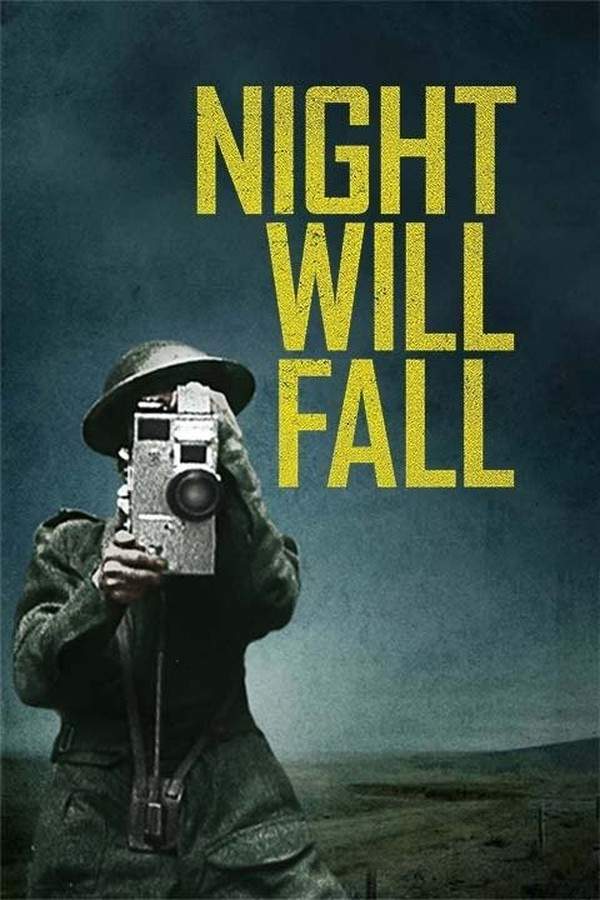
What Is Night Will Fall About?
The premise of Night Will Fall in 326 words, with nothing given away. The full story follows below.
Night Will Fall opens on the stark legacy of World War II and the difficult task of preserving evidence from history’s darkest chapters. At its center is a British documentary conceived in 1945 by Sidney Bernstein after he encountered Allied footage from the liberation of Bergen-Belsen. Bernstein brings renowned director Alfred Hitchcock into the project alongside editors and cameramen, creating an uneasy alliance between celebrated filmmaking, urgent testimony, and political pressure. The film intends to expose the horrors of Nazi concentration camps, while its troubled history raises a broader question: how can documentary evidence be created, controlled, and kept from the public?
The world of the film spans the immediate aftermath of war and the decades that followed. Archival images captured by Allied cameramen are placed beside interviews with survivors, liberators, and members of the original production team. These contrasting perspectives build a tone that is solemn, investigative, and deeply unsettling. Rather than relying on narration alone, the documentary allows the camera footage and human recollection to carry the emotional weight, creating a space where historical distance gives way to intimate testimony.
Survivor memories anchor the story. Branko Lustig, a producer and former prisoner, offers perspective on survival, liberation, and the political forces surrounding the project’s suppression. Anita Lasker-Wallfisch and Eva Mozes Kor likewise contribute recollections that connect the liberation of the camps with the long aftermath of confinement. Their voices join a collective portrait of resilience, while filmmakers and Allied cameramen reflect on the practical and moral challenges of documenting atrocity under chaotic conditions.
Rather than functioning as a straightforward historical record, Night Will Fall becomes a meditation on memory, testimony, and the power of images to challenge official narratives. Its mixture of lost footage, present-day interviews, and reflections on censorship gives the film an atmosphere of forensic urgency. The central intrigue lies not only in what the surviving images reveal, but in why a documentary meant to bear witness remained inaccessible for so long.
What Happens in Night Will Fall?
The complete story of Night Will Fall, from the first scene to the last, in 338 words (about 1 minute). Spoilers throughout.
Spoilers ahead
This film examines the critical role of cinema as a tool for documenting the horrors of war. It specifically focuses on the Allied cameramen who captured the liberation of Nazi prison, labor, and extermination camps across Germany and Eastern Europe between 1944 and 1945. By utilizing archival footage from the 1945 British documentary German Concentration Camps Factual Survey and combining it with contemporary interviews, the movie explores both the atrocities committed and the subsequent struggle to bring that truth to the public.
The project was driven by Sidney Bernstein, who was moved to action after witnessing footage of the liberation of Bergen-Belsen. This imagery eventually served as vital evidence during the Nuremberg trials, where camp commander Josef Kramer and his guards were held accountable. The film details how the Allies forced German civilians and officials to tour these sites—witnessing the piles of bodies and warehouses filled with stolen eyeglasses, hair, and toys—to ensure that the scale of the genocide could never be denied.
The documentary also highlights the creative process behind the 1945 survey. While Alfred Hitchcock only worked on the project for a brief period, he is credited with strongly influencing its final shape. Other key contributors included Richard Crossman and Stewart McAllister, described as one of London’s most renowned film editors. Despite the effort, the British government shelved the film for years. Branko Lustig, a survivor of both Auschwitz and Bergen-Belsen, suggests the delay was political, tied to the onset of the Cold War and British tensions regarding the Jewish state in Palestine.
Personal testimonies provide a haunting emotional core to the film. Branko Lustig recalls the sound of bagpipes during the liberation, which he initially mistook for the music of angels. Anita Lasker-Wallfisch and Eva Mozes Kor also share their experiences, with Kor recalling the kindness of Soviet soldiers in white camouflage who provided chocolate and hugs to the prisoners of Auschwitz. Through these accounts and the eyes of the cameramen, the film underscores the necessity of visual evidence in the face of systemic cruelty.
Night Will Fall Timeline: Every Key Event in Order
16 key events in the order they happen, from “Soviet Cameramen Film the First Liberations” to “Night Will Fall Brings the Story to Light”. 10 events name a place, across 8 locations.
- 1
Soviet Cameramen Film the First Liberations
Soviet cameramen were the first to film the liberation of the Nazi camps, recording the horrors at Auschwitz and Majdanek in occupied Poland. Their footage provided some of the earliest moving images of the extermination and labor camp system, documenting atrocities many in the West had not yet seen or believed.
When:1944–1945 Where:Majdanek and Auschwitz, Poland
- 2
A Survivor Remembers Liberation at Auschwitz
Survivor Eva Mozes Kor recounts seeing Soviet soldiers in white camouflage uniforms liberate Auschwitz in the snow. The soldiers gave the prisoners chocolate, cookies, and hugs, offering a first moment of humanity after years of suffering. Her testimony is featured among the interviews recorded for the film.
When:January 1945 Where:Auschwitz, Poland
- 3
Western Suspicions of Soviet Footage
When Westerners first saw the Soviet footage and heard the accompanying reports of the camps, they suspected the Soviets of producing atrocity propaganda, as had been the case in some earlier instances. This distrust meant the true scale of the Nazi crimes was slow to be accepted in Britain and America.
When:1944–1945
- 4
British Forces Liberate Bergen-Belsen
British forces liberated the Bergen-Belsen concentration camp, encountering masses of dead prisoners whose bodies had been left on the ground all around the camp. The shocking scenes, caught on film by Allied cameramen, would soon inspire the creation of a British documentary about the camps.
When:April 1945 Where:Bergen-Belsen, Germany
- 5
Branko Lustig Hears the Bagpipes of Liberation
Twelve-year-old internee Branko Lustig was so weak he could not raise his body to look out the window, and hearing the unearthly music of bagpipes as British forces led by Scots arrived, he believed he was dying or already dead and that this was the music of angels. Decades later, he recounted this memory on camera for the film.
When:April 1945 Where:Bergen-Belsen, Germany
- 6
The Camp Commander and Guards Are Taken Prisoner
The camp commander, Josef Kramer, and the Bergen-Belsen guards were taken as prisoners of war. They were forced to aid in the burial of the masses of dead prisoners, confronting them directly with the consequences of the camp's operation.
When:April 1945 Where:Bergen-Belsen, Germany
- 7
Allied Cameramen Gather the Footage
Throughout 1944 and 1945, Allied cameramen filmed the liberation of the prison, labor, and extermination camps run by the Nazis and their allies across Germany and eastern Europe. Their work was gathered as raw material for a planned 1945 British documentary, later known as German Concentration Camps Factual Survey.
When:1944–1945 Where:Germany and eastern Europe
- 8
Sidney Bernstein Commissions a Documentary
Sidney Bernstein was inspired to make a documentary after seeing the footage of Bergen-Belsen's liberation by British forces. The project aimed to assemble the Allied film evidence into a definitive record of the Nazi atrocities for German audiences and the wider world.
When:1945
- 9
Alfred Hitchcock Joins the Project
Director Alfred Hitchcock was recruited to work on the 1945 documentary, and Night Will Fall includes a recording of an interview with him about the project. Although he only worked on it for a short time, commentators believe he strongly influenced its shape and expression.
When:1945
- 10
A Team Assembles in London
Bernstein assembled a team for the documentary that included Stewart McAllister, referred to in the film as 'perhaps the best-known film editor in London,' and Richard Crossman. Together they began shaping the vast archive of liberation footage into a coherent film.
When:1945 Where:London, England
Show the other 6 events of Night Will Fall Hide the last 6 events
- 11
German Civilians Are Forced to Tour the Camps
After the war, the Allies forced German officials, servicemen, and civilians from towns surrounding the camps to tour the sites. They were made to see the piles of those who had died of starvation, torture, and disease, partially burned remains in the crematoria, and warehouses full of hair, clothing, children's toys, eyeglasses, and valuables stripped from the dead, so they could never later deny what had happened.
When:After the war, 1945 Where:Germany
- 12
The Footage Becomes Evidence at Nuremberg
The film of the camp liberations, including the British footage of Bergen-Belsen, was later used as evidence in the Nuremberg trials. It helped document the systematic crimes of the Nazi regime before the international tribunal.
When:1945–1946 Where:Nuremberg, Germany
- 13
The British Government Shelves the Film
When editing on German Concentration Camps Factual Survey was nearly complete, the British government decided to shelve it. The documentary was never released, and the footage and its story remained largely unknown for decades.
When:1945 Where:Britain
- 14
Theories Behind the Suppression
In an interview for the film, Branko Lustig, producer of Schindler's List and a former internee at Auschwitz and Bergen-Belsen, theorizes that the 1945 documentary was shelved for political reasons, such as shifting relationships between the Allies and the imminence of the Cold War. He also remarks that 'At this time, the Brits had enough problems with the Jews,' referring to pressure over Palestine and the influx of Jewish migrants from Europe after the war.
- 15
Survivors, Liberators, and Crew Speak Decades Later
Decades after the war, recent interviews were gathered with survivors such as Anita Lasker-Wallfisch, Eva Mozes Kor, and Branko Lustig, as well as with the producers, editors, and cameramen who worked on the 1945 documentary, and cameramen who had filmed at the camps. Their testimony connects the historical footage to the people who lived and recorded it.
When:Decades after the war
- 16
Night Will Fall Brings the Story to Light
The completed documentary combines the archival footage gathered for the 1945 survey with new survivor and liberator testimony, finally bringing the long-suppressed film and its history to public attention. It also explores the reasons behind the documentary's decades-long delayed release and affirms the importance of film as a witness to warfare.
What Kind of Film Is Night Will Fall?
Dark in tone, with variable pacing and a complex story, going by the plot summary.
- Tone
- Dark
- Pacing
- Variable
- Story
- Complex
- Intensity
- High
- Ending
- Mixed
A harrowing, sober documentary confronts Holocaust horrors through graphic liberation footage and survivor testimony, balancing historical investigation with grief, moral urgency, and a fragile insistence on truth.
- haunting
- somber
- oppressive
- grief-stricken
- psychologically heavy
- reflective
- holocaust
- world war ii
- concentration camps
- wartime liberation
Content notes: holocaust and genocide, concentration camps, mass death and mass graves, graphic archival footage, survivor trauma, torture and forced confinement.
Quiz
How well do you remember Night Will Fall? Test yourself on the story.