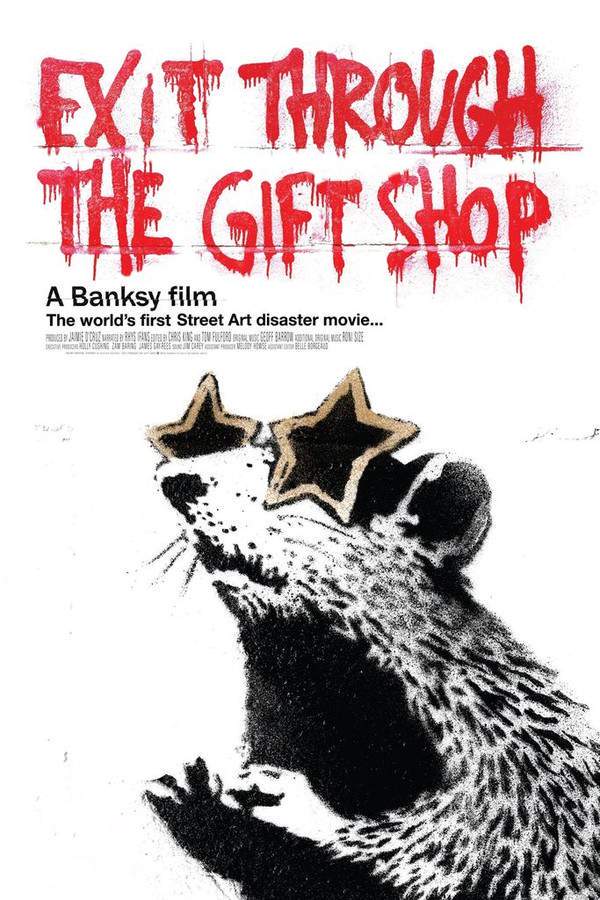
What Happens in Exit Through the Gift Shop?
The complete story of Exit Through the Gift Shop, from the first scene to the last, in 729 words (about 3 minutes). Spoilers throughout.
Spoilers ahead
Thierry Guetta is a French immigrant living in Los Angeles, who runs a successful upscale vintage clothing shop and obsessively films his life. While visiting France in 1999, Guetta discovers his cousin is famed street artist Invader. Fascinated, he accompanies Invader and his friends, who include Monsieur André and Zevs, on their nocturnal adventures, documenting everything.
A few months later, Invader visits Guetta in LA and arranges a meeting with Shepard Fairey. Guetta continues to film Fairey after Invader returns to France, and when Fairey asks what Guetta plans to do with the footage, Guetta says he is going to make a documentary about street art. He follows Fairey as Fairey travels the world executing the OBEY Giant campaign, and films numerous artists at work, among them Poster Boy, Seizer, Neck Face, Sweet Toof, Cyclops, Ron English, Dotmasters, Swoon, Azil, Borf, and Buff Monster. However, in reality, Guetta merely likes to film things and has no intention of making a film out of the footage, which he never watches, simply dumping the tapes into boxes.
Guetta becomes obsessed with filming the mysterious Banksy, but can’t arrange an introduction. Then, in the spring of 2006, Banksy’s visit to LA is complicated when his usual accomplice is turned back at the border control, so he contacts Fairey, who recommends that Guetta would make a good guide. Things go well, and Banksy invites Guetta to England to film the production and deployment of his “Murdered Phone Booth” piece, including the crowd reaction. This confuses Banksy’s crew, who are used to secrecy, but Banksy sees value in documenting street art, which he admits typically has a “short lifespan”. After Guetta returns home, he begins to put up his own stickers and posters.
When Banksy is back in LA preparing for his Barely Legal show, he takes Guetta to Disneyland to film the reaction after he deploys an inflatable doll dressed like a Guantanamo Bay detainee there. Guetta is caught and interrogated by security but can stash the videotape in his sock and delete his still photographs, so he is released after four hours. Following this, Banksy admits he began to trust Guetta implicitly.
“Barely Legal” is a huge success, and the price of street art begins to skyrocket in auction houses. Banksy is stunned by the sudden hype and urges Guetta to finish his documentary to show what the movement is really about. Over the next six months, Guetta turns his several thousand hours of footage into a film titled Life Remote Control: an unfocused 90 minutes of disorienting fast cutting. Banksy deems it “unwatchable”, but feels that the street art footage itself is valuable, and decides to try and produce a film himself; to distract Guetta, he suggests him to go home, make some art, and put on a show.
Adopting the name “Mr. Brainwash”, Guetta mortgages his business and home to rent equipment, hires a production team to create art under his supervision, and rents the 15,000 square-foot former CBS Studios complex for his first show, “Life Is Beautiful”. As the show date approaches, Banksy becomes worried that things are going out of control and sends some professionals to help, who take care of the show’s practical considerations, while Guetta focuses on publicity. He gets quotes from Fairey and Banksy, after which the LA Weekly does a cover story about the show, even though at that point he has yet to choose which of his team’s works he wants to include. The press leads private art collectors to call Guetta about buying pieces before the opening, and he quotes prices of tens of thousands of dollars.
On the day of the opening, the nearly 200 paintings finally arrive to be hung, but Guetta is busy giving interviews, so the crew decides where to put them. The doors open, and over 4,000 people saw the show that day. Almost a million dollars’ worth of Guetta’s art is sold the first week of the show, which is extended by two months, and his pieces are included in shows and galleries around the world. The success of Mr. Brainwash confuses Banksy and Fairey, who found Guetta derivative and unready for the world stage, but Guetta insists time would tell whether or not he is a real artist. The closing titles reveal Guetta went on to create the cover artwork for Madonna’s hits collection Celebration.